







Buyers ask me about Magic Fire Powder's metal salt component almost weekly. One bad headline about a poisoning case can freeze a purchase order. On our production line in Ningbo, we solved this with formulation and documentation, not marketing spin.
Magic Fire Powder's metal salt component is safe when used as directed — sealed packets tossed into an outdoor fire. It is not food-safe and must never be swallowed or inhaled as dust. Toxicity depends on the specific salt, the dose, and the exposure route, not the word "metal."
That answer needs unpacking. Different salts carry different risks. Different suppliers use different chemistry. Below, I walk through certifications, ingredients, batch consistency, and the paperwork you need for customs.
What certifications prove Magic Fire Powder's metal salts are safe for my market?
Last spring, a German distributor rejected a competitor's shipment at port over missing test reports. He then asked us one question first: which certifications do you actually hold?
Look for ISO 9001 quality management, BSCI social compliance, CE marking for the EU, and third-party SGS or Intertek test reports covering heavy metal content and chemical composition. Together, these prove the metal salt colorant meets consumer product safety expectations in the US and Europe.

Certifications matter because pyrotechnic colorants sit in a gray zone. They are not fireworks, but they are not ordinary household goods either. Customs officers, retail compliance teams, and insurance underwriters all want proof that someone independent tested the product. In our seventeen-plus years exporting to the US, Germany, the UK, France, and beyond, we have never shipped a container that could not be backed by paperwork on demand.
What each certification actually covers
Each document answers a different question. A CE mark alone does not tell you the heavy metal toxicity profile. An SDS alone does not prove your factory runs a controlled process. You need the full stack.
| Certification | What it proves | Why buyers need it |
|---|---|---|
| ISO 9001 | The factory runs a documented quality system | Batch consistency is process-driven, not luck |
| BSCI | Ethical and social compliance at the facility | Required by many large retail sourcing channels |
| CE marking | Conformity with EU product safety directives | Legal market access across the EU |
| SGS / Intertek reports | Independent lab testing of composition and hazards | Verifies heavy metal limits and SDS accuracy |
Certificates versus claims
Be careful with suppliers who say "non-toxic" without a report number. SDS safety guidelines 1 allow phrases like "practically non-toxic" based on acute test data, but that language describes low risk under normal use — not edibility. A real supplier hands you the underlying lab report, dated, with the tested batch identified. We provide test reports with every serious inquiry because our buyers treat compliance as a hard requirement, not a nice-to-have. If a supplier stalls when you ask for documents, that stall is your answer.
Which metal salts does Sunrich use, and are they free of harmful chemicals?
When we developed our current Magic Fire formula, we tested dozens of salt blends in our Liuyang R&D room before locking in the chemistry we ship today.
Sunrich uses carefully selected, eco-friendly metal salt colorants — such as copper-based salts for blue-green and strontium chloride for red — screened against harmful chemical limits. The formulation excludes high-toxicity options like barium compounds and is verified by third-party testing, though it remains non-edible.

The honest starting point is this: every flame colorant on the market uses metal salts, because metal ions are what produce color in a flame. Copper gives blue and green. Strontium chloride 2 gives red. Potassium leans violet. The safety question is never "metal or no metal." It is which salt, at what purity, in what quantity, and sealed in what packaging.
Not all salts carry the same risk
Copper sulfate 3 is the workhorse of the industry. It performs well, but it is also the salt behind most poisoning reports, because swallowing a concentrated packet can cause corrosive injury 4 to the throat and stomach. Strontium salts generally carry a better safety profile at the doses used for flame color. Barium salts 5 produce brilliant greens in professional pyrotechnics, but we deliberately avoid them in consumer products because their toxicity threshold is far lower.
| Metal salt | Flame color | Relative hazard in consumer use | Our position |
|---|---|---|---|
| Copper salts | Blue / green | Corrosive if swallowed; low risk sealed in fire | Used at controlled, minimal dosage |
| Strontium chloride | Red | Comparatively favorable profile; still not edible | Used for red effects |
| Barium compounds | Green | Higher systemic toxicity | Excluded from our formula |
| Sodium / potassium salts | Yellow / violet | Lower acute hazard; not food-safe | Used as supporting colorants |
What "free of harmful chemicals" really means
We formulate to be free of harmful chemicals in the regulatory sense: no banned substances, heavy metal content 6 within tested limits, and no barium or lead-based pyrotechnic colorants. That is different from claiming the powder is food-grade. It is not. Our packets are heat-sealed precisely so the user never touches the granules, never breathes the dust, and never confuses the shimmer with candy. Public health agencies have warned that colorant packets resembling snacks lead to accidental ingestion — which is exactly why our warning labels are printed on a high-visibility yellow band, and why we help private-label buyers replicate that labeling on their own packaging.
How do I verify batch-to-batch safety consistency before I place a bulk order?
A Canadian importer once told me his previous supplier's third container burned duller and smokier than the first two. Same label, different chemistry. That story shaped our QC playbook.
Verify consistency by requesting batch-coded samples from separate production runs, comparing them against the original SGS or Intertek test report, auditing the factory's ISO 9001 process records, and confirming raw material traceability. A real factory can show identical composition data across multiple dated batches.
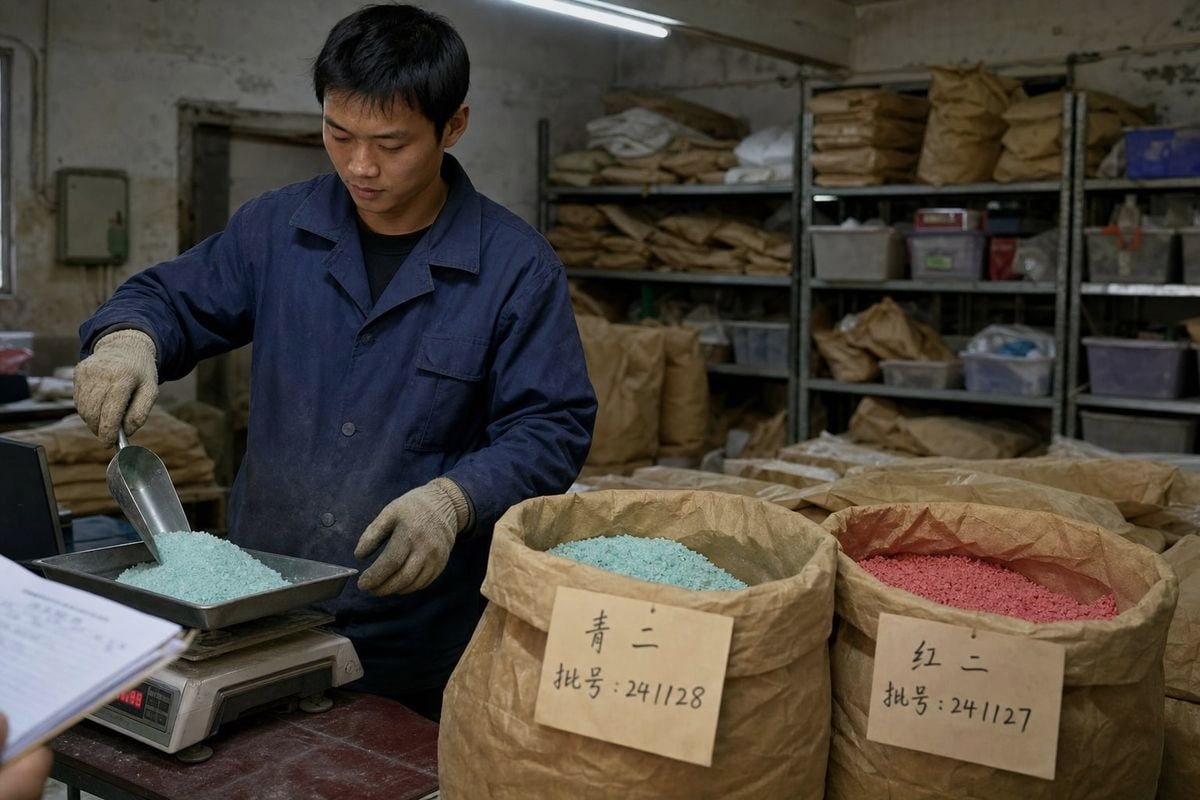
Batch drift is where safety promises quietly die. A supplier can pass one lab test with a golden sample, then cut costs on raw salts for mass production. The colorant still burns, but purity drops, smoke increases, and respiratory irritation 7 complaints start reaching your customer service inbox. Because we run our own complete production lines rather than trading someone else's goods, we control the variables that cause drift: raw material sourcing, mixing ratios, granule sizing, and fill weight.
A practical verification process
Here is the sequence I recommend to any purchasing manager evaluating a flame colorant supplier, including us:
- Request samples from two or more different production batches, not one hand-picked pouch.
- Match the batch codes on those samples to dated internal QC records.
- Send one sample for your own independent lab screen if your compliance team requires it.
- Ask how raw metal salts are inspected on arrival — certificates of analysis should exist for incoming materials.
- Confirm the fill-weight tolerance per sachet, since dosage control affects both color performance and inhalation hazards from excess smoke.
- Place a trial order and burn-test units pulled randomly from the shipment, not from the top carton.
Why manufacturing depth matters here
Trading companies cannot answer step four, because they never see the raw salts. Our Ningbo facility logs every incoming lot, and our line supervisors run burn tests on each production batch before sealing. The result our long-term buyers care about most: the first sample they approved reliably reflects the mass-production quality they receive a year later. Consistency is not a promise. It is a process you can audit, and we invite audits.
What safety documentation should I request for customs and retail compliance?
Documentation is where we spend surprising amounts of time with new buyers. Getting the paperwork stack right before shipment prevents ninety percent of clearance delays we have seen over the years.
Request the Safety Data Sheet, third-party chemical test reports, heavy metal analysis, transport classification documents, CE declaration for EU markets, and market-appropriate warning labels with usage instructions. Retailers may additionally require BSCI audit reports, barcodes, and child-safety labeling on retail-ready packaging.
Customs officers and retail compliance teams read documents differently. Customs cares about classification and transport safety. Retailers care about consumer-facing labels and liability. Your documentation stack has to satisfy both, and it has to be internally consistent — a mismatch between the SDS composition section and the lab report is a red flag that triggers holds.
The core document checklist
| Document | Who demands it | Key content to verify |
|---|---|---|
| Safety Data Sheet (SDS) | Customs, retailers, insurers | Composition, first-aid measures, handling under SDS safety guidelines |
| Third-party test report | Retail compliance, importers | Heavy metal limits, batch identification, lab accreditation |
| Transport classification | Freight forwarders, customs | Confirmation the product is not regulated as fireworks |
| CE declaration | EU customs and distributors | Directive references and responsible party |
| Warning label artwork | Retail buyers | Ingestion warnings, keep-away-from-children text, no-cooking notice |
| BSCI audit report | Large retail chains | Valid audit cycle and factory identity |
Labels are documentation too
Do not treat the printed sachet as an afterthought. The label must state the food safety precautions clearly: never cook marshmallows or hot dogs over treated flames, because metal salts deposit on food surfaces. It should warn against opening the packet, since concentrated dust can cause skin and respiratory irritation. It should address indoor fireplace safety — our guidance is well-ventilated fireplaces or outdoor fires only, never enclosed or poorly ventilated spaces. And it should note the environmental impact of ash: residue from treated fires contains metal compounds, so it should not be spread on gardens or left where pets dig. We supply all of this as part of our one-stop OEM service, including custom warning bands, barcodes, and display boxes matched to each destination market's rules.
Conclusion
Magic Fire Powder's metal salt component is safe as directed, never as food. Demand certifications, salt transparency, batch verification, and full documentation — then partner with a factory that proves all four.
Footnotes
1. OSHA's Hazard Communication Standard governs how SDS documents classify and phrase toxicity data. ↩︎
2. Background on this compound's chemistry supports the article's red-flame colorant safety comparison. ↩︎
3. Explains chemical properties and known toxicity profile of the workhorse blue-green colorant salt. ↩︎
4. MedlinePlus explains poisoning and corrosive chemical injury mechanisms relevant to ingested metal salts. ↩︎
5. Reference on barium's properties supports claim about its higher toxicity threshold and exclusion. ↩︎
6. ATSDR provides authoritative toxicological profiles for heavy metals referenced in formulation limits. ↩︎
7. Authoritative EPA source detailing how particulate matter (smoke/dust) causes respiratory irritation and other health effects. ↩︎



 English
  Spanish
  German
  French
  Arabic
  Portuguese
Join the Conversation