







Wood fire starter safety instructions can make or break your import shipment. On our production line in Ningbo, we have watched buyers lose entire orders over a missing warning line.
To verify wood fire starter safety instructions meet fire inspection standards, request UL 2115 or SGS/Intertek test reports, confirm CPSC labeling requirements are met, cross-check the Safety Data Sheet against label claims, and validate warnings against NFPA 211 and International Fire Code storage rules.
That is the short answer. Now let me walk you through each step, the way I explain it to our B2B buyers before they place their first order.
What Certifications Should I Request to Confirm My Wood Fire Starters Meet International Fire Safety Standards?
A German distributor once emailed me a one-line question: "Which papers do I actually need?" After 17 years of exporting our wax-dipped wood rolls to 30+ countries, I keep the answer simple.
Request UL 2115 certification for solid-fuel firestarters, CE marking for European markets, and third-party test reports from SGS or Intertek. Also ask for the supplier's ISO 9001 and BSCI audits, plus a current Safety Data Sheet for the exact formulation shipped.

Certifications are not decoration. They are the first thing a fire marshal 1, customs officer, or retail compliance team will ask about. And here is the hard truth: many suppliers wave a generic certificate that does not match the actual product. I have seen "certified" firestarters where the test report covered a different wax blend entirely.
The Core Documents by Market
Different markets lean on different frameworks. This table reflects what our buyers request most often:
| Market | Key Certification / Standard | What It Covers |
|---|---|---|
| USA / Canada | UL 2115, CPSC labeling requirements 2 | Solid-fuel firelog and firestarter safety, warning labels |
| EU (Germany, France, NL) | CE marking, REACH compliance | Product safety, chemical content limits |
| UK | UKCA, GB safety regulations | Post-Brexit equivalent of CE |
| Global retail chains | SGS or Intertek test reports | Independent burn, emissions, and composition testing |
| Factory-level trust | ISO 9001, BSCI | Quality management and ethical production audits |
Match the Certificate to the Product
Check three things on every certificate. First, the product description must match your SKU — "wax-dipped wood roll" and "paraffin wood-fiber cube" are not interchangeable. Second, the certificate holder must be the actual factory, not a trading company borrowing paperwork. Third, the issue date must be recent; test reports older than two or three years raise questions during a fire marshal checklist review.
At our factory, we keep certificates tied to specific production formulations. When a buyer changes burn time or wax content, we re-test. That discipline costs us money upfront, but it is exactly what keeps our buyers out of trouble at inspection time.
How Do I Know If My Supplier's Test Reports Are Valid for Fire Inspection Compliance in My Market?
Early in my export career, a Polish importer showed me a competitor's test report. The lab name did not exist. That lesson shaped how we handle documentation at Sunrich ever since.
Validate test reports by confirming the issuing lab is accredited, verifying the report number directly with SGS or Intertek, matching the tested sample description to your exact product, and checking that the test methods cited align with the standards your local fire authority enforces.

A test report is only as good as its traceability. Most legitimate labs let you verify a report number online or by email within a day. If a supplier resists that verification, walk away. In my experience shipping to the US, Germany, and Australia, honest factories volunteer verification details before you even ask.
A Simple Validation Process
Here is the process I recommend to every purchasing manager:
- Check the lab's accreditation. SGS, Intertek, TÜV, and Bureau Veritas 3 are widely recognized. Unknown local labs may not satisfy your authority having jurisdiction 4 (AHJ).
- Verify the report number. Contact the lab directly. Do not rely on the PDF alone; documents can be edited.
- Compare the sample description. The report must describe your product's material, wax type, and dimensions. A report for wood-wool spheres does not cover wax-dipped rolls.
- Confirm the test methods. Look for references to recognized standards. An ASTM E84 rating 5, for example, addresses surface burning characteristics that some commercial buyers require.
- Check the date and scope. Reports should be current and cover the formulation actually in production, not a prototype.
What Inspectors Accept vs. Reject
| Document Quality | Inspection Outcome |
|---|---|
| Accredited lab, matching SKU, recent date | Generally accepted by AHJ and retail compliance teams |
| Accredited lab, but different product variant | Often rejected; re-testing usually required |
| Unverifiable lab or edited PDF | Rejected; may trigger a wider supplier audit |
| Report older than 3 years | Flagged; renewal typically requested |
One more point. The Safety Data Sheet 6 must agree with the test report. If the SDS lists paraffin and wood fiber but the report tested a gel formula, an inspector will notice the contradiction. Ignition source control 7 language, flashpoint data, and flammable solids storage guidance should read consistently across both documents.
Which Warning Label and Safety Instruction Details Do Fire Inspectors Typically Check on Imported Fire Starters?
Designing warning labels is a bigger part of our OEM work than most buyers expect. Our team builds private-label packaging for US and EU markets, and every label goes through a compliance review before printing plates are made.
Fire inspectors check for a clear signal word, prohibition of gasoline and liquid accelerants, never-leave-unattended warnings, keep-away-from-children statements, appliance compatibility guidance, storage instructions away from heat, and first-aid directions — all aligned with CPSC labeling requirements and NFPA 211 standards.
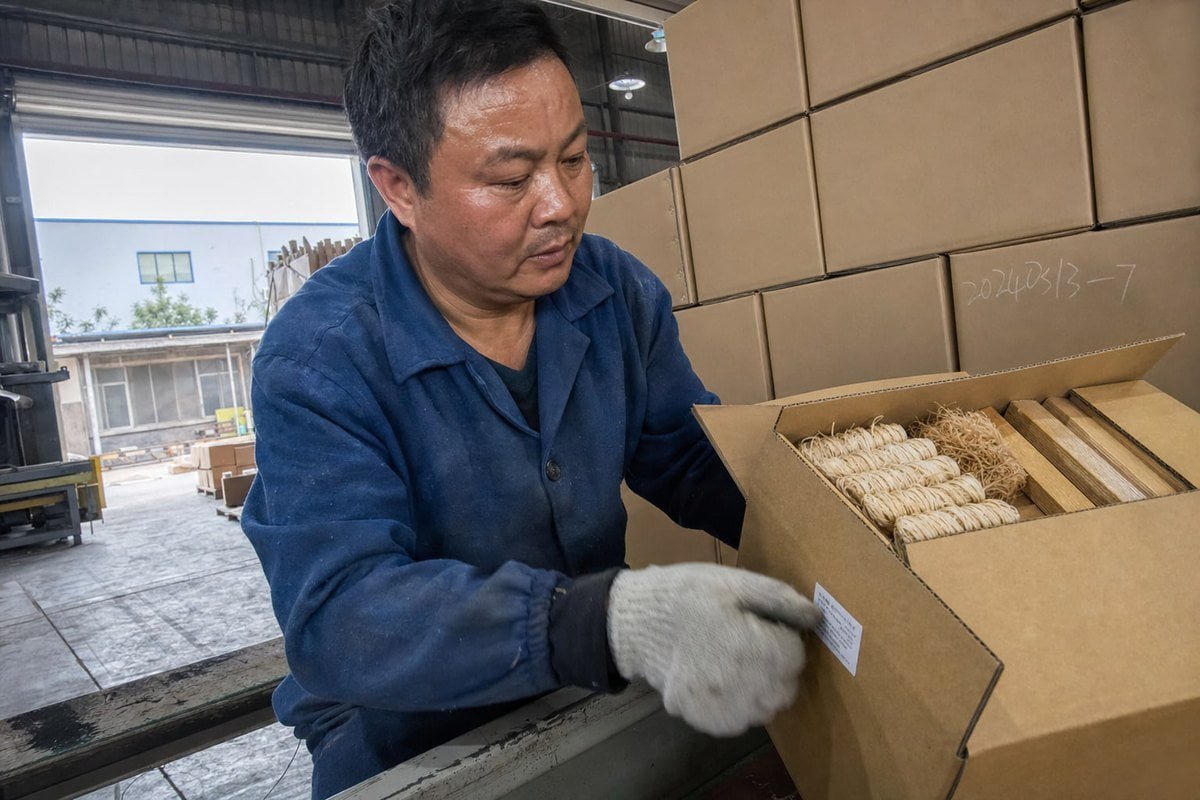
Think of the label as your product's conversation with the inspector. If the label answers every predictable question, the inspection goes smoothly. If it stays vague, the inspector digs deeper — into your SDS, your import records, and sometimes your whole supply chain.
The Non-Negotiable Label Elements
| Label Element | Why Inspectors Check It |
|---|---|
| Signal word (WARNING / CAUTION) | Required under FHSA and CPSC labeling frameworks |
| "Do not use gasoline or liquid accelerants" | Appliance manuals and NFPA 211 standards prohibit accelerant use |
| "Never leave fire unattended" | Unattended flame is a leading residential fire cause |
| "Keep away from children and pets" | Standard hazard mitigation language inspectors expect |
| Appliance type guidance | Some starters suit open fireplaces but not sealed stoves |
| Storage instructions | International Fire Code addresses flammable solids storage |
| Combustible material clearance | Supports safe use near hearths, decks, and camp setups |
| First-aid and ingestion guidance | Mandated handling instructions for consumer chemical products |
Where Labels Commonly Fail
In our 17 years, three failure patterns repeat. First, translated labels lose legally required phrasing — a French label that softens "never" to "avoid" can fail review. Second, the label contradicts the Safety Data Sheet on storage temperature or hazard class. Third, the label omits appliance restrictions; a wax-based starter that is fine in an open hearth may be restricted in certain wood stoves, and NFPA 211 standards push users back to the appliance manual for that judgment.
We solve this by treating the label, the SDS, and the box copy as one document set. When we customize packaging for a buyer — barcodes, warning panels, display boxes — the compliance text is locked before any design work begins. Combustible material clearance wording, in particular, gets checked against both US and EU conventions because the phrasing differs.
Can I Get Sample Batches Verified Before Placing a Bulk Order to Avoid Compliance Issues?
The trade-off I discuss most with new buyers is speed versus certainty. A trial order verified properly adds two to four weeks. Skipping verification saves that time — until a container gets flagged, and you lose months instead.
Yes. Order a small sample batch, send units to an accredited lab for burn and composition testing, review the labels against your market's fire marshal checklist, and confirm the supplier's mass production matches the sample through batch-level quality control documentation.

Sample verification only works if the sample honestly represents mass production. This is where factory depth matters. A trading company sends you a polished sample sourced from one workshop, then fills your bulk order from three others. The wax content drifts, the burn time changes, and suddenly your tested documentation no longer describes what is on the shelf.
A Practical Pre-Order Verification Sequence
- Request samples from a real production run, not a hand-made showcase batch. Ask for the lot number.
- Send samples to a third-party lab for composition analysis. This confirms "natural wood fiber and paraffin" claims and screens for undisclosed synthetic accelerants that could cause overfiring.
- Run your own label audit against CPSC labeling requirements or your EU market's rules. Check the signal word, warnings, and first-aid text.
- Cross-check the SDS supplied with the sample. Flashpoint, hazard class, and flammable solids storage guidance must match the lab findings.
- Ask for batch traceability. Every carton we ship carries lot identification, so if a question ever arises, the buyer can trace instructions and test data back to a specific production run.
- Confirm consistency terms in writing. Your purchase agreement should state that bulk goods must match the verified sample's specification and burn time tolerance.
Why Batch Consistency Is the Real Test
Anyone can pass one lab test. The harder promise is that unit 50,000 burns like unit one. On our lines, we control wax temperature, dip time, and wood-roll density batch by batch, because ignition source control and predictable burn behavior are what inspectors and insurers actually care about in the field. When your documentation, your sample, and your bulk shipment all tell the same story, fire inspection compliance stops being a gamble.
Conclusion
Verifying wood fire starter safety instructions is straightforward with the right process: real certifications, validated test reports, inspector-ready labels, and sample batches that truly match bulk production. Partner with factories that prove it.
Footnotes
1. Background on the fire marshal role relevant to inspection compliance context. ↩︎
2. CPSC's official FHSA page details the labeling rules buyers must audit against. ↩︎
3. Bureau Veritas is a recognized testing lab named for verifying supplier certifications. ↩︎
4. Explains the AHJ concept that determines local fire code acceptance of test reports. ↩︎
5. Provides a stable, accessible overview of the fire-test-response standard and flame spread indices. ↩︎
6. OSHA's hazard communication page defines Safety Data Sheet requirements cited for compliance checks. ↩︎
7. NFPA is the authoritative body for fire safety standards including ignition source control. ↩︎



 English
  Spanish
  German
  French
  Arabic
  Portuguese
Join the Conversation