







Testing a Magic Fire Powder sample properly protects your budget CPSC labeling expectations 1. On our production line in Ningbo, we have seen buyers lose entire seasons to untested, non-compliant powder from other suppliers.
To test a Magic Fire Powder sample before ordering, request SDS and third-party certifications, run controlled burn tests on multiple sachets to check flame color and burn time, screen for harmful chemicals like barium or lead, and confirm the sample comes from the actual mass-production line.
That is the short answer. Now let me walk you through each step in the order a professional buyer should follow, from paperwork to burn testing to production verification.
What certifications and test reports should I request before approving a Magic Fire Powder sample?
A buyer from Germany once told me his previous shipment sat in customs for six weeks because the supplier had no SDS. At our Liuyang headquarters, documentation comes before any sample ships.
Before approving a Magic Fire Powder sample, request the SDS, third-party lab test reports from SGS or Intertek, CE marking documentation, the supplier's ISO 9001 certificate, BSCI audit results, and the correct HS code with shipping classification for your import market.

Paperwork is the fastest way to filter out risky suppliers. In our 17+ years of exporting color-flame products to the US, Germany, the UK, and 30+ other markets, we have never seen a serious retail buyer skip this step. Documents tell you three things: whether the product is legal to import, whether it is safe to sell, and whether the factory has real systems behind it.
The core documents and what each one proves
Ask for these before you even light a match:
| Document | What it proves | Red flag if missing |
|---|---|---|
| SDS (Safety Data Sheet) | Chemical composition range, hazard class, handling and storage rules | Supplier does not know or will not disclose what is in the powder |
| SGS / Intertek test report | Independent verification of heavy metals 2 and composition | Claims are marketing only, not lab-verified |
| CE documentation | Compliance for the European market | Product may be pulled from EU shelves |
| ISO 9001 3 certificate | The factory runs a real quality management system | Batch consistency is likely poor |
| BSCI audit report | Ethical and social compliance for retail channels | Big-box retailers will reject the vendor |
| HS code + shipping classification | Correct customs treatment and freight handling | Customs delays, fines, or shipment rejection |
Verify, do not just collect
A PDF is easy to fake. Check the report number directly on the SGS or Intertek website 4. Confirm the certificate holder name matches the factory you are dealing with, not a trading company borrowing documents. Also check the report date. A test report from five years ago tells you nothing about the current formula. When we issue reports to our buyers, they are tied to current production formulas, and we encourage buyers to verify them independently.
Finally, ask whether the documents cover the exact SKU you are sampling. A certificate for a wax firestarter does not cover a color-flame powder sachet.
How do I evaluate flame color consistency and burn time across multiple sample batches?
When we calibrate a new color-flame formula in our Ningbo facility, we never judge it from one sachet. One burn can look brilliant while the batch behind it is unstable.
Evaluate consistency by burn-testing at least three sachets from different production lots on the same fuel type, timing each burn from color onset to fade, and recording flame color, intensity, and duration. Results should vary by no more than roughly ten percent between sachets.

Repeatability matters more than one dramatic flame. A sample that dazzles once but fades in thirty seconds the next time will generate returns, negative reviews, and chargebacks from your retail customers. Here is the structured way to test it.
A simple five-step burn evaluation
- Standardize the fire. Use the same fuel each time — seasoned hardwood at a steady flame. Wind, wet wood, and gas logs all change results, so control the base fire first.
- Test one sachet at a time. Note the time from application to visible color change. Good color-flame packets show effect within a minute or two.
- Time the full effect. Record when color starts, when it peaks, and when it fades back to orange. Our standard packets are engineered for a defined burn window, and we hold that window across batches.
- Photograph or video each burn. Human memory exaggerates. Side-by-side footage shows real differences in blue, green, and purple intensity.
- Repeat on different fuels. If your end customers use fire pits, fireplaces, and campfires, test all three environments.
What to record for each test
| Metric | How to measure | What good looks like |
|---|---|---|
| Time to color onset | Stopwatch from sachet placement | Consistent within seconds across sachets |
| Total color duration | Onset to fade | Matches supplier's stated burn time |
| Color vibrancy | Video comparison in identical light | Blues, greens, purples clearly visible, not washed out |
| Smoke and odor | Observe downwind | No harsh chemical smell, no heavy dark smoke |
| Residue | Inspect ash after burn | No sticky or metallic residue in the fire bed |
If two sachets from the same sample box behave very differently, that is a manufacturing consistency problem, not bad luck. Fine powders can also segregate during shipping, so shake and inspect the granules before burning. In our factory, we blend and QC-check every batch precisely so that sachet one and sachet one thousand behave the same way — that is what your buyers will silently expect too.
What safety and compliance checks should I run to confirm the powder is free of harmful chemicals?
Years ago, we made a deliberate choice at Sunrich to build our color-flame formulas around eco-friendly materials, because our US and EU buyers simply cannot sell anything else. That decision shapes how I advise buyers to screen samples.
Screen the sample by cross-checking the SDS against a third-party lab analysis for heavy metals such as lead, barium, arsenic, and chromium, verifying smoke toxicity claims, checking for banned substances in your import market, and confirming warning labels meet local consumer safety rules.
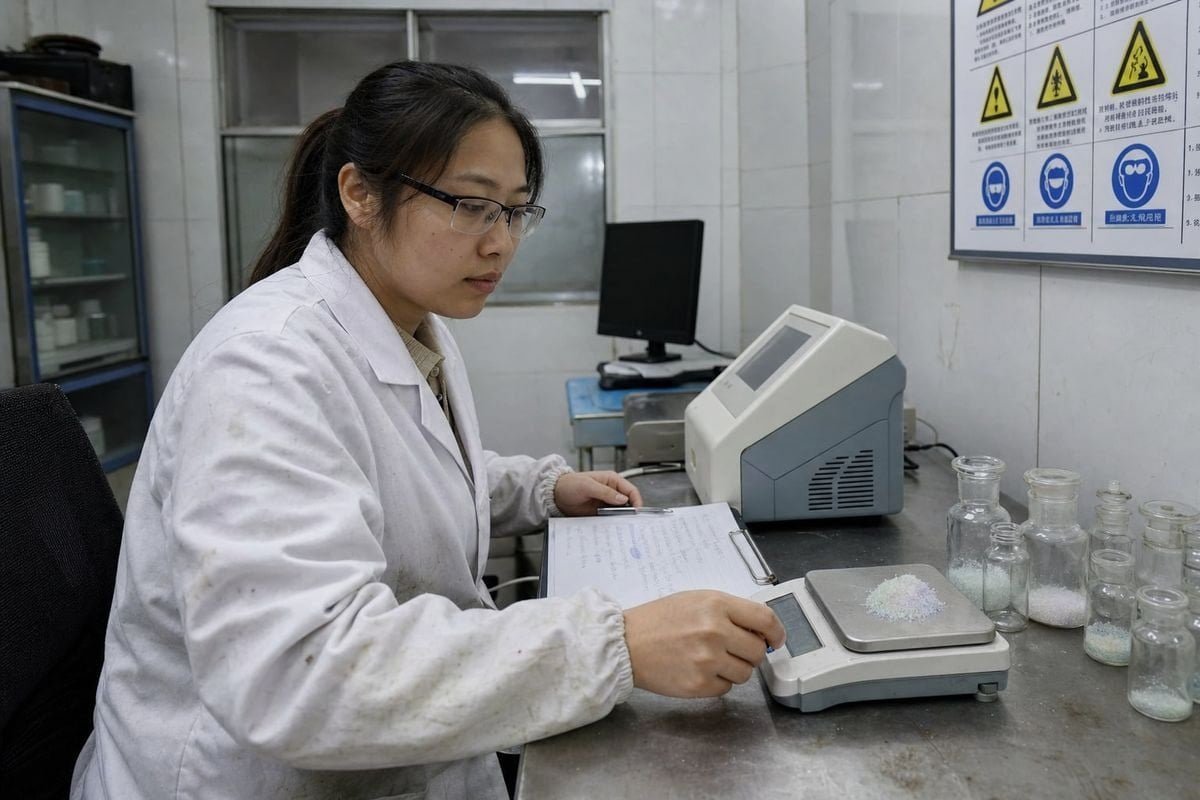
Color-flame effects come from metal salts. Copper compounds produce blues and greens, and other salts produce other colors. The question is which salts a supplier uses. Reputable factories use safer copper- and metal-salt chemistry. Low-cost suppliers sometimes cut corners with cheaper compounds that carry real toxicity risks — barium salts and lead compounds are the classic offenders.
Three layers of chemical screening
Layer one: the SDS review. Read the composition section carefully. If the SDS lists vague terms like "proprietary blend" with no hazard data, treat that as a warning. A proper SDS discloses hazard classes, first-aid measures, and storage conditions.
Layer two: independent lab verification. Send a portion of the sample to a third-party lab for elemental analysis or flame spectroscopy 6. This confirms two things at once: that harmful heavy metals are absent, and that the active metal salts actually match the claimed color output rather than being diluted with cheap fillers. In our experience, buyers who invest a few hundred dollars in this step avoid five-figure disasters later.
Layer three: market-specific compliance. Every market regulates differently. The EU has REACH restrictions 7. The US has CPSC labeling expectations. Australia and Canada have their own hazardous-goods rules. Confirm your target market's rules before the container ships, not after.
Practical safety observations during testing
Beyond the lab, your own burn test tells you a lot. Watch for excessive smoke, sharp chemical odors, popping sparks, or residue that irritates skin. None of these should appear with a properly formulated product. Also check the packaging itself: warning text, child-safety language, and usage instructions should already be printed clearly. On our packets, the yellow caution band and instruction text are standard because retailers demand shelf-ready compliance — if a sample arrives with no warnings at all, the supplier does not understand your market.
How can I confirm the sample quality will match mass-production output before placing a bulk order?
The hardest lesson I hear from new buyers is this: the golden sample was hand-mixed by a chemist, and the bulk order came off a line that had never made it before. We structure our sampling process specifically to prevent that gap.
Confirm production-match by requiring samples pulled from the actual mass-production line with lot numbers, requesting the factory's batch QC records, running a small trial order before the bulk order, and stress-testing stored samples for humidity caking over two to four weeks.
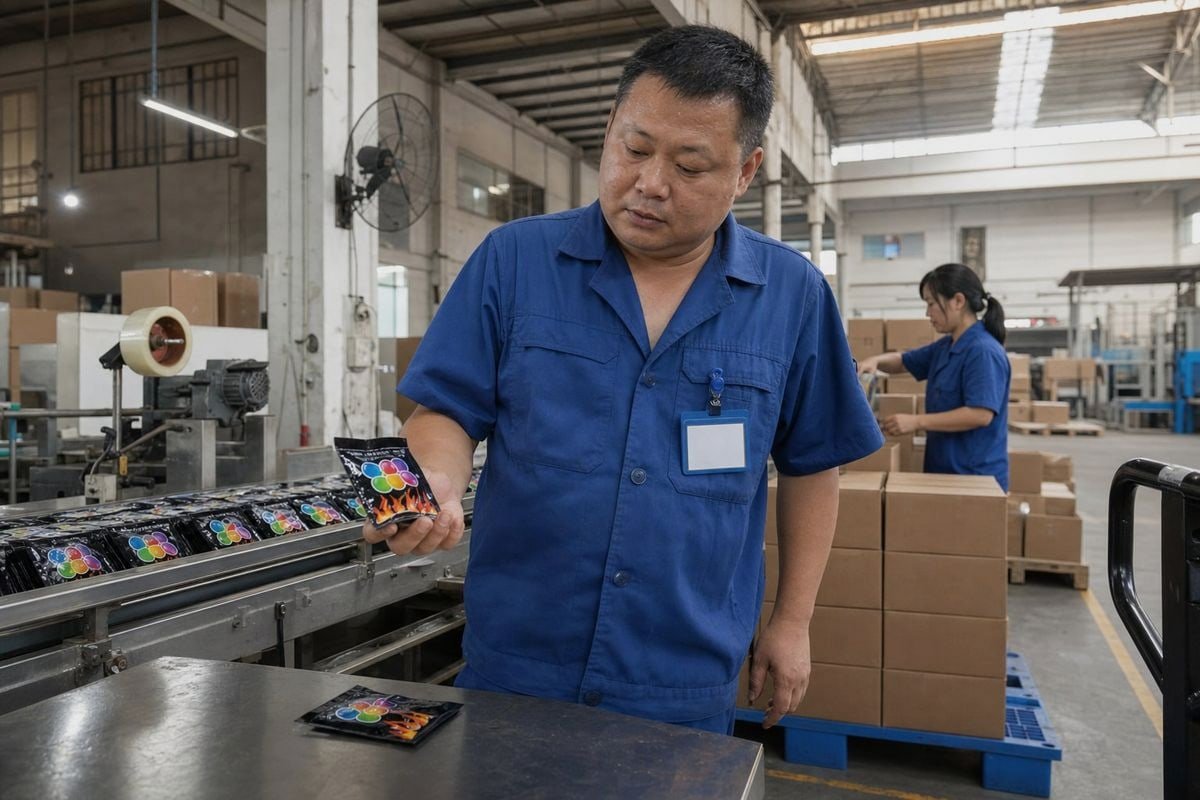
A sample only predicts bulk quality if it truly represents the production process. Here is how to close that gap systematically.
Ask where the sample came from
Always ask: was this sample taken from a production run, or mixed by hand in a lab? Demand the lot number and packaging date. A factory with genuine manufacturing depth can answer instantly, because every batch is traceable. At our facility, samples ship from real production lots, and we share the lot data because we want the first sample to be an honest preview, not a sales prop.
Run a shelf-life and storage stress test
Fine crystalline powders absorb moisture. Store part of your sample in different conditions for two to four weeks, then re-test the burn:
| Storage condition | What you are checking | Failure sign |
|---|---|---|
| High humidity (bathroom or humid room) | Moisture uptake through sachet seal | Caking, clumping, weak or delayed color |
| Warm environment | Heat stability of the blend | Discoloration, odor change |
| Normal warehouse conditions | Baseline shelf behavior | Should burn identically to day one |
If a sachet's heat-sealed foil keeps the granules dry and free-flowing after the humidity test, the packaging will survive a sea freight container and a season on a retail shelf.
Bridge with a trial order
The smartest de-risking move is a small trial order between sample and bulk. Test random sachets from different cartons of that trial shipment. Compare them against your original sample using the same burn protocol. If they match, scale up with confidence. We deliberately keep MOQs flexible for trial orders because a buyer who verifies us once usually stays for years — that trade-off strongly favors long-term partners over one-time transactions.
Also calculate the true cost-per-use during this phase. Weigh the grams needed per application against actual burn duration. A cheaper powder that needs double the dose is not cheaper at all.
Conclusion
An untested Magic Fire Powder sample can cost you a season, a customer, or a customs seizure. Verify documents, burn-test multiple sachets, screen chemistry, and confirm production traceability — then order with confidence.
Footnotes
1. US agency setting consumer product labeling and safety requirements for imported goods. ↩︎
2. WHO fact sheet on health risks from heavy metal exposure like lead and barium. ↩︎
3. Official standard defining the quality management system referenced for supplier certification. ↩︎
4. Buyers can independently verify authenticity of third-party lab test report numbers here. ↩︎
5. Explains the chemistry behind how metal salts produce colored flames. ↩︎
6. Background on the analytical technique used to verify metal salt composition. ↩︎
7. EU chemical regulation governing hazardous substances relevant to color-flame powder imports. ↩︎


 English
  Spanish
  German
  French
  Arabic
  Portuguese
Join the Conversation