







Requesting third-party inspection for Magic Fire Powder confuses many buyers who visit our Liuyang factory ISO 9001 1. Skip it, and one bad batch can trigger recalls, blocked listings, and lost inventory investment. Here is how we help buyers get it right.
To request third-party inspection for Magic Fire Powder, define the inspection scope in your purchase contract, select an accredited agency like SGS or Intertek, submit your PO, product datasheet, MSDS, and factory address, then schedule pre-shipment testing before releasing final payment.
That is the short version. Below, I break down each decision — which agency to pick, which standards to test, when to schedule, and what the final report must contain.
Which third-party inspection agencies should I choose for Magic Fire Powder shipments?
Over 17 years of exporting color-flame products to 30+ countries, our team has hosted inspectors from nearly every major agency on our Ningbo production floor. The differences between them matter.
Choose an accredited agency with chemical and flammable-goods expertise — SGS, Intertek, Bureau Veritas, or TÜV Rheinland are the most widely accepted. Verify the agency holds ISO 17025 lab accreditation and that your marketplace or buyer recognizes its reports before booking.

Not all inspection agencies are equal for this product category. Magic Fire Powder is a color-flame additive, not an ordinary consumer good. A general consumer-goods inspector can check packaging and quantity. But most cannot properly assess chemical composition 2, moisture content, or transport classification. So your first filter should always be chemical expertise.
The four agencies buyers ask us about most
| Agency | Best For | Typical Strength |
|---|---|---|
| SGS | Chemical composition and marketplace compliance | Broad lab network, widely accepted by Amazon-style platforms |
| Intertek | Consumer product safety plus chemical testing | Strong in US and EU retail acceptance |
| Bureau Veritas | Pre-shipment and factory audits | Deep supply-chain audit experience |
| TÜV Rheinland | EU-focused certification and safety marks | Strong recognition in Germany and wider Europe |
Our own factory holds SGS and Intertek 3 test reports, alongside ISO 9001, BSCI, and CE. In our experience, buyers in the US usually prefer SGS or Intertek. German and French distributors often lean toward TÜV Rheinland or Bureau Veritas.
Three questions to ask before you book
- Does the agency have inspectors trained in flammable or pyrotechnic-adjacent goods?
- Is its lab ISO 17025 accredited for the specific tests you need?
- Will your target marketplace or retail channel accept its report format?
If the answer to any of these is no, keep looking. A cheap report nobody accepts is money wasted. Also, request quotes from at least two agencies. Prices, turnaround times, and sample-handling procedures vary more than most first-time buyers expect.
What safety and compliance standards should I ask my inspector to test for?
A UK distributor once asked us for "just a basic quality check" on a trial order of color-flame packets. We pushed back and recommended a fuller compliance panel — and that decision saved his customs clearance three months later.
Ask your inspector to verify chemical composition against the agreed specification, heavy-metal and harmful-substance limits, moisture content, UN transport classification (IMDG/IATA where relevant), packaging integrity, and warning-label accuracy for your destination market, such as CE-related requirements in the EU.

The test panel for Magic Fire Powder splits into two halves: product safety and transport compliance. Both matter. A powder that burns beautifully but ships illegally is useless to an importer.
Product safety checks
Start with identity and composition. The inspector should confirm the granules match the Certificate of Analysis you were given. Our color-flame packets use eco-friendly materials with no harmful chemicals, and we expect every buyer to verify that claim independently rather than take our word for it. That is what third-party inspection is for.
Then cover these areas:
- Heavy-metal and restricted-substance screening 5 against your destination market's limits
- Moisture content, because damp powder produces weak or inconsistent flame colors
- Particle size consistency across sampled sachets
- Burn performance against the stated color effect and burn time
Transport and labeling compliance
| Compliance Area | What the Inspector Checks | Why It Matters |
|---|---|---|
| UN classification | Whether the formulation triggers dangerous-goods codes | Determines legal shipping method |
| IMDG / IATA rules | Sea and air transport documentation | Prevents carrier rejection or fines |
| Packaging integrity | Heat-sealed sachets, outer cartons, drop resistance | Avoids leaks and moisture damage |
| Warning labels | Correct language, symbols, and placement | Required for retail shelves in the US and EU |
| Barcodes and batch codes | Match to PO and traceability records | Enables recalls and marketplace listing |
One practical tip from our export desk: combine the quality inspection and the compliance check into a single factory visit. It cuts cost and avoids scheduling two separate trips for the inspector.
When during production should I schedule a third-party inspection for the best results?
Timing is a trade-off we discuss with almost every new buyer. Inspect too early, and finished packaging is not ready. Inspect too late, and there is no time to fix problems before the vessel departs.
Schedule a Pre-Shipment Inspection (PSI) when 80–100% of goods are produced and packed — this is the minimum. For first orders or large volumes, add a Pre-Production Inspection (PPI) of raw materials and a During Production Inspection (DPI) at roughly 20–50% completion.

Each inspection stage answers a different question. Choosing the right combination depends on your order size, your history with the supplier, and how much risk you can tolerate.
The three inspection stages compared
| Stage | Timing | What It Catches | Best For |
|---|---|---|---|
| Pre-Production (PPI) | Before mass production starts | Wrong raw materials, unverified formulation | First orders, new suppliers |
| During Production (DPI) | 20–50% of goods complete | Process drift, early defect patterns | Large orders, tight deadlines |
| Pre-Shipment (PSI) | 80–100% complete and packed | Final quality, packaging, labeling, quantity | Every order, no exceptions |
On our production lines in Ningbo, we run strict batch-to-batch quality control precisely so that the first sample reliably reflects mass-production quality. Even so, we encourage buyers to book a PSI on every order. Independent verification protects both sides. It removes doubt from the relationship, and it gives the buyer a document to show their own retail customers.
A practical scheduling rule
Book the inspection agency at least one to two weeks before your target inspection date. Agencies get busy before peak shipping seasons, especially ahead of the Q4 campfire and fireplace season, which is our busiest export window. Also, tie the inspection to your payment terms. A common structure we see: 30% deposit, balance released only after the PSI report confirms compliance. This single clause protects you against last-minute raw-material substitution better than any amount of email follow-up.
What inspection report details should I request to confirm consistent quality?
Early in my career here, a Dutch importer showed me a competitor's inspection report: two pages, three photos, and a vague "PASS." It told him almost nothing. A useful report looks very different.
Request a report containing the sampling plan and AQL level used, test results against each contractual specification, batch and lot numbers, photos or video of sampling and testing, packaging and label verification, quantity confirmation, and a clear pass/fail conclusion per checkpoint.
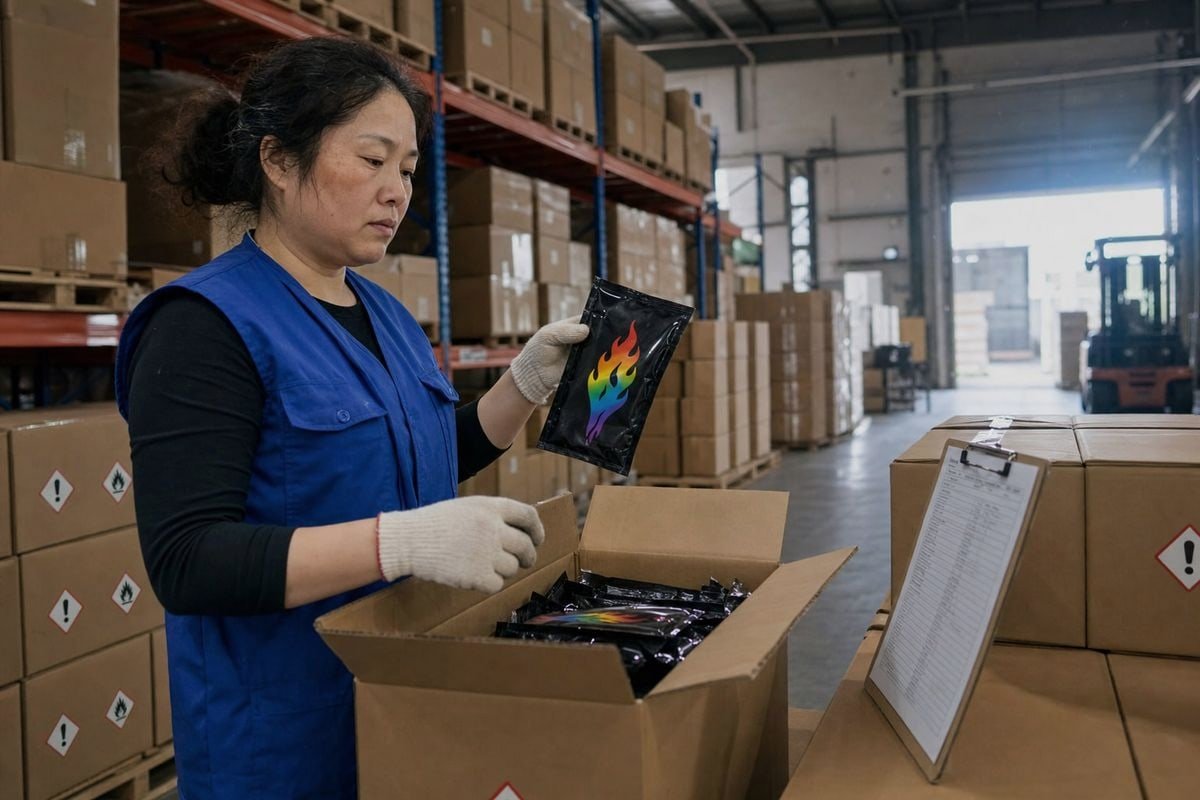
A report is only as good as the criteria behind it. That is why we always tell buyers: define your AQL standards and sampling method in the contract before booking the inspection, not after. The inspector can only judge against criteria that exist in writing.
The non-negotiable report elements
- Sampling methodology. The report should state the AQL level 6, the number of sachets pulled, and which cartons they came from. Random sampling across the full lot matters — samples taken only from the top cartons prove nothing.
- Spec-by-spec results. Every agreed parameter — composition, moisture, particle size, burn color, burn time, net weight per sachet — should appear with a measured value, not just a checkmark.
- Batch traceability. Batch and lot numbers link the report to the exact goods shipped. Without them, the report cannot support a recall or a claim.
- Visual evidence. Ask for photos or video of the sampling and burn testing. Flammable powder samples often cannot be legally couriered to you internationally, so recorded evidence is your remote verification.
- Packaging and label checks. Confirm the report covers your private-label artwork, warning text, barcodes, and carton markings. We handle full OEM packaging for our buyers, and this section is where labeling errors get caught before they reach a retail shelf.
Finally, compare the report against your first approved sample. Consistency between the golden sample and mass production is the real definition of quality — and it is what separates a manufacturing partner from a one-shipment supplier.
Conclusion
Third-party inspection for Magic Fire Powder protects your compliance, your customers, and your capital. Pick a chemical-savvy agency, define standards early, inspect before shipment, and demand a detailed report — then buy with confidence.
Footnotes
1. Official ISO page explaining the ISO 9001 quality management certification mentioned. ↩︎
2. Explains the concept of chemical composition inspectors must verify against product specifications. ↩︎
3. Official site of a leading accredited inspection agency named in the article. ↩︎
4. Background on moisture content testing relevant to powder quality and flame consistency. ↩︎
5. WHO fact sheet explains health risks behind heavy-metal and restricted-substance testing limits. ↩︎
6. ISO standards define acceptable quality level sampling procedures used in inspection reports. ↩︎


 English
  Spanish
  German
  French
  Arabic
  Portuguese
Join the Conversation