







[Flammability warning labels on private label wood fire starter packaging](https://sunrichfire.com/?p=1291) can make or break a launch. In our 17 years exporting fire products, we have seen shipments held at customs over a missing signal word.
Flammability warning labels for private label wood fire starter packaging must include a signal word, principal hazard statement, precautionary measures, child safety language, and manufacturer identity on the principal display panel, printed in conspicuous, legible, heat-resistant materials that comply with FHSA, CPSC, and destination-market rules.
That is the short answer. But each export market adds its own layer. Below, I walk through the compliance details, customization options, certifications, and batch consistency methods we use every day.
What Compliance Information Must My Warning Labels Include for Different Export Markets?
A German distributor once returned our first artwork proof because the warning text was only in English. That single revision taught us to map label content to markets before design begins.
Warning labels must include an FHSA-compliant signal word, hazard statement, first-aid and storage instructions, and child safety warning for the US; CLP hazard pictograms and multilingual text for the EU; plus local-language warnings, importer identity, and any state-specific disclosures for each destination market.

The biggest mistake private label sellers make is assuming one universal "flammable" graphic covers every market. It does not. A wood fire starter made of wood fiber and paraffin sits at the intersection of several labeling regimes at once. You need to satisfy consumer hazard labeling, transport marking rules, and regional overlays.
The US Baseline: FHSA and CPSC Rules
In the United States, the Federal Hazardous Substances Act 1 sets the floor. CPSC compliance requires the immediate package to carry a signal word such as WARNING or CAUTION, a principal hazard statement, precautionary measures, first-aid directions where appropriate, handling and storage instructions, "Keep out of reach of children," and the name and address of the manufacturer or distributor. The principal display panel must show at least the signal word, the main hazard statement, and a direction to read cautionary text elsewhere on the pack. A back-panel paragraph alone is never enough.
The exact flammability wording depends on classification. FHSA defines "extremely flammable" for flash points at or below 20°F, "flammable" between 20°F and 100°F, and "combustible" between 100°F and 150°F. Even though our wax-dipped wood rolls are solids, we base the combustible material warning on flash point testing 2 and the Safety Data Sheet, not on guesswork.
Market-by-Market Comparison
| Market | Key Regulation | Language Requirement | Notable Extras |
|---|---|---|---|
| USA | FHSA / CPSC, 16 CFR 1500 | English | Possible California Prop 65 3 disclosures |
| EU (Germany, France, NL, Poland) | CLP Regulation 4 | Local language of each country | GHS flame pictogram, UFI code where applicable |
| UK | GB CLP | English | UK importer address post-Brexit |
| Canada | CCCR | English and French | Bilingual hazard statements mandatory |
| Australia | ACCC / Poisons Standard | English | Specific first-aid phrasing |
Consumer Label vs. Transport Label
Remember that "flammability warning label" means two different things. The consumer safety warning lives on the retail box. A transport hazard label may also be required on the shipping carton if the product classifies as a regulated flammable solid under DOT or IMDG rules. When both apply, hazard class labels must sit near the proper shipping name marking. We coordinate this between our compliance team and freight forwarders before any artwork is locked.
Can Sunrich Customize Label Design While Meeting Safety Regulations for My Private Label Brand?
Balancing a rustic brand aesthetic against legally mandated warning text is a trade-off we negotiate with buyers weekly. The good news: the two goals rarely conflict when planned early.
Yes. Sunrich provides full OEM/ODM private label customization — custom boxes, colors, logos, and display packaging — while our design team reserves compliant warning panels, correct signal words, GHS pictograms, and required font contrast, so your branding and safety regulations coexist on one shelf-ready package.

Our approach is what some designers now call integrated aesthetic compliance. Instead of bolting a warning sticker onto finished artwork, we build the safety zone into the layout from day one. On our own Sunrich-branded fire starter boxes, the flame graphic, product count badge, and composition statement (50% wood fiber, 50% paraffin) all share space with the hazard panel without crowding it. We apply the same discipline to every private label project.
How the Customization Process Works
- You send us your brand guidelines, logo files, and target markets.
- We review the Safety Data Sheet 5 and classification for your chosen product spec.
- Our designers draft artwork with a reserved warning panel, correct signal word, and warning symbol placement locked in non-negotiable positions.
- You review two or three revision rounds for branding elements only — safety copy stays fixed.
- We produce a physical proof for approval before mass printing.
What You Can Change vs. What Stays Fixed
You control colors, typography for brand elements, box structure, window cutouts, imagery, taglines, and barcodes. You cannot shrink the warning text below legibility thresholds, reduce contrast, place marketing graphics over hazard statements, or delete child safety precautions. We also advise on modern options like a QR code on the back panel that links to the full Safety Data Sheet, which keeps the front clean without sacrificing information access.
One practical detail buyers often overlook: label durability. Fire starters live near fireplaces, grills, and outdoor storage. We print on heat-resistant labeling materials with moisture-proof coatings, so the warning does not fade, peel, or smudge before the last piece is used. If your pack is shrink-wrapped or bundled, we make sure the outer layer never hides the warning on the immediate package.
Which Certifications Should I Verify Before Approving My Wood Fire Starter Packaging?
A purchasing manager from the Netherlands once asked us for our full test file before even requesting a price. That order of priorities is exactly right, and we respect buyers who lead with it.
Verify ISO 9001 quality management, BSCI social compliance, CE marking for the EU, and third-party SGS or Intertek test reports covering flash point testing, composition, and burn behavior. Also confirm the Safety Data Sheet matches your final formulation and that label claims align with test data.

Certificates are only useful if you know what each one actually proves. Some cover the factory, some cover the product, and some cover a single batch. Before you approve packaging artwork, the paperwork behind the label claims must be complete, current, and traceable to your exact specification.
Certification Checklist
| Certification / Document | What It Proves | Who Issues It | Check Before Artwork? |
|---|---|---|---|
| ISO 9001 6 | Factory quality management system | Accredited certification body | Yes |
| BSCI | Ethical and social compliance | Audit platform | Yes, especially for large retailers |
| CE marking | Conformity for EU market entry | Manufacturer declaration with test support | Yes for EU |
| SGS / Intertek report | Product-level testing, flash point, composition | Third-party lab | Yes — must match your SKU |
| Safety Data Sheet | Hazard classification, first-aid data | Manufacturer / lab | Yes — labels are written from it |
Why the SDS Drives Everything
The Safety Data Sheet is the source document for your label. It records the hazard classification, combustion byproducts, and recommended precautions. If you change the wax ratio, add a fragrance, or switch to a color-flame formulation, the SDS must be updated — and the label with it. We regenerate documentation whenever a buyer customizes burn time or composition, because a label that contradicts its SDS is a liability, not a formality.
There is also a commercial angle. Many retailers and product liability insurance providers now request SDS copies, test reports, and packaging mockups before onboarding fire-related products. Buyers who arrive with a complete compliance file get faster listings and better insurance terms. ASTM safety standards may also apply to specific performance claims, so verify any standard referenced on your artwork is one your product was actually tested against.
How Do I Ensure Consistent Label Placement and Accuracy Across Large Production Batches?
Early in our Ningbo facility's history, we learned that a warning label drifting five millimeters off-position across 50,000 boxes is not a small problem — it is a retailer rejection waiting to happen.
Ensure consistency by locking approved artwork as a master reference, using printed cartons or automated label applicators with fixed registration marks, running first-article inspections at every batch start, and applying AQL sampling checks for placement, legibility, and text accuracy before shipment release.
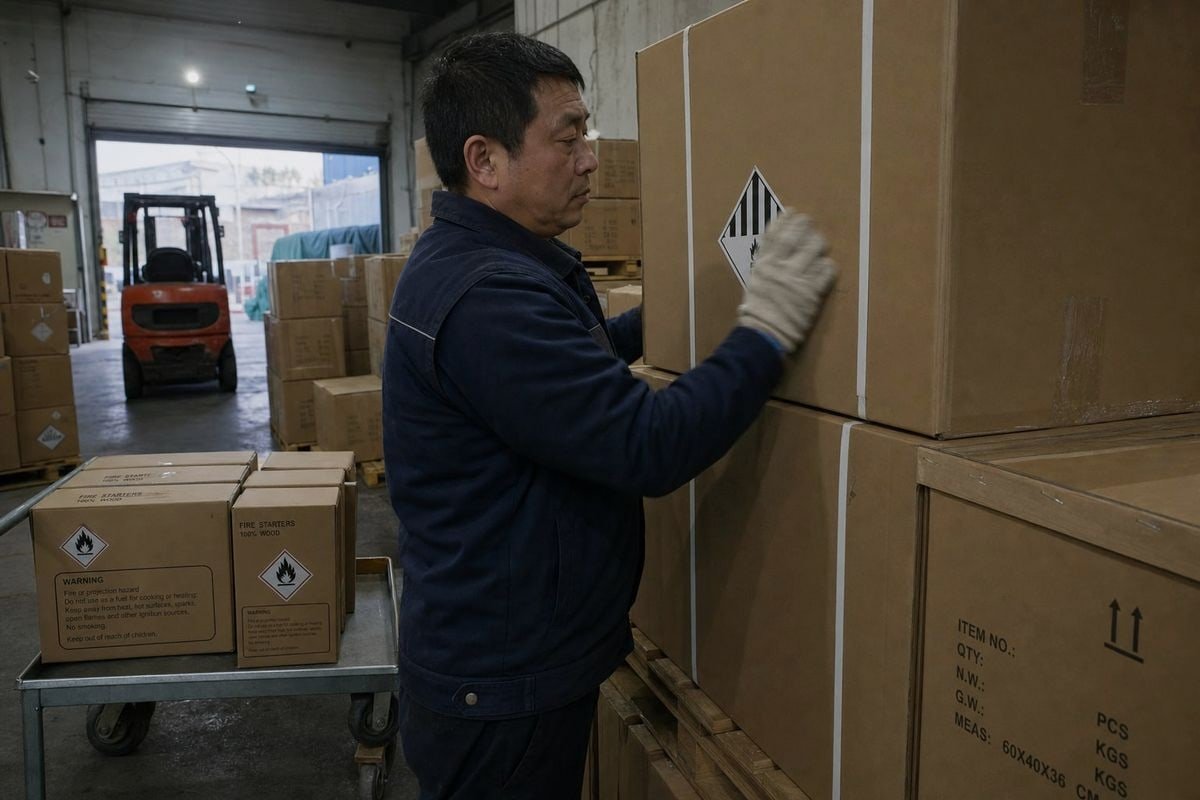
Consistency is where genuine manufacturing depth matters more than any design skill. A perfect sample means nothing if piece number 80,000 looks different. Our batch-to-batch quality control system was built over 17 years specifically so the first sample reliably predicts mass-production quality. Here is how we structure it, and what you should demand from any supplier.
The Batch Control Workflow
First, we freeze a golden sample. Once you approve the proof, that physical package becomes the master reference for every future run. Second, we prefer direct carton printing over applied stickers wherever volumes allow. Printed warnings cannot peel, shift, or be applied upside down. When stickers are necessary — for example, market-specific overlays on a shared base carton — we use automated applicators with registration marks and defined position tolerances.
Third, every production run starts with a first-article inspection. An operator compares the first finished pack against the golden sample: warning text word-for-word, signal word size, pictogram position, barcode scan, and color contrast. Fourth, in-process checks pull samples at set intervals. Finally, pre-shipment inspection uses AQL sampling 7 before containers close.
Common Label Defects and Prevention
| Defect | Root Cause | Prevention Method |
|---|---|---|
| Warning text misprint | Unapproved file version used | Version-controlled artwork with single master file |
| Label misalignment | Applicator drift | Registration marks plus hourly position checks |
| Faded or smudged print | Wrong ink or substrate | Heat-resistant labeling materials, rub tests |
| Missing outer-carton marking | Packing line oversight | Packing checklist signed per pallet |
| Wrong language variant | Mixed-market SKUs on one line | Color-coded work orders per destination market |
For buyers, my practical advice is simple. Ask your supplier three questions: Do you keep a golden sample? Do you perform first-article inspection with documented sign-off? What is your AQL level for labeling defects? A factory that answers all three specifically is a partner. One that answers vaguely is a risk you will pay for later.
Conclusion
Flammability warning labels demand market-specific compliance, SDS-driven wording, verified certifications, and disciplined batch control. Get these four steps right, and your private label wood fire starters reach shelves safely and confidently.
Footnotes
1. Official CPSC reference for the core US flammability labeling statute discussed. ↩︎
2. Background concept explaining the flash point measurement referenced for classification. ↩︎
3. OEHHA's official page covers Proposition 65 disclosure requirements mentioned for US labeling. ↩︎
4. Authoritative EU source for CLP hazard classification and labeling rules cited. ↩︎
5. OSHA guidance on SDS content that drives label wording as described. ↩︎
6. Official ISO page for the quality management certification mentioned in checklist. ↩︎
7. Wikipedia explains acceptable quality limit sampling used for shipment inspection. ↩︎



 English
  Spanish
  German
  French
  Arabic
  Portuguese
Join the Conversation