






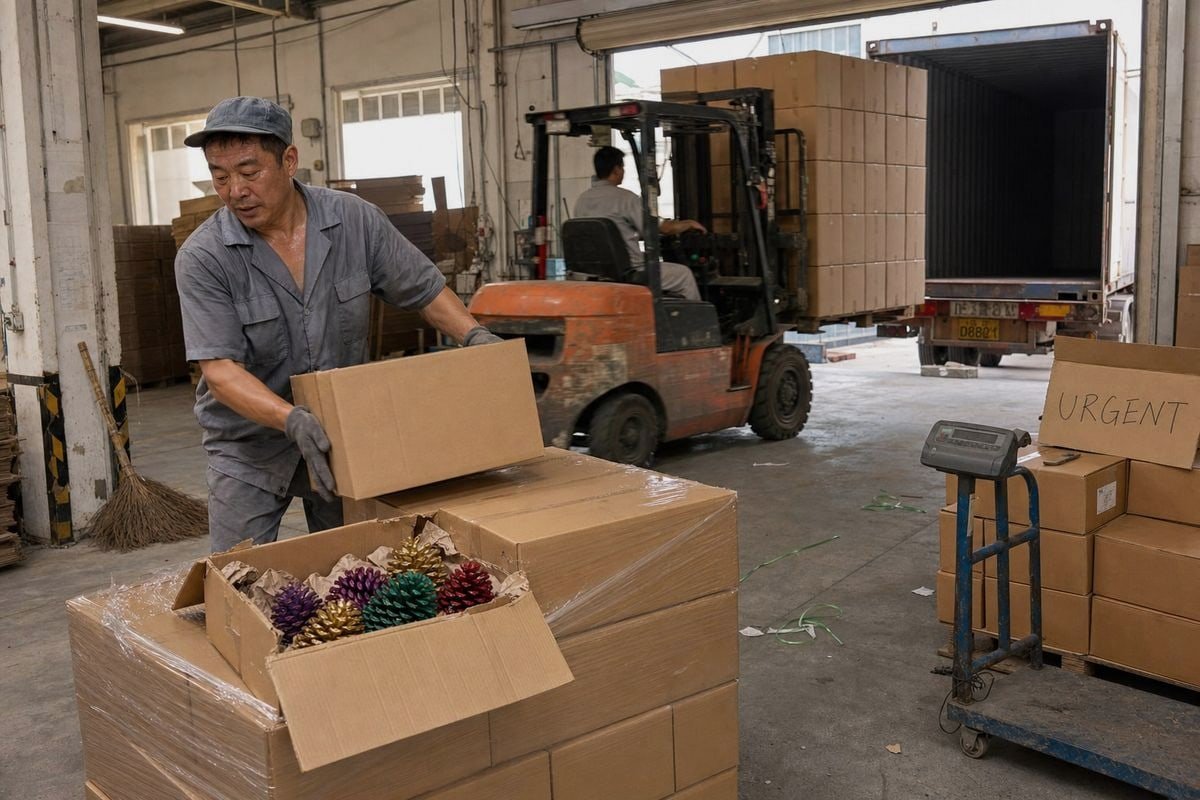
Les ruptures de stock en haute saison sur les pommes de pin sont douloureuses. Chaque octobre, les acheteurs appellent notre ligne de production de Ningbo pour supplier des [expéditions aériennes d'urgence](https://sunrichfire.com/emergency-restocking-air-freight-sea-wood-fire-starters/) Marquage CE 1. Manquez la fenêtre, et les ventes de la saison sont tout simplement perdues.
Pour éviter les ruptures de stock en période de pointe sur les pommes de pin, expédiez 60 à 80 % de votre volume par fret maritime réservé 60 à 90 jours à l'avance, et réservez le fret aérien uniquement pour la petite quantité nécessaire pour protéger les références les plus vendues lorsque le coût de rupture de stock dépasse la prime aérienne.
C'est la réponse courte. Mais la vraie décision dépend de vos marges, de vos délais, et de la façon dont vous planifiez avec votre fournisseur. Laissez-moi vous expliquer chaque partie.
Comment décider entre le fret aérien et le stockage maritime anticipé pour éviter de manquer de pommes de pin pendant la haute saison ?
En septembre dernier, un distributeur allemand de foyers nous a demandé d'expédier par avion trois palettes de pommes de pin colorées. Le devis de fret était supérieur à la valeur du produit. Cet appel nous a appris une leçon à tous les deux.
Choisissez le fret maritime pour le volume de base prévu car les pommes de pin sont volumineuses et de faible valeur unitaire ; choisissez le fret aérien uniquement pour les articles les plus vendus urgents où les ventes perdues coûtent plus cher que la prime de fret de 4 à 6 fois supérieure. La plupart des acheteurs devraient opter par défaut pour un hybride mer d'abord, air en secours.

La décision ne concerne pas vraiment les modes de transport. Il s'agit de faire correspondre chaque mode au risque de délai, à la marge et à la certitude de la demande. Voici la comparaison directe que nous expliquons aux acheteurs :
| Facteur | Fret aérien | Stockage maritime anticipé |
|---|---|---|
| Délai de transit | 3–7 jours | Mêmes QMC |
| Coût par kg | 4 à 6 fois plus élevé que par voie maritime | De base (le plus bas) |
| Idéal pour | Articles à rotation rapide, à forte marge | Volume saisonnier en vrac |
| Délai de réservation | 7 à 14 jours standard ; 30 à 60 jours en période de pointe | 60 à 90 jours avant le pic de demande |
| Risque principal | Le coût efface la marge | Retards, reports, congestion portuaire |
| Flux de trésorerie | Paiement tardif, rotation rapide | Capital immobilisé plus tôt |
Pourquoi les pommes de pin sont un produit du pire scénario pour l'avion
Les pommes de pin ont un rapport poids/volume terrible. Elles sont volumineuses mais légères. Les prix du fret aérien sur le poids dimensionnel 2, vous payez donc pour l'espace, pas pour les grammes. Pour notre pommes de pin à flamme colorée, un réapprovisionnement aérien complet peut coûter plus cher par unité que le produit lui-même. L'électronique compacte peut absorber cela. Les plantes décoratives ne le peuvent pas.
Pourquoi la voie maritime seule est également risquée
Certains acheteurs poussent tout vers la voie maritime pour protéger leur marge. Cela fonctionne jusqu'à ce qu'une navigation blanche ou une saisie douanière mange deux semaines. Dans une fenêtre de vente étroite au quatrième trimestre, deux semaines perdues peuvent détruire les ventes. La réponse honnête est donc qu'aucune stratégie pure n'est la bonne. La voie maritime transporte le volume. L'avion sert d'assurance. D'après notre expérience d'exportation dans plus de 30 pays, les acheteurs qui répartissent ainsi les expéditions ne font presque jamais face à une rupture de stock complète, et ils ne paient jamais les tarifs aériens sur toute leur commande.
À quelle distance à l'avance dois-je passer mes commandes de fret maritime pour répondre à la demande des fêtes et de la haute saison ?
Un compromis que nous pesons constamment dans notre usine : la capacité de production en juillet est bon marché et flexible, mais en septembre, toutes les lignes de Ningbo sont engagées. Commander tôt vous achète à la fois de l'espace de fret et la priorité de l'usine.
Passez vos commandes de fret maritime 60 à 90 jours avant votre pic de demande, et réservez l'espace du navire 10 à 16 semaines à l'avance pour les marchandises du quatrième trimestre. Pour les produits de pommes de pin, commandez en juin ou juillet pour garantir la disponibilité en rayon en octobre aux États-Unis et en Europe.

Travailler à rebours à partir de votre date de vente est la seule méthode fiable. Ne commencez pas par quand vous voulez commander. Commencez par quand le produit doit être en rayon, puis soustrayez chaque étape.
Le calendrier inversé pour les commandes de pommes de pin
| Jalon | Temps requis | Délai cumulé |
|---|---|---|
| Date de mise en rayon | Objectif : début octobre | 0 |
| Réception et distribution | 1–2 semaines | 2 semaines |
| Dédouanement et inspection | 1–2 semaines | 4 semaines |
| Transit maritime (Chine vers États-Unis/UE) | 4–6 semaines | 10 semaines |
| Manutention à l'exportation et réservation de navire | 1–2 semaines | 12 semaines |
| Production et CQ | 3–4 semaines | 16 semaines |
| Tampon de perturbation | 2 semaines | 18 semaines |
Cela place votre date de commande début juin pour un lancement en octobre. La plupart des acheteurs sont choqués par ces calculs la première fois qu'ils les voient.
Il y a une autre contrainte spécifique à ce produit. Les pommes de pin sont récoltées naturellement, avec des fenêtres de collecte fixes à la fin de l'été et au début de l'automne. La disponibilité des matières premières est saisonnière avant même le début de l'expédition. De plus, les exportations de plantes naturelles nécessitent généralement un traitement thermique ou une fumigation, ainsi que des certificats phytosanitaires 3 sur de nombreuses lignes. Nous pré-organisons cette documentation pour nos acheteurs, car les retards de paperasse peuvent ajouter des semaines si elle est traitée de manière réactive. Les tarifs maritimes augmentent également de 200 à 400 % d'août à octobre avant la demande du quatrième trimestre. Réserver tôt n'est pas seulement une question de temps. Il s'agit de verrouiller les tarifs avant la flambée.
Quand est-il judicieux de payer un supplément pour le fret aérien afin d'éviter une rupture de stock ?
Une marque britannique de camping nous a envoyé un courriel à la mi-novembre : leur sachet de pommes de pin le plus vendu s'était épuisé cinq semaines plus tôt. Nous avons expédié par avion deux semaines de stock de couverture pendant qu'un réapprovisionnement par mer suivait. Cette dépense aérienne s'est rentabilisée en quelques jours.
Le fret aérien est judicieux lorsque le profit des ventes que vous perdriez autrement dépasse la prime aérienne. Utilisez-le uniquement pour les SKUS les plus vendus et éprouvés pendant la fenêtre de vente active, jamais pour les réapprovisionnements de catalogue complet ou les articles à faible rotation.

La règle de décision est simple : passer à l'avion si le coût supplémentaire du fret est inférieur au coût du retard. Le coût du retard comprend la perte de marge brute, la perte de classement sur le marché et la perte de clients fidèles. Pour un produit phare en décembre, ces coûts s'accumulent rapidement.
Un exemple simple et concret
Supposons qu'une rupture de stock sur votre produit phare vous coûte 500 unités de ventes par semaine à 4 € de marge brute chacune. Cela représente 2 000 € par semaine perdus. Si le fret aérien coûte 1 500 € de plus que le fret maritime pour deux semaines de stock, l'avion l'emporte clairement. Si le même calcul s'applique à un produit lent perdant 300 € par semaine, le maritime plus la patience l'emporte.
Quand l'avion n'a PAS de sens
- Le produit a une faible marge et la demande est faible. Le surcoût mange le profit.
- La période de vente est presque terminée. Un stock arrivant le 20 décembre pour un article de Noël peut simplement devenir un stock de report.
- Les documents de conformité ne sont pas prêts. Les certificats phytosanitaires et les inspections douanières pour les produits botaniques peuvent neutraliser complètement l'avantage de vitesse de l'avion s'ils ne sont pas pré-organisés.
- La capacité aérienne de pointe est limitée. D'octobre à nos jours, l'espace aérien est rationné et surtaxé, de sorte que "rapide" peut tranquillement devenir lent et très cher.
Une autre note pratique de notre part. Parce que nous gérons des lignes de production complètes avec un contrôle qualité strict lot par lot, une commande aérienne d'urgence de notre part correspond à la qualité de votre expédition maritime d'origine. Cela compte. Une expédition de sauvetage qui échoue à l'inspection de détail ne sauve rien.
Comment puis-je travailler avec mon fabricant pour élaborer une stratégie de stock de sécurité qui évite complètement les pénuries en période de pointe ?
Les acheteurs qui ne nous appellent jamais en panique en novembre partagent une habitude : ils nous traitent comme un partenaire de planification, pas seulement comme un fournisseur. Ils partagent leurs prévisions au printemps, et nous réservons la capacité et le stock de pommes de pin brutes en conséquence. gestion de la chaîne d'approvisionnement 4.
Partagez les prévisions au niveau SKU avec votre fabricant tôt, définissez les points de réapprovisionnement en utilisant les ventes quotidiennes moyennes multipliées par le délai total plus le stock de sécurité, échelonnez les expéditions tout au long de la saison et convenez d'un arrangement de capacité réservée ou de stock tampon préproduit avant le début du pic.

Stock de sécurité 5 n'est pas une devinette. C'est une formule plus une relation. La formule : point de réapprovisionnement 6 = ventes quotidiennes moyennes × délai de réapprovisionnement total + stock de sécurité. Dimensionnez le stock de sécurité par rapport à la variabilité historique des délais de votre fournisseur, et non par rapport à une règle empirique fixe. Si les délais varient de deux semaines, conservez deux semaines supplémentaires de vos articles les plus vendus.
Un cadre de collaboration pratique
| Synchronisation | Votre action | Action du fabricant |
|---|---|---|
| Mars-avril | Partager la prévision saisonnière par SKU | Réserver l'approvisionnement en pommes de pin brutes à partir des contrats de récolte |
| Mai-juin | Passer la commande maritime de base (60–80 % de la prévision) | Bloquer les créneaux de production ; pré-organiser les documents phytosanitaires |
| Juillet–août | Confirmer l'emballage, les étiquettes, les codes-barres | Produire, contrôler la qualité et expédier le volume de base par voie maritime |
| Septembre | Examiner les données de vente anticipée | Conserver une capacité flexible de 20–40 % pour les commandes de suivi |
| Octobre–Novembre | Déclencher des compléments aériens uniquement pour les produits phares à risque | Lots de petite taille à rotation rapide avec des normes de contrôle qualité correspondantes |
Pourquoi le côté fabricant est plus important que ce que pensent les acheteurs
Les pommes de pin ont une fenêtre de récolte fixe. Si votre fournisseur n'a pas sécurisé de matière première à la fin de l'été, aucun mode de transport ne pourra vous sauver plus tard. Dans notre usine de Ningbo, nous achetons sur la base de prévisions confirmées, c'est pourquoi le partage précoce des prévisions protège directement votre saison de pointe. Nous gérons également la couche de conformité en amont — ISO 9001 7 et les normes d'usine BSCI, le marquage CE et les rapports de test SGS/Intertek — de sorte qu'une commande urgente ne soit jamais bloquée à la douane en attendant des documents. Et comme nous proposons des MOQ flexibles, les acheteurs peuvent détenir un stock modeste de produits de marque privée sans sur-engager de capital. Des expéditions échelonnées plus une voie d'approvisionnement aérien pré-convenue sont ce qui se rapproche le plus d'une immunité contre les ruptures de stock dans cette catégorie de produits.
Conclusion
Les ruptures de stock de saison de pointe sur les pommes de pin sont évitables. Expédiez le volume de base par voie maritime 60 à 90 jours à l'avance, gardez l'avion comme assurance ciblée et planifiez les tampons avec votre fabricant avant le début de la saison.
Notes de bas de page
Référence de fond pour le marquage de conformité CE mentionné dans la section conformité fabricant. ↩︎
Explique le concept de tarification du fret aérien auquel il est fait référence lors de la comparaison des coûts maritimes et aériens. ↩︎
Source officielle sur la certification phytosanitaire requise pour les exportations botaniques comme les pommes de pin. ↩︎
Explique les concepts plus larges de planification de la chaîne d'approvisionnement sous-jacents au cadre de collaboration acheteur-fabricant. ↩︎
Fournit des informations générales sur le concept de tampon de stock au cœur de la stratégie de point de commande discutée. ↩︎
Définit la formule de stock utilisée pour calculer quand déclencher les commandes de réapprovisionnement. ↩︎
Page ISO officielle expliquant la norme de gestion de la qualité mentionnée pour la conformité de l'usine. ↩︎



 English
  Spanish
  German
  French
  Arabic
  Portuguese
Rejoignez la conversation