






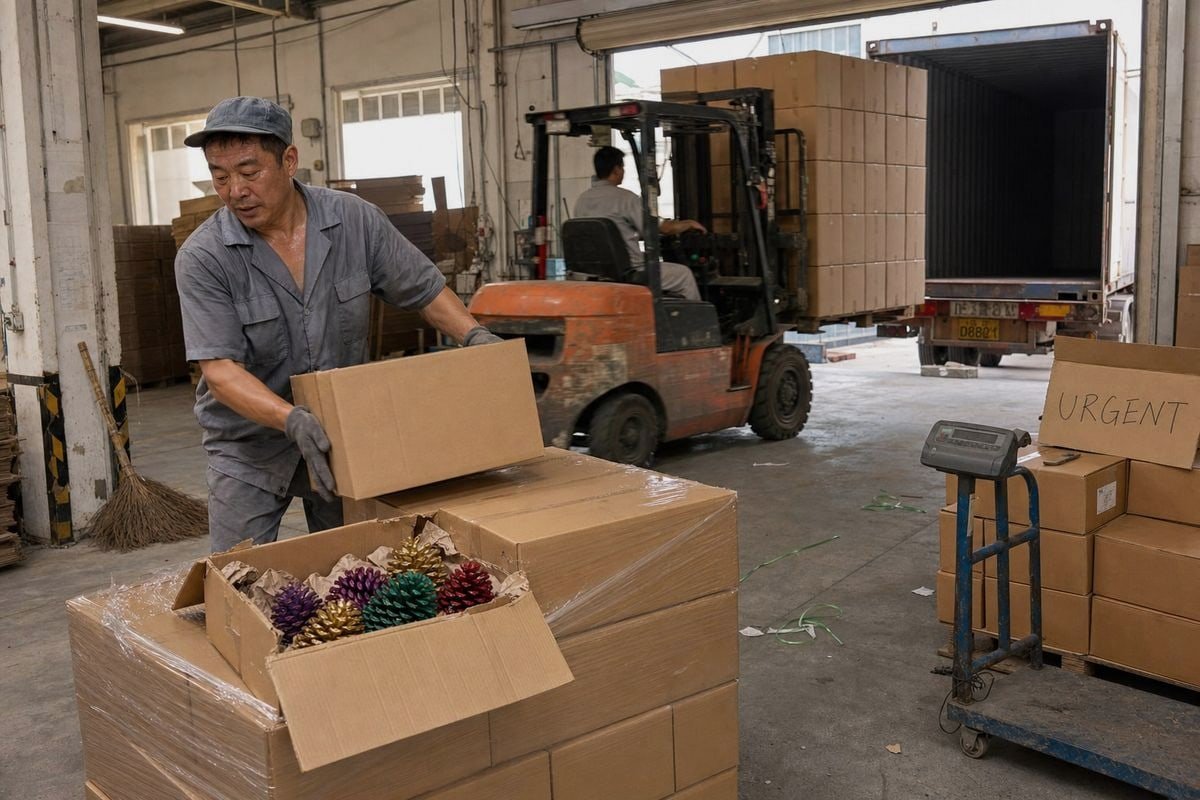
Peak season stockouts on pine cones hurt. Every October, buyers call our Ningbo production line begging for [emergency air shipments](https://sunrichfire.com/emergency-restocking-air-freight-sea-wood-fire-starters/) Marcado CE 1. Miss the window, and the season's sales are simply gone.
To avoid peak season stockouts on pine cones, ship 60–80% of your volume by advance sea freight booked 60–90 days ahead, and reserve air freight only for the small quantity needed to protect top-selling SKUs when stockout cost exceeds the air premium.
That is the short answer. But the real decision depends on your margins, your lead times, and how you plan with your supplier. Let me walk you through each part.
How do I decide between air freight and advance sea stocking to avoid running out of pine cones during peak season?
Last September, a German fireplace distributor asked us to air-ship three pallets of color-flame pinecones. The freight quote was higher than the product value. That call taught us both a lesson.
Choose sea freight for planned base volume because pine cones are bulky and low value per unit; choose air freight only for urgent top-sellers where lost sales cost more than the 4–6x freight premium. Most buyers should default to a sea-first, air-backup hybrid.

The decision is not really about transport modes. It is about matching each mode to lead-time risk, margin, and demand certainty. Here is the direct comparison we walk buyers through:
| Factor | Transporte aéreo | Advance Sea Stocking |
|---|---|---|
| Tiempo de tránsito | 3–7 días | 25–40 días |
| Costo por kg | 4–6x higher than ocean | Base (más bajo) |
| Lo mejor para | Urgent, high-margin SKUs | Bulk seasonal volume |
| Booking lead time | 7–14 days standard; 30–60 days at peak | 60–90 days before demand spike |
| Riesgo principal | Cost erases margin | Delays, rollovers, port congestion |
| Flujo de caja | Late payment, fast turnaround | Earlier capital tied up |
Why pine cones are a worst-case product for air
Pine cones have a terrible weight-to-volume ratio. They are bulky but light. Air freight prices on peso dimensional 2, so you pay for the space, not the grams. For our piñas de fuego de color, a full air restock can cost more per unit than the product itself. Compact electronics can absorb that. Decorative botanicals cannot.
Why sea alone is also risky
Some buyers push everything to ocean to protect margin. That works until a blank sailing or customs hold eats two weeks. In a narrow Q4 selling window, two lost weeks can destroy sell-through. So the honest answer is neither pure strategy. Sea carries the volume. Air stands by as insurance. In our experience exporting to 30+ countries, buyers who split shipments this way almost never face a full stockout, and they never pay air rates on their whole order.
How far ahead do I need to place my sea freight orders to keep up with holiday and peak season demand?
One trade-off we weigh constantly at our factory: production capacity in July is cheap and flexible, but by September every line in Ningbo is committed. Ordering early buys you both freight space and factory priority.
Place sea freight orders 60–90 days before your demand spike, and book vessel space 10–16 weeks ahead for Q4 goods. For pine cone products, order by June or July to guarantee October shelf availability in the US and Europe.

Working backward from your sell date is the only reliable method. Do not start from when you want to order. Start from when the product must be on the shelf, then subtract every step.
The backward timeline for pine cone orders
| Hito | Time required | Cumulative lead time |
|---|---|---|
| Retail shelf date | Target: early October | 0 |
| Receiving and distribution | 1–2 semanas | 2 semanas |
| Customs clearance and inspection | 1–2 semanas | 4 semanas |
| Tránsito marítimo (China a EE. UU./UE) | 4–6 semanas | 10 semanas |
| Export handling and vessel booking | 1–2 semanas | 12 weeks |
| Producción y control de calidad | 3–4 semanas | 16 weeks |
| Disruption buffer | 2 semanas | 18 weeks |
That puts your order date in early June for an October launch. Most buyers are shocked by this math the first time they see it.
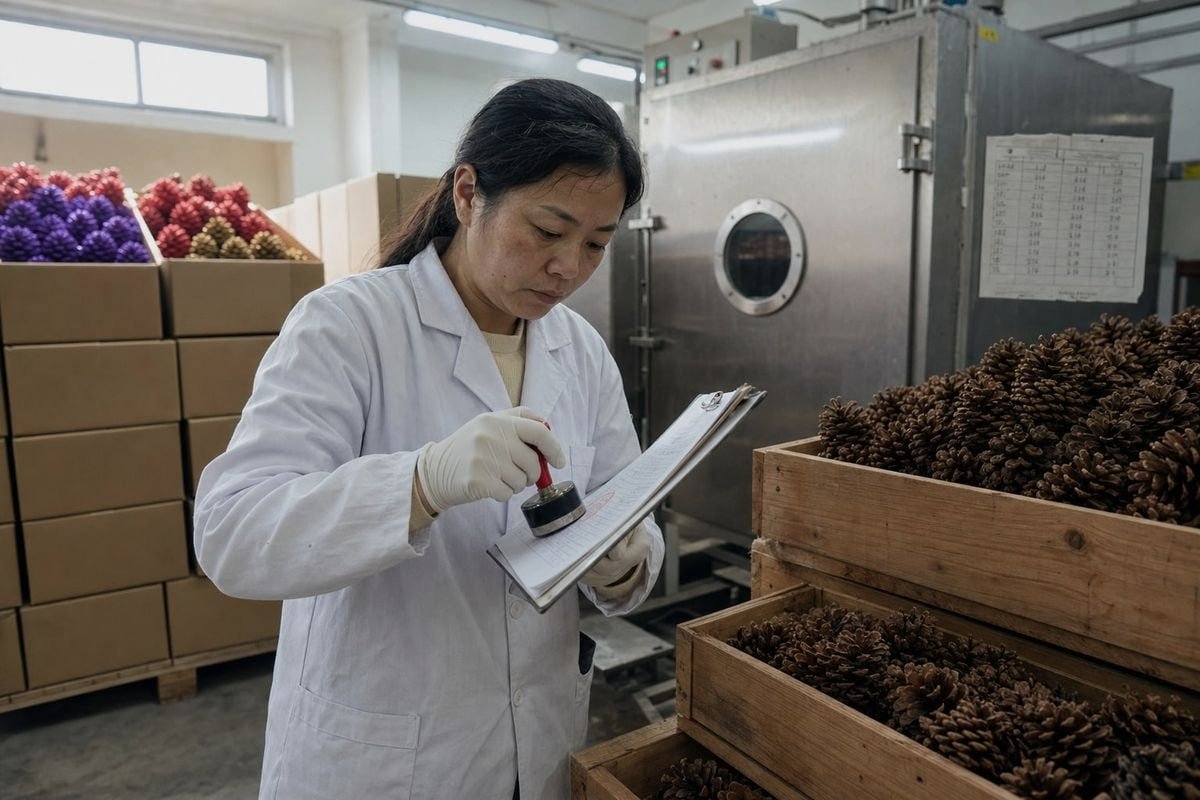
There is another constraint specific to this product. Pine cones are naturally harvested, with fixed collection windows in late summer and early fall. Raw material availability is seasonal before shipping even begins. On top of that, natural botanical exports typically need heat treatment or fumigation, plus certificados fitosanitarios 3 in many lanes. We pre-arrange this documentation for our buyers, because paperwork delays can add weeks if handled reactively. Ocean rates also spike 200–400% from August through October ahead of Q4 demand. Booking early is not just about time. It is about locking rates before the surge.
When does paying extra for air freight actually make sense to save a stockout situation?
A UK camping brand once emailed us in mid-November: their best-selling campfire pinecone pouch had sold through five weeks early. We air-shipped two weeks of cover stock while a sea replenishment followed. That air spend paid for itself in days.
Air freight makes sense when the profit from sales you would otherwise lose exceeds the air premium. Use it only for proven top-selling SKUs during the active selling window, never for full-catalog restocks or slow movers.

The decision rule is simple: switch to air if the extra freight cost is less than the delay cost. Delay cost includes lost gross profit, lost marketplace ranking, and lost repeat customers. For a hot SKU in December, those costs stack fast.
Un ejemplo simple resuelto
Say a stockout on your lead SKU costs you 500 units of sales per week at $4 gross profit each. That is $2,000 per week lost. If air freight costs $1,500 more than sea for two weeks of stock, air wins clearly. If the same math applies to a slow SKU losing $300 per week, sea plus patience wins.
When air does NOT make sense
- The SKU is low-margin and demand is soft. The premium eats the profit.
- The selling window has nearly closed. Stock arriving December 20th for a Christmas item may just become carryover inventory.
- Compliance paperwork is not ready. Phytosanitary certificates and customs inspections for botanical products can neutralize air's speed advantage entirely if they are not pre-arranged.
- Peak air capacity is tight. From October onward, air space gets rationed and surcharged, so "fast" can quietly become slow and very expensive.
One more practical note from our side. Because we run complete production lines with strict batch-to-batch QC, an emergency air order from us matches the quality of your original sea shipment. That matters. A rescue shipment that fails retail inspection rescues nothing.
How can I work with my manufacturer to build a safety stock strategy that prevents peak season shortages altogether?
The buyers who never panic-call us in November share one habit: they treat us as a planning partner, not just a supplier. They share forecasts in spring, and we reserve capacity and raw pine cone stock accordingly gestión de la cadena de suministro 4.
Share SKU-level forecasts with your manufacturer early, set reorder points using average daily sales times total lead time plus safety stock, stagger shipments across the season, and agree on a reserved-capacity or pre-produced buffer arrangement before peak begins.
Stock de seguridad 5 is not guesswork. It is a formula plus a relationship. The formula: punto de reorden 6 = average daily sales × total replenishment lead time + safety stock. Size the safety stock against your supplier's historical lead-time variability, not against a fixed rule of thumb. If lead times swing by two weeks, hold two extra weeks of your fastest movers.
A practical collaboration framework
| Temporización | Your action | Manufacturer's action |
|---|---|---|
| Marzo-abril | Share seasonal forecast by SKU | Reserve raw pine cone supply from harvest contracts |
| Mayo-junio | Place base sea order (60–80% of forecast) | Lock production slots; pre-arrange phytosanitary docs |
| Julio-agosto | Confirm packaging, labels, barcodes | Produce, QC, and ship base volume by sea |
| Septiembre | Review early sell-through data | Hold flexible 20–40% capacity for follow-up orders |
| Octubre-Noviembre | Trigger air top-ups only for at-risk top SKUs | Fast-turn small batches with matching QC standards |
Why the manufacturer side matters more than buyers think
Pine cones have a fixed harvest window. If your supplier has not secured raw material in late summer, no freight mode can save you later. At our factory in Ningbo, we buy against confirmed forecasts, which is why early forecast sharing directly protects your peak season. We also handle the compliance layer up front — ISO 9001 7 and BSCI factory standards, CE marking, and SGS/Intertek test reports — so a rush order never stalls at customs waiting on documents. And because we offer flexible MOQs, buyers can hold a modest buffer of private-label stock without over-committing capital. Staggered shipments plus a pre-agreed air contingency lane is the closest thing to stockout immunity this product category allows.
Conclusión
Peak season stockouts on pine cones are preventable. Ship base volume by sea 60–90 days early, keep air as targeted insurance, and plan buffers with your manufacturer before the season starts.
Notas al pie
1. Background reference for the CE compliance marking mentioned in the manufacturer compliance section. ↩︎
2. Explains the air freight pricing concept referenced when comparing sea and air costs. ↩︎
3. Official source on phytosanitary certification required for botanical exports like pine cones. ↩︎
4. Explains broader supply chain planning concepts underlying the buyer-manufacturer collaboration framework. ↩︎
5. Provides background on the inventory buffer concept central to the reorder-point strategy discussed. ↩︎
6. Defines the inventory formula used to calculate when to trigger replenishment orders. ↩︎
7. Official ISO page explaining the quality management standard mentioned for factory compliance. ↩︎



 English
  Spanish
  German
  French
  Arabic
  Portuguese
Únete a la conversación