







La classification CLP des cônes de pin colorés pour cheminée piège de nombreux importateurs. J'ai vu des expéditions bloquées dans les douanes de l'UE parce que le fournisseur précédent de notre acheteur avait complètement omis cette étape.
Traitez les pommes de pin colorées comme un mélange chimique en vertu du règlement CLP (CE) n° 1272/2008 : classez la formulation complète, vérifiez les entrées harmonisées de l'annexe VI, soumettez une notification au centre antipoison avec un UFI via le portail de l'ECHA si elle est dangereuse, et imprimez les pictogrammes, les mentions d'avertissement et les phrases de danger conformes sur l'emballage.
Cela semble beaucoup. C'est gérable si vous suivez un flux de travail clair. Laissez-moi vous guider à travers chaque étape, en fonction de ce que nous faisons pour nos propres acheteurs européens.
Quelles classes de danger CLP s'appliquent à mes produits de pommes de pin colorées ?
Un distributeur allemand m'a un jour demandé pourquoi un cône de pin "naturel" avait besoin d'une classification chimique. Notre équipe de conformité entend cette question chaque saison, et la réponse surprend la plupart des acheteurs.
Le pin lui-même n'est pas le problème ; ce sont les additifs colorants ignifuges. Selon la formulation, les pommes de pin colorées peuvent déclencher des classifications d'inflammabilité, d'oxydant, d'irritant pour la santé ou de toxicité aquatique selon le CLP. La classification des mélanges chimiques doit évaluer l'ensemble du produit traité, et non le support botanique non traité.
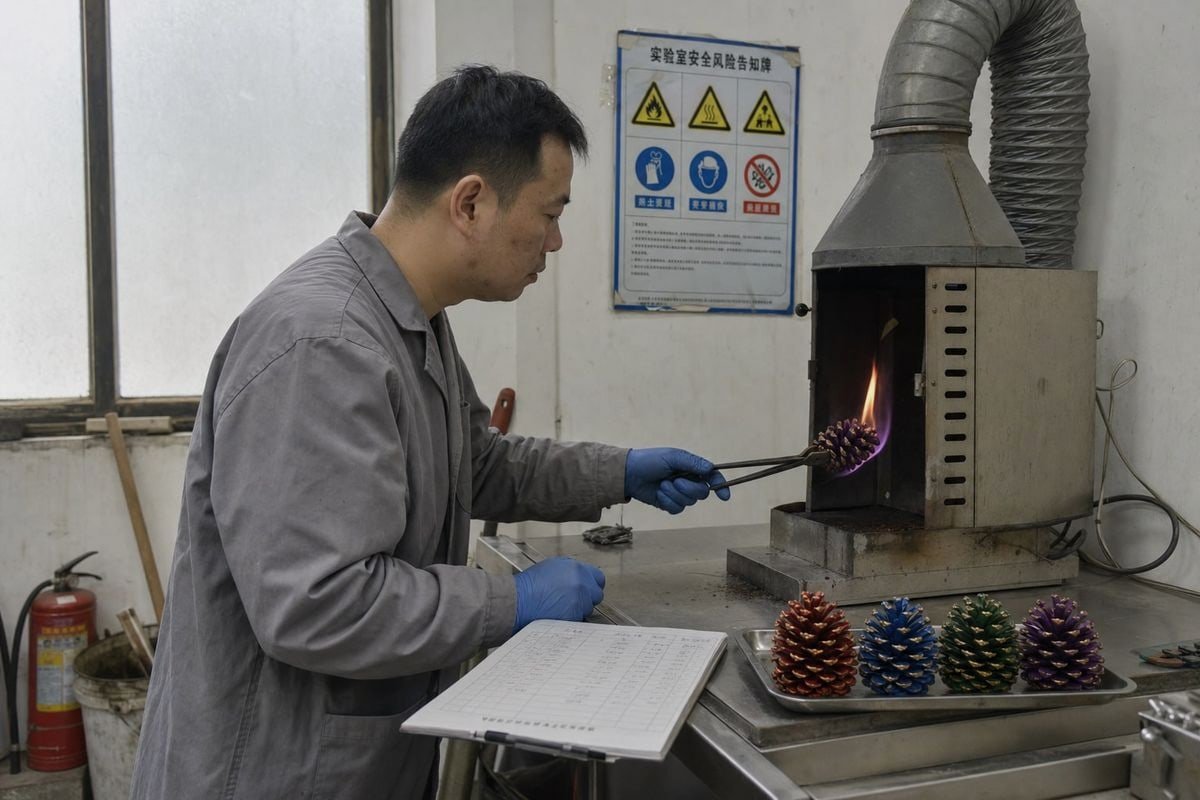
Voici la distinction fondamentale. Un cône de pin ordinaire est un article naturel. Un cône de pin saturé de sels métalliques conçus pour libérer des flammes colorées pendant la combustion est, en termes réglementaires, généralement traité comme un mélange sur un support. La fonction chimique — la combustion colorée — est le but même du produit. C'est pourquoi le CLP s'applique.
Au cours de nos dix-sept années de production de produits à flamme colorée, nous avons examiné des dizaines de formulations. Le profil de danger se résume toujours à trois questions. Premièrement, quels sont les dangers physiques ? Les cônes de pin sont riches en résine et très inflammables par eux-mêmes, et si la formulation comprend des composants oxydants, ceux-ci peuvent provoquer ou contribuer à un incendie et doivent être soigneusement évalués. Deuxièmement, quels sont les dangers pour la santé des additifs ? Certains colorants traditionnels sont irritants ou nocifs en cas d'ingestion. Troisièmement, quels sont les dangers environnementaux ? Les colorants à base de cuivre, courants dans les formulations bon marché, sont souvent classés comme très toxiques pour la vie aquatique avec des effets à long terme (H410) — et cette classification environnementale finit souvent par être la partie la plus stricte de l'étiquette.
Classes de danger typiques à examiner
| Domaine de danger | Classes CLP possibles | Déclencheur courant dans les cônes de pin colorés |
|---|---|---|
| Physique | Solide inflammable ; Solide oxydant | Support riche en résine ; auxiliaires de combustion oxydants |
| Santé | Toxicité aiguë Cat. 4 ; Irritation cutanée/oculaire ; STOT | Certains sels métalliques et liants |
| Environnement | Aquatique Chronique 1 (H410) | Composés de cuivre et colorants similaires |
Un autre point est important. La combinaison de plusieurs sels métalliques pour obtenir un effet arc-en-ciel peut produire une classification globale plus stricte que ce que suggère un seul ingrédient. Les règles d'additivité pour les dangers aquatiques, en particulier, peuvent faire passer un mélange dans une catégorie supérieure. Nous effectuons toujours le calcul complet du mélange plutôt que de vérifier les ingrédients un par un. Nos propres formulations utilisent des matériaux écologiques spécifiquement pour maintenir ce profil de danger aussi propre que possible, et nous le soutenons avec des rapports de test SGS et Intertek.
Comment puis-je effectuer la notification au Centre antipoison de l'ECHA avant l'expédition vers l'Europe ?
Le compromis que nous évaluons pour chaque commande destinée à l'UE est le délai : soumettre le Notification au Centre Antipoison 1 trop tard, et un conteneur fini attend dans notre entrepôt de Ningbo pendant que la paperasse rattrape. Nous intégrons donc le PCN dans le calendrier de pré-production, pas dans le calendrier d'expédition.
Si vos pommes de pin colorées sont classées comme dangereuses pour la santé ou pour des effets physiques, vous devez soumettre une notification au centre antipoison conformément à l'annexe VIII du CLP via le portail de soumission de l'ECHA, générer un identifiant unique de formulation (UFI) de 16 caractères et imprimer cet UFI sur l'étiquette avant de mettre le produit sur le marché de l'UE.
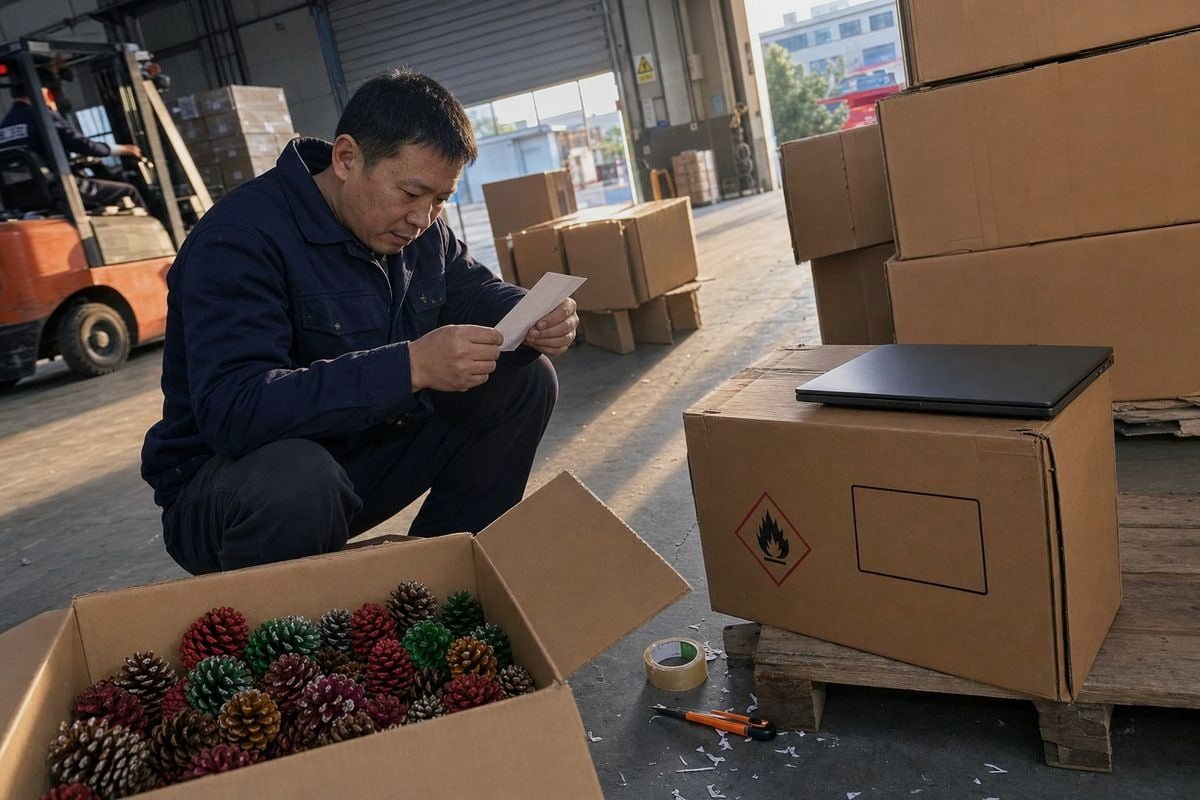
Je vais décomposer le processus en étapes concrètes, car c'est là que je vois la plupart des petites marques et des importateurs bloquer.
Le flux de travail PCN, étape par étape
- Confirmer le déclencheur. Annexe VIII CLP 2 les obligations s'appliquent aux mélanges classés comme dangereux en raison de dangers pour la santé ou de dangers physiques. Un mélange classé uniquement pour des dangers environnementaux ne déclenche pas lui-même de PCN, mais vous devez toujours le classer et l'étiqueter correctement.
- Identifier le responsable. L'importateur de l'UE ou l'utilisateur en aval basé dans l'UE assume normalement le devoir de notification. Une usine non européenne comme la nôtre ne peut pas soumettre seule, mais nous préparons le dossier complet de formulation afin que la soumission de notre acheteur prenne quelques jours, pas quelques mois.
- Compiler le dossier. Vous avez besoin de la composition complète avec les plages de concentration, les informations toxicologiques, la catégorie de produit (EuPCS), les types et tailles d'emballage, et les éléments d'étiquetage. Notre Fiches de données de sécurité (FDS) s'intègrent directement dans cela.
- Générer l'UFI. Le gratuit d'ECHA générateur d'UFI 3 crée le code à 16 caractères à partir de votre numéro de TVA et d'un numéro de formulation. Une formulation, une UFI — si vous reformulez, vous en avez besoin d'une nouvelle.
- Soumettre via le portail de soumission d'ECHA. Les produits de consommation nécessitent l'ensemble complet d'informations. Maintenez la soumission à jour chaque fois que la recette, la classification ou l'emballage changent.
- Imprimer l'UFI sur l'étiquette. Il doit être clairement visible, lisible et précédé de l'acronyme "UFI".
Une obligation connexe mais distincte est la notification C&L pour les substances dangereuses qu'un importateur introduit dans l'UE au-dessus des quantités seuils. Ne confondez pas les deux ; le PCN couvre le mélange pour les interventions d'urgence, tandis que la notification C&L couvre la classification des substances dans l'inventaire d'ECHA. Selon les quantités et l'analyse article versus mélange, des questions d'enregistrement en vertu du règlement REACH peuvent également se poser, de sorte qu'une vérification juridique au niveau de la formulation vaut le modeste coût.
Quels avertissements et pictogrammes sont légalement requis sur mon emballage ?
Lors d'un projet de marque de distributeur pour une marque britannique de cheminées l'année dernière, notre équipe d'emballage a reconstruit les illustrations des étiquettes trois fois avant que le consultant en conformité de l'acheteur ne donne son approbation. Cette expérience nous a appris à concevoir les éléments d'étiquetage CLP avant la conception graphique, jamais après.
Une étiquette CLP conforme doit indiquer l'identité du fournisseur, l'identificateur du produit, la quantité nominale, les composants dangereux, les pictogrammes de danger, une mention d'avertissement, les mentions de danger, les conseils de prudence, l'UFI si nécessaire, et toute information supplémentaire — le tout dimensionné et positionné conformément aux règles d'étiquetage CLP.
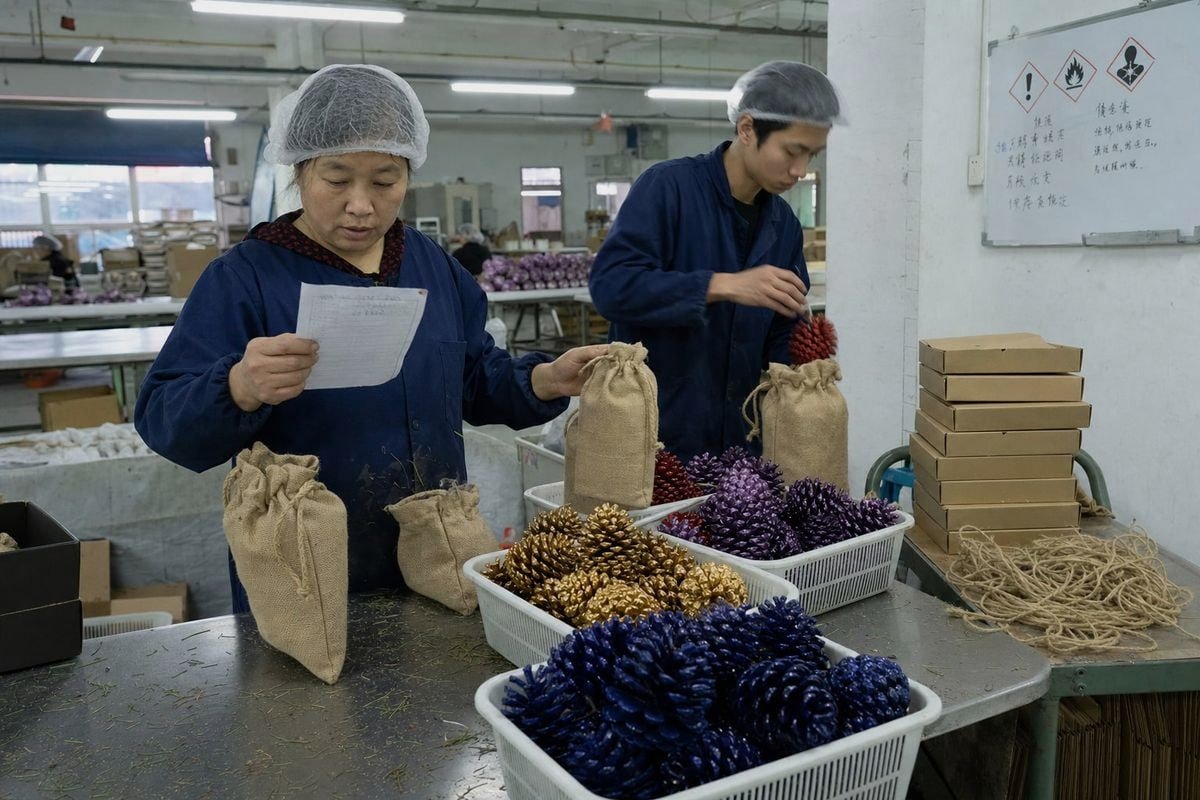
De nombreux acheteurs pensent qu'un pictogramme de flamme seul suffit. Ce n'est pas le cas. Les étiquettes CLP sont un système d'information complet, et chaque élément est obligatoire lorsque la classification l'exige.
Éléments d'étiquetage qui s'appliquent généralement
| Élément d'étiquette | Ce à quoi cela ressemble pour les pommes de pin colorées |
|---|---|
| Pictogrammes de danger | Flamme (GHS02) si inflammable ; point d'exclamation (GHS07) pour les irritants ; environnement (GHS09) pour la toxicité aquatique ; flamme sur cercle (GHS03) si comburant |
| Mots-clés | "Danger" ou "Attention" — utilisez uniquement le plus sévère, jamais les deux |
| Mentions de danger | Toutes les mentions de danger H pertinentes de la classification, par exemple, H228, H410 |
| Mentions de prudence | Généralement pas plus de six mentions de prudence P, sélectionnées pour le scénario d'utilisation réel |
| UFI | Imprimé clairement, précédé de "UFI :" |
| Coordonnées du fournisseur | Le nom, l'adresse et le numéro de téléphone du fournisseur sur le marché de l'UE |
Deux points pratiques méritent une attention particulière. Premièrement, les conseils de prudence doivent être choisis, pas simplement ajoutés. Les directives CLP stipulent que les étiquettes ne doivent généralement pas contenir plus de six mentions, sauf si la gravité des dangers en exige davantage. Pour un produit de cheminée, les mentions concernant la garde hors de portée des enfants, la non-combustion dans des espaces clos non ventilés et l'élimination des cendres sont généralement les plus importantes. Deuxièmement, si plusieurs classes de danger s'appliquent, toutes les mentions de danger pertinentes apparaissent, sauf si l'une fait clairement double emploi avec une autre.
Notre service OEM/ODM intègre ces éléments d'étiquetage dans les pochettes en papier kraft, les bocaux et les boîtes d'exposition du client dès la première ébauche des illustrations. Nous ajoutons également des extras spécifiques au marché — codes-barres, texte multilingue pour l'Allemagne, la France et les Pays-Bas, et espace pour l'UFI. À l'avenir, nous conseillons aux acheteurs de réserver de l'espace sur l'étiquette pour un code QR scannable, car les futures réglementations de l'UE pousseront probablement les données de transparence des produits chimiques en ligne. Passeport numérique de produit 4 règles pousseront probablement les données de transparence des produits chimiques en ligne.
Mon fabricant peut-il fournir des rapports de test pour soutenir la conformité CLP et ECHA ?
Une leçon que nous avons apprise tôt dans notre histoire d'exportation : un bel échantillon sans dossier de données ne vaut rien pour un acheteur européen sérieux. Depuis lors, chaque produit à flamme colorée quittant nos lignes est expédié avec son dossier de conformité déjà assemblé.
Oui — un fabricant compétent devrait fournir des Fiches de Données de Sécurité (FDS), la divulgation complète de la formulation sous accord de non-divulgation, des rapports de tests par des tiers tels que SGS ou Intertek, et des ébauches d'éléments d'étiquetage. Sans ces documents, un importateur ne peut pas classifier, notifier ou étiqueter le produit légalement.

Voici la vérité inconfortable sur l'approvisionnement en pommes de pin colorées : de nombreux fournisseurs à bas prix ne peuvent pas vous dire ce qu'il y a réellement dans la pomme de pin. Si votre fournisseur ne peut pas divulguer la recette, vous ne pouvez pas effectuer la classification du mélange chimique, vous ne pouvez pas déposer de PCN, et vous portez seul le risque juridique en tant qu'importateur de l'UE.
Le dossier à exiger avant de commander
| Document | Pourquoi vous en avez besoin | Qui le fournit |
|---|---|---|
| FDS en 16 sections | Alimente la classification, le PCN et la communication de sécurité en aval | Fabricant |
| Formulation complète avec numéros CAS | Requis pour les vérifications de l'Annexe VI et le dossier ECHA | Fabricant (sous NDA) |
| Rapports de test par des tiers | Preuve indépendante de la composition et des allégations de sécurité | SGS / Intertek via le fabricant |
| Éléments d'étiquetage provisoires | Accélère la conformité des illustrations et évite les réimpressions | Fabricant + consultant de l'importateur |
| ISO 9001 5 / Certificats BSCI | Preuve de production cohérente et d'approvisionnement éthique | Fabricant |
Dans notre usine de Ningbo, soutenue par notre siège social de Liuyang dans le cluster de feux d'artifice de Chine, ce dossier est standard. Nos certifications ISO 9001 et BSCI couvrent le système de production ; nos documentation CE 6 et nos rapports SGS/Intertek couvrent le produit lui-même. Contrôle qualité lot par lot 7 est important ici aussi, et pas seulement pour la performance de combustion. Si la formulation dérive entre les lots, votre PCN et votre UFI ne correspondent plus à ce qu'il y a dans le sac — un véritable problème juridique. Nos contrôles de lots stricts existent précisément pour que le premier échantillon, le rapport de test et le cinquantième conteneur décrivent tous le même produit.
Une mise en garde honnête : les rapports de test soutiennent la conformité, mais ils ne remplacent pas les devoirs de l'importateur. Vous conservez la décision de classification, la soumission du PCN et la responsabilité de l'étiquetage sur votre marché. Ce qu'un véritable partenaire d'usine fait, c'est rendre ces devoirs rapides, peu coûteux et défendables.
Conclusion
Les pommes de pin colorées ont l'air décoratives mais sont réglementées comme des produits chimiques. Classez le mélange, déposez le PCN avec un UFI, étiquetez correctement et associez-vous à une usine qui vous remet le dossier de conformité complet.
Notes de bas de page
Portail officiel de l'ECHA expliquant les obligations de notification aux centres antipoison pour les mélanges dangereux. ↩︎
Page de législation de l'ECHA détaillant les obligations de notification PCN de l'Annexe VIII CLP pour les mélanges. ↩︎
L'outil officiel de l'ECHA pour générer le code identifiant unique de formule requis. ↩︎
Référence expliquant le futur cadre de transparence du passeport de produits de l'UE pour les produits. ↩︎
Page officielle de l'ISO expliquant la norme de gestion de la qualité citée comme certification du fabricant. ↩︎
Informations générales sur les exigences de marquage CE référencées aux côtés des rapports de test dans le dossier de conformité. ↩︎
Référence générale expliquant les concepts de contrôle qualité pertinents pour des lots de formulation cohérents. ↩︎



 English
  Spanish
  German
  French
  Arabic
  Portuguese
Rejoignez la conversation