







CLP hazard classification for fireplace colored pine cones trips up many importers. I have watched shipments sit in EU customs because our buyer's previous supplier skipped this step entirely.
Treat colored pine cones as a chemical mixture under CLP Regulation (EC) No 1272/2008: classify the full formulation, check Annex VI harmonised entries, submit a Poison Centre Notification with a UFI via the ECHA portal if hazardous, and print compliant pictograms, signal words, and statements on packaging.
That sounds like a lot. It is manageable if you follow a clear workflow. Let me walk you through each stage, based on what we do for our own European buyers.
What CLP Hazard Classes Apply to My Colored Pine Cone Products?
A German distributor once asked me why a "natural" pine cone needed chemical classification at all. Our compliance team hears this question every season, and the answer surprises most buyers.
The pine cone itself is not the issue; the flame-coloring additives are. Depending on the formulation, colored pine cones may trigger flammability, oxidiser, health-irritant, or aquatic-toxicity classifications under CLP. Chemical mixture classification must assess the whole treated product, not the untreated botanical carrier.
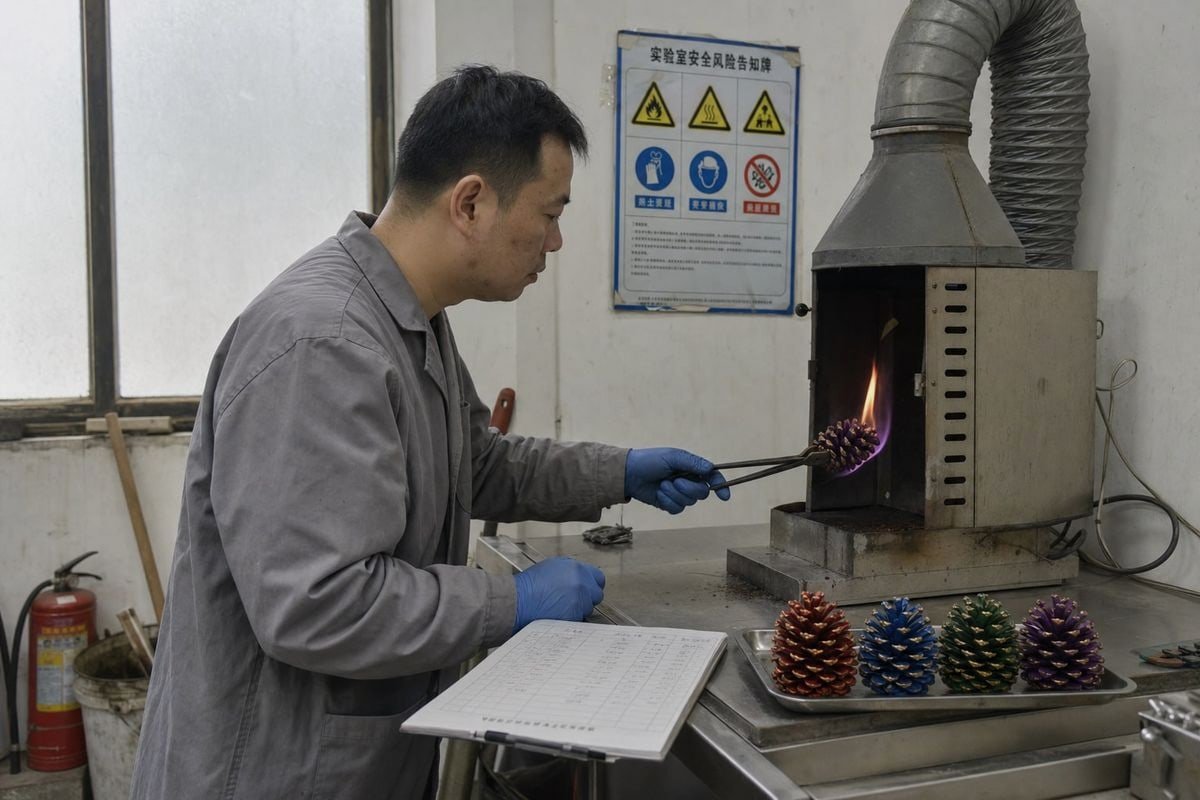
Here is the core distinction. A plain pine cone is a natural article. A pine cone saturated with metal salts designed to release colored flames during burning is, in regulatory terms, usually treated as a mixture on a carrier. The chemical function — colored combustion — is the whole point of the product. That is why CLP applies.
In our seventeen-plus years producing color-flame products, we have reviewed dozens of formulations. The hazard profile always comes down to three questions. First, what physical hazards exist? Pine cones are resin-rich and highly flammable on their own, and if the formulation includes oxidising components, those may cause or contribute to fire and must be assessed carefully. Second, what health hazards do the additives carry? Some traditional colorants are irritants or harmful if swallowed. Third, what environmental hazards apply? Copper-based colorants, common in cheap formulations, are often classified as very toxic to aquatic life with long-lasting effects (H410) — and this environmental classification frequently ends up being the strictest part of the label.
Typical Hazard Classes to Screen For
| Hazard Area | Possible CLP Classes | Common Trigger in Colored Pine Cones |
|---|---|---|
| Physisch | Flammable solid; Oxidising solid | Resin-rich carrier; oxidising combustion aids |
| Health | Acute toxicity Cat. 4; Skin/eye irritation; STOT | Certain metal salts and binders |
| Environmental | Aquatic Chronic 1 (H410) | Copper compounds and similar colorants |
One more point matters. Combining several metal salts to get a rainbow effect can produce a stricter overall classification than any single ingredient suggests. Additivity rules for aquatic hazards, in particular, can push a mixture into a higher category. We always run the full mixture calculation rather than checking ingredients one by one. Our own formulations use eco-friendly materials specifically to keep this hazard profile as clean as possible, and we back that with SGS and Intertek test reports.
How Do I Complete ECHA Poison Centre Notification Before Shipping to Europe?
The trade-off we weigh with every EU-bound order is timing: submit the Meldung an das Giftinformationszentrum 1 too late, and a finished container waits in our Ningbo warehouse while paperwork catches up. So we build PCN into the pre-production schedule, not the shipping schedule.
If your colored pine cones are classified as hazardous for health or physical effects, you must submit a Poison Centre Notification under Annex VIII CLP through the ECHA Submission Portal, generate a 16-character Unique Formula Identifier (UFI), and print that UFI on the label before placing the product on the EU market.
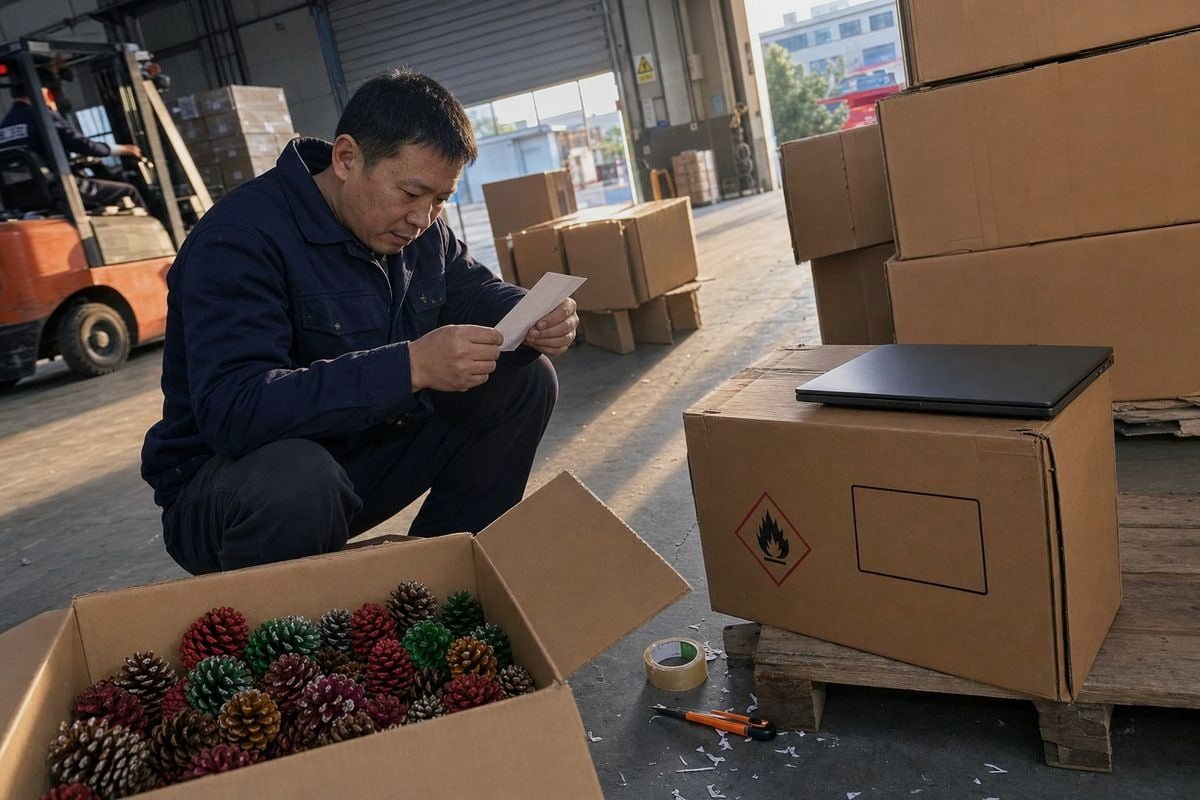
Let me break the process into concrete steps, because this is where I see most small brands and importers stall.
The PCN Workflow, Step by Step
- Confirm the trigger. Annex VIII CLP 2 obligations apply to mixtures classified as hazardous based on health or physical hazards. A mixture classified only for environmental hazards does not itself trigger PCN, but you must still classify and label it correctly.
- Identify the duty holder. The EU importer or the EU-based downstream user normally carries the notification duty. A non-EU factory like ours cannot submit on its own, but we prepare the full formulation dossier so our buyer's submission takes days, not months.
- Compile the dossier. You need the complete composition with concentration ranges, toxicological information, product category (EuPCS), packaging types and sizes, and label elements. Our Sicherheitsdatenblätter (SDB) feed directly into this.
- Generate the UFI. ECHA's free UFI generator 3 creates the 16-character code from your VAT number and a formulation number. One formulation, one UFI — if you reformulate, you need a new one.
- Submit via the ECHA Submission Portal. Consumer products need the full information set. Keep the submission updated whenever the recipe, classification, or packaging changes.
- Print the UFI on the label. It must be clearly visible, legible, and preceded by the acronym "UFI".
A related but separate obligation is the C&L notification for hazardous substances an importer brings into the EU above threshold quantities. Do not confuse the two; PCN covers the mixture for emergency response, while C&L notification covers substance classification in ECHA's inventory. Depending on quantities and the article-versus-mixture analysis, REACH Regulation registration questions can also arise, so a formulation-level legal check is worth the modest cost.
What Warning Labels and Pictograms Are Legally Required on My Packaging?
During a private-label project for a UK fireplace brand last year, our packaging team rebuilt the label artwork three times before the buyer's compliance consultant signed off. That experience taught us to design CLP label elements before the graphic design, never after.
A compliant CLP label must show supplier identity, product identifier, nominal quantity, hazardous components, hazard pictograms, a signal word, hazard statements, precautionary statements, the UFI where required, and any supplemental information — all sized and positioned according to CLP label rules.

Many buyers assume a flame pictogram alone covers them. It does not. CLP labels are a complete information system, and every element is mandatory when the classification calls for it.
Label Elements That Typically Apply
| Kennzeichnungselement | What It Looks Like for Colored Pine Cones |
|---|---|
| Gefahrenpiktogramme | Flame (GHS02) if flammable; exclamation mark (GHS07) for irritants; environment (GHS09) for aquatic toxicity; flame-over-circle (GHS03) if oxidising |
| Signal words | "Danger" or "Warning" — use the more severe one only, never both |
| Gefahrenhinweise | All relevant H-statements from the classification, e.g., H228, H410 |
| Sicherheitshinweise | Usually no more than six P-statements, selected for the real use scenario |
| UFI | Printed clearly, preceded by "UFI:" |
| Supplier details | The EU-market supplier's name, address, and phone number |
Two practical points deserve attention. First, precautionary statements should be chosen, not dumped. CLP guidance says labels should generally carry no more than six unless the severity of the hazards demands more. For a fireplace product, statements about keeping away from children, not burning in enclosed unventilated spaces, and disposal of ashes usually matter most. Second, if multiple hazard classes apply, all relevant hazard statements appear unless one clearly duplicates another.
Our OEM/ODM service builds these label elements into the customer's kraft pouches, jars, and display boxes from the first artwork draft. We also add market-specific extras — barcodes, multilingual text for Germany, France, and the Netherlands, and space for the UFI. Looking ahead, we advise buyers to reserve label real estate for a scannable QR code, since the EU's coming Digitales Produkt-Pass 4 rules will likely push chemical transparency data online.
Can My Manufacturer Provide Test Reports to Support CLP and ECHA Compliance?
A lesson we learned early in our export history: a beautiful sample without a data package is worthless to a serious European buyer. Since then, every color-flame product leaving our lines ships with its compliance file already assembled.
Yes — a capable manufacturer should supply Safety Data Sheets (SDS), full formulation disclosure under NDA, third-party test reports from labs like SGS or Intertek, and label-element drafts. Without these documents, an importer cannot classify, notify, or label the product legally.

Here is the uncomfortable truth about sourcing colored pine cones: many low-price suppliers cannot tell you what is actually on the cone. If your supplier cannot disclose the recipe, you cannot complete chemical mixture classification, you cannot file a PCN, and you carry the legal risk alone as the EU importer.
The Document Package to Demand Before Ordering
| Dokument | Warum Sie es brauchen | Wer stellt es zur Verfügung? |
|---|---|---|
| 16-section SDS | Feeds classification, PCN, and downstream safety communication | Hersteller |
| Full formulation with CAS numbers | Required for Annex VI checks and the ECHA dossier | Manufacturer (under NDA) |
| Prüfberichte von Drittanbietern | Independent proof of composition and safety claims | SGS / Intertek via manufacturer |
| Draft label elements | Speeds up compliant artwork and avoids reprints | Manufacturer + importer's consultant |
| ISO 9001 5 / BSCI certificates | Evidence of consistent production and ethical sourcing | Hersteller |
At our factory in Ningbo, backed by our Liuyang headquarters in China's fireworks cluster, this package is standard. Our ISO 9001 and BSCI certifications cover the production system; our CE-Dokumentation 6 and SGS/Intertek reports cover the product itself. Batch-to-batch quality control 7 matters here too, and not only for burn performance. If the formulation drifts between batches, your PCN and UFI no longer match what is inside the bag — a genuine legal problem. Our strict batch controls exist precisely so that the first sample, the test report, and container number fifty all describe the same product.
One honest caveat: test reports support compliance, but they do not replace the importer's own duties. You still hold the classification decision, the PCN submission, and the label responsibility in your market. What a real factory partner does is make those duties fast, cheap, and defensible.
Schlussfolgerung
Colored pine cones look decorative but regulate like chemicals. Classify the mixture, file the PCN with a UFI, label correctly, and partner with a factory that hands you the full compliance file.
Fußnoten
1. Official ECHA portal explaining Poison Centre Notification duties for hazardous mixtures. ↩︎
2. ECHA legislation page detailing Annex VIII CLP notification obligations for mixtures. ↩︎
3. ECHA's official tool page for generating the required Unique Formula Identifier code. ↩︎
4. Background reference explaining the EU's upcoming Digital Product Passport transparency framework for products. ↩︎
5. Official ISO page explaining the quality management standard cited as manufacturer certification. ↩︎
6. Background on CE marking requirements referenced alongside test reports in the compliance package. ↩︎
7. General reference explaining quality control concepts relevant to consistent formulation batches. ↩︎



 English
  Spanish
  German
  French
  Arabic
  Portuguese
Diskutieren Sie mit