







Getting QC for colored pine cones wrong is expensive Audits BSCI 1. I have seen buyers skip inspection to save $300, then eat thousands in returns when moldy or patchy cones reached their customers.
Balance cost and credibility by matching QC depth to risk: use documented self-inspection for small orders from trusted suppliers, and third-party inspection for bulk orders, new suppliers, or branded retail programs. A hybrid model — self-checks plus periodic independent audits — delivers the best cost-to-credibility ratio.
That is the short answer. Below, I break down the real costs, the trust question, retailer requirements, and a practical decision framework for trial versus bulk orders.
What Does Third-Party Inspection Really Cost Compared to Self-Inspection Over a Full Order Cycle?
A few years back, a German distributor asked me why our color-flame pinecone quotes included a QC line item. When I walked him through the math of one failed container, he stopped asking.
Third-party inspection typically costs $200–400 per inspector day, plus optional lab testing. Self-inspection appears free but carries hidden costs: undetected mold, dye inconsistency, returns, chargebacks, and negative reviews. Over a full order cycle, third-party QC usually costs less than 1–2% of order value.

The right comparison is never "inspection fee versus zero." It is inspection fee versus the expected cost of failure. Cheap QC becomes very expensive the moment a defect is visible to your end customer.
The True Cost Ledger
Here is how the two models compare when you count every cost across an order cycle, not just the invoice line:
| Catégorie de coût | Self-Inspection | Inspection par tierce partie |
|---|---|---|
| Direct fee | Labor and time only | $200–400 per inspector day |
| Lab testing (colorfastness, heavy metals) | Rarely done | Optional add-on |
| Travel to factory | High if overseas | Included in day rate |
| Cost of missed defects | High (sampling bias) | Low (AQL sampling) |
| Dispute documentation | Faible | Strong, court-usable |
| Return/refund exposure | Full exposure | Sharply reduced |
At our Ningbo production site, we run batch-to-batch checks on every run of color-flame pinecones. Even so, we encourage first-time buyers to book independent inspection. Why? Because our internal reports protect our process, but a third-party report protects your purchase order.
Two more cost factors matter. First, timing: inspection agencies charge premium surcharges during peak holiday-décor production months, roughly August through October, so booking early or off-peak saves real money. Second, scale: some freight forwarders now bundle basic QC add-ons at lower rates than dedicated agencies, which works well for small and mid-volume buyers who cannot justify a full inspector day.
For a $20,000 pinecone order, a $350 inspection is 1.75% of value. One rejected retail shipment can wipe out the margin on the entire order. That asymmetry is the whole economic argument.
Can I Trust My Supplier's Self-Inspection Reports Without Independent Verification?
Honest answer from someone who issues those reports: it depends on what backs them up. Our own QC sheets are only as credible as the certifications and processes behind them.
Supplier self-inspection reports are trustworthy only when backed by verifiable systems: ISO 9001 certification, BSCI audits, documented AQL sampling, batch records, and third-party test reports like SGS or Intertek. Without independent verification on at least the first order, a self-report is an unverified claim.

The core problem is structural, not moral. When a factory grades its own output, there is an inherent conflict of interest. Even honest suppliers suffer from optimism bias: their inspectors know what "acceptable" has meant historically, and standards drift when production is rushed.
What Separates a Credible Self-Report From a Worthless One
In our 17+ years exporting fire-themed products to 30+ countries, we have learned that serious buyers do not ask "do you inspect?" They ask "show me how." Here is what to demand:
- A certified quality system. ISO 9001 2 means the factory follows documented procedures, not tribal knowledge. Audits BSCI 3 confirm the facility itself has passed independent scrutiny.
- AQL-based sampling records. Professional inspection uses Acceptable Quality Level sampling 4 to statistically validate a batch. If your supplier cannot tell you their AQL level and sample size, their "inspection" is likely a glance at the top cartons.
- Batch documentation. For colored pine cones, every dye batch should be logged. Natural cones absorb dye unevenly because of porous wood grain, so batch records are the only way to trace a color-consistency complaint back to its source.
- Existing third-party test reports. SGS ou Intertek 5 reports on coating safety, heavy metals, and burn behavior show the supplier has already submitted to outside verification — a strong trust signal.
- Photo and video evidence per shipment. Live video walkthroughs are now a practical middle ground. They retain much of the objectivity of on-site inspection while cutting travel costs, and we host them regularly for buyers in the US and Europe.
The pro-self-inspection argument says pine cones are simple, low-tech products, so outside verification is overkill. I understand the appeal. But simplicity is misleading. Organic products hide their worst defects: mold inside dense scales, moisture that emerges as musty odor weeks later, insect damage deep in the carton. A trained eye at the factory helps. Independent eyes on the first order settle the question.
Which QC Approach Do Retailers Like Home Depot Actually Require for Colored Pine Cones?
Supplying large retail sourcing channels changed how we build QC files. The paperwork demands taught us that big-box buyers care less about your inspection method and more about your evidence trail.
Large retailers like Home Depot require third-party verification, not supplier self-reports alone: independent lab testing for coating safety (lead-free, CPSIA/REACH compliance), factory audits such as BSCI or ISO 9001, and pre-shipment inspection documentation. Self-inspection alone will not pass their vendor compliance programs.
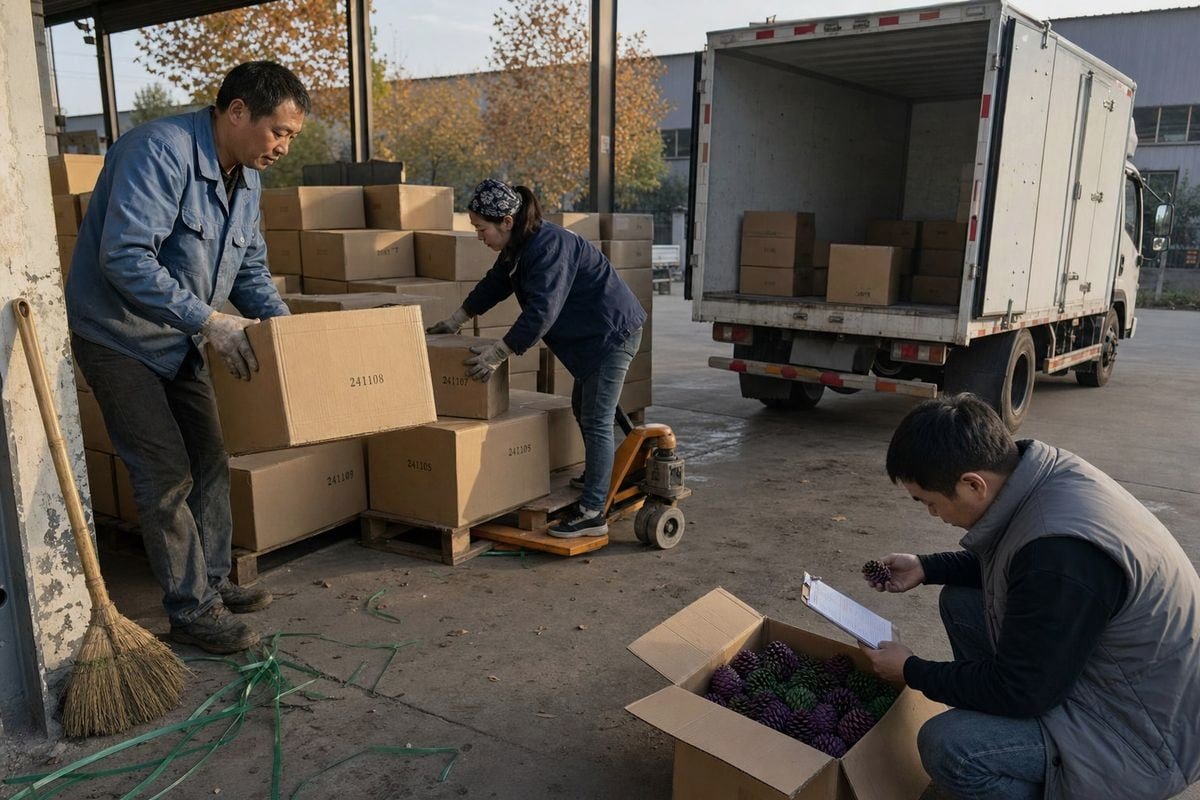
Big-box retail is where credibility stops being optional. A regional craft shop might accept your word. A national chain will not, because their liability exposure runs through every SKU on the shelf.
What Retail Vendor Programs Typically Demand
| Exigence | What It Means for Colored Pine Cones | Self-Inspection Enough? |
|---|---|---|
| Tests de sécurité des produits | Lead-free dyes/paints; CPSIA (US) or REACH (EU) compliance on coatings | No — accredited lab required |
| Audit d'usine | BSCI, ISO 9001, or retailer-specific social/quality audit | No — independent auditor required |
| Inspection avant expédition | AQL sampling of color consistency, count, packaging, defects | Usually third-party or retailer-nominated |
| Conformité de l'étiquetage | Warning labels, barcodes, country of origin | Supplier prepares; retailer verifies |
| Flame-product claims | Burn behavior and ingredient disclosure for fire-use cones | No — test reports required |
The flame-use category raises the bar further. Decorative painted cones face coating-safety scrutiny. But color-flame pinecones — the kind you toss into a fireplace or campfire for rainbow flames — sit closer to consumer fire products. Buyers and retailers rightly ask about formulation transparency and safe-use claims, not just looks. This is exactly why we maintain Marquage CE 6 and SGS/Intertek test reports on our color-flame lines and use eco-friendly formulations with no harmful chemicals. For our retail-channel buyers, these documents are a hard requirement, not a nice-to-have.
There is a practical upside. Once your QC file meets big-box standards, it works everywhere. Marketplace platforms, distributors, and smaller chains all accept the same evidence package. Building it once, properly, is cheaper than rebuilding trust after a compliance failure.
How Do I Decide Between Self-Inspection and Third-Party QC for a Trial Order vs a Bulk Order?
Trial orders create a tempting trap, and I flag it for buyers weekly: skipping QC on the small order because "it's just a test." The trial is precisely when verification matters most.
For trial orders: inspect samples yourself against a written defect checklist, and request batch photos and test reports. For bulk orders: commission third-party AQL inspection, especially with new suppliers or branded resale. Then shift to a hybrid model — self-checks plus periodic independent audits — as trust builds.

The logic is simple. A trial order is where you establish the quality baseline. A bulk order is where deviation from that baseline gets expensive. Each stage needs a different QC weight.
A Practical Decision Matrix
| Scénario | Recommended QC Approach | Pourquoi |
|---|---|---|
| Small trial order, personal or internal use | Self-inspection on receipt | Low failure cost; you see everything |
| Trial order before a bulk commitment | Self-inspection + supplier test reports + video walkthrough | Sets your quality baseline cheaply |
| First bulk order, new supplier | Full third-party pre-shipment inspection | Highest risk point in the relationship |
| Bulk reorder, trusted supplier | Hybrid: self-checks + periodic third-party audits | Cost control with risk protection |
| Branded retail or flame-use product | Third-party inspection + lab testing every program | Compliance and liability demand it |
What Your Self-Inspection Checklist Should Cover
Whether you inspect yourself or brief an agency, define defects in writing first. For colored pine cones, check: even color with no streaking, bleaching, or patchiness; firm scales that do not crumble or snap; no musty odor, mold spots, or white crystalline residue; no pest holes; and matched appearance across the batch. High-grade cones feel light but substantial and resist compression.
One overlooked point: generic inspection checklists often miss dye-specific failures. Because porous wood grain absorbs dye unevenly, serious programs add colorfastness and dye-migration testing 7 under UV and moisture exposure. We build these checks into our own batch QC in Ningbo, so the first sample a buyer approves reliably reflects mass-production quality — that consistency between sample and bulk is, in my experience, the single biggest thing a trial order should verify. Our flexible MOQs exist exactly so buyers can run that micro-batch test before committing.
Conclusion
Match QC depth to risk. Self-inspect small, low-stakes orders; commission third-party checks for bulk, branded, or flame-use pine cones; then run a hybrid model. Credible QC costs little — failure costs everything.
Notes de bas de page
1. Official source describing BSCI social compliance audits mentioned as a trust signal. ↩︎
2. Official ISO page explains the quality management standard referenced for supplier credibility. ↩︎
3. Amfori runs the BSCI social audit program cited as a supplier verification requirement. ↩︎
4. Background on the statistical sampling method used in professional inspection. ↩︎
5. Official site of a major inspection and testing firm named as a trust signal. ↩︎
6. Official EU explanation of the CE marking compliance requirement mentioned for color-flame products. ↩︎
7. Background on colorfastness testing methodology referenced for dye-consistency checks. ↩︎



 English
  Spanish
  German
  French
  Arabic
  Portuguese
Rejoignez la conversation