






Flame colorant for fireplace pine cones raises one big sourcing question. On our production line, we hear it weekly: soaked or sprayed? Choose wrong, and your customers get pale, short-lived flames — and returns.
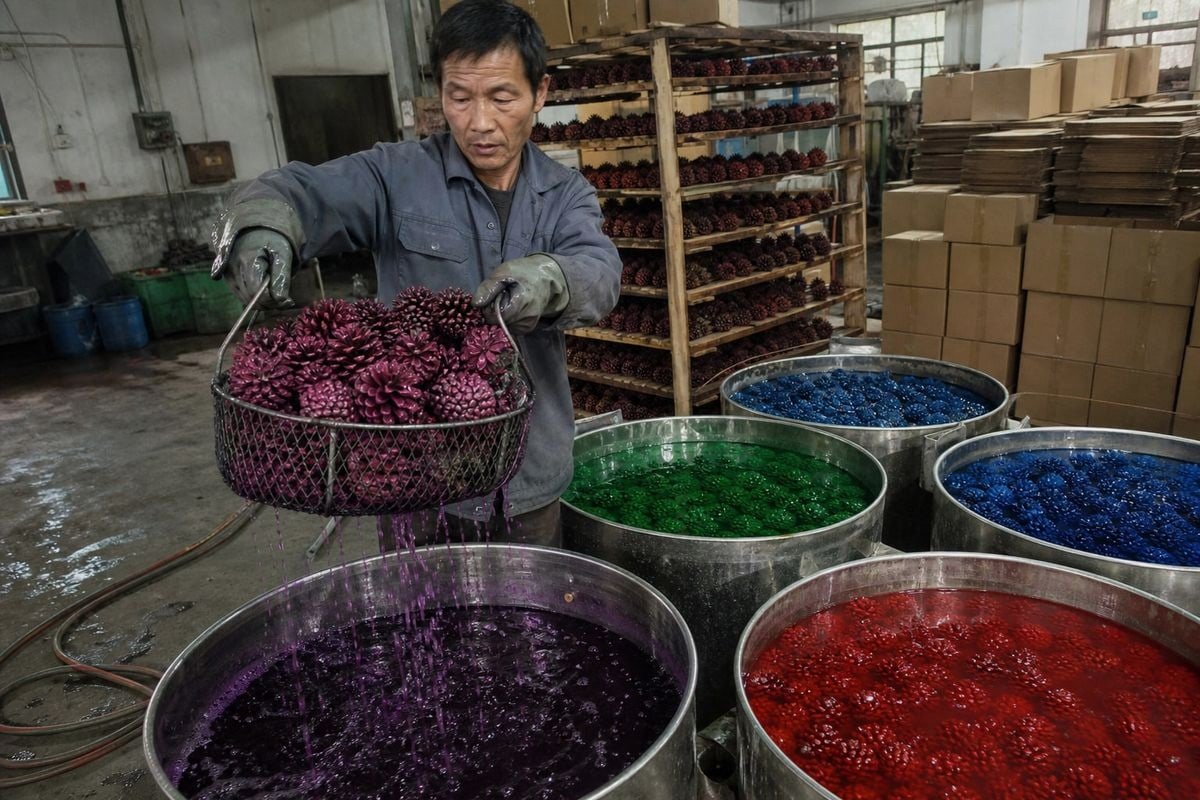
Flame colorant for fireplace pine cones is applied primarily by soaking. Cones are submerged in a dissolved mineral-salt solution, then dried thoroughly, so the colorant penetrates the fibers. Spraying only coats the surface, producing weaker, shorter-lasting flame color, and is used mainly for touch-ups.
That is the short answer. But if you are placing a bulk order, the application method affects compliance, consistency, burn time, and packaging. Let me walk you through each point.
What compliance documents should I request to confirm the coating method is safe for indoor fireplace use?
A German distributor once told me his previous supplier could not produce a single rapport de test 1. His whole container sat in customs. That conversation shaped how we handle documentation at our factory in China.
Request an SGS or Intertek test report on the finished soaked cones, the supplier's ISO 9001 and BSCI certificates, CE marking documentation where applicable, a material safety data sheet for the colorant, and heavy-metal or toxic-emission test results confirming safe indoor combustion.

The application method matters here because soaking and spraying leave different chemical loads on the cone. A soaked cone carries colorant inside its fibers. A sprayed cone carries a surface film that may include propellants or binders 2. Your documents must match the actual process used.
Voici ce que nous remettons aux acheteurs le premier jour, et ce que vous devriez exiger de tout fournisseur :
In our seventeen-plus years exporting to the US, Germany, the UK, and beyond, these are the papers serious buyers always ask for. We keep them ready because, for our clients, compliance is a hard requirement, not a nice-to-have.
| Document | Ce qu'elle prouve | Why the coating method matters |
|---|---|---|
| Rapport de test SGS / Intertek | Finished product is safe when burned | Tests must be done on treated cones, not raw materials |
| MSDS / SDS for the colorant | Chemical composition and handling risks | Reveals if sulfate de cuivre 3 or other restricted salts are used |
| Certificat ISO 9001 | Gestion de la qualité constante | Confirms the soaking process is documented and controlled |
| rapport d'audit BSCI | Site de production éthique et audité | Verifies you are dealing with a real factory |
| CE / market-specific documentation | Meets destination-market rules | Required for many EU retail channels |
| Emission or heavy-metal test | No toxic fumes indoors | Critical for fireplace (indoor) positioning |
Watch for one common gap
Some suppliers show a test report for the raw colorant powder only. That is not enough. Indoor fireplace use means the burned product — the soaked and dried cone — must be tested. Ask directly: was this report issued on the finished cone? If the answer is vague, walk away. Also confirm the colorant formula is eco-friendly and free of harmful compounds like raw copper sulfate, which several DIY guides flag as unsuitable for indoor burning.
Which application method delivers more consistent flame color from batch to batch when I place a bulk order?
There is a trade-off we weigh on every production run: soaking takes more time and drying space, while spraying is faster and cheaper. We chose soaking years ago, and consistency is the reason.
Soaking delivers far more consistent batch-to-batch flame color. Controlled solution concentration, timed immersion, and full drying let the mineral salts saturate every cone evenly. Sprayed coatings vary with nozzle pressure, coverage angle, and drying speed, causing visible color differences between batches.

Consistency in a color-flame product comes down to one thing: how much colorant each cone actually carries, and how evenly it is distributed. Soaking controls both variables. Spraying controls neither very well.
Why soaking is easier to standardize
When we soak, we can measure the solution concentration before every batch. We can time the immersion. We can weigh cones before and after treatment to verify uptake. These are simple, repeatable checkpoints. Our QC team logs them for every run, which is why our first sample reliably reflects mass-production quality — a promise we make to every buyer.
Spraying depends on operator technique. Nozzle distance, spray angle, overlap, and ambient humidity 4 all shift the deposited amount. Two cones sprayed minutes apart can carry noticeably different loads. Across a 40-foot container, that variation becomes customer complaints.
| Consistency factor | Soaking | Spraying |
|---|---|---|
| Colorant dosage control | Measured by solution concentration and soak time | Varies with pressure, distance, and angle |
| Penetration depth | Deep, into internal fibers | Surface film only |
| Batch verification | Weight-gain checks per batch | Difficult to verify objectively |
| Color duration in flame | Consistent through most of the burn | Fades after the first minutes |
| Scalability with stable quality | High, with tanks and drying racks | Low without heavy automation |
The uptake question buyers should ask
Ask your supplier how they verify colorant uptake per batch. If they soak, they should describe concentration checks and weight-gain sampling. If they cannot describe any verification step, the color performance of your order is essentially luck. In our experience shipping to thirty-plus countries, this single question separates real factories from trading companies reselling untested stock.
Can I request product samples showing both soaking and spraying methods before choosing my supplier?
A buyer from the Netherlands once asked us to prove the soaking difference instead of just claiming it. So we sent him both versions to burn side by side. He placed his trial order two weeks later.
Yes, and you should. A credible manufacturer will provide soaked samples — and, on request, sprayed comparison samples — so you can burn-test color intensity, duration, and smoke behavior yourself. Sample evaluation before committing to a bulk order is standard B2B practice, not a special favor.

Samples are your cheapest insurance policy. A few dollars in courier fees can save you a five-figure mistake. But you need to test the samples properly, not just look at them in the box.
How to run a fair burn test
- Establish a small, steady fire first. Colorant cones perform best on an existing low flame, not as kindling.
- Add one soaked cone and one sprayed cone at the same time, spaced apart.
- Time how long each shows visible color. Soaked cones should hold color through most of the burn; sprayed cones typically fade within the first few minutes.
- Note smoke and odor. Excess smoke can indicate incomplete drying or a poor formula.
- Check the ash. Heavy residue or unusual clumping suggests binder-heavy surface coatings.
- Repeat with two or three cones from the same sample bag. Consistency within the sample predicts consistency in mass production.
What sample behavior tells you about the factory
If a supplier hesitates to send samples, or sends samples that differ from later production goods, treat it as a red flag. We support flexible MOQs 5 for trial orders precisely because we know buyers need to validate before scaling. A factory confident in its soaking process will happily let the product speak. Also compare the sample's visual finish — evenly saturated, fully dried cones look uniform, while rushed batches show blotches or damp cores that never ignite cleanly.
Does the coating method affect burn time and packaging requirements for my private label pine cones?
One lesson we learned early: a perfectly soaked cone can still fail in the market if it goes into the wrong bag. Moisture control does not end at the drying rack.
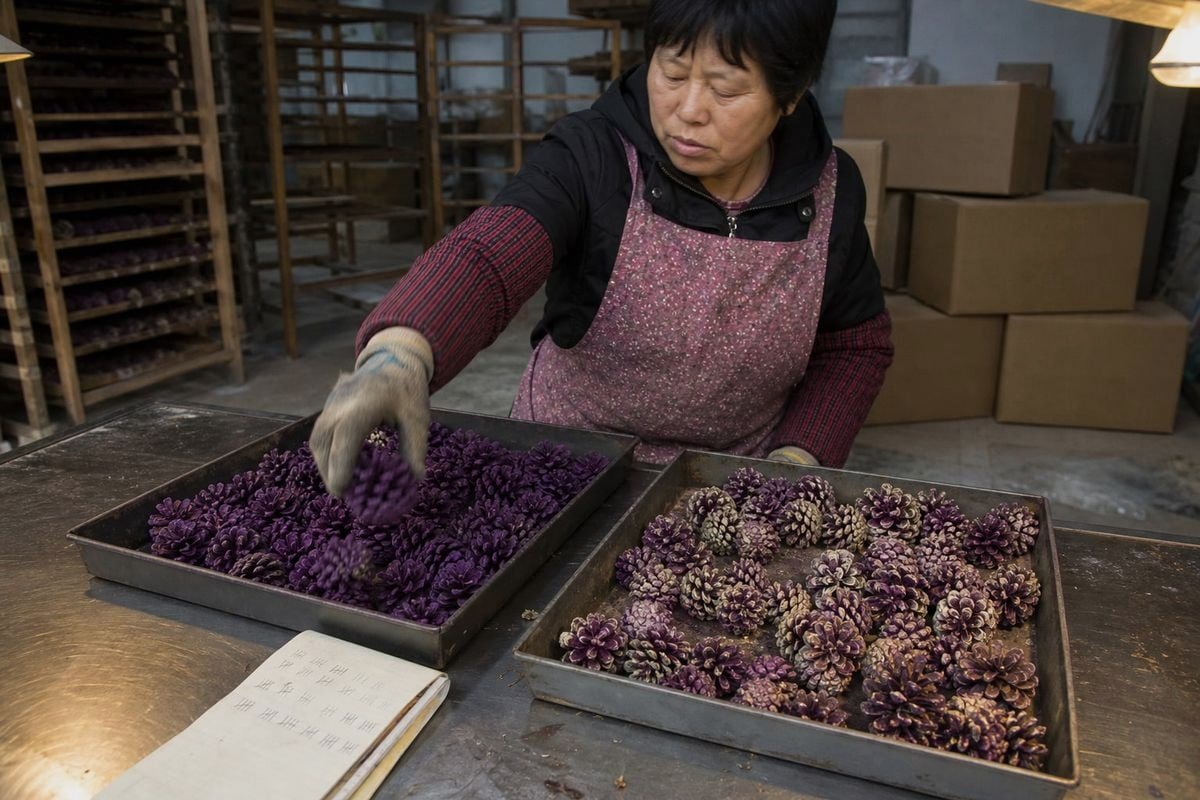
Yes. Soaked cones burn longer with sustained color because colorant is distributed through the whole cone, but they require thorough drying and moisture-barrier packaging. Sprayed cones burn with brief color and may shed surface coating, demanding sealed packaging to prevent flaking and color transfer.
Burn time and packaging are linked to the same root cause: where the colorant sits and how much moisture the cone holds. Let me break both down for private-label planning.
Burn time: what the method changes
A properly soaked and fully dried cone burns steadily, releasing color as each layer of scales ignites. Residual moisture is the enemy — a cone that is not fully dry smokes heavily, lights poorly, and shows weak color. Industrial drying 6, done right, takes days, and commercial-scale operations control it with racks, airflow, and moisture checks rather than guesswork. A sprayed cone ignites like an untreated cone; only its first minutes are colorful, so perceived burn value is lower even if total burn time is similar.
Packaging: what your private label needs
| Exigence | Soaked cones | Sprayed cones |
|---|---|---|
| Barrière contre l'humidité | Essential — cones can reabsorb humidity in transit | Helpful but less critical |
| Resealable pouch or jar | Recommended for multi-use retail packs | Recommandé |
| Abrasion protection | Low concern — colorant is inside the cone | High concern — coating can flake and transfer |
| Warning labels and usage instructions | Required for fire products in most markets | Requis |
| Display-ready options | Kraft pouches, burlap sacks, jars, custom boxes | Same, plus liner to catch flaking |
For our OEM and ODM 7 clients, we customize all of this: pouch material, clear windows, kraft or burlap looks, étiquettes d'avertissement, barcodes, and retail display cartons. We also match packaging to the shipping route — a container crossing the equator to Brazil faces different humidity stress than a truck run into Poland. Because the soaked product is stable inside the cone, image de marque de distributeur stays clean; nothing rubs off onto your printed packaging, which is a real problem with sprayed coatings.
Conclusion
Soaking, not spraying, is how flame colorant for fireplace pine cones is properly applied. Verify test reports, burn samples, and demand documented QC — then order with confidence.
Notes de bas de page
1. ISO defines conformity assessment standards used to verify product safety test reports. ↩︎
2. EPA guidance covers indoor air quality risks from aerosol propellants and surface binders. ↩︎
3. EPA regulates copper sulfate as a chemical, relevant to indoor combustion safety concerns. ↩︎
4. Background on how humidity affects coating de



 English
  Spanish
  German
  French
  Arabic
  Portuguese
Rejoignez la conversation