







Les pommes de pin colorées pour foyer se vendent rapidement au Canada — jusqu’à ce qu’une expédition soit signalée pour absence de texte français. Notre équipe de production a vu des acheteurs perdre des saisons entières à cause d’une seule erreur d’étiquetage.
Pour étiqueter les pommes de pin colorées pour cheminée afin de se conformer à la LCPA du Canada, indiquez l'identité du produit et la quantité nette en anglais et en français, ajoutez le nom et l'adresse canadienne du distributeur, utilisez des unités métriques, respectez les règles de taille minimale des caractères et évitez toute allégation fausse ou trompeuse concernant les performances de la flamme.
C’est la réponse courte. Les détails sont importants, cependant. Ci-dessous, je passe en revue le texte d’avertissement, les rapports de test, les matériaux d’étiquetage et la manière dont un fournisseur doit tout cela.
Quelles déclarations d'avertissement et quels textes bilingues la CPLA exige-t-elle sur mon emballage ?
Un distributeur canadien a un jour envoyé à notre équipe d’emballage une épreuve d’étiquette rejetée. Le problème était simple : la quantité nette apparaissait en anglais seulement. Nous vérifions maintenant le texte français sur tous les fichiers graphiques destinés au Canada.
CPLA exige l'identité du produit et la déclaration de la quantité nette en anglais et en français sur le panneau d'affichage principal, la quantité nette étant en unités métriques. Le nom et l'adresse du revendeur peuvent apparaître dans une seule langue, mais les avertissements de sécurité pour un produit inflammable doivent être entièrement bilingues.

Laissez-moi décomposer cela de la manière dont nous informons nos propres concepteurs graphiques, car la CPLA a une structure claire une fois que vous la voyez en morceaux.
Les trois éléments d’étiquetage obligatoires
Le Loi sur l'emballage et l'étiquetage des produits de consommation 1 couvre les produits de consommation préemballés. Les pommes de pin colorées dans un sachet, un bocal ou un sac de toile sont clairement concernées. Trois éléments sont obligatoires :
| Élément | Ce que cela signifie | Bilingue ? |
|---|---|---|
| Identité du produit | Nom commun ou générique, par exemple, "Pommes de pin colorées pour foyer / Colored Fireplace Pine Cones" | Oui, les deux langues |
| Quantité nette | Quantité ou poids métrique sur le panneau d’affichage principal, en caractères lisibles | Oui, les deux langues |
| Identité du distributeur | Nom et adresse commerciale du fabricant, de l’importateur ou du distributeur | Une langue est acceptable |
Déclarations d’avertissement qui vous protègent réellement
La CPLA elle-même ne dicte pas la formulation de sécurité incendie. Mais elle interdit les représentations fausses ou trompeuses, et un produit à usage de feu sans restrictions d’utilisation peut induire en erreur par omission. D’après notre expérience d’expédition de pommes de pin à flamme colorée au Canada et en Europe, la posture la plus sûre comprend des avertissements tels que :
- Utiliser uniquement dans les foyers à bois, les braseros ou les feux de camp.
- Ne pas utiliser dans les foyers au gaz ou les ensembles de bûches au gaz.
- Ne pas utiliser sur les feux de cuisson ou les grils de barbecue.
- Tenir hors de portée des enfants ; ne pas laisser les feux sans surveillance.
- Utiliser dans un endroit bien ventilé.
Chaque déclaration doit apparaître en anglais et en français. Les règles de taille de caractères s’adaptent à la surface du panneau, de sorte qu’un petit sachet nécessite toujours un texte lisible. Nous maintenons des blocs d’avertissement bilingues d’un poids visuel égal dans les deux langues — les acheteurs de détail canadiens vérifient cela de près, et cela témoigne du professionnalisme sur l’étagère.
Quels rapports de test et certifications dois-je demander à mon fabricant avant d'importer ?
Les questions de documentation se posent dans presque tous les premiers appels que nous recevons des importateurs canadiens. Les acheteurs qui demandent des documents à l’avance franchissent les douanes plus rapidement et négocient les listes de vente au détail avec beaucoup moins de friction.
Demandez les rapports de test SGS ou Intertek couvrant les émissions de combustion et la teneur en métaux lourds, les certificats ISO 9001 et BSCI du fournisseur, une fiche de composition des matériaux pour les revêtements et les colorants, et les enregistrements de qualité au niveau des lots. Ces documents étayent les affirmations de véracité de la CPLA et les évaluations des risques de la CCPSA.
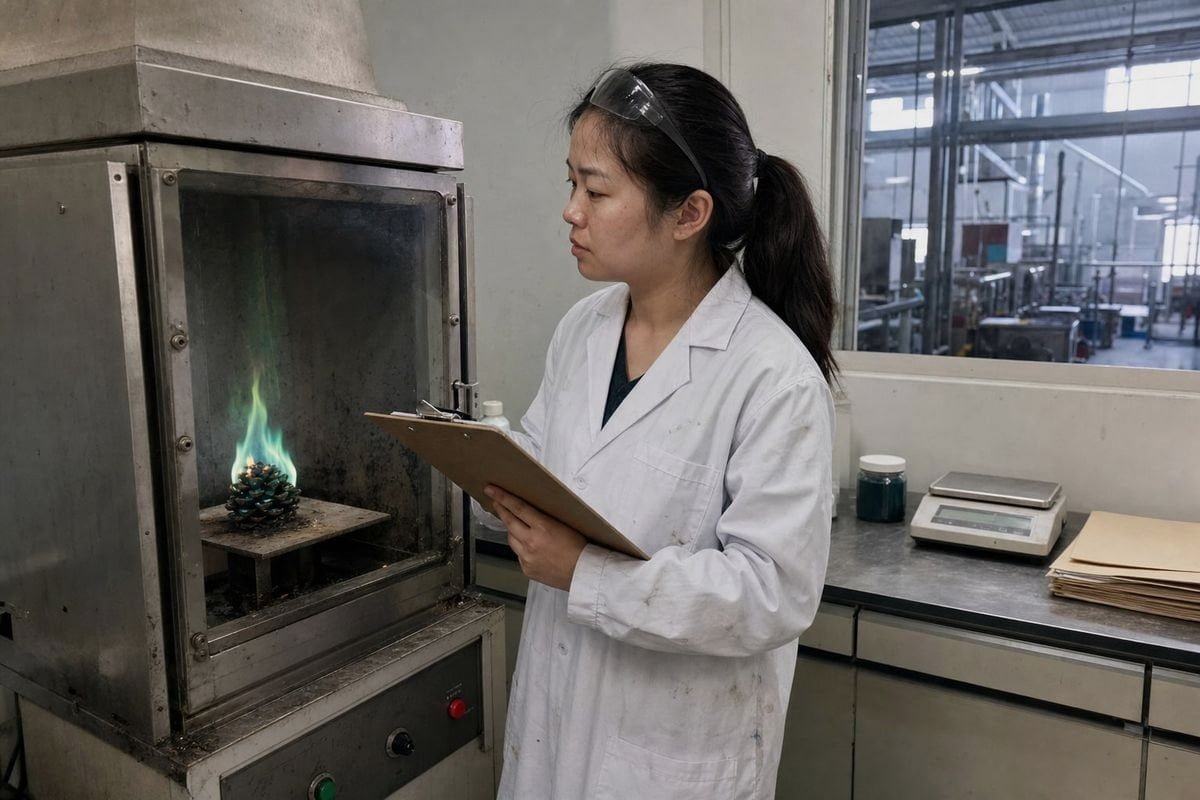
Voici la tension à laquelle tout importateur est confronté. Certains vendeurs traitent les pommes de pin colorées comme une simple nouveauté et sautent les tests. La vision plus stricte — et celle que l’application canadienne soutient — est qu’un produit conçu pour être brûlé a besoin de preuves derrière ses affirmations de sécurité. Je suis fermement du côté de la vision plus stricte, et pas seulement parce que notre usine détient les certificats. La CPLA interdit les représentations trompeuses. Si votre emballage indique "sûr" ou "non toxique" et que vous ne détenez aucun rapport de test, cette affirmation est exposée. Pire encore, les produits à flamme colorée fabriqués avec certains sels métalliques peuvent déclencher Loi canadienne sur la sécurité des produits de consommation 2 un examen des sous-produits de combustion toxiques, qui s’ajoute aux règles d’emballage de la CPLA.
La liste de contrôle des documents que nous préparons pour les commandes destinées au Canada
| Document | Objectif | Qui l'utilise |
|---|---|---|
| Rapport de test de combustion SGS/Intertek 3 | Vérifie les émissions et les affirmations de sécurité des colorants | Demandes de Santé Canada, acheteurs de détail |
| Fiche de composition des matériaux | Confirme l’absence de métaux lourds restreints dans les revêtements | Votre réviseur de conformité, ACFC 4 en cas de signalement |
| Certificat ISO 9001 5 | Démontre que l’usine dispose de systèmes de qualité réels | Intégration des fournisseurs de détail |
| rapport d'audit BSCI 6 | Confirme la production éthique | Grands canaux d'approvisionnement de détail |
| Dossiers de contrôle qualité des lots | Prouve que la production de masse correspond à l’échantillon approuvé | Votre propre assurance qualité |
Après plus de 17 ans à gérer des lignes de production, je peux vous dire que l’écart entre l’échantillon et la production de masse est là où les importateurs se font avoir. Un fournisseur peut tester un échantillon parfait, puis expédier des lots non testés. Demandez comment la cohérence d’un lot à l’autre est contrôlée avant de signer, pas après qu’un conteneur arrive à Vancouver.
Comment choisir les bons matériaux d'étiquetage et le bon emplacement pour les produits de cheminée ?
Les pochettes en kraft, les sacs en toile et les bocaux en plastique se comportent tous différemment sur nos lignes d’emballage. Une étiquette qui semble parfaite sur une épreuve plate peut se rider, se décolorer ou se décoller une fois qu’elle rencontre un emballage réel.
Choisissez un matériau d'étiquette résistant à l'humidité et aux bavures, adapté à la surface de votre emballage — papier couché pour les pochettes en papier kraft, étiquettes synthétiques laminées pour les bocaux, étiquettes volantes imprimées pour les sacs en toile de jute. Placez les informations bilingues obligatoires sur le panneau d'affichage principal et les avertissements là où ils sont visibles avant utilisation.
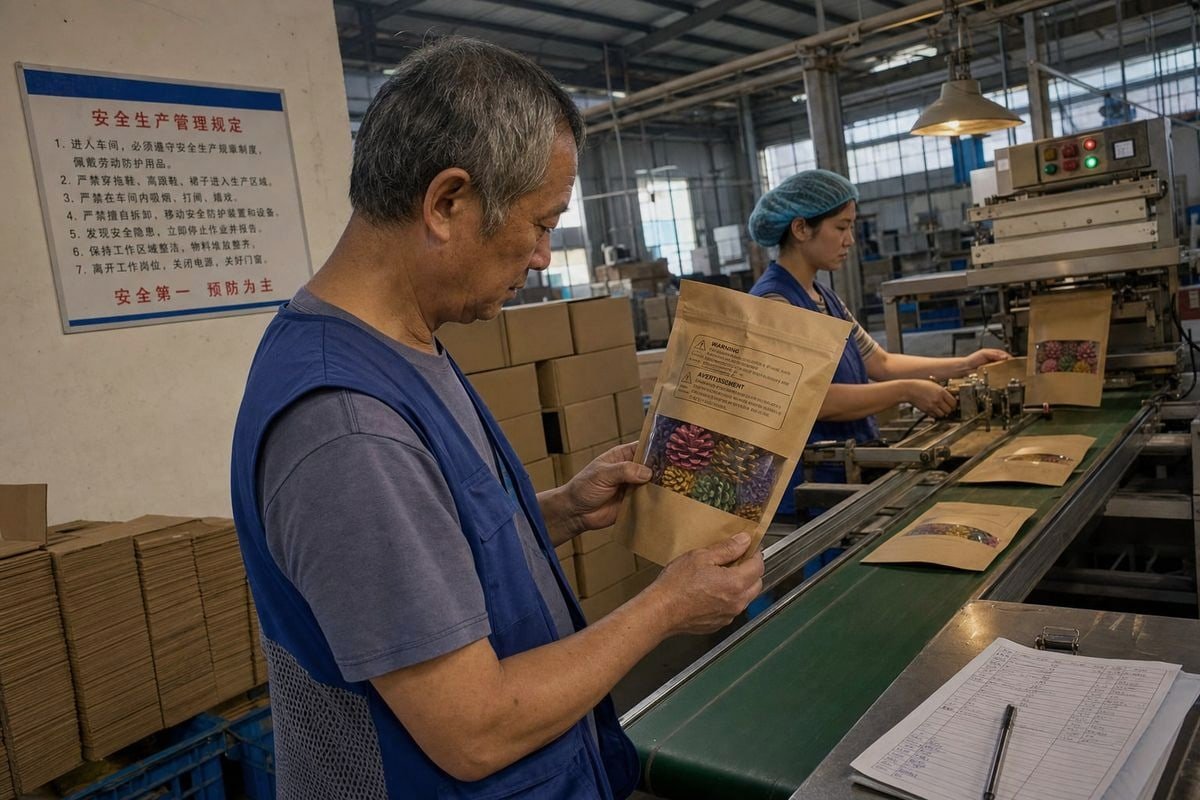
Le placement est d'abord une question juridique, puis une question de conception. Le panneau d'affichage principal est la surface que le consommateur voit lors de l'achat. C'est là que l'identité du produit et la quantité nette doivent figurer, dans les deux langues, à la taille de caractères requise. Les avertissements peuvent figurer sur le panneau arrière, mais ils doivent être trouvés avant que le consommateur n'utilise le produit. Enterrer un avertissement " feux de bois uniquement " sous une languette dépliante va à l'encontre de l'objectif et invite à un argument de falsification d'étiquetage.
Correspondance du matériau d'étiquette au format d'emballage
Nous produisons des pommes de pin colorées en trois formats principaux, et chacun exige une approche d'étiquetage différente :
| Format d'emballage | Solution d'étiquette recommandée | Notes de placement |
|---|---|---|
| Pochette en kraft autoportante | Impression directe ou étiquette en papier couché | Le panneau avant porte l'identité et la quantité ; le panneau arrière porte les avertissements bilingues |
| Sac à cordon en toile de jute | Étiquette volante imprimée plus étiquette cousue ou adhésive | L'étiquette volante seule peut se détacher ; ajoutez une étiquette fixe pour les éléments obligatoires |
| Bocal en plastique | Étiquette d'emballage synthétique laminée | L'emballage offre de la place pour un texte bilingue complet sans réduire la taille des caractères |
Règles de conception pratiques que nous appliquons
Premièrement, ne laissez jamais le texte français être plus petit que l'anglais. Une proéminence égale vous protège et est plus esthétique. Deuxièmement, testez les étiquettes contre l'humidité et la manipulation — les pommes de pin se trouvent souvent près des foyers et dans les garages. Troisièmement, gardez l'imagerie d'effet de flamme honnête. Si votre produit produit des flammes bleues et vertes, ne montrez pas un arc-en-ciel que la chimie ne peut pas produire. Les images marketing et les avertissements sur l'emballage doivent raconter la même histoire, car la CPLA juge la représentation globale, pas seulement les petits caractères. Quatrièmement, laissez un espace libre pour les codes-barres et les codes de lot, que les détaillants exigent pour la traçabilité.
Mon fournisseur peut-il gérer un étiquetage bilingue personnalisé et une documentation de conformité pour le Canada ?
Une marque canadienne d'articles de plein air nous a récemment demandé de développer une gamme de pommes de pin sous marque privée avec un emballage entièrement bilingue dès le premier jour. Ce projet m'a appris à quel point les lancements se déroulent plus facilement lorsque la conformité commence à l'usine, pas à la frontière.
Un fournisseur compétent doit fournir la conception d'étiquettes bilingues OEM/ODM, des illustrations prêtes à imprimer en anglais et en français, des déclarations d'avertissement, des codes-barres et des codages de lots, ainsi que des rapports et certificats SGS ou Intertek sur demande. Si une usine ne peut pas fournir cela, le fardeau de la conformité vous incombe entièrement.
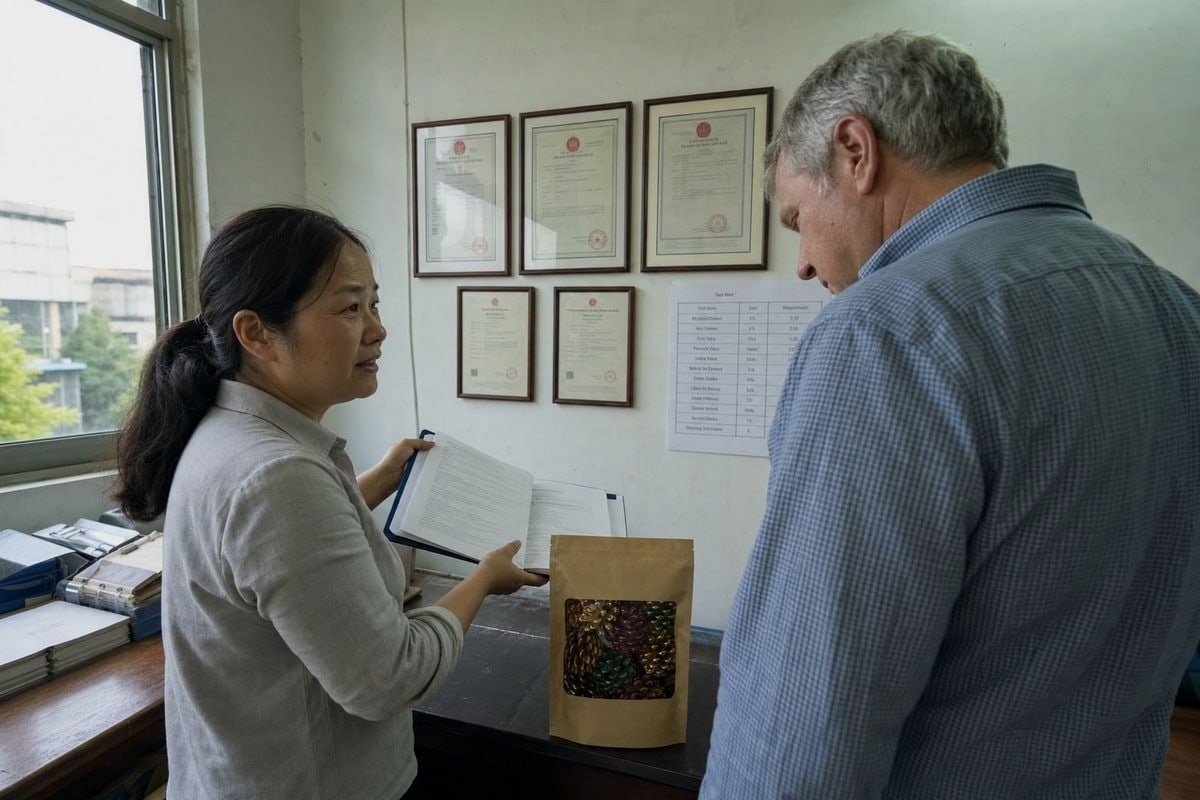
Certains acheteurs résistent ici. Ils soutiennent que l'étiquetage est le travail de l'importateur, donc n'importe quelle usine bon marché fera l'affaire, et le travail de conformité se fait après l'arrivée. Je comprends la logique, mais elle échoue sur le coût et le calendrier. Ré-étiqueter un conteneur de pochettes dans un entrepôt canadien coûte plus cher par unité que d'imprimer un emballage correct à la source. Cela retarde également votre saison de vente — et pour un produit de cheminée, manquer octobre signifie manquer l'année.
À quoi ressemble un flux de travail de conformité tout-en-un
Dans notre usine de production de Ningbo, les commandes sous marque privée destinées au Canada suivent une séquence définie :
- Nous confirmons le format de l'emballage, les dimensions des panneaux et les éléments bilingues requis avec l'acheteur.
- Notre équipe élabore des illustrations avec l'identité du produit anglais-français, la quantité nette métrique, le bloc du distributeur et les déclarations d'avertissement.
- Le réviseur juridique ou de conformité de l'acheteur approuve la preuve avant toute impression.
- Nous joignons les rapports de test SGS/Intertek pertinents et les fiches de matériaux au dossier de commande.
- Le contrôle qualité par lot vérifie la qualité d'impression de l'étiquette, l'adhérence et le codage par lot avant le chargement du conteneur.
Parce que nos produits à flamme colorée sont fabriqués à partir de matériaux écologiques sans produits chimiques nocifs, la documentation de test soutient les déclarations de sécurité sur l'étiquette plutôt que de les contredire. Cet alignement est important. Une étiquette est un ensemble de déclarations, et chaque déclaration a besoin de quelque chose derrière elle. Lorsque vous évaluez un fournisseur, demandez à voir une ancienne étiquette bilingue qu'il a produite, demandez quel laboratoire a testé leur produit, et demandez comment ils gèrent une enquête de Santé Canada ou du Bureau de la concurrence. Les réponses révèlent si vous avez un partenaire ou juste un fournisseur. Des MOQ flexibles pour un essai permettent également de valider l'étiquette sur le marché avant de s'engager sur un volume saisonnier complet.
Conclusion
La conformité CPLA pour les pommes de pin colorées pour cheminée se résume à l'identité et à la quantité bilingues, à un bloc du distributeur, à des déclarations honnêtes, à de vrais rapports de test et à un fournisseur qui intègre la conformité dès le départ.
Notes de bas de page
Loi canadienne officielle établissant les règles d'étiquetage bilingue discutées tout au long de l'article. ↩︎
Loi fédérale régissant l'examen des sous-produits de combustion toxiques mentionnée pour les produits à flamme colorée. ↩︎
Site officiel de l'organisme de test vérifiant les affirmations relatives aux émissions et à la sécurité des colorants référencées pour la conformité. ↩︎
Site officiel de l'Agence des services frontaliers du Canada pertinent pour les saisies de marchandises discutées dans l'article. ↩︎
Page officielle de l'ISO expliquant la certification de gestion de la qualité requise des fabricants. ↩︎
Contexte sur l'audit de production éthique amfori BSCI référencé pour la documentation des fournisseurs. ↩︎
Site officiel de l'agence d'application de la CPLA au Canada nommée dans l'article. ↩︎
 English
  Spanish
  German
  French
  Arabic
  Portuguese
Rejoignez la conversation