







Fireplace colored pine cones confuse many buyers on our production line: are they a real product or a promo item? Choose wrong, and margin or conversion suffers.
Fireplace colored pine cones should usually be a standalone SKU because they have search demand, gift appeal, and refill potential. The highest-performing strategy is hybrid: sell them year-round, then deploy them as a free gift or bundle enhancer during seasonal promotions.
The answer depends on your margins, your audience, and your season. Let me walk you through the decision framework we share with our distributor clients.
How do I decide whether colored pine cones deserve their own SKU or work better as a bundled gift?
A German fireplace distributor once asked our team this exact question during a sampling call. We ran his numbers together, and the answer surprised him: it was both.
Decide based on three signals: search demand, unit economics, and repeat purchase behavior. If shoppers actively search for color changing flames and reorder refills, list a standalone SKU. If the item mainly sweetens larger purchases, use it as a gift with purchase.

The core business tradeoff is simple. As a standalone SKU, colored pine cones earn direct gross margin, capture search traffic, and open the door to refill sales. As a free gift, they lift cart conversion, raise valeur de commande moyenne 1 through threshold offers, and reduce friction for first-time buyers. Neither role is wrong. The question is which job you need done right now.
Here is how the two options compare on the factors that matter most to importers and distributors:
| Facteur | Standalone SKU | Free Gift (GWP) |
|---|---|---|
| Direct margin | Yes, full retail markup | None, absorbed as marketing cost |
| Conversion impact | Neutral | High, lifts checkout rates |
| Average order value | Moderate, via upselling strategy | High, via spend thresholds |
| Inventory risk | Higher, needs sell-through plan | Lower, clears stock fast |
| Repeat purchases | Strong with refill packs | Weak, one-time delight |
| Education burden | Full packaging copy required | Insert card required |
Read the demand signals first
Retail listings across the US and Europe already frame these cones as giftable, easy-to-use novelty items. They also come in refill bags and larger formats, which tells you shoppers buy them more than once. That is a replenishment pattern, not a giveaway pattern. In our experience exporting to 30+ countries, products with refill demand almost always justify their own listing.
Then check your catalog structure
If you carry hero products like fire pits or hearth accessories, a low-cost cone pack works beautifully as a conversion lever. If colored cones would be one of your stronger novelty items, giving them away for free leaves money on the table. Run a simple test: list them for one quarter, track attach rate and standalone sales, then decide. rationalisation des SKUs 2 should follow data, not instinct.
What certification and compliance requirements should I check before selling colored pine cones as a standalone product?
Compliance is where trial orders live or die. Our factory holds ISO 9001 3, BSCI, CE, and SGS/Intertek certifications precisely because our US and EU buyers cannot clear customs or pass retailer audits without them.
Before selling colored pine cones as a standalone SKU, verify supplier certifications such as ISO 9001, BSCI, and CE, request SGS or Intertek test reports, confirm eco-friendly chemical formulations, and ensure packaging carries correct warning labels, usage instructions, and barcodes for your market.

A standalone SKU carries more compliance weight than a free gift, because it stands on a retail shelf under your brand name. Retail sourcing channels like Home Depot-type chains will audit your chaîne d'approvisionnement 4 before your product ever reaches a planogram. Distributors in Germany, France, and the Netherlands face similar scrutiny. So do Amazon sellers, whose listings can be suspended over missing documentation.
Here is the compliance checklist we walk new buyers through:
| Exigence | Pourquoi c'est important | Ce qu'il faut demander |
|---|---|---|
| ISO 9001 | Confirms consistent quality management | Current certificate copy |
| Audit BSCI | Requis par de nombreux détaillants de l'UE et des États-Unis | Audit report and score |
| Marquage CE 5 | Needed for EU market access | Déclaration de conformité |
| rapports SGS/Intertek | Proves chemical safety of colorants | Batch-level test reports |
| Étiquettes d'avertissement | Reduces liability and misuse | Approbation de la maquette d'étiquette |
Safety copy is part of compliance
These cones are made for wood-burning fireplaces, fire pits, and campfires. They are not for gas fireplaces, where ash and residue can clog components. They are also not fire starters; they go into an established fire. Your packaging must say all of this clearly. When we develop private-label packaging for clients, we build these warnings into the artwork from day one, in the buyer's local language.
Chemical formulation matters more than price
DIY tutorials compete with commercial cones, and their color results vary wildly. A lab-tested, eco-friendly formulation with no harmful chemicals is your differentiation. It justifies a premium price and protects your reviews. Ask any supplier for batch-to-batch consistency evidence, not just a one-time sample report. In our 17+ years, we have seen buyers burned by suppliers whose first sample never matched the mass-production run.
Can I get flexible MOQs to test colored pine cones as a trial SKU before committing to bulk orders?
One lesson we learned early: rigid MOQs kill good partnerships before they start. A UK camping brand once walked away from a competitor over a container-load minimum, then tested with us at a fraction of that volume and now reorders every season.
Yes, reputable factories offer flexible MOQs for trial orders of colored pine cones. Start with a small mixed batch to validate sell-through, test both standalone and bundle positioning, then scale to bulk pricing once your data confirms demand and reorder rates.

A trial SKU strategy makes special sense for this product because demand is sharply seasonal. Sales peak in Q4 and taper through late winter. If you over-order in your first year, you carry dead stock until next autumn. If you under-order, you miss the holiday window entirely. Flexible MOQs let you thread that needle without betting the budget. Good inventory management here is not optional; it is the difference between a profitable seasonal line and a warehouse problem.
Here is the phased approach we recommend to first-time buyers:
- Order a trial batch. Request a low-MOQ mixed order, ideally with two or three packaging formats, such as burlap sacks and resealable kraft pouches.
- Run a split test. List half as a standalone SKU and use half as a gift with purchase 6 on your hero products for four to six weeks.
- Measure three numbers. Track standalone conversion rate, GWP attach rate, and any lift in average order value.
- Review and reorder. If standalone sales clear your margin threshold, scale that SKU. If GWP lifted your core products more, negotiate bulk pricing for promotional stock.
- Plan Q4 early. Confirm your bulk order by late summer so production and ocean freight land before hearth season.
What a fair trial arrangement looks like
Expect trial pricing slightly above bulk rates; that is normal and fair. What should not change is quality. Because we run complete production lines with strict batch-to-batch quality control, the trial sample a buyer receives reflects exactly what mass production delivers. Ask your supplier to commit to that in writing. Also confirm lead times for the reorder, because a successful trial is worthless if the follow-up shipment misses the season.
How do private-label packaging and branding options change if I position colored pine cones as a free gift instead of a retail item?
Packaging is where the two strategies truly diverge. When our design team builds artwork for a client marque de distributeur 7, the very first question we ask is: shelf, shipment insert, or both?
Retail SKUs need shelf-ready packaging: branded pouches, barcodes, full compliance labels, and display boxes. Free gifts need lighter, cost-efficient packaging: simple branded sacks, insert cards with usage instructions, and QR codes that drive customers back to your digital content and email list.
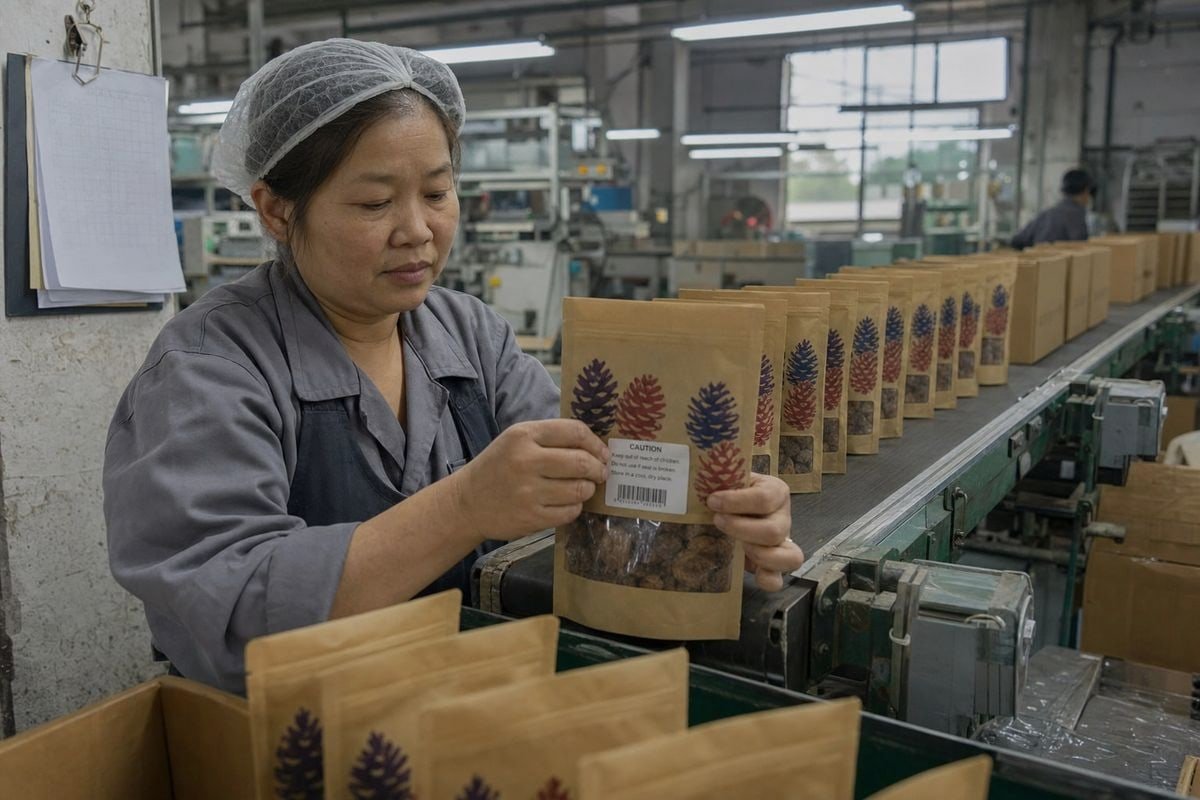
A standalone retail item must sell itself in three seconds on a shelf or a product page. That means premium formats like rustic burlap drawstring sacks with printed logos, or stand-up resealable kraft pouches with a clear window showing the natural cones inside. It needs a barcode, warning labels, batch codes, and often a countertop display box. This packaging protects perceived value, which lets you hold a premium price against DIY alternatives.
A free gift flips the logic. The packaging cost comes straight out of your marketing budget, so it must stay lean while still feeling generous. A simple branded cotton or burlap pouch delivers the artisanal feel without the retail overhead. The essential piece is an insert card: it explains wood-fire-only use, warns against gas fireplaces, and reinforces your brand.
| Élément d'emballage | Standalone SKU | Free gift |
|---|---|---|
| Formater | Display-ready pouch or jar | Simple branded sack |
| Code-barres | Requis | Pas nécessaire |
| Étiquettes d'avertissement | Full printed compliance copy | Insert card |
| Unit packaging cost | Higher, supports retail price | Minimal, protects promo budget |
| Branding goal | Shelf conversion | Customer loyalty incentives |
The hybrid packaging play
Smart brands order both formats in one production run. The retail pouch serves the standalone SKU year-round. The lighter gift sack powers seasonal promotional items, holiday product bundling like fireplace starter kits, and end-of-season stock clearing. Because our OEM/ODM line customizes size, burn time, packaging, and labeling in a single order, this dual approach rarely adds meaningful cost.
Turn the gift into data
One angle many buyers miss: a QR code on the gift packaging can link to a digital fireplace guide or a discount code. That converts a low-cost physical item into first-party customer data and repeat traffic. A free gift that captures an email address is not a cost. It is acquisition.
Conclusion
Fireplace colored pine cones deserve a standalone SKU, backed by compliance documents and shelf-ready packaging, while doubling as a seasonal gift with purchase. Test small, measure, then scale with a certified factory partner.
Notes de bas de page
1. Wikipedia background on this core ecommerce metric used to compare SKU strategies. ↩︎
2. Wikipedia explains SKU concept underlying the article's rationalization decision framework. ↩︎
3. Official ISO source explaining the quality management standard referenced repeatedly in compliance section. ↩︎
4. WTO trade resource relevant to distributor sourcing and compliance across international markets. ↩︎
5. Official EU source clarifying CE marking requirements mentioned for EU market access. ↩︎
6. Forbes business source relevant to gift-with-purchase promotional strategy discussed in article. ↩︎



 English
  Spanish
  German
  French
  Arabic
  Portuguese
Rejoignez la conversation