







On our production line, I see wood fire starters shipped as loose consumables every week BSCI documentation 1. Sold alone, they earn thin margins, get lost on shelves, and rarely build brand loyalty for retailers.
Bundle wood fire starters with kindling, matches, and one or two useful accessories to raise average order value, guarantee the customer's first fire succeeds, and turn a cheap consumable into a complete, giftable, shelf-ready kit that commands a premium retail price.
That is the short answer. Now let me walk you through exactly what to pair, how to package it, what it costs, and how to stay compliant.
What Kindling and Accessories Should I Pair With Wood Fire Starters for a Best-Selling Bundle?
A German fireplace distributor once asked our team to build a trial kit around our wax-dipped wood rolls. That project taught me which pairings actually move at retail and which just add cost.
Pair wood fire starters with dry kindling sticks or fatwood sticks, safety matches, and one accessory such as a storage bag, gloves, or jute twine. The best-selling bundles mirror the fire-starting sequence: starter, kindling, then logs, so the customer succeeds on the first match.
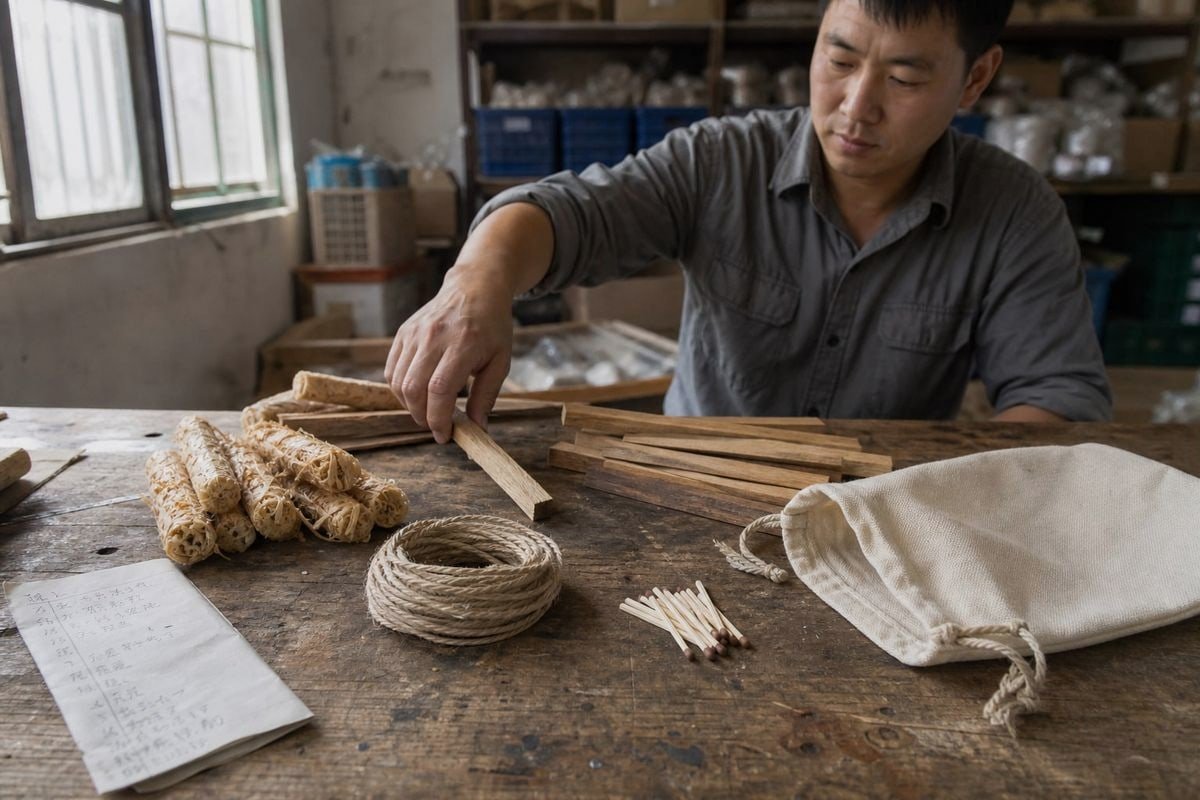
The logic behind a high-converting bundle is simple. Customers do not buy fire starters. They buy a fire that lights on the first try. Every component should serve that job. Anything else is dead weight that inflates your landed cost.
Build the Bundle in Layers
Start with the ignition core. Our wax-dipped wood rolls burn long enough to ignite kindling without lighter fluid, which is the whole point of a starter. Then add the flame bridge: small, dry kindling pieces or Fatwood-Stöcke 2 that catch quickly and transfer heat to larger fuel. Finally, add one or two accessories that improve convenience or safety perception.
Here is how I rank common components when buyers ask us to spec a kit:
| Komponente | Role in the Kit | Kostenaufwand | Retail Value Perception |
|---|---|---|---|
| Wax-dipped wood fire starters | Core ignition | Niedrig | High — the hero product |
| Kindling or fatwood sticks | Flammenübertragung | Niedrig–mittel | High — makes it "complete" |
| Safety matches | Removes friction for beginners | Sehr niedrig | Mittel |
| Jute twine or kraft wrap | Bundling + burnable | Sehr niedrig | Medium — rustic appeal |
| Storage bag or box | Feuchtigkeitsschutz | Mittel | High — feels premium |
| Gloves | Safety and handling | Mittel | Medium — safety signal |
| Color-flame packets or pinecones | Experience upgrade | Niedrig–mittel | Very high — unique gifting hook |
Differentiate by Use Case, Not by Volume
One generic kit rarely works across channels. In our OEM projects, we usually spec three to five clearly separated formats:
- Starter Bundle: fire starters + small kindling pack + matches — for hardware stores and convenience channels.
- Home Hearth Bundle: larger kindling pack + starters + storage bag — for fireplace retailers, merchandised near fireplace tool sets and log carriers.
- Camping Bundle: compact starters + tinder + waterproof pouch — for outdoor brands and shops selling gear for outdoor fire pits.
- Gift Bundle: starters + kindling + color-flame pinecones + twine and tags — perfect as seasonal gift sets in Q4.
- Refill Bundle: multiple starters + extra kindling — designed for repeat purchase and subscription-style replenishment.
Adding one of our color-flame products to a gift kit is a small cost with an outsized effect. It gives the shopper a reason to pick your bundle over the plain sack of kindling next to it.
How Can I Customize Bundle Packaging and Branding to Stand Out on Retail Shelves?
During a packaging revision for a UK client last year, we tested three box designs side by side under store lighting. The winner was not the prettiest one — it was the clearest one.
Use a printed retail box or windowed kraft packaging with your private label, a bold product name, a three-step usage graphic, burn-time claims, and moisture protection. Add a carry handle and a QR code linking to a fire-building tutorial for extra shelf appeal.
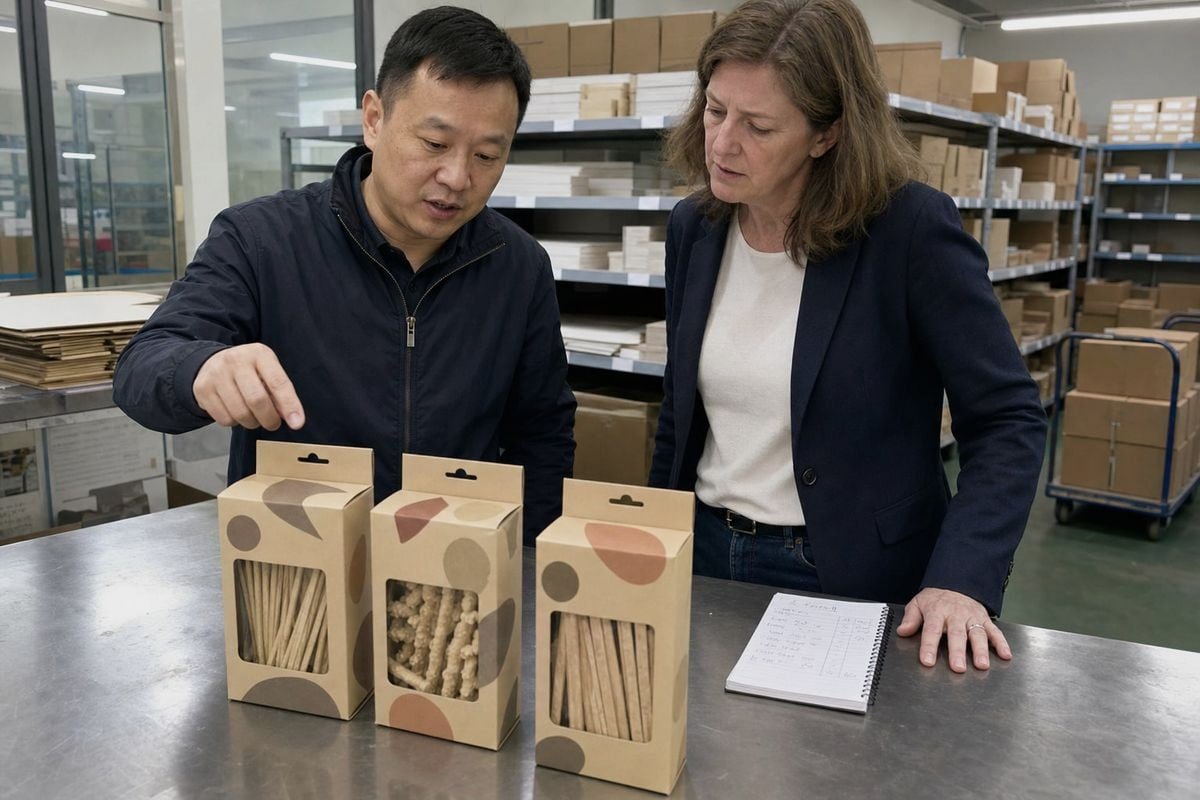
Packaging does two jobs at once. It protects a moisture-sensitive product, and it sells the product in about three seconds of shelf attention. Our one-stop OEM/ODM service exists because most importers underestimate the second job.
What We Customize for Private-Label Buyers
On our lines in Ningbo, we routinely adapt box size, burn time, insert trays, warning labels, barcodes, and display packaging for each market. In practice, these are the elements that matter most:
| Verpackungselement | Warum es wichtig ist | Our Recommendation |
|---|---|---|
| Outer box or bag | First impression, stackability | Rigid printed box or kraft bag with window |
| Feuchtigkeitsbarriere | Wet kindling kills repeat sales | Inner liner or shrink wrap |
| Carry handle | Grab-and-go convenience | Die-cut or rope handle for hearth bundles |
| Usage graphic | Reduces returns and bad reviews | Three-step sequence: place, stack, light |
| Trust labeling | Builds reliability | Wood species, composition, burn time |
| QR-Code | Post-purchase engagement | Link to tutorial and safety guide |
| POP display | Sell-through at checkout | Counter display units near the register |
Design for the Shelf, Not the Studio
A few practical rules I share with every buyer. First, make the flame benefit visible — either through a window showing the natural wood-wool texture, or a strong flame graphic like the black-and-orange retail boxes we produce. Second, state the count and burn time on the front panel. Shoppers compare value fast. Third, design Point-of-Purchase-Displays 3 alongside the primary pack, because a great box hidden on a bottom shelf sells nothing. Fourth, plan seasonal variants early. Seasonal gift sets need artwork approved by summer to hit Q4 shelves in the US and Europe.
Also remember the tension between looks and function. A tightly wrapped, dense-looking bundle photographs beautifully, but fire needs airflow. We design packs that look neat on the outside while keeping the starters and kindling loose enough to light well. Production bundling and combustion bundling are two different problems, and your packaging must solve both.
What MOQ and Pricing Should I Expect When Sourcing Pre-Packed Fire Starter Bundles From a Manufacturer?
Trial orders are a topic I discuss with buyers almost daily. A Canadian importer recently wanted 500 kits to test a new bundle concept before committing to a container. That conversation is worth unpacking.
Expect MOQs of roughly 500–1,000 units for trial orders of custom-branded fire starter bundles, and 3,000–10,000 units for full production pricing. Unit costs typically run 30–60% below assembling components yourself, with better margins as kit complexity and volume increase.

Pricing a pre-packed bundle is different from pricing loose fire starters. You are buying assembly labor, packaging tooling, and quality control on the whole kit, not just on each component. In our experience exporting to 30+ countries over 17 years, the buyers who succeed treat the kit as one SKU with one landed cost, then work backward to retail price.
How Bundle Costs Break Down
Here is a simplified view of where the money goes in a typical hearth bundle, based on our factory costing conversations:
| Kostentreiber | Share of Ex-Works Cost | How to Optimize |
|---|---|---|
| Fire starters and kindling | 40–55% | Standardize sizes across your kit range |
| Ja – pro SKU und Packungsgröße | 20–30% | Shared box tooling across bundle variants |
| Assembly and QC labor | 10–15% | Simple insert design, fewer loose parts |
| Accessories (matches, twine, bag) | 10–20% | Choose high-perceived-value, low-cost items |
Pricing the Bundle at Retail
The commercial logic of bundling is a form of cross-selling built into a single SKU. A shopper who came for starters leaves with kindling and matches too, which lifts average order value without any sales effort at the register. Two upselling techniques work well here. First, anchor with a "best value" bundle so the mid-tier option looks reasonable. Second, sell bundles alongside individual refills, so customers trade up on the first visit and replenish afterward. Some of our distributors also segment by session length — an evening kit versus an all-night hearth kit — which helps shoppers self-select and reduces price comparison.
One honest caution from our side: chasing the lowest quoted price on bundles usually means inconsistent kindling moisture, thin wax coating, or flimsy boxes. We position ourselves as a long-term manufacturing partner, and our batch-to-batch quality control exists precisely so your tenth container lights as well as your first sample.
How Do I Make Sure My Bundled Fire Starter Kits Meet Safety and Compliance Standards for My Market?
Compliance is where I have seen more deals die than anywhere else. Years ago, a promising order stalled for months because the buyer's previous supplier could not produce a valid test report — a mistake we make sure our clients never repeat.
Require ISO 9001 and BSCI factory certification, CE marking where applicable, and third-party SGS or Intertek test reports for the finished kit. Verify warning labels, composition declarations, and flammable-goods shipping classification match your destination market's rules before production starts.

Fire products sit in a higher-scrutiny category than most consumer goods. Retail chains in the US, Germany, UK, and France will ask for documentation before they even review your samples. For our buyers, compliance is a hard requirement, not a nice-to-have, and we built our factory processes around that reality.
A Practical Compliance Checklist
I recommend buyers work through these steps in order, before signing a purchase order:
- Audit the factory, not just the product. Fordern Sie ISO 9001 4 and BSCI documentation. A trading company reselling from unknown workshops cannot guarantee batch consistency.
- Get third-party test reports for the finished bundle. SGS oder Intertek 5 reports should cover the actual kit configuration, because adding matches or accessories can change the classification.
- Confirm composition transparency. Our wax-dipped wood rolls use eco-friendly materials with no harmful chemicals, and we state composition on the pack — for example, wood fiber and paraffin ratios 6 — because trust-based labeling drives reorders.
- Check warning labels and language requirements. The EU, UK, and North America each have specific expectations for warning text, symbols, and language versions. We print market-specific labels as part of our OEM service.
- Verify shipping and storage classification. Wax-based starters generally ship as standard goods, but bundled lighters or certain accessories can trigger dangerous-goods rules 7. Confirm this before booking freight.
- Test moisture control across the supply chain. Kiln-dried firewood standards 8 are a useful benchmark for kindling: dry, consistent, and ready to light. Ask your supplier how they control moisture at packing and in transit.
The lesson I keep repeating to new buyers is simple. Compliance paperwork done upfront costs days. Compliance failures discovered at the port cost the whole season.
Schlussfolgerung
Loose fire starters earn thin margins and no loyalty. Bundle them with kindling, smart packaging, fair MOQs, and full compliance, and you sell a first successful fire — and a lasting brand.
Fußnoten
1. BSCI is amfori's social compliance program referenced for factory certification requirements. ↩︎
2. Wikipedia explains fatwood, the resin-rich kindling material referenced for the flame-transfer stage. ↩︎
3. Point-of-sale concepts explain why in-store display placement drives retail sell-through. ↩︎
4. ISO 9001 is the internationally recognized quality management certification referenced for factory audits. ↩︎
5. SGS is a leading third-party inspection and testing firm named for compliance verification. ↩︎
6. PubChem provides authoritative chemical composition data on paraffin used in fire starters. ↩︎
7. IATA governs dangerous goods shipping classification relevant to bundled fire-starter accessories. ↩︎
8. Wood drying processes explain the moisture benchmark used for kindling quality control. ↩︎



 English
  Spanish
  German
  French
  Arabic
  Portuguese
Diskutieren Sie mit