







Magic fire powder selection looks simple until an order goes wrong معادن ثقيلة 1. On our production line in Ningbo, I have seen buyers confuse retail sachets with event-grade supply — and pay for it. One mismatch can mean rejected shipments, unhappy venues, or shelf returns. The fix is knowing exactly what each buyer type actually optimizes for.
Consumers choose magic fire powder for convenience: small pre-measured sachets, easy ignition, and safe novelty color effects. Event planners choose for control: bulk quantities, verified certifications, consistent burn times, venue compliance, and custom branding. The same product category serves two very different purchasing logics.
Let me break this down section by section. I will cover certifications, burn time and color intensity, packaging and labeling, and finally MOQs and private-label options. Each area splits cleanly between the two buyer segments.
What Certifications Should I Verify When Sourcing Magic Fire Powder for Large-Scale Events vs Retail Packs?
A German distributor once asked me for our full test-report file before he even asked about price. That conversation taught me how compliance-driven serious buyers really are, especially in the EU.
For retail packs, verify SGS or Intertek safety test reports, CE marking, and non-toxic material documentation. For large-scale events, additionally confirm factory-level ISO 9001 and BSCI audits, batch test consistency, and documentation that satisfies venue fire codes and liability insurers.

يشتعل سائل الإشعال في أقل من ثانية ولكنه ينطفئ في 30 إلى 60 ثانية، وهو وقت قصير جدًا لإشعال نار خشبية - التحمل هو معيار الأداء الحقيقي. certification question is the first filter any professional buyer should apply. In our 17+ years exporting color-flame products to 30+ countries, I have never seen a large retail chain or a serious event supplier accept goods without paperwork. But the paperwork differs by channel, and that difference matters.
Retail-Focused Certifications
Retail buyers need proof the product is safe in the hands of an untrained person. That means third-party lab reports from bodies like SGS أو Intertek 2 covering material safety and heavy metals. It also means علامة CE 3 for the EU and clear non-toxic ingredient documentation for markets like the US. A big-box chain such as a Home Depot–type retailer will also often audit the factory itself. This is why we hold BSCI social compliance certification 4 alongside our product certificates. Retailers check the factory, not just the sachet.
Event-Focused Documentation
Event planners carry legal responsibility for crowds. Their suppliers must provide more than a safety report. They usually need صحائف بيانات السلامة 5, batch-level test consistency, and documents a venue's fire marshal 6 or insurer will accept. An outdoor festival in Poland and an indoor LARP event in France may apply different fire rules, so the paperwork must be complete enough to adapt.
| الشهادة / المستند | Retail Consumers | Event Planners |
|---|---|---|
| تقرير اختبار SGS / Intertek | مطلوب | مطلوب |
| علامة CE (الاتحاد الأوروبي) | مطلوب | مطلوب |
| شهادة مصنع ISO 9001 | Preferred | Effectively required |
| تدقيق اجتماعي BSCI | Required by major chains | Preferred |
| صحيفة بيانات السلامة (SDS) | Rarely requested | Standard requirement |
| Batch consistency records | Rarely requested | مطلوب غالبًا |
| Venue/insurer-ready documentation | Not needed | حرج |
My advice is simple: ask your supplier for the full document set before sampling. A real factory can produce it within a day. A trading company usually cannot.
How Do I Choose the Right Burn Time and Color Intensity for Different Buyer Segments?
Burn time is the spec we adjust most often during OEM projects. When we calibrate a formula for a camping brand versus a festival trader, the granule blend and dosage change noticeably.
Consumers respond best to 20–60 minute burn times per sachet with vivid multi-color transitions for campfires and fireplaces. Event planners need longer, repeatable burns, saturated single or sequenced colors that photograph well, and dosage that scales predictably across large fire features.
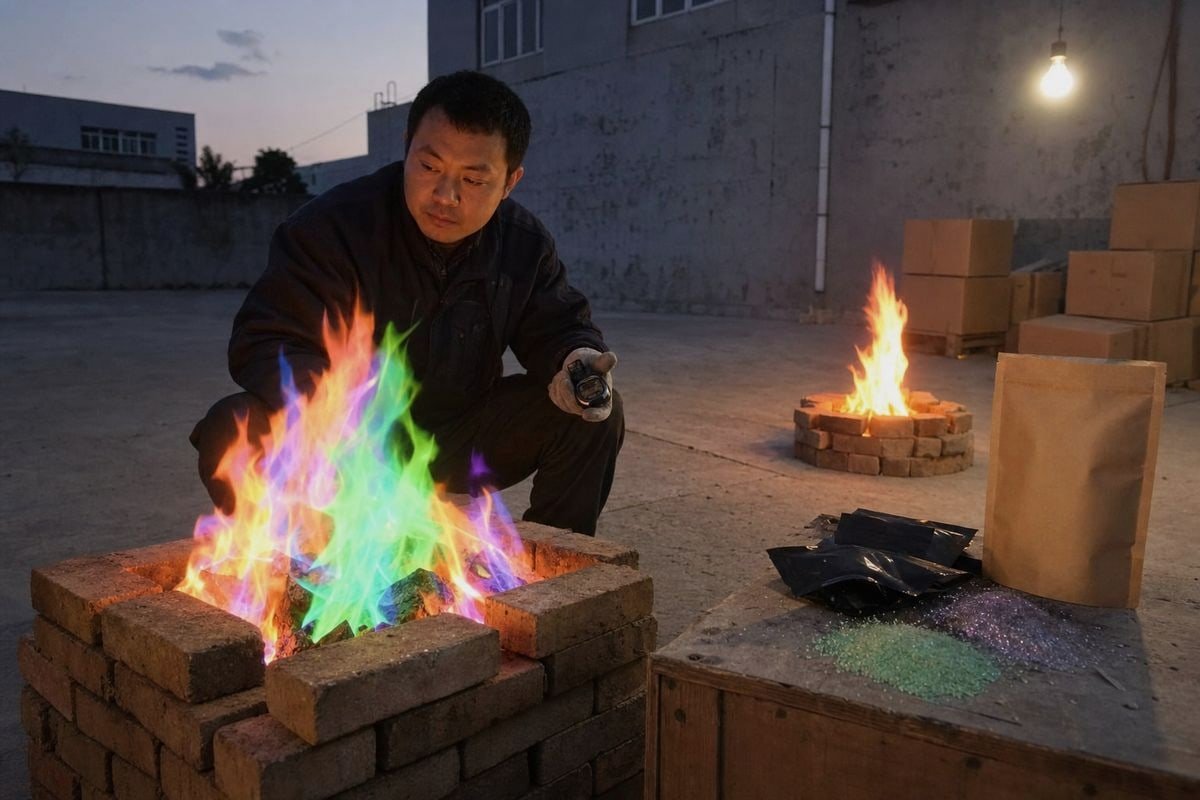
Burn time and color intensity are where product engineering meets buyer psychology. I weigh this trade-off on nearly every custom order: more colorant per sachet means richer color, but it also raises cost per unit and changes how the granules feed into the flame. Getting the balance right depends on who lights the fire.
What Consumers Actually Want
A family at a campsite wants one thing: toss the packet in, see rainbow flames, enjoy the moment. Our standard Magic Fire packets are tuned for that. A 25-gram sachet giving roughly half an hour of shifting blues, greens, and purples hits the sweet spot of wow-factor and price. Consumers rarely compare technical specs. They compare the photo on the package with what they see in the fire pit. So batch-to-batch color consistency is the real quality metric — if the flame looks weaker than the box art, you get returns.
What Event Planners Actually Need
Event buyers think in totals, not moments. A wedding coordinator wants a fire bowl glowing in the couple's theme color for a full two-hour reception. A LARP or medieval event organizer wants "magic" flames that stay dramatic across multiple braziers all evening. That changes the selection criteria:
- Duration per dose — longer, steadier burns reduce re-dosing during the event.
- Color saturation — deep, camera-friendly hues matter for photography and video.
- Repeatability — every brazier must match; a mixed batch ruins the visual.
- Scalability — dosage guidance must translate from one fire pit to twenty.
We often develop single-color or sequenced-color formulas for these buyers, while retail lines stay multi-color. Ask your supplier whether they can tune burn time and hue independently. If they cannot, they are reselling a fixed formula.
What Packaging and Labeling Requirements Differ Between Retail Consumers and Event Planning Clients?
Packaging is where I have watched the most trial orders succeed or fail. Our factory produces the same core granules in heat-sealed foil sachets, kraft stand-up pouches, plastic jars, and flip-top display boxes — and each format serves a different buyer.
Retail magic fire powder needs eye-catching single-use sachets, display-ready boxes, barcodes, and consumer warning labels in local languages. Event planning clients need bulk moisture-proof resealable packaging, dosage instructions per fire type, SDS access, and often neutral or brand-matched labeling.

Packaging is not just a container decision. It is a compliance decision, a logistics decision, and a marketing decision rolled into one. Let me separate the two channels clearly.
Retail Packaging Priorities
Retail lives or dies on the shelf. Our consumer sachets use glossy foil with vivid flame graphics because impulse buyers decide in seconds at a campground store or checkout aisle. But the exciting front hides serious requirements on the back: warning text in the destination market's language, usage instructions, barcodes, and importer details. For our EU shipments, we prepare multilingual warning labels; for the US, we follow consumer product labeling norms 7. Display matters too — flip-top counter boxes holding individual sachets turn one SKU into a self-merchandising unit. Moisture-proof heat sealing is non-negotiable, because a damp sachet means a dull flame and a bad review.
Event Client Packaging Priorities
Event buyers care less about shelf appeal and more about handling. They want resealable kraft or foil stand-up pouches in larger weights, clear dosage tables for fire pits versus fire bowls versus braziers, and stable storage performance across a seasonal calendar. Some also need guest-facing safety information they can post at the venue, since attendees with respiratory sensitivities may ask what is in the fire.
| عنصر التعبئة | Retail Channel | Event Channel |
|---|---|---|
| تنسيق | Single-use foil sachets, display boxes | Bulk resealable pouches or jars |
| Front design | High-impact graphics, brand colors | Functional, often neutral or client-branded |
| الملصقات | Consumer warnings, barcodes, local language | Dosage tables, SDS reference, handling notes |
| حماية الرطوبة | Heat-sealed sachets | Resealable barrier pouches |
| Extras | Shelf-ready display packaging | Staggered delivery packing, storage guidance |
When you brief a supplier, specify the channel first. The packaging spec writes itself from there.
Should I Offer Different MOQs or Private-Label Options for Consumer Retailers vs Event Planners?
A UK importer once started with a small trial order of our sachets before scaling to full container loads. That staged approach shaped how we structure MOQs today — and I recommend every buyer negotiate the same way.
Yes. Offer lower trial MOQs with full private-label support for consumer retailers testing shelf performance, and flexible bulk MOQs with custom colors, dosing, and staggered deliveries for event planners. One rigid MOQ structure loses one of the two segments.

MOQ and private-label strategy is where a real factory separates itself from a trading company. Because we run our own complete production lines, we can adjust batch sizes, packaging runs, and branding without renegotiating with a hidden third party. Here is how I advise buyers to structure their sourcing.
MOQ Logic for Consumer Retailers
Retail buyers face shelf risk. A new colored-flame SKU might fly in Germany and stall in Brazil. So the smart structure is a modest trial MOQ — enough units to test two or three retail doors — followed by scaled pricing tiers as reorders come in. Private labeling should be available from the first order, not gated behind huge volumes. In our OEM projects, that means custom sachet artwork, brand-matched display boxes, barcodes, and localized warning labels even at trial quantities. If a supplier demands a full container before printing your brand, your market test becomes far too expensive.
MOQ Logic for Event Planners and Prop Buyers
Event-side buyers — festival gift traders, LARP prop suppliers, event-supply distributors — order in pulses tied to seasons. Their needs differ:
- Bulk-weight MOQs rather than unit-count MOQs, since they dose by fire feature.
- Custom color development for theme or corporate-color matching.
- Staggered delivery schedules aligned to event calendars, so stock stays fresh.
- Shelf-life assurance through proper barrier packaging and storage guidance.
A Practical Sourcing Checklist
Before committing, confirm these six points with any supplier: legal status of the product class in your market, intended fire type, certification file completeness, packaging channel fit, sample-to-mass-production consistency, and reorder lead times. We built our business on the third and fifth points — our first sample reliably reflects bulk quality because the same lines and QC process produce both. That consistency is worth more than a marginal price discount over a multi-year relationship.
خاتمة
Consumers buy magic fire powder for easy novelty; event planners buy for compliant, repeatable production. Match certifications, burn specs, packaging, and MOQs to the right segment — and partner with a factory that supports both.
ملاحظات ختامية
1. Background on toxic elements screened in third-party material safety reports. ↩︎
2. Leading third-party labs referenced for verifying product safety test reports. ↩︎
3. Explains the EU conformity marking required for consumer product compliance. ↩︎
4. Official body administering BSCI social compliance audits referenced by the factory. ↩︎
5. Official guidance on required hazard communication documentation for suppliers. ↩︎
6. Explains the role of fire marshals in approving venue safety documentation. ↩︎
7. US agency setting official labeling requirements referenced for consumer shipments. ↩︎



 English
  Spanish
  German
  French
  Arabic
  Portuguese
انضم إلى المحادثة