






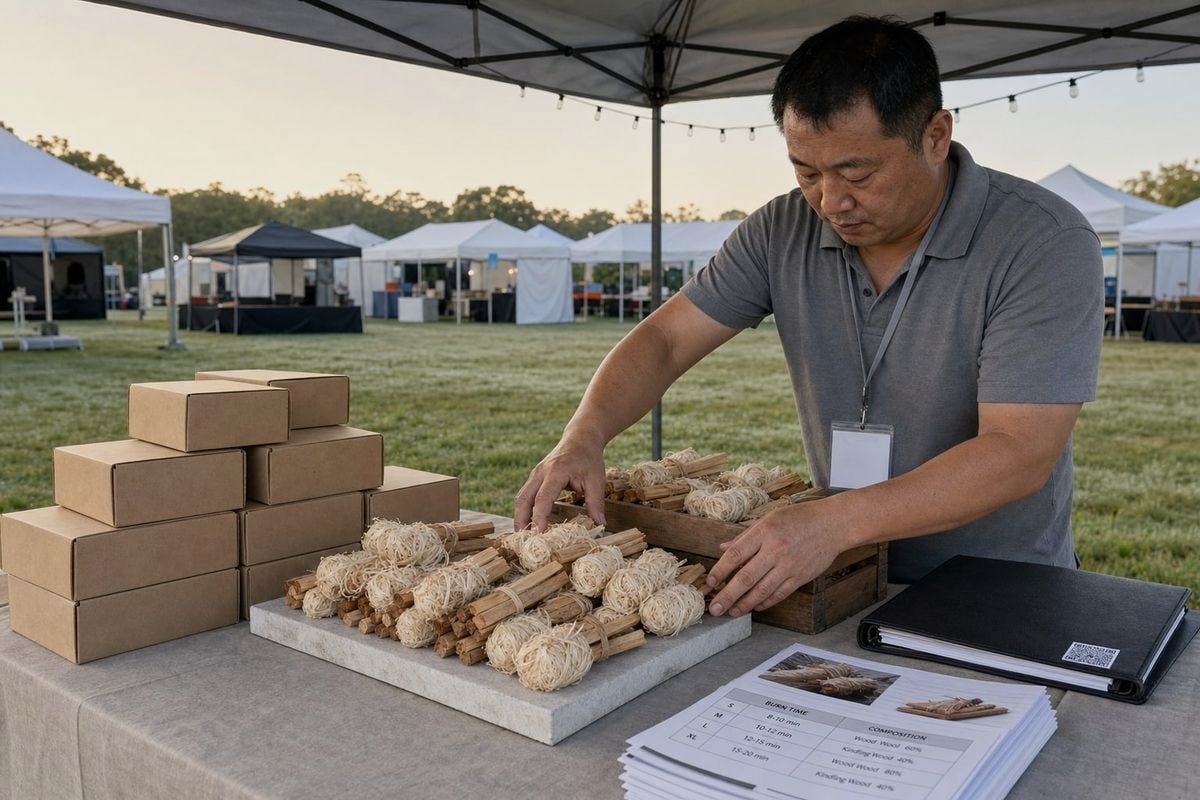
Preparing materials for wood fire starters at outdoor trade shows nearly ruined our first exhibition. Our factory shipped great samples, but buyers asked for documents we never packed.
For wood fire starters at outdoor trade shows, prepare four material groups: certifications and lab test reports, uniform product samples from multiple batches, private-label packaging mockups showing OEM/ODM capability, and printed catalogs with spec sheets covering burn time, composition, MOQ, and lead times.
I learned this the hard way. In this guide, I will walk through each material group, one by one, so your booth is ready for serious buyers.
What Certifications and Test Reports Should I Bring to Prove My Wood Fire Starters Are Compliant?
A German distributor once stopped at our booth, picked up a wax-dipped wood roll, and asked one question before anything else: can I see your SGS report? Our answer decided the meeting.
Bring printed and digital copies of ISO 9001, BSCI, CE documentation, and third-party lab reports from SGS or Intertek. Include burn-behavior tests, composition statements, and safety data sheets. European and US buyers treat fire safety compliance as a hard entry requirement, not a bonus.
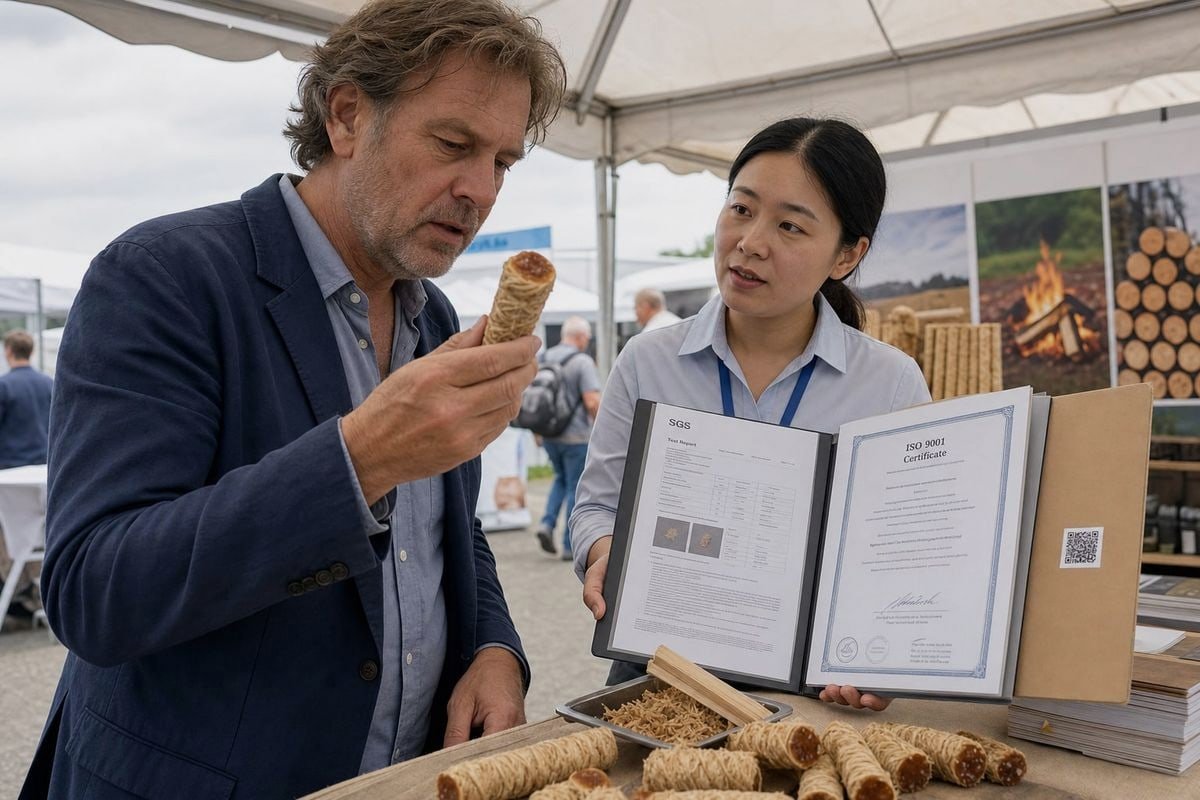
Compliance paperwork is the first filter serious buyers apply. In our 17+ years exporting fire-starting goods to 30+ countries, I have never closed a deal with a large retail chain without documents on the table first. So I now treat the compliance folder as booth equipment, just like the banner and the samples.
The Core Compliance Folder
Here is what we physically carry to every show, in a labeled binder plus a QR code linking to digital copies:
| Document | What It Proves | Who Asks for It |
|---|---|---|
| ISO 9001 1 certificate | Quality management system | Almost every B2B buyer |
| BSCI audit report | Ethical and social compliance | European retail chains |
| CE documentation 2 | EU market conformity | EU importers and distributors |
| SGS / Intertek test reports | Third-party verified safety and composition | US and EU buyers alike |
| Composition statement | Wood fiber and paraffin wax 3 ratios, no harmful chemicals | Eco-focused brands |
| SDS (safety data sheet) | Handling, storage, and shipping safety | Logistics and compliance teams |
Why Printed Copies Still Matter
Trade show Wi-Fi fails. Buyers skim paper faster than a phone screen. A printed report also signals confidence. When a purchasing manager can flip through a real Intertek report 4 at your table, the conversation shifts from "are you legitimate" to "what are your lead times."
Also remember the venue itself. Trade show safety regulations often restrict live flames indoors, so your documents may be the only proof of burn performance you can show. Some organizers require an ABC-rated extinguisher 5 and flame-retardant booth fabrics if you demo anything hot. Check the exhibitor manual early. If live product demonstration kits are banned, a short looping video of a burn test, timestamped and tied to your lab report, works nearly as well.
How Can I Showcase Consistent Quality Across Batches When Displaying Samples at a Trade Show?
There is a trade-off we weigh before every show: hand-pick flawless samples, or show honest production reality? We choose reality, because a first sample that does not match mass production destroys trust faster than any defect.
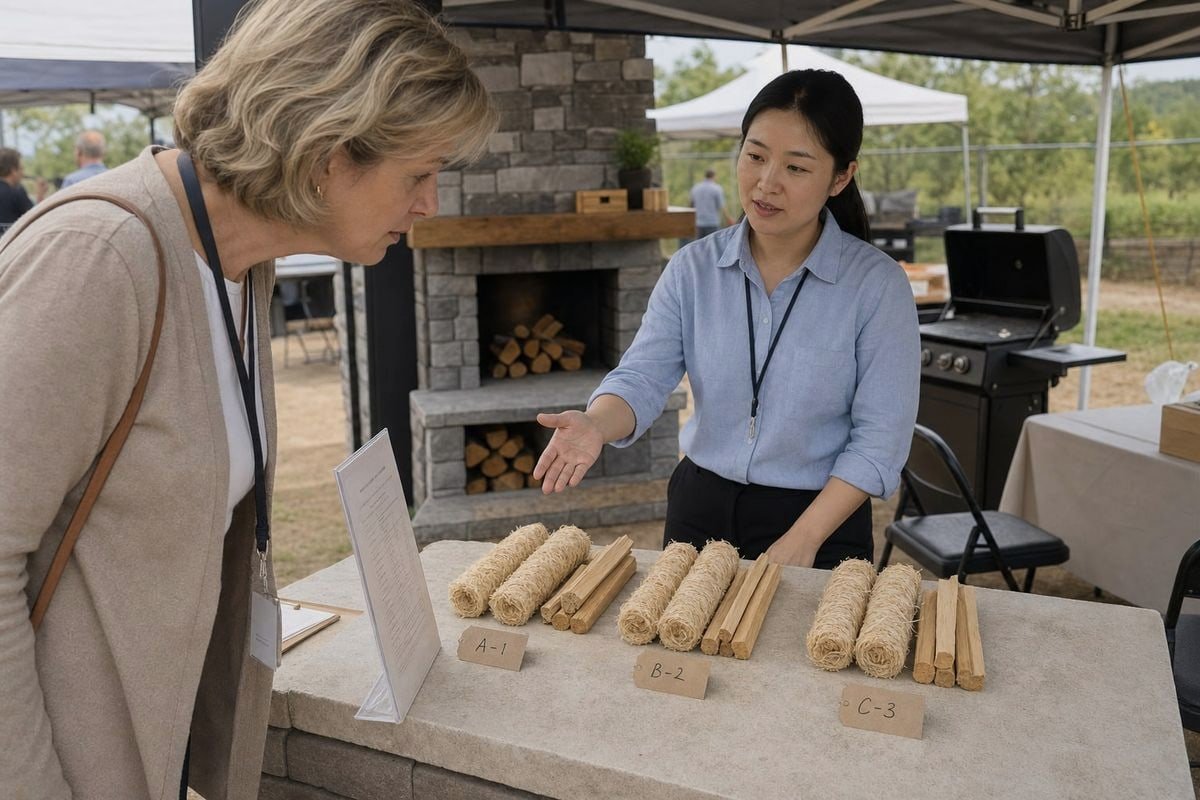
Display samples pulled from three or more separate production batches, side by side, with batch codes visible. Add a spec card showing tolerances for weight, size, wax content, and burn time. Matching samples across batches prove your quality control is systematic, not staged.

Buyers at outdoor shows have been burned before, sometimes literally. They received a beautiful golden sample, placed a container order, and got pale, crumbly wood rolls with uneven paraffin wax coating. So the smartest purchasing managers now test consistency at the booth itself. I want to make that test easy for them.
Build a Batch Comparison Display
Our booth setup follows a simple numbered process:
- Pull samples from at least three production runs, weeks apart.
- Label each with its batch code and production date.
- Place them in a row on a neutral surface, such as a stone slab or linen cloth, so color and fiber texture differences would be obvious if they existed.
- Attach a spec card listing target values and tolerances.
- Invite the buyer to weigh two pieces on a small scale at the table.
That last step is powerful. A pocket scale costs almost nothing, but letting a buyer weigh two wax-dipped wood rolls from different batches, and see them land within tolerance, says more than any brochure.
The Spec Card That Answers Consistency Questions
| Attribute | Target | Tolerance | How We Control It |
|---|---|---|---|
| Piece weight | Set per SKU | Tight gram range | In-line check weighing |
| Wax content | ~50% paraffin wax | Narrow percentage band | Dip time and temperature control |
| Burn time | Per customer spec | Small minute variance | Batch burn sampling |
| Color and texture | Pale straw wood wool | Visual standard boards | Kiln-dried raw material sourcing |
I also bring cut cross-sections. Slicing a fire starter open shows the wound wood-wool core 6 and even wax penetration. It proves the natural tinder inside matches the outside. Combined with our batch records, this turns "consistent quality" from a claim into something the buyer can hold.
What Packaging and Private-Label Samples Should I Prepare to Demonstrate OEM/ODM Options?
A UK camping brand once told me at a show that they liked our product but "couldn't picture it on their shelf." That comment changed how we pack for exhibitions. Now we bring the shelf to them.
Prepare a range of finished packaging mockups: retail boxes with flame graphics, kraft bags, jars, and display cartons, plus at least one dummy private-label sample carrying a fictional brand. Include warning labels, barcodes, and multilingual text to show full OEM/ODM readiness.

Packaging is where a factory proves it understands retail, not just production. Our one-stop OEM/ODM service covers custom size, burn time, packaging format, and branding, but buyers cannot feel that from a sentence in a catalog. They need physical objects in their hands.
The Packaging Range to Display
We bring one example of every format we can produce:
- A glossy retail box, like our 100-piece fire starter carton with flame graphics and the composition printed clearly, 50% wood fiber and 50% paraffin wax.
- A kraft bag version for eco-positioned outdoor brands that want an eco-friendly ignition story and recycled-paper feel.
- A jar or tub format for fireplace distributors and BBQ channels.
- A counter display unit, pre-filled, so a retail buyer can see the point-of-sale footprint.
- Pine cone starters and color-flame products in gift-style packaging, to show range beyond standard wood rolls.
The Dummy Private-Label Sample
This is the single most persuasive item at our booth. We create a fully finished box under a fictional brand name, complete with logo, tagline, barcode, batch code, and EU-compliant warning labels in multiple languages. When a purchasing manager holds it, they instantly imagine their own logo in that spot. Then we walk them through the customization path:
| Customization Area | Options We Show |
|---|---|
| Product | Size, burn time, wax blend, wood roll or pine cone format |
| Primary packaging | Box, kraft bag, jar, shrink pack, waxed pouch |
| Branding | Logo, colors, taglines, QR-coded instructional packaging |
| Compliance printing | Warning labels, barcodes, multilingual text |
| Logistics | Carton sizes, pallet plans, optimized freight |
One more tip from experience: bring flat, unassembled packaging blanks too. Buyers who import in bulk care about carton dimensions and shipping efficiency, and a flat blank sparks that logistics conversation naturally.
Which Product Documents and Catalogs Do I Need to Answer Buyer Questions on the Spot?
Years of booth conversations taught me a pattern. Buyers ask the same eight questions in roughly the same order, and the exhibitor who answers instantly, with paper in hand, wins the follow-up meeting.
Carry a printed catalog, one-page spec sheets per SKU, a price and MOQ matrix, lead-time and logistics sheets, an OEM/ODM process flowchart, and an FAQ card. Add QR codes linking to burn-test videos and digital files so buyers leave with everything.
Documents are the memory of your booth. A buyer may visit two hundred stands in two days. If they cannot recall your answers on the flight home, the conversation dies. So we design every document to survive a crowded suitcase and a tired reader.
The Eight Questions and the Document That Answers Each
- What exactly is this made of? → Spec sheet with composition, including wood fiber, paraffin wax, and natural tinder details.
- How long does one piece burn? → Burn-time chart per SKU, linked by QR code to test videos.
- Are these waterproof fire starters? → Water-resistance test summary from lab reports.
- What is your MOQ for a trial order? → Price and MOQ matrix, with flexible trial-order tiers highlighted.
- What is the lead time? → Production and shipping timeline sheet by destination region.
- Can you do our branding? → OEM/ODM flowchart, from artwork to shelf-ready cartons.
- Do you also supply related products? → Catalog pages covering fatwood sticks, ferrocerium rods, bulk kindling supplies, wax torches, and color-flame packets, so distributors can consolidate suppliers.
- Who else do you export to? → A market map showing our export regions across the US, Europe, and beyond.
Promotional Materials That Keep Working After the Show
We also prepare small giveaways with intent. Compact promotional samples 7, such as a single wax-dipped roll in branded kraft sleeve, travel well and stay TSA-friendly for flying attendees, unlike matches or liquid fuels. Each sleeve carries a QR code to a short lighting tutorial. That turns a two-minute booth chat into a lasting digital touchpoint, and it puts our product physically into the buyer's office when they return.
Conclusion
Trade shows punish unprepared exhibitors. Pack compliance certificates, multi-batch samples, private-label packaging mockups, and printed spec documents, and your wood fire starters will convert booth traffic into real orders.
Footnotes
1. Official ISO page explaining the quality management standard mentioned in the article. ↩︎
2. Official European Union resource explaining CE marking requirements for product compliance. ↩︎
3. Technical information about the petroleum-based wax used in fire starter production. ↩︎
4. Authoritative testing lab mentioned for verifying safety and composition of fire starters. ↩︎
5. OSHA guide explaining the classification of fire extinguishers, including ABC-rated types required at venues. ↩︎
6. Wikipedia entry for wood wool, describing its uses as a specialized wood product. ↩︎
7. Wikipedia article on promotional items used at trade shows to increase brand awareness. ↩︎

 English
  Spanish
  German
  French
  Arabic
  Portuguese
Join the Conversation