







Buyers sourcing wood fire starters often get burned by the wrong supplier Moisture content 1. On our production line in Ningbo, I hear the same story: inconsistent batches, missed seasons, hidden markups.
For wood fire starters, a factory is better when you need lower unit cost, consistent quality, OEM support, and reliable seasonal lead times. A trading company suits smaller trial orders and mixed-product sourcing. Serious brands and distributors gain more control by working factory-direct.
That short answer hides real nuance. Let me walk you through how I would compare the two, based on what actually happens on the production floor and in [export paperwork](https://sunrichfire.com/need-phytosanitary-declaration-wood-fire-starters-china-uk/).
How can I verify a wood fire starter supplier's certifications before signing a contract?
A German distributor once asked me to prove our ISO 9001 certificate 2 was real before he would even review a quote. I respected that. Fake paperwork is common in this category.
Verify certifications by requesting the original certificate numbers, then confirming them directly with the issuing bodies such as SGS, Intertek, or the ISO registrar. Check the business license scope for manufacturing verbs, ask for recent audit reports, and match the factory address to the certificate.

Verification is not complicated, but most buyers skip steps. Then they discover problems after the deposit is paid. Here is the process I recommend, because it is the same process our best customers run on us.
A five-step verification process
- Request the certificate copies with numbers visible. A supplier who hesitates here is telling you something. We share our ISO 9001, BSCI, CE, and SGS/Intertek documents 3 in the first or second email.
- Verify with the issuing body. SGS and Intertek 4 both let you confirm report authenticity. ISO registrars can confirm a certificate is active, not expired or revoked.
- Read the business license scope. Manufacturing verbs like "production" or "processing" indicate a real factory. Pure sales and trade wording signals a trader, even if the website says "manufacturer."
- Match addresses. The certificate, the audit report, and the factory address should all line up. A mismatch usually means the certificate belongs to someone else's plant.
- Ask for test reports on the actual product. For wood fire starters, that means burn time, ignition performance, and material safety documentation such as SDS sheets 5.
What each document actually tells you
| Document | What it proves | Red flag if missing |
|---|---|---|
| ISO 9001 | A working quality management system | No batch-to-batch consistency process |
| BSCI audit | Worker safety and social compliance | Big-box retailers will reject the factory |
| SGS/Intertek reports | Third-party tested product safety | Claims are self-declared only |
| Business license | Whether the company manufactures or trades | Identity may not match marketing |
| SDS sheets | Chemical composition and handling safety | Customs and retail compliance risk |
In our 17-plus years exporting to more than 30 countries, I have never seen a serious US or EU retail buyer treat these as optional. Big-box channels typically require a third-party factory audit 6 before the first shipment even leaves port. If your supplier cannot support an on-site audit, you are almost certainly dealing with a trader who does not control the factory, or a factory that would fail the audit. Either way, you want to know before you sign, not after.
Why does working directly with a factory give me more consistent quality than sourcing through a trading company?
Moisture content 7 is the trade-off I think about most. Wood wool that is slightly too damp ruins ignition time, and only the people running the wax-dipping line catch it early.
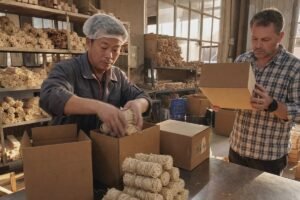
Factories control raw materials, wax ratios, moisture content, and packaging on one line, so every batch follows one standard. Trading companies often shift orders between different factories, which changes materials and processes, producing visible batch-to-batch variation in burn time and ignition performance.

Quality in wood fire starters is not abstract. It comes down to a handful of measurable variables. A buyer feels these variables as complaints: "the new batch won't light," or "these burn out in four minutes instead of eight."
The variables that decide fire starter quality
Our QC team checks these on every production run, because each one directly affects how the product performs in a fireplace or grill:
- Wood shaving moisture content. Too damp, and ignition is slow or fails.
- Wax-to-wood ratio. Our standard rolls target a consistent blend; drift here changes burn time.
- Winding density. Loose rolls burn fast and fall apart in transit.
- Wax coverage uniformity. Bare spots create weak ignition points.
- Packaging moisture barrier. A sea shipment can undo months of good production if the box absorbs humidity.
Now consider who controls these variables. When we run an order, the first sample we approve comes from the same line, same wax kettles, and same operators as the mass production. That is why the sample reliably predicts the shipment. A trading company approving your sample often cannot promise which factory will run your repeat order six months later.
Where variation enters the supply chain
| Quality variable | Factory-direct control | Via trading company |
|---|---|---|
| Raw material source | Fixed, traceable suppliers | May change between factories |
| Wax formula | One recipe, documented | Varies by producing plant |
| In-process QC | Checked on the line daily | Usually final inspection only |
| Sample-to-bulk match | Same line, same standard | Sample factory may differ from bulk factory |
| Corrective action speed | Immediate, on-site | Relayed through a middleman |
To be fair, a good trader with a locked, audited factory relationship can manage QC well. But the buyer rarely knows how locked that relationship really is. And one caution the other direction: a factory is not automatically better. A poorly run plant can still ship bad product. That is why the certifications and audits from the previous section matter more than the label on the supplier's profile.
Can I get better OEM and private-label support from a factory versus a trading company?
Last year, a French BBQ brand asked us for a shorter roll with a longer burn time, plus a retail display box with their own barcode and warning labels. That request went straight from their email to our production planning meeting.
Yes. Factories offer deeper OEM and private-label support because they control formulas, molds, sizes, and packaging lines directly. You can adjust burn time, dimensions, wax blends, and branded packaging in one place. Trading companies must coordinate changes through third-party factories, adding delay, cost, and miscommunication risk.

Private label 8 is where the factory advantage becomes hard to argue against. Customization is not one decision. It is a chain of small technical decisions, and every link needs someone with production authority.
What true OEM/ODM covers in this category
When buyers ask us for private-label wood fire starters, the customization usually touches four layers:
- The product itself. Roll diameter, length, winding tightness, and wax formula all change burn time and ignition speed. If a brand wants an eight-minute burn instead of five, we adjust the recipe and validate it with test burns before quoting.
- The unit packaging. Kraft bags, jars, or shrink-wrapped bundles, each with the brand's artwork.
- The retail packaging. Custom boxes, display-ready packaging, piece counts, warning labels, and barcodes that meet US or EU retail requirements.
- The logistics setup. Carton dimensions optimized for pallets and containers, which quietly saves buyers real freight money.
A trading company can relay all of this. But relay is the right word. Each revision travels buyer-to-trader-to-factory and back. In my experience, that adds days to every artwork approval and blurs accountability when a warning label prints wrong. When you work with the plant directly, the person who answers your email can walk to the packaging line.
OEM capability comparison
| OEM element | Factory-direct | Trading company |
|---|---|---|
| Burn-time formula changes | Yes, with in-house testing | Depends on the producing factory |
| Custom sizes and shapes | Direct tooling control | Limited to partner factories' tooling |
| Private-label packaging | Full artwork-to-print control | Possible, slower revisions |
| Compliance labels and barcodes | Built into the packaging process | Coordinated externally |
| MOQ for custom work | Negotiable with the producer | Often higher, stacked margins |
One honest caveat: some factories only run their own standard SKUs and resist customization. Ask early whether custom work is core business or an exception. For us it is core, and the answer shows in how fast a supplier turns around a custom sample.
Will choosing a factory over a trading company help me secure more reliable lead times for my orders?
Every August, our production schedule in Ningbo fills up fast. Fire starters are brutally seasonal, and I have learned that autumn delivery promises are made or broken in summer planning.
Generally, yes. A factory controls its own production calendar, so it can reserve capacity, pre-produce for peak season, and give you honest delivery dates. Trading companies depend on their factories' queues, though strong traders can pool capacity across plants. Verified on-time delivery records matter most.

Lead time reliability is where fire starters differ from many other products. Demand peaks sharply before winter and grilling season. A two-week delay in April is annoying. A two-week delay in October can mean your product misses the entire selling window and sits in a warehouse until next year.
Why seasonality changes the sourcing math
Think through what happens during peak season under each model. A factory sees its full order book. It can tell you honestly whether your order fits, quote a realistic date, and pre-produce wood wool cores in the slow months to buffer the rush. We do exactly this: raw material stocking and semi-finished production start well before peak orders land, because wax-dipping and packing are the bottleneck stages.
A trading company sees none of this directly. It holds a promise from a factory that is also promising capacity to other traders. When the plant overbooks, guess whose order slips first? Usually the middleman's, because the factory protects its direct, long-term customers.
That said, the counterargument deserves airtime. A trader with several partner factories can, in theory, shift an order if one plant fails. For a first-time importer buying a small mixed container, that flexibility has real value. The problem is you cannot verify it. You can verify a factory's capacity, audit history, and delivery record.
Questions that reveal real lead-time reliability
- What is your on-time delivery rate during September to November, specifically?
- Do you pre-produce or stock semi-finished goods before peak season?
- What is the standard lead time for stock items versus custom orders? In this industry, roughly 15 to 30 days is standard, with custom work adding one to two weeks.
- Who exactly manufactures the goods, and can I visit that facility?
- If a delay happens, who do I call, and what authority do they have to fix it?
Ask for delivery performance data, not promises. Strong suppliers track it. The best sourcing benchmarks put on-time delivery above 95 percent with response times under a few hours. Any supplier, factory or trader, who cannot discuss those numbers plainly is a seasonal risk.
Conclusion
Choosing wrong suppliers costs seasons, not just margins. For wood fire starters, verified factories win on cost, quality, OEM depth, and seasonal reliability. Verify certifications first, then partner factory-direct for the long term.


 English
  Spanish
  German
  French
  Arabic
  Portuguese
Join the Conversation