







Ingredient documentation for Magic Fire Powder is where I see most buyers get burned. On our production line, we watch importers accept vague "eco-friendly" labels — until customs or a retailer asks for proof.
Request a full chemical composition disclosure with CAS numbers and percentages, the complete Safety Data Sheet (SDS), third-party test reports covering heavy metal testing and REACH compliance, a Certificate of Analysis (CoA) for each batch, and the supplier's written substantiation file behind the eco-friendly claim.
That is the short answer. Now let me walk you through each document, what it should contain, and how to read it. I will also flag the red flags we see when auditing competitor products.
What Certifications Should I Verify to Support a Supplier's Eco-Friendly Claims?
A German distributor once told me he had rejected three color-flame suppliers in one month. Every one of them showed a certificate. Not one certificate actually covered the powder itself. That conversation shaped how we present our own files.
Verify ISO 9001 for quality management, SGS or Intertek test reports for the actual formulation, REACH compliance for EU markets, CE marking where applicable, and BSCI for factory ethics. Confirm each certificate names the exact product, is current, and comes from an independent, traceable certifier.

A certificate is only as good as its scope. In our 17+ years exporting fire products to 30+ countries, the single most common problem we see is scope mismatch. A supplier waves an ISO 9001 1 certificate as if it proves the powder is safe. It does not. ISO 9001 proves the factory runs a documented quality system. It says nothing about copper sulfate toxicity, heavy metals, or combustion byproducts. You need both types of documents: system certificates and product test reports.
Match the Certificate to the Claim
Here is how we advise our B2B buyers to sort the paperwork:
| Certificate / Report | What It Actually Proves | What It Does NOT Prove |
|---|---|---|
| ISO 9001 | The factory has a quality management system | The product is non-toxic or eco-friendly |
| BSCI | Ethical labor and social compliance at the factory | Anything about chemical safety |
| SGS / Intertek test report | The tested sample met specific chemical limits | Future batches match, unless backed by a CoA |
| REACH compliance 2 statement | Substances are registered or exempt for the EU | US or other market compliance |
| CE marking | Conformity with relevant EU directives | Environmental performance of the powder |
| Biodegradability certification | The tested material breaks down under defined conditions | That ash or residue is harmless |
Verify the Certifier, Not Just the Paper
Ask three questions. First, is the certifier independent, with no business ties to the seller? FTC guidance requires disclosure of any material connection. Second, can you verify the report number directly with SGS or Intertek? We give our buyers report numbers precisely so they can check. Third, does the certificate cover the product, the packaging, or one ingredient? An "eco" seal that only covers a kraft-paper pouch does not support a claim about the powder inside. When we ship to Home Depot–type retail channels, their sourcing teams check all three points before a single pallet moves. You should too.
Which Test Reports Prove Magic Fire Powder Contains No Harmful Chemicals?
There is a real trade-off we weigh every time we formulate a color batch: some metal salts give brighter flames, but they fail heavy metal testing. We chose the compliant path years ago, and the test reports are how we prove it.
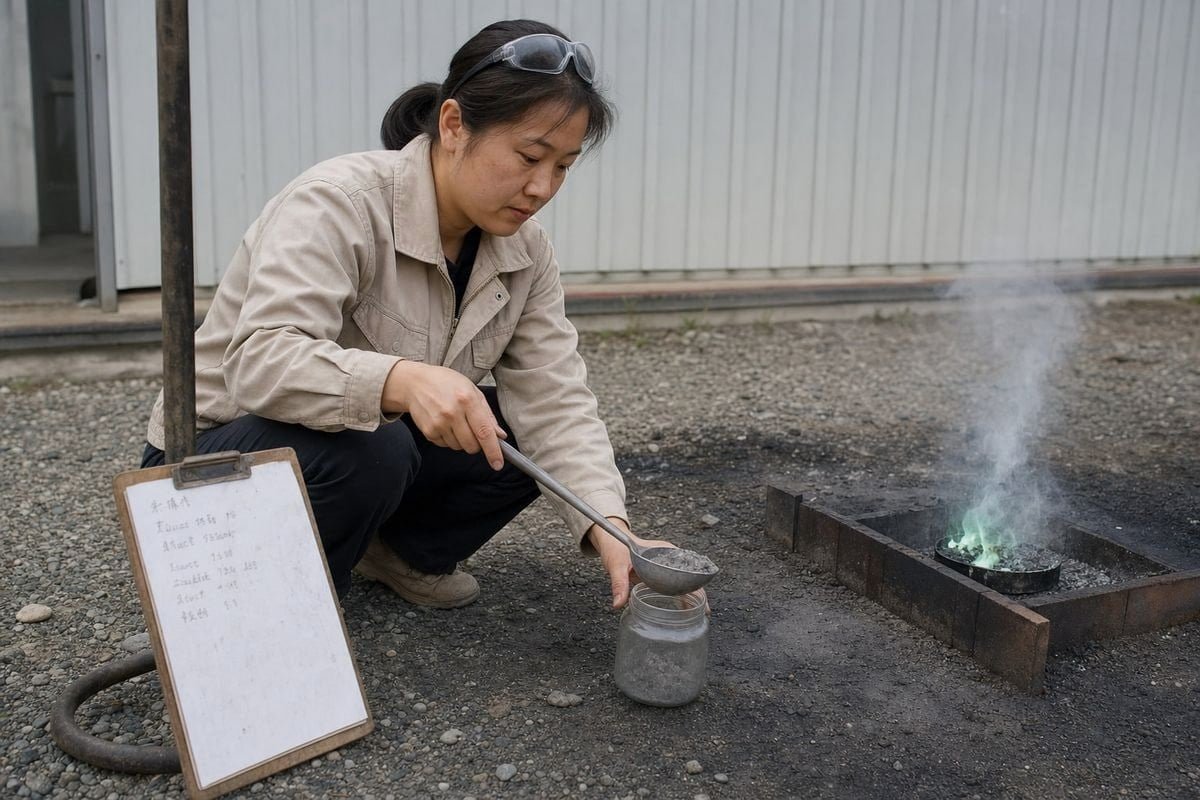
Request heavy metal testing for lead, arsenic, mercury, and cadmium; a full SDS with Section 12 ecological data; aquatic toxicity results; a halogen and VOC emission profile for combustion byproducts; and TCLP leaching results for residual ash. Each report should reference the exact formulation.

Marketing language like "natural" or "clean burn" means nothing without lab data. A fire product is intentionally burned, so you must evaluate three phases: the powder itself, the smoke, and the ash left behind. Most sellers only document the first phase. We learned to document all three because our EU and US buyers demanded it, and regulators like the FTC and bodies enforcing EPA environmental standards expect substantiation for every "free of" claim.
Read the SDS Section by Section
The Safety Data Sheet 3 — still called a Material Safety Data Sheet (MSDS) in older files — is your primary map. Do not skim it. Focus here:
| SDS Section | What to Look For | Red Flag |
|---|---|---|
| Section 2 | Hazard classification and GHS pictograms 4 | "Environmentally Hazardous Substance" marking |
| Section 3 | Chemical composition disclosure with CAS numbers | Vague terms like "proprietary colorant blend" |
| Section 12 | Biodegradability, persistence, aquatic toxicity | "Not tested for environmental properties" |
| Section 13 | Disposal guidance | Hazardous waste disposal instructions on an "eco" product |
| Section 15 | Regulatory information, REACH status | Missing or outdated regulatory references |
Test the Whole Burn Cycle
For the smoke phase, ask for a halogen emission profile. If a powder uses PVC as a chlorine donor or fuel binder, burning it can release dioxins and furans 5. Our formulations avoid chlorinated binders for exactly this reason. Ask for VOC emission data too, because "clean burn" is a specific, testable claim about combustion byproducts, not a slogan. For the ash phase, request TCLP leaching results 6. This tells you whether post-burn residue can sit safely in soil at a campsite or must be treated as hazardous waste. One flame-colorant SDS we reviewed during a competitive audit listed lead compounds and admitted lead is toxic to aquatic species. That product was sold with "safe" language on the front of the pouch. The lab reports, not the pouch, told the truth.
How Can I Confirm Ingredient Consistency Across Different Production Batches?
Early in our export history, we shipped a trial order that tested perfectly, then almost lost the account when the buyer asked how we would guarantee batch two. That lesson built our current batch-control system in Ningbo.
Require a Certificate of Analysis (CoA) for every production batch, tied to a batch number printed on the packaging. Confirm the supplier's incoming raw-material inspection process, ask for their batch retention-sample policy, and compare CoA values against the original third-party test report.

Eco-friendly documentation is only trustworthy if it describes the product you actually receive. A perfect SGS report from 2022 proves nothing about a container loaded last week — unless the supplier can show the formulation never changed and each batch was verified. This is where trading companies usually fail and real factories can prove themselves.
The Batch-Control Chain to Ask For
Here is the process we run on our own lines, which you can use as an audit checklist for any supplier:
- Incoming raw-material inspection. Every drum of metal salt or carrier material gets checked against a purchase specification before it enters production. Ask for a sample inspection record.
- Batch numbering. Each production run receives a unique batch code printed on the sachet or pouch. If the packaging has no batch code, traceability is impossible.
- In-process QC checks. Color intensity, granule size, and moisture are checked during blending. Consistency here is why our first sample reliably reflects mass-production quality.
- Batch-level Certificate of Analysis. The CoA states measured values — not just "pass" — for the parameters that matter, referencing the batch code.
- Retention samples. We hold sealed samples from each batch so a dispute can be settled with physical evidence, not emails.
- Change notification. Any reformulation triggers written notice to buyers and fresh testing. Silent reformulation is one of the biggest hidden risks in this category.
Compare CoA Data Over Time
Do not file CoAs and forget them. Line up three or four consecutive batches and compare the numbers. Stable values indicate real process control. Values that drift, or CoAs that suspiciously repeat identical figures batch after batch, both deserve questions. A supplier confident in its production depth will welcome that scrutiny.
What Documentation Should I Keep on File for Customs and Retail Compliance?
A UK buyer once emailed me in a panic: a retail chain's compliance team wanted a full document pack within 48 hours. Because we keep everything organized by SKU, he made the deadline. That habit is worth copying.
Keep the SDS, batch CoAs, third-party test reports, REACH and market-specific compliance statements, the eco-claim substantiation file, warning-label artwork, and shipping classification documents. Organize them by SKU and batch, retain them for the product's full retail life, and update them at every reformulation.
Customs officers and retail compliance teams ask different questions, so your file needs to answer both. Customs cares about classification, safety in transit, and whether the goods match the declaration. Retailers care about labeling, claim substantiation, and consumer safety. In our experience exporting to the US, Germany, the UK, and Australia, buyers who maintain a complete file clear both hurdles quickly. Buyers who rely on the supplier to "send documents when needed" face delays, demurrage, and delisting risk.
The Buyer's Document Retention File
| Document | Why Customs Needs It | Why Retail Needs It |
|---|---|---|
| SDS / MSDS | Confirms transport classification and hazard status | Required for store safety files and recalls |
| Batch CoA | Links shipment to declared composition | Proves ongoing quality for audits |
| SGS / Intertek reports | Supports non-hazardous or compliant declaration | Substantiates label claims |
| REACH / EPA-relevant statements | Market entry requirement in EU / US context | Chain-of-custody proof for chemical rules |
| Eco-claim substantiation file | Rarely requested, but decisive in disputes | Direct defense against greenwashing 7 complaints |
| Warning-label and packaging artwork | Confirms goods match import declaration | Verifies mandatory warnings and barcodes |
| Biodegradability certification (if claimed) | Supports "eco" descriptors on documents | Backs on-shelf environmental language |
Get the Claims and Labels Right Before Shipping
Two practical points from our OEM work. First, define exactly what "eco-friendly" means on your packaging before printing. If the claim covers only the kraft pouch, say so; a broad claim covering the powder must be backed by the composition and combustion data discussed above. Second, include explicit use limitations — for example, that the powder is not intended for fires used to cook or roast food. We build these warning labels, barcodes, and market-specific text into private-label packaging during development, because retrofitting compliance after a retailer's rejection is far more expensive than doing it once, correctly.
Conclusion
Do not accept "eco-friendly" as a slogan. Demand composition disclosure, the SDS, batch CoAs, heavy metal and emission testing, and claim substantiation — then partner with a factory that provides them proactively.
Footnotes
1. Official ISO standard page clarifying what this quality management certification covers ↩︎
2. Official EU regulation reference for chemical registration requirements mentioned throughout article ↩︎
3. Background definition for the SDS document format discussed extensively in the article ↩︎
4. Explains the hazard classification symbols referenced in the SDS section breakdown table ↩︎
5. EPA reference on toxic combustion byproducts mentioned regarding chlorinated binder risks ↩︎
6. EPA's official test method page for the leaching procedure referenced for ash disposal ↩︎
7. Background concept explaining the deceptive environmental marketing practices the article warns against ↩︎



 English
  Spanish
  German
  French
  Arabic
  Portuguese
Join the Conversation