






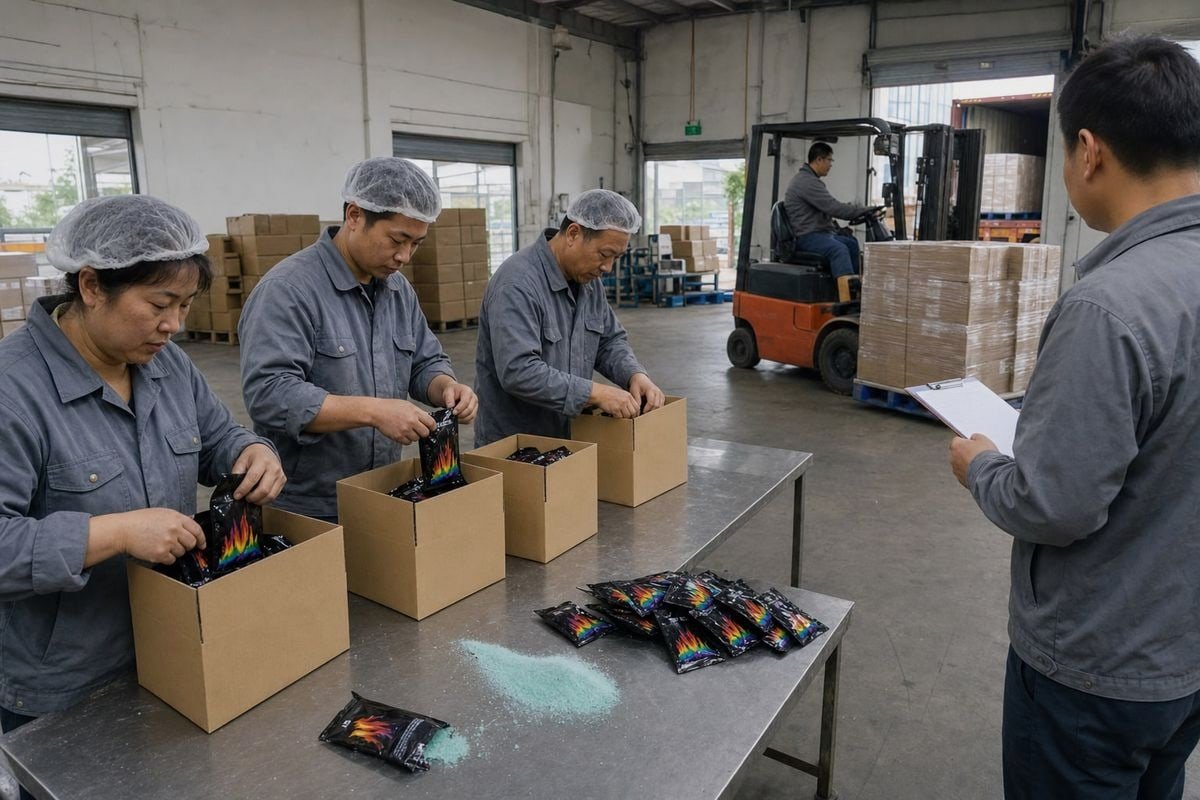
Buying magic fire powder in bulk sounds simple until a pallet arrives clumped, off-color, or blocked at customs. On our production line in Ningbo, we see the fallout when buyers skip due diligence. One failed batch can ruin an event calendar, damage a brand, and burn a season's budget. The fix is treating this purchase as risk-managed procurement, not a novelty buy.
When buying magic fire powder in bulk for events, the factors that matter most are verified safety certifications, batch-to-batch color consistency, moisture-proof packaging, realistic MOQ and lead times, documented supplier reliability, and private-label capability — judged on total event value, not the lowest unit price.
Let me break each factor down. I will cover certifications, quality verification, order planning, and custom branding. These are the four questions serious buyers ask us most often.
What certifications should I check before importing Magic Fire powder for large events?
A German distributor once told me his previous shipment sat in customs for six weeks because the supplier had no test reports. That conversation shaped how we prepare every export file today.
Before importing Magic Fire powder in bulk, check for ISO 9001 factory certification, CE marking for the EU, SGS or Intertek third-party test reports, a current MSDS, BSCI social compliance audits, and confirmation that the formula contains no restricted heavy metals or toxic compounds.

Certification is not paperwork for its own sake. It is the difference between a shipment that clears customs and one that gets seized. It is also the difference between a product a venue will approve and one an insurer will reject. In our seventeen-plus years exporting to the US, Germany, the UK, and more than thirty countries, we have never seen compliance requirements loosen. They only tighten.
The core documents to request
Ask every supplier for these before you wire a deposit:
| Document | What It Proves | Who Requires It |
|---|---|---|
| ISO 9001 | Factory quality management system | Serious B2B buyers, large retailers |
| CE test report | EU safety conformity | EU importers and customs |
| SGS / Intertek report | Independent third-party testing | Retail chains, event venues |
| MSDS | Chemical composition and handling data | Freight carriers, venues, insurers |
| BSCI audit | Ethical and social compliance | Major retail sourcing channels |
Why third-party reports matter more than claims
Listing photos say "non-toxic" and "eco-friendly" all the time. Anyone can print those words. A third-party lab report 1 confirming the absence of harmful heavy metals 2 — such as unsafe copper or lithium salt concentrations — is what protects you when the powder burns near a crowd. Inhalation risk at a large event is a real liability question, and your documentation is your defense.
Also check shipping classification early. Some flame-colorant powders trigger hazmat handling fees 3 or freight restrictions. A supplier who ships this product weekly will know the correct classification and the right carriers. A trading company reselling stock often will not. Request the export file before ordering, and confirm your destination country's rules for the specific event venue too, because local fire codes can be stricter than national import rules.
How do I verify consistent color-flame quality across bulk production batches?
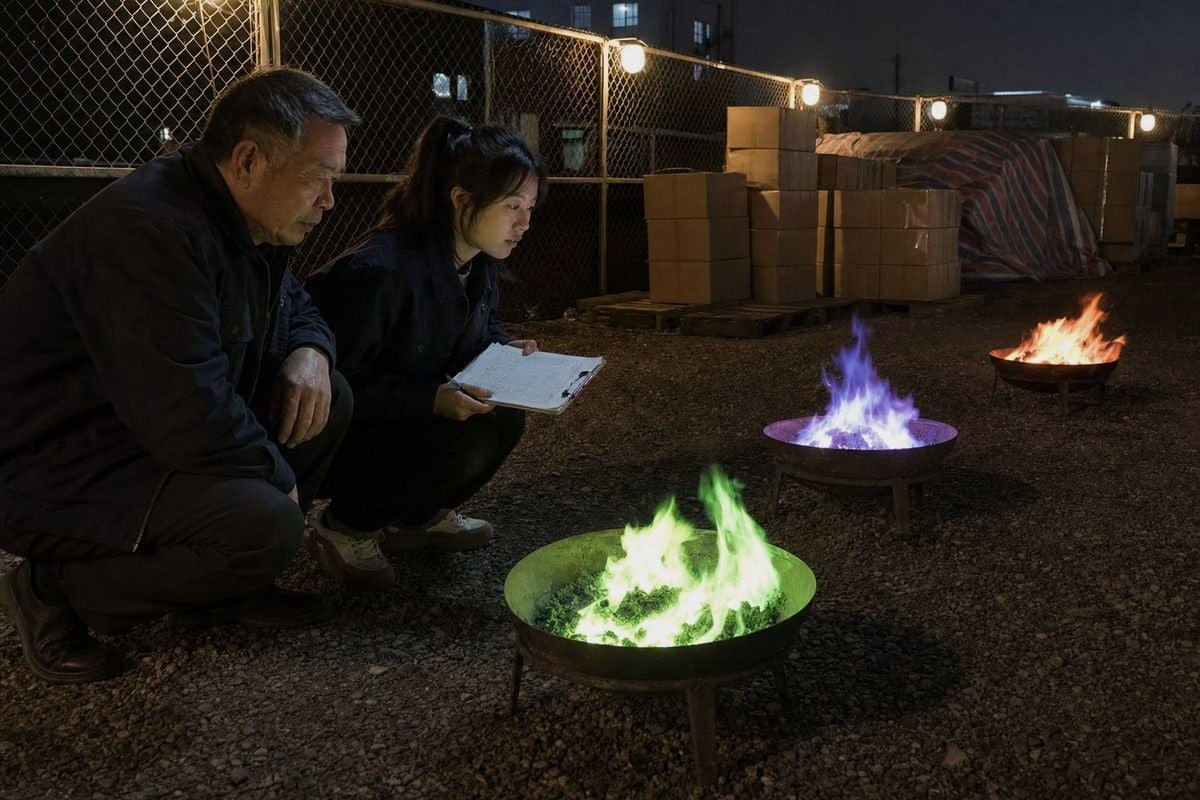
Every production run at our Ningbo facility ends the same way: sample packets from the batch go into a test fire, and our QC team compares the flame colors against a reference standard before anything ships.
Verify batch consistency by requesting samples from the actual production batch, running test burns under your real fire conditions, comparing multiple lots side by side, asking for the supplier's batch QC records, and confirming the factory controls raw materials rather than reselling mixed stock.

Color consistency is the product. Event buyers are not purchasing "some color." They are purchasing a repeatable visual outcome — the same vivid blues, greens, and purples at event fifty as at event one. In my experience, inconsistency almost always traces back to one of three causes: variable raw material sourcing 4, sloppy blending ratios, or moisture absorbed during packing. A real factory controls all three. A reseller controls none.
A practical verification process
- Request pre-production samples. Test color clarity and burn duration in the exact fire setup you will use — bonfire, fire pit, or fireplace.
- Request mass-production samples from the same order. The first sample should reliably reflect bulk quality. If a supplier hesitates here, walk away.
- Compare at least two lots. Burn them side by side. Look for color drift, weak segments, or shorter burn times.
- Account for the environment. Wind, humidity, and altitude all affect flame vibrancy and spread. Test outdoors if your events are outdoors.
- Ask for QC documentation. A factory with real batch control can show inspection records, not just photos.
What real conditions change
| Variable | Effect on Flame Color | How to Test |
|---|---|---|
| Wind | Disperses color, shortens visible effect | Outdoor burn on a breezy day |
| Humidity | Clumped powder burns unevenly | Store a sample humid for a week, then burn |
| Fire size | Small fires mute color intensity | Test at your actual fire scale |
| Fuel type | Some woods mask color tones | Use the wood your events use |
One more point from hard experience: build a 10–15% surplus into bulk orders. Spillage, humidity loss, and rehearsal burns eat inventory faster than most planners expect.
What MOQ and lead time options work best for trial and repeat event orders?
The trade-off we weigh most often with new buyers is this: a low trial MOQ protects the buyer, but only stable repeat volume unlocks the best pricing and priority production slots. Getting that ladder right matters more than either number alone.
For trial orders, choose a supplier offering a flexible low MOQ — often a few cartons — with a two-to-three-week lead time; for repeat event orders, lock in scheduled bulk shipments of 5kg, 10kg, or 25kg+ tiers with four-to-six-week production windows and agreed quality standards.

The smartest buyers we work with treat the first order as a paid test, not a profit center. A small trial order lets you verify color performance, packaging durability, and documentation accuracy before real money is committed. Suppliers who demand a full container for a first order are asking you to take all the risk. We deliberately keep trial MOQs accessible because we would rather earn a five-year customer than a one-time container.
Matching order structure to your event calendar
| Order Stage | Typical Quantity | Typical Lead Time | Purpose |
|---|---|---|---|
| Sample pack | A handful of sachets | 3–7 days by courier | Color and burn verification |
| Trial order | Small carton quantity | 2–3 weeks | Market test, packaging check |
| First bulk order | 5kg–25kg tiers or carton pallets | 4–6 weeks | First event season stock |
| Repeat program | Scheduled container or pallet runs | Agreed calendar | Locked pricing and consistency |
Lead time realities buyers underestimate
Production time is only part of the clock. Sea freight 5 to the US or Europe adds four to six weeks. Customs clearance 6 adds more if documents are incomplete. Peak seasons — the run-up to summer camping and the winter holiday period — compress factory capacity across the industry. My advice is blunt: plan bulk orders three to four months before your event season, and confirm your supplier's production schedule in writing.
Also compare price per unit across quantity tiers honestly. Bulk breakpoints reduce per-event cost, but only if the powder survives storage. Cool, dry, shaded storage in airtight packaging is what makes a 25kg tier a saving instead of a write-off.
Can I get private-label packaging and custom branding for my Magic Fire powder orders?
A UK festival-goods trader once came to us with nothing but a logo file and a color palette. Six weeks later, his branded sachets, display boxes, and barcoded cartons were on the water. That project is close to our standard OEM workflow now.
Yes — established factories offer full private-label service for Magic Fire powder, including custom sachet and pouch printing, branded display boxes, kraft or jar packaging formats, warning labels in your market's language, barcodes, custom burn times, and even proprietary color-blend formulations.
Private labeling is where bulk buying becomes brand building. Generic packets earn generic margins. A branded sachet with your artwork, your compliance labels, and your barcode sits on a retail shelf or in an event gift bag as your product. In our OEM/ODM 7 work for outdoor brands, fireplace distributors, and festival traders across the US and Europe, packaging decisions often affect sell-through as much as the flame effect itself.
What can actually be customized
- Packaging format. Single-use foil sachets, resealable kraft stand-up pouches, or plastic jars. Sachets suit retail and gift bags; jars and bulk pouches suit event operators who dose by hand.
- Artwork and branding. Full-surface printing, logo placement, and flame graphics matched to your brand identity.
- Display packaging. Flip-top counter display boxes that hold individual sachets, ready for checkout counters and camping stores.
- Compliance elements. Warning text in your market's language, usage instructions, barcodes, and batch codes — shelf-ready on arrival.
- Product performance. Custom burn times, packet weights, and even signature color blends for event branding. Most bulk buyers never ask for proprietary color mixes, yet it is one of the strongest differentiators available.
Questions to ask before committing artwork
First, confirm the printing MOQ, since custom film usually has its own minimum. Second, ask for a pre-production packaging sample so you can approve print quality and seal integrity physically, not from a photo. Third, verify the packaging is genuinely airtight and moisture-resistant. Beautiful printing on a leaky pouch still delivers clumped, weakened powder. In our packing lines, seal testing is a standard step because we learned early that packaging failures cost more goodwill than any other defect.
Conclusion
Buying magic fire powder in bulk carries real risk: customs holds, faded colors, ruined events. Verified certifications, tested batch consistency, sensible MOQs, and true private-label support remove that risk. Partner with a documented factory, and every event fire looks exactly as promised.
Footnotes
1. SGS is a leading independent testing authority referenced for verifying product safety claims. ↩︎
2. Explains health risks of heavy metal contamination relevant to powder safety testing. ↩︎
3. Official US hazmat regulator clarifies shipping classification rules for restricted materials. ↩︎
4. Background reference on raw material variability affecting manufacturing consistency. ↩︎
5. International Maritime Organization governs sea freight standards affecting shipping lead times. ↩︎
6. US Customs and Border Protection provides authoritative import clearance requirements for traders. ↩︎
7. Explains OEM/ODM manufacturing model referenced for private-label production capability. ↩︎


 English
  Spanish
  German
  French
  Arabic
  Portuguese
Join the Conversation