






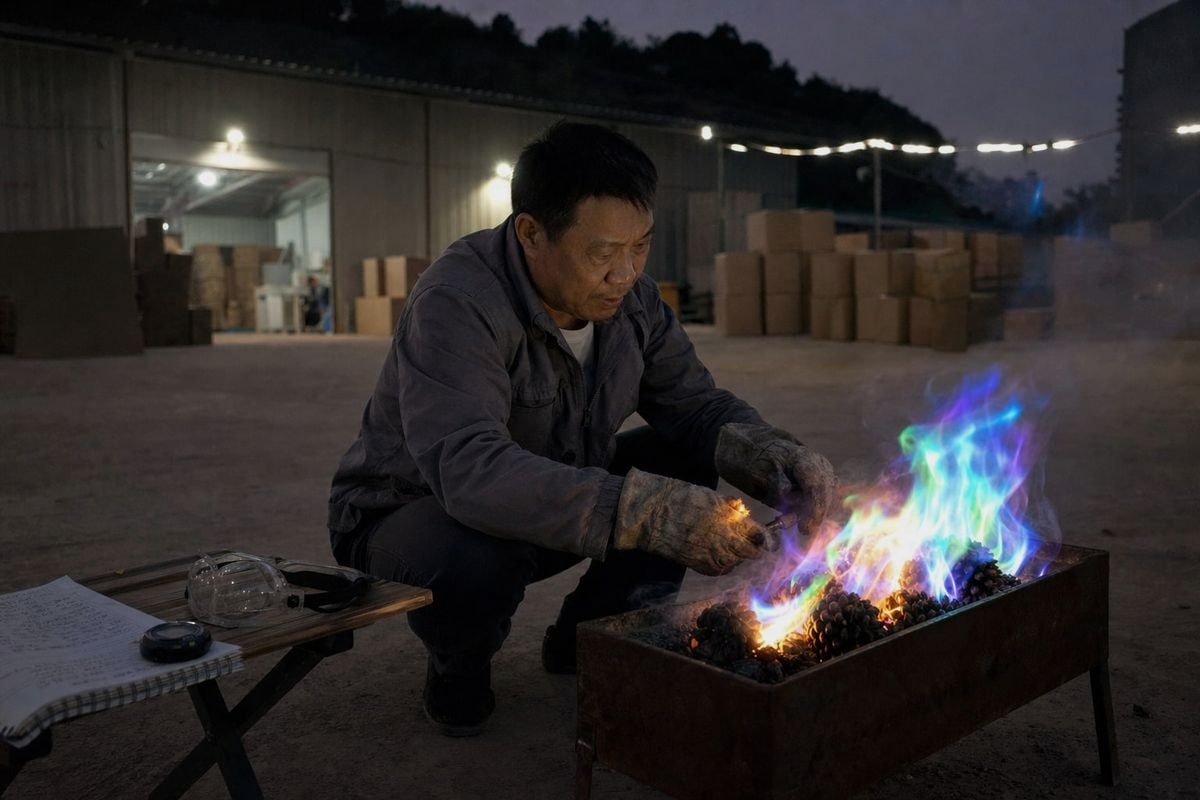
Colored pine cones are one of the most requested items on our production line, yet many buyers cannot answer a basic customer question: which flame colors do they actually make?
Colored pine cones most commonly produce blue and green flames, created by copper compounds. Other formulations can produce red (strontium or lithium salts), purple (potassium salts), yellow (sodium salts), orange (calcium chloride), and white (magnesium sulfate) flame colors.
That short answer hides a lot of practical detail. If you buy, sell, or private-label these products, the ingredients matter for compliance, safety, and repeat sales. Let me walk you through what we have learned over 17 years of making color-flame products.
What Chemical Compounds Create Each Specific Flame Color in These Pine Cones?
A buyer from Germany once asked me to list every additive in our color-flame pinecones before he would even look at pricing. That request shaped how openly we now document our formulations.
Copper chloride or copper sulfate creates blue and green flames, strontium chloride creates red, lithium chloride creates pink-red, potassium chloride creates purple, sodium chloride creates yellow, calcium chloride creates orange, and magnesium sulfate creates white. The pine cone itself is only the carrier for these metal salts.

O science behind flame colors is simple once you strip away the jargon. When a metal salt heats up in a fire, the metal ions absorb thermal energy. Electrons jump to higher energy states. As those electrons fall back down, they release energy as visible light 1. Each element releases light at its own specific wavelength. That wavelength is the color you see. Copper gives blue-green. Strontium gives red. Potassium gives lilac. The pine cone just burns and carries the salt into the flame.
The Standard Color-to-Ingredient Chart
Here is the reference table we share with buyers during product development:
| Cor da Chama | Primary Ingredient | Notas |
|---|---|---|
| Blue / Blue-green | Copper chloride (cupric chloride) | The most vivid and most common commercial effect |
| Verde | Copper sulfate, boric acid, or borax | Compostos de bário 2 also work but raise compliance flags |
| Red / Crimson | Cloreto de estrôncio | Deep, saturated red |
| Pink-red / Magenta | Lithium chloride | Brighter, pinker than strontium |
| Roxo / Violeta | Cloreto de potássio | Subtle lilac; easily masked by sodium |
| Amarelo | Cloreto de sódio (sal de cozinha) | Very dominant; can override other colors |
| Laranja | Cloreto de cálcio | Warm orange tone |
| Branco | Magnesium sulfate (Epsom salt 3) | Bright white flashes |
Why the Pine Cone Matters Less Than the Salt
We source natural pine cones, but the cone species barely affects color. What matters is how the salt is applied. Soaking gives deeper penetration and longer color duration. Surface coating gives a faster, brighter initial burst. In our factory, we soak, dry, and then test-burn samples from every batch. A properly treated cone should produce visible color for roughly five to ten minutes, which matches what most retail buyers expect to print on their packaging.
One more point buyers often miss: DIY recipes online frequently conflict. Some say Epsom salt makes red; most credible sources say white. Some list borax as yellow-green, others as green or orange. These conflicts happen because concentration, combustion temperature, and sodium contamination all shift the visible result. That is exactly why controlled factory formulation beats kitchen-table mixing for a commercial product.
How Can I Verify the Ingredients Meet Safety and Compliance Standards for My Market?
Compliance is where deals live or die. In our experience exporting to the US, Germany, the UK, and 27 other countries, no serious distributor will place a container order without relatórios de teste 4 in hand first.
Verify compliance by requesting third-party test reports from labs like SGS or Intertek, confirming CE marking for the EU, checking the supplier holds ISO 9001 and BSCI certification, and reviewing the full ingredient disclosure against restricted-substance lists such as barium and heavy-metal limits in your market.

Not all flame-coloring chemicals are treated equally by regulators. This is the single most important thing to understand before you choose a product line. Some traditional flame colorants carry real regulatory risk. Compostos de bário 5 produce a beautiful apple-green flame, but barium is toxic and heavily restricted in many consumer markets. Any supplier still using barium salts for green should be a red flag for your sourcing team. We formulate green effects with copper-based and boron-based alternatives specifically to keep buyers out of that problem.
Um Checklist Prático de Verificação
When you evaluate a supplier, work through these steps in order:
- Request the full ingredient list in writing. A factory that hesitates here is hiding something.
- Ask for current SGS or Intertek test reports. Check the report date and confirm it covers the actual product, not a similar SKU.
- Confirm CE documentation for EU sales. Our EU buyers treat this as non-negotiable, and customs increasingly checks it.
- Check factory-level certifications. ISO 9001 tells you the quality system exists. BSCI 6 tells you the factory passes social audits, which large retail chains require.
- Review labeling requirements. Warning labels, usage instructions, and barcodes must match your destination market. We produce these in-house for private-label orders.
- Test-burn a sample yourself. Documents matter, but so does watching the product perform.
There are also disclosure points that responsible sellers should pass on to end users. Ash from colored pine cones should not go into gardens or compost, because residual metal salts can harm plants and soil life. Repeated heavy use in a fireplace can leave chemical residue in chimney flues over time. And the product should always be used in well-ventilated spaces 7, kept away from children and pets. Putting these points on your packaging is not just ethical. It reduces your liability and builds trust with retail partners.
Which Flame Colors Sell Best With My Customers, and How Do I Choose the Right Mix?
Choosing a color mix is a trade-off we discuss with nearly every new client. More colors sound better on packaging, but each added colorant raises cost, complicates compliance testing, and can muddy the visual effect in the fire.
Blue and green flames sell best because copper-based effects are the most vivid against orange wood fire, and they photograph well. Most successful retail products lead with blue-green, then add purple or red as a premium multicolor option for holiday and camping segments.

Why do blue and green dominate? A normal wood fire already burns yellow and orange. Sodium and calcium effects blend into that background. Copper's blue-green sits at the opposite end of the visible spectrum 8, so it creates maximum contrast. Your customer throws one cone into the fire and immediately sees the magic. That instant, obvious payoff drives repeat purchases and word of mouth.
Matching Colors to Customer Segments
Different buyers want different things. Here is how we typically advise clients to segment:
| Customer Segment | Recommended Color Focus | Estilo de Embalagem | Por que Funciona |
|---|---|---|---|
| Marcas de camping / ao ar livre | Blue-green plus purple | Kraft resealable pouch | Rugged look; vivid colors show well at night campfires |
| Fireplace / hearth retailers | Blue-green classic | Saco de juta com cordão | Cozy, giftable, matches hearth décor aesthetics |
| Holiday gift traders | Multicolor mix with red | Painted decorative cones, display boxes | Red and gold fit seasonal themes; strong impulse buy |
| BBQ distributors | Blue-green, longer burn | Jar or bulk bag | Value positioning; used across many fire sessions |
| Festival and LARP buyers | Purple, green, red | Custom-branded pouches | Dramatic, theatrical color effects for events |
One Cone at a Time, or a Rainbow?
Here is a nuance worth putting on your packaging. Burning several differently treated cones at once can cause the colors to overlap and muddy each other. Sodium in particular dominates almost everything else. For the most vivid single-color effect, users should burn one cone at a time. Some of our clients turn this into a selling point: a variety pack becomes a sequence of color moments rather than one confused blaze. Others want a blended multicolor cone, which we formulate deliberately so the colors flicker in succession rather than cancel out. Both approaches work. What matters is that the product delivers what the package promises.
For trial orders, we usually suggest starting with a blue-green core SKU plus one multicolor variant, then letting sell-through data decide the expansion.
How Do I Make Sure the Flame Colors Stay Consistent Across Every Production Batch?
A lesson we learned early: a beautiful first sample means nothing if batch fifty burns dull. One of our longest-standing US clients came to us after a previous supplier's third shipment produced weak, patchy color and triggered retail returns.
Batch consistency comes from controlled salt concentration, standardized soaking time and drying conditions, sourcing uniform cone sizes, and test-burning random samples from every production run. Ask your supplier to document these controls and to guarantee the first sample matches mass production.

Flame color intensity is sensitive to several production variables. If a factory does not control them, the color drifts. Here are the variables that matter most and how we handle each one on our lines in Ningbo:
The Variables That Cause Color Drift
| Variável | What Goes Wrong If Uncontrolled | Our Control Method |
|---|---|---|
| Salt concentration | Weak or oversaturated color | Fixed solution ratios, measured per batch |
| Soaking time | Uneven absorption between cones | Standardized soak duration for every run |
| Drying conditions | Moisture left inside dulls color and slows ignition | Controlled drying with moisture checks before packing |
| Cone size and density | Different burn rates and color duration | Sorted, graded cones from consistent sources |
| Sodium contamination | Yellow overrides the target color | Clean water and clean handling throughout treatment |
| Storage humidity | Salts absorb moisture and leach out | Sealed, moisture-barrier packaging options |
Perguntas a Fazer ao Seu Fornecedor
You do not need to run a factory to audit one. Ask these questions and listen for specific answers:
- Do you test-burn samples from every batch, and can you share the records?
- What is your documented soaking and drying procedure?
- How do you grade and sort incoming pine cones?
- What moisture level do you allow before packing?
- Will the mass-production goods match the approved sample, and will you put that in the contract?
A supplier with genuine manufacturing depth answers these in detail. A trading company usually cannot, because it does not control the process. After 17 years, we treat batch-to-batch consistency as the product itself. The color is what your customer pays for. If it varies, your brand pays the price, not the factory's. That is why we tie our quality guarantee to the approved sample and keep retained samples from each production run for comparison.
Conclusão
Colored pine cones produce blue-green flames most reliably, with red, purple, yellow, orange, and white possible through specific metal salts. Choose a certified factory partner, verify ingredients, and demand batch consistency.
Notas de rodapé
1. Background reference explaining how metal ions emit visible light in flame tests. ↩︎
2. Background on barium's chemical and toxicological properties supports the safety warning. ↩︎
3. Epsom salt is magnesium sulfate, explaining the chemical basis of the color debate. ↩︎
4. SGS is a leading third-party testing lab referenced for compliance verification. ↩︎
5. Supports claim that barium compounds are toxic and heavily regulated. ↩︎
6. BSCI is the amfori social audit certification mentioned for supplier verification. ↩︎
7. CDC guidance on indoor air quality supports the ventilation safety recommendation. ↩︎
8. Explains the physics of visible light wavelengths referenced for flame color contrast. ↩︎



 English
  Spanish
  German
  French
  Arabic
  Portuguese
Participe da conversa