






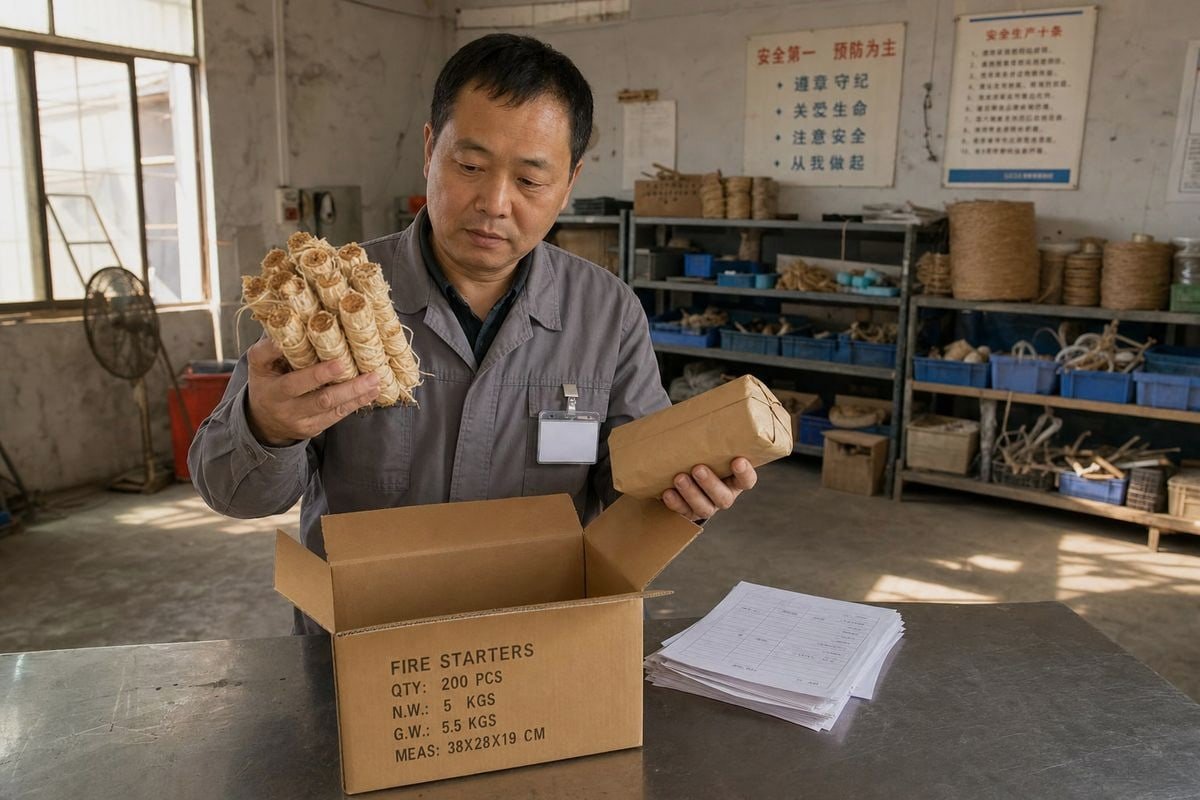
Wood fire starter safety is where I see importers get burned monóxido de carbono 1. One recalled container, one failed audit, and a season's margin disappears. Our factory learned this early, so we built verification into everything.
Verify wood fire starter safety by matching the product to the appliance type, requesting UL, SGS, or Intertek test reports, checking flashpoint temperature and emissions data, and confirming the label states approval for enclosed stoves, inserts, or open hearths specifically.
Below, I break the verification process into four practical steps. Each one maps to a question your supplier should be able to answer in writing.
What certifications should I request to confirm wood fire starter safety for indoor use?
After 17 years of exporting fire-starting goods to the US and Europe, I can tell you one thing: buyers who skip the certification check always regret it later.
Request ISO 9001 factory certification, third-party SGS or Intertek test reports, CE documentation for European markets, and evidence the starter aligns with UL listed firestarter standards. Also ask for composition disclosure proving non-toxic fire starters with no banned accelerants.

Certifications fall into two groups, and you need both. The first group proves the factory is credible. The second group proves the specific product is safe. A supplier can hold a beautiful ISO 9001 2 certificate and still ship you a batch soaked in cheap accelerant. So treat factory certificates and product test reports as separate requirements.
Certificações em nível de fábrica
Our production line runs under ISO 9001 quality management, and we maintain a BSCI social compliance audit because most large retail sourcing channels demand it. If a supplier cannot show a current BSCI report, big-box buyers in the US and Germany will usually reject the listing anyway. Ask for the audit date. An expired certificate is a red flag.
Product-level documentation
For the product itself, insist on third-party lab reports from SGS ou Intertek 3. These should cover composition, flashpoint temperature 4, and burn behavior. For indoor use, the composition matters most. Wood fiber, wood wool, fatwood sticks, and food-grade cera de parafina 5 or soy wax are all acceptable when properly declared. Hidden solvents are not.
| Documento | O que prova | Quem o emite |
|---|---|---|
| ISO 9001 | Consistent quality system | Accredited registrar |
| Auditoria BSCI | Ethical, audited factory | Auditores Amfori |
| Relatório SGS / Intertek | Composition, flashpoint, emissions | Independent lab |
| Documentação CE | Conformidade com o mercado da UE | Manufacturer + lab |
| FISPQ / SDS | Handling and toxicity data | Fabricante |
Also request the SDS sheet. It tells you the flashpoint temperature and confirms there are no volatile liquid accelerants. In our experience, honest suppliers hand these over within a day. Evasive ones ask why you need them.
How do I know if a fire starter is safe for enclosed fireplaces versus open pits?
A German distributor once asked us why the same wax-dipped wood roll needed two different warning labels. The answer changed how we design packaging for every market.
A starter is safe for enclosed fireplaces only if its label explicitly approves wood stoves, inserts, or closed doors. Open pits tolerate faster, hotter starters; enclosed fireboxes restrict airflow, so unapproved products can over-fire, smoke heavily, or raise carbon monoxide risk.

The core difference is airflow and containment. Here is the quick comparison I walk buyers through:
| Fator | Open fireplace / fire pit | Enclosed fireplace / insert / stove |
|---|---|---|
| Airflow | Abundant, unrestricted | Controlled by vents and doors |
| Heat containment | Heat escapes freely | Heat concentrates in the firebox |
| Over-firing risk | Baixo | High with fast-burning starters |
| CO concern | Lower with good chimney draft | Higher if vents are misused |
| Spark control | Needs a spark arrestor or screen | Glass door contains sparks |
| Ideal starter | Broader tolerance | Slow, clean, low-residue burn only |
Why enclosure changes everything
In an open hearth, excess heat and combustion byproducts rise straight up the flue. In a wood stove insert, the same starter releases its energy into a sealed metal box with restricted oxygen. That can push temperatures past design limits, a condition called over-firing. Some manufactured firelogs explicitly warn against use in wood stove inserts with doors that affect airflow. That warning exists because real damage happens.
There is a second, quieter problem. High-sulfur or chemical-heavy starters produce acidic soot that can etch ceramic glass doors and coat catalytic combustors in modern EPA certified wood heaters 6. Once the catalyst is contaminated, the stove's efficiency drops permanently. When we develop starters for enclosed use, we test them on ceramic glass and check for residue films, because our fireplace distributor clients ask us to.
The practical rule: never assume "safe for fireplaces" covers your appliance. Match the label to the exact unit, and if the appliance manual is stricter than the starter label, the manual wins.
What test reports should my supplier provide to prove safe combustion and emissions?
The trade-off I weigh most often in product development is burn heat versus burn cleanliness. Test reports are the only honest way to show a buyer where a product lands.
Ask for flashpoint and burn-time reports, composition analysis confirming the wax-to-wood-fiber ratio, emissions data covering combustion byproducts and smoke output, and heavy-metal or toxicity screening. Reports should come from independent labs like SGS or Intertek, dated within the past two years.

Not all test reports are equal. Some suppliers send you a one-page "certificate of conformity" they printed themselves. That is not a test report. A real report names the lab, the test method, the sample batch, and the measured values. Here is what I recommend requesting, in priority order:
- Composition analysis. For a typical compressed starter, this confirms the declared ratio, for example 50% wood fiber and 50% paraffin. It also rules out solvents and liquid accelerants that should never be used indoors.
- Flashpoint temperature. A properly formulated wax starter has a high flashpoint, meaning no explosive flare-up on ignition. Gel fuels and liquid starters fail here, which is why they are excluded from enclosed fireboxes entirely.
- Burn time and heat output. Enclosed stoves need a starter that burns long enough to overcome the cold plug in the flue and establish chimney draft efficiency before it dies. Eight to ten minutes is a common benchmark for our wood rolls.
- Emissions and smoke screening. This addresses indoor air quality directly. Clean-burning starters produce minimal visible smoke and low residue, which also limits acúmulo de creosoto 7 na chaminé ao longo de uma temporada de uso.
- Toxicity and heavy metals. Essential for retail markets, and often required by importers' insurers.
Paraffin wax vs soy wax in reports
Buyers frequently ask about paraffin wax vs soy wax. Both can test clean when refined properly. Soy and beeswax appeal to eco-positioned brands and tend to burn with less odor, while quality paraffin offers longer, more predictable burn times at lower cost. Our lab reports show the measured difference, and we let the buyer's market positioning decide. What matters is that the report matches the material you will actually receive.
How can I verify batch-to-batch consistency before placing a bulk import order?
A lesson we learned the hard way years ago: a beautiful golden sample means nothing if container number three arrives with pale, under-waxed rolls that will not hold a flame.
Verify consistency by requesting samples from multiple production batches, comparing weight, wax saturation, and burn time against written specifications, reviewing the factory's QC records, and arranging a pre-shipment inspection. A real factory documents tolerances; a trading company usually cannot.
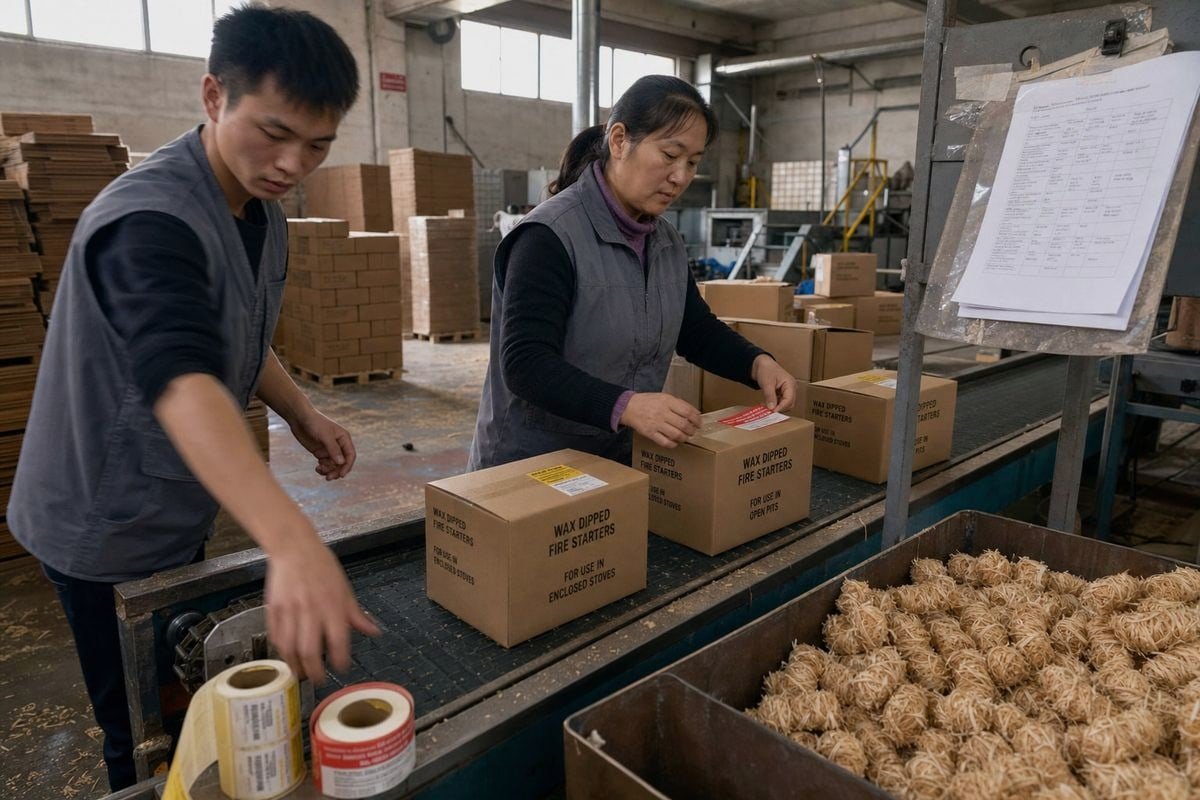
Consistency is where manufacturing depth shows. At our facilities in Ningbo, every batch of wax-dipped wood rolls passes through weight checks, wax-saturation checks, and randomized burn tests before packing. We do this because our positioning depends on one promise: the first sample reliably reflects mass-production quality. You should hold every supplier to that same promise. Here is how.
Um processo de verificação de cinco etapas
- Get a written spec sheet first. It should state dimensions, unit weight with tolerance, wax type, burn time range, and packaging details. No spec sheet means no accountability.
- Request samples from two or more different batches. Compare them side by side. Uniform color, density, and wax coverage across batches signals a controlled process.
- Faça seu próprio teste de queima. Time the ignition, the flame duration, and the smoke. Test in the actual appliance type your customers will use, both open hearth and enclosed insert if you sell both.
- Ask for internal QC records. A genuine factory logs inspection data per batch. Ask to see a recent example, even redacted.
- Book a pre-shipment inspection. SGS or Intertek can pull random cartons and verify against the spec before the container closes.
| Check point | Acceptable variance | Por que importa |
|---|---|---|
| Peso da unidade | Small, defined tolerance per spec | Predicts burn time |
| Saturação de cera | Even coating, no dry cores | Ensures reliable ignition |
| Tempo de queima | Within the stated range | Critical for enclosed, low-oxygen fireboxes |
| Conteúdo de humidade | Low and stable | Prevents smoke and weak flames |
| Packaging & labels | Exact match to approved artwork | Compliance and shelf readiness |
One more practical tip from our export experience across 30+ countries: negotiate a trial order with flexible MOQ before committing to a full container. A supplier confident in their consistency will agree. One who resists is telling you something.
Conclusão
Verifying wood fire starter safety means matching product to appliance, demanding real test reports, and proving batch consistency. Get these three right, and your import risk drops sharply.
Notas de rodapé
1. CDC provides authoritative health guidance on carbon monoxide risks from combustion appliances. ↩︎
2. Authoritative source defining the ISO 9001 quality management standard referenced for factory certification. ↩︎
3. Official site of SGS, a leading independent inspection and testing body cited for fire starter verification. ↩︎
4. Explains the flash point concept critical to evaluating combustion safety of fire starters. ↩︎
5. Background reference explaining the composition and properties of paraffin wax used in fire starters. ↩︎
6. EPA Burnwise program is the official source on certified wood heater standards and emissions. ↩︎
7. Background on creosote formation relevant to flue safety and clean-burning starter claims. ↩︎



 English
  Spanish
  German
  French
  Arabic
  Portuguese
Participe da conversa