







Buyers ask us this constantly: can Magic Fire Powder work in gas fireplaces? On our production line, we designed these packets for wood flames — and mixing that up creates real risk.
No. Magic Fire Powder should not be used in gas fireplaces, propane fire pits, or artificial flame devices. It is formulated for wood-burning fires only. The powder can clog burner ports, damage gas log sets, void warranties, and create indoor air quality hazards in gas systems.
That short answer protects your customers and your liability. But if you are importing or private-labeling color-flame products, you need more detail. Below, I break down the certifications, ingredient checks, customization options, and labeling rules that matter before you place an order.
What safety certifications should I request before selling color-flame powder for gas fireplace use?
A German distributor once asked me for gas-appliance certification on our Magic Fire packets. I had to explain something important: no legitimate certificate exists for that use, because the product is not made for it.
Request SGS or Intertek chemical composition reports, CE conformity documentation, ISO 9001 factory certification, and BSCI social audits. No credible certification exists for color-flame powder in gas fireplaces, because reputable manufacturers formulate and test these products exclusively for wood-burning applications.

Let me be direct about this, because it matters for your risk exposure. If a supplier hands you a certificate claiming their color-flame powder is "approved for gas fireplaces," treat that as a red flag, not a selling point. Gas appliances are safety-tested with specific fuel-air mixtures. No third-party lab certifies chemical additives for use inside a sealed burner assembly, and no serious fireplace manufacturer warranty covers foreign material introduced into the unit.
The certifications that actually matter
In our seventeen-plus years exporting to the US, Germany, the UK, and thirty other markets, these are the documents our buyers require before a purchase order moves forward:
| Certification / Report | What It Covers | Why Buyers Need It |
|---|---|---|
| SGS / Intertek test report | Chemical composition, heavy metal screening | Proves the formula is free of harmful chemicals |
| CE documentation | EU conformity for consumer goods | Required for EU customs clearance and retail shelves |
| ISO 9001 | Factory quality management system | Confirms batch-to-batch consistency |
| BSCI audit | Social and ethical compliance | Required by large retail sourcing channels |
How to verify the paperwork
Do not accept a PDF at face value. Check the report number directly with the testing body. Confirm the report covers the exact formulation you are buying, not a different SKU. And confirm the intended-use statement says wood fires, campfires, and fire pits. If the paperwork is vague about fuel type, your product liability insurer will notice even if customs does not.
How can I confirm Magic Fire Powder ingredients are safe for enclosed or ventilated fireplace systems?
During a QC review at our Ningbo facility last year, we rejected a raw material lot over trace impurities. That level of scrutiny is exactly what you should demand from ingredient documentation.
Request a full ingredient disclosure and third-party chemical analysis. Safe formulations use metallic salts like copper sulfate that vaporize cleanly in vented wood fires. No formulation is safe for ventless gas fireplaces or enclosed gas systems, where particulates enter indoor air directly.

The color effect comes from mineral salts. Copper sulfate 1 produces blue-green flames. Other metallic compounds produce purples, oranges, and pinks. In a wood fire with a hot coal bed and a working chimney 2, these salts vaporize and the combustion byproducts vent outdoors. That is the environment the chemistry was designed for.
Now consider what happens in a gas system. Ventless gas fireplaces release all combustion products 3 into the living room. Add metallic vapor to that mix, and you push heavy metal particulates straight into the indoor air quality your customer breathes. Even in vented gas units, the chemical residue settles where it should never be: on the pilot light assembly 4, the thermocouple, and the ceramic logs. A coated flame sensor causes nuisance shutdowns. Residue on porous ceramic logs causes permanent staining. Fine salts lead to clogged burner ports and uneven flame patterns.
Questions to ask your supplier
- Can you provide the full ingredient list with CAS numbers?
- Do your SGS or Intertek reports screen for restricted heavy metals?
- Is the formula free of harmful chemicals at the disclosed dosage?
- Does the intended-use statement explicitly exclude gas log sets and electric fireplace inserts?
- Do you test each production batch, or only the initial sample?
At our factory, the answer to that last question is every batch. Strict batch-to-batch control is why our first sample reliably matches mass production — and why our buyers do not get surprises at the port. One more point we always flag: these salts are not food-safe. Retail instructions should tell users never to cook marshmallows or hot dogs over a treated fire, because ingesting metal oxides is a genuine health risk.
Can I request custom formulations or burn-time adjustments for artificial flame applications?
We have turned down this exact request more than once. A festival-goods trader wanted a version for propane fire pits, and we walked him toward a safer product path instead.
Yes for wood-fire products, no for artificial flames. Reputable OEM partners can customize colors, burn time, packet size, and packaging for wood-burning use. No responsible factory will formulate powder for gas fireplaces, gas log sets, or electric fireplace inserts, because the risk cannot be engineered away.

Here is what genuine one-stop OEM/ODM customization 5 looks like within the safe scope. We adjust granule size and salt blend to shift the color palette. We adjust packet weight to control burn duration. We package in plastic sachets, kraft bags, or plastic jars under your private label. Every variable stays inside the wood-fire use case, because that is where the chemistry and the certifications hold.
Standard customization options
| Variable | Typical Range | Effect |
|---|---|---|
| Packet weight | 10 g – 30 g | Larger packets burn longer |
| Burn time | 15 – 60 minutes | Depends on weight and fire intensity |
| Color blend | Blue, green, purple, multi | Set by the metallic salt mix |
| Packaging | Sachet, kraft bag, jar, display box | Matches your retail channel |
| Branding | Full private label | Custom artwork, barcodes, warning labels |
Why we refuse artificial-flame formulations
Some buyers assume a lower-residue formula could make gas use acceptable. It cannot. The failure points are mechanical, not just chemical. Any solid additive can migrate into burner orifices. Any vapor can coat a flame-sensing rod. Any residue can etch a cloudy film onto ceramic glass doors that standard cleaners will not remove. Soot buildup accelerates on surfaces the appliance designer never planned for. And the moment a consumer adds foreign material, the fireplace manufacturer warranty is typically void. A supplier who promises you a "gas-safe" formulation is transferring that liability to you. We would rather help you sell color-flame pinecones and packets into the wood-fire market, where demand is strong and the safety case is clean.
What packaging and warning label requirements apply when importing color-flame products for gas fireplace markets?
Years of clearing shipments through US and EU customs taught our team one lesson early: the label is inspected as hard as the powder inside it.
Packaging must carry explicit warnings: for wood fires only, not for propane or artificial gas log pits, do not open the packet, keep away from children, and do not cook over treated flames. EU and US markets also require compliant hazard symbols, importer details, and traceable batch codes.
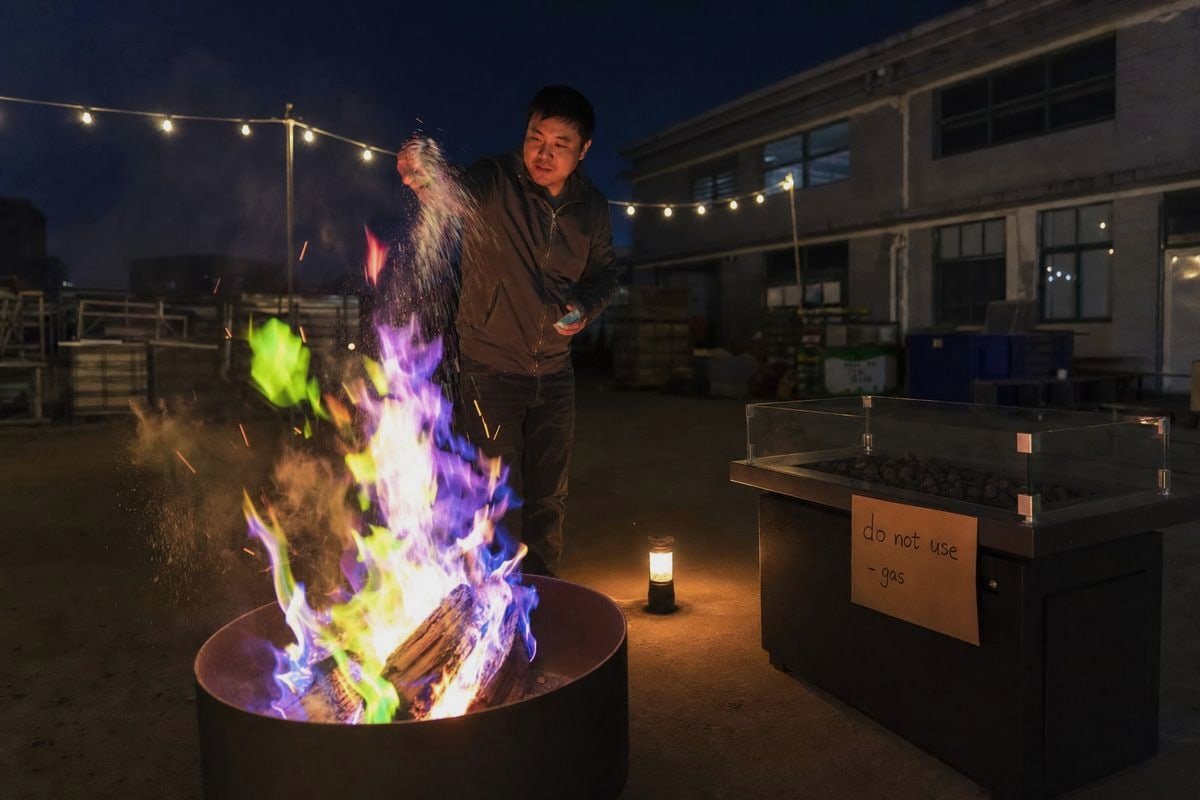
The gas-fireplace exclusion is the single most important line on the label. Marketplace listings that vaguely say "safe for fireplaces" cause exactly the misuse this article warns against. Your packaging must close that gap in plain language. We print the exclusion on the sachet, the display box, and the instruction panel — three touchpoints, because consumers skim.
Core label elements we build into private-label runs
| Label Element | Requirement | Reason |
|---|---|---|
| Intended-use statement | Wood fires, campfires, fire pits only | Blocks gas and artificial-flame misuse |
| Fuel exclusion warning | Not for propane, gas logs, or electric inserts | Protects appliances and limits liability |
| Do not open packet | Throw the sealed sachet into the fire | Prevents skin contact and inhalation |
| Child safety warning | Keep away from children | Colorful sachets can be mistaken for candy |
| No-cooking warning | Do not cook over treated flames | Colorants are not food-safe |
| Batch code and barcode | Printed per production run | Traceability for recalls and retail systems |
Market-specific details
For the EU, CLP-aligned hazard communication 6 and an EU-based importer address are standard expectations. For the US, retailers in the Home Depot–type channel ask for clear cautionary language and scannable barcodes before listing. Child-appeal packaging deserves special attention: our sachets look playful by design, so the child-resistance messaging 7 must be unmissable. Because we handle custom boxes, warning labels, and barcodes in-house, buyers get shelf-ready compliance in one production run instead of coordinating three vendors.
Conclusion
Magic Fire Powder belongs in wood fires — never gas fireplaces or artificial flames. Verify certifications, demand ingredient transparency, customize within safe limits, and label clearly. Partner with a compliant factory, and sell with confidence.
Footnotes
1. Background on the mineral salt that produces blue-green flame coloration in wood fires. ↩︎
2. EPA program on safe wood-burning practices relevant to vented fireplace chemistry discussed. ↩︎
3. EPA resource on indoor air quality risks from combustion byproducts in ventless gas systems. ↩︎
4. Explains the gas fireplace component vulnerable to chemical residue damage from color-flame powders. ↩︎
5. Background concept on private-label manufacturing arrangements referenced for wood-fire product customization. ↩︎
6. Official EU regulation governing chemical hazard labeling requirements mentioned for import compliance. ↩︎
7. US federal standard on child-resistant packaging relevant to color-flame sachet safety warnings. ↩︎


 English
  Spanish
  German
  French
  Arabic
  Portuguese
Join the Conversation