







Magic Fire powder shipments confuse many importers UN Manual of Tests 1. On our production line in Ningbo, we see buyers lose weeks—and margins—because nobody checked the cargo classification before booking freight.
Magic Fire powder ships as ordinary cargo when SDS data and lab tests prove it is non-hazardous; it becomes restricted cargo if classified as Class 4.1 flammable solid or Class 1 pyrotechnic, triggering UN packaging, hazard labels, limited carriers, and 2–5x higher costs.
The name on the pouch does not decide anything. The chemistry, the test reports, and the carrier's acceptance rules do. Let me walk you through each piece, step by step.
How do I know if my Magic Fire powder shipment qualifies as ordinary cargo or restricted/hazardous cargo?
A German distributor once asked me why his first container sat at the port for eleven days. His forwarder had booked our color-flame packets with no SDS attached. That single missing document froze everything.
Classification depends on tested properties, not the product name. Request the SDS and a UN Manual of Tests burn-test result. If the powder passes as non-flammable and contains no energetic composition, it ships as ordinary cargo; otherwise it falls under Class 4.1 or Class 1 restrictions.

Here is the honest truth from seventeen years of exporting fire-themed products to 30+ countries: "Magic Fire powder" is a marketing term, not a shipping name. Regulators and carriers only recognize a proper shipping name, a UN number, a hazard class, and a packing group. Your job is to find out which—if any—apply to your specific formulation.
The three possible outcomes
Think of it as a decision tree with three branches:
| Outcome | What it means | Typical trigger |
|---|---|---|
| Ordinary cargo | Ships through normal parcel, LTL, or ocean channels | SDS confirms non-hazardous; burn test below Class 4.1 threshold |
| Restricted cargo | Ships only with DG paperwork, UN packaging, approved carriers | Classified as Class 4.1 flammable solid 2, Class 5.1 oxidizer, or similar |
| Forbidden cargo | Cannot ship at all by that mode or carrier | Class 1 explosive entries such as UN0027 (gunpowder) or UN0334 (fireworks) |
Canada's TDG schedule lists black powder as UN0027, Class 1.1D, and fireworks as UN0334, Class 1.2G—both marked forbidden in that table. That is why a genuinely pyrotechnic powder may simply have no legal shipping route through standard channels.
Why our Magic Fire packets usually qualify as ordinary cargo
Our color-flame formulations use metal salts that color the flame of an existing fire. They do not self-ignite, do not contain oxidizer-fuel energetic mixes, and pass the UN burn-time criteria for non-Class-4.1 material. We back this up with SGS and Intertek test reports so the classification is proven, not assumed. Some buyers push back and say "it's just powder, treat it as ordinary merchandise." That works only if the test data supports it. A carrier will not accept your opinion; it will accept your lab report.
What packaging and labeling requirements do carriers require for compliant color-flame powder shipments?
Packaging is where we spend surprising amounts of engineering time at our factory in Liuyang. A pouch that looks great on a retail shelf can still fail a carrier's sift-proof or moisture requirement.
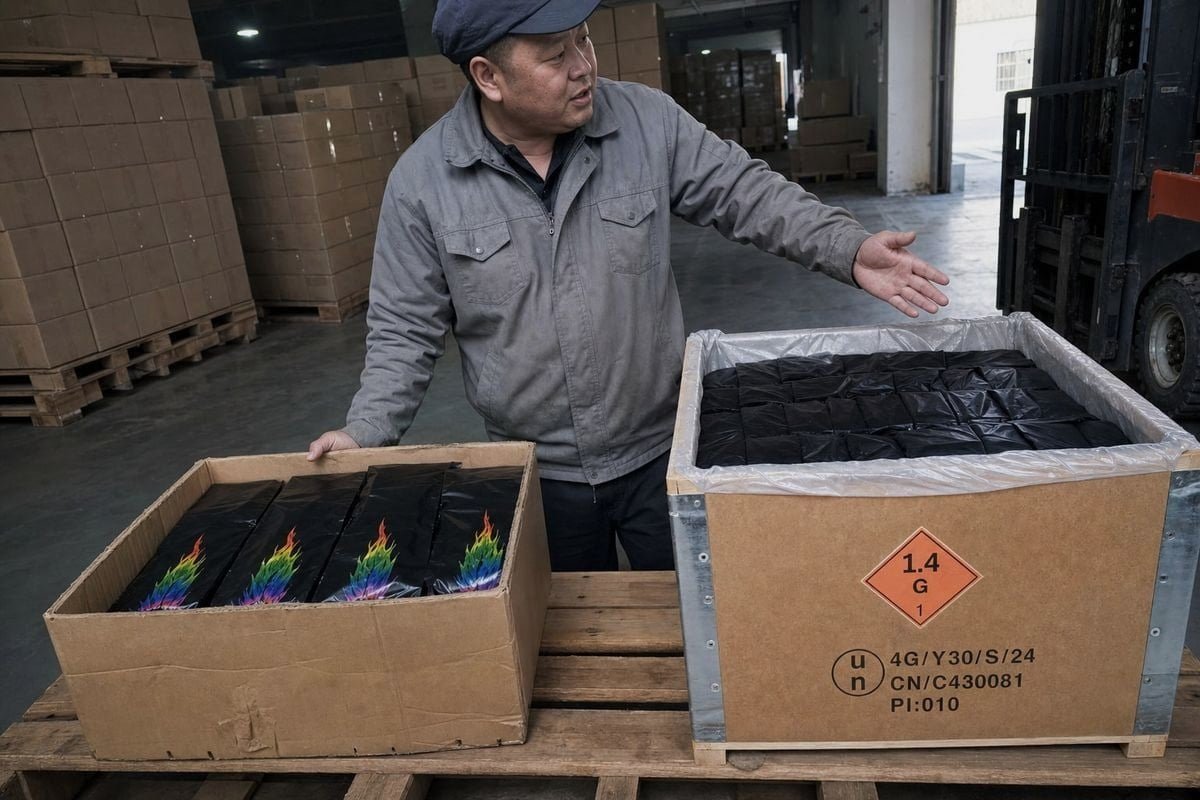
Ordinary color-flame cargo needs sealed, sift-proof, moisture-resistant packaging with clear warning labels and ingredient disclosure. Restricted shipments additionally require UN-certified packaging—such as UN4G fiberboard boxes with approved inner liners—plus Class 4.1 hazard labels, UN number marks, and a Dangerous Goods Declaration.

The key distinction is between industrial packaging and regulatory packaging. A container can be physically strong yet still non-compliant if it is not approved for the specific dangerous-goods entry. Buyers often miss this. They see a thick foil pouch inside a sturdy carton and assume it will clear any carrier. It will not, if the goods are classified hazardous and the carton lacks a UN specification mark.
Packaging requirements compared
| Requirement | Ordinary cargo | Restricted (Class 4.1) cargo |
|---|---|---|
| Inner packaging | Heat-sealed foil pouch, sift-proof | Tight inner packagings, often non-sparking, moisture-barrier |
| Outer packaging | Standard export carton | UN-spec box (e.g., UN4G) matched to packing group |
| Labels | Retail warning label, usage instructions | Hazard class label, UN number, proper shipping name |
| Documents | Commercial invoice, packing list, SDS | All of the left, plus Dangerous Goods Declaration 3 |
| Quantity limits | None from regulation | Per-package and per-shipment caps set by carrier tables |
What we build into every shipment
For our Magic Fire packets—whether in plastic bags, kraft bags, or plastic jars—we standardize a few things regardless of classification. First, heat-sealed inner pouches that block moisture, because damp metal salts clump and burn unevenly. Second, printed warning labels and barcodes tailored to the destination market; US and EU retail chains reject cartons without them. Third, an SDS packed with the documents so customs never has to guess. When we run private-label OEM projects, we also pre-check the buyer's custom packaging artwork against carrier labeling rules. Fixing artwork before printing costs nothing. Fixing it after ten thousand printed boxes arrive is painful, and I have watched a buyer learn that the hard way.
Keep in mind the ORM-D era is over. Compliance for small consumer quantities now runs through Limited Quantity and Excepted Quantity provisions, so older shipping guides for novelty powders are outdated. Always work from current carrier tariffs, not a forum post from 2012.
Why does shipping cost vary so much between ordinary and restricted classifications for the same product?
One trade-off we weigh constantly is formulation versus freight. A slightly "hotter" formula might look impressive in a demo video, but if it tips the product into a hazmat class, the buyer's landed cost can double or worse.
Restricted classification adds UN-spec packaging costs, DG documentation fees, hazmat surcharges, trained-handler requirements, and fewer competing carriers. Combined, these layers typically raise shipping costs 2–5x over ordinary parcel or freight rates for the exact same physical product.

Ordinary cargo pricing is simple. You pay for weight, volume, distance, and speed. Carriers compete hard on those lanes, so rates stay tight. Restricted cargo breaks that model in several ways at once.
Where the extra money goes
- UN-spec packaging. Certified boxes and liners cost more per unit than standard cartons, and you cannot substitute cheaper stock.
- Classification and testing. Lab tests and DG classification work are paid before the first box moves.
- Hazmat surcharges. Carriers apply tiered surcharges by mode and distance—air surcharges run far above ground—so you must model route-specific costs, not assume one flat fee.
- Documentation and trained staff. A Dangerous Goods Declaration 4 must be prepared and signed by certified personnel.
- Reduced competition. Many parcel carriers refuse pyrotechnic-adjacent powders outright, so the few that accept them price accordingly.
- Insurance. Hazardous classification raises cargo insurance 5 premiums and can cap liability coverage—an often-overlooked line in total shipping economics.
Cost drivers side by side
| Cost driver | Ordinary cargo | Restricted cargo |
|---|---|---|
| Base freight | Market-competitive | Limited-carrier premium |
| Packaging | Standard cartons | UN-certified, higher unit cost |
| Surcharges | None | Tiered hazmat fees by mode |
| Paperwork | Minimal | DGD prep, certified signer fees |
| Insurance | Standard premium | Elevated premium, coverage limits |
| Storage | Normal warehouse | DG-approved storage fees |
And if the product is classified as forbidden—like true black powder under UN0027—the cost conversation ends. There is no price; there is only reformulation or a different product. That is precisely why we engineered our color-flame line to test non-hazardous from the start. For buyers moving real volume, a hazmat-certified 3PL with consolidated DG lanes can soften per-unit costs, but nothing beats a product that never enters the restricted category at all.
Which certifications and test reports should I request from my supplier to avoid customs and carrier delays?
A lesson we learned early: buyers do not get delayed by what they know—they get delayed by documents they never thought to ask for. That is why compliance became our first differentiator, not an afterthought.
Request the Safety Data Sheet, a third-party non-hazardous classification or burn-test report from SGS or Intertek, factory certifications such as ISO 9001 and BSCI, product safety marks like CE where applicable, and confirmation the SDS matches the exact shipped formulation and batch.
Documents are the language carriers and customs officers actually read. In our experience exporting to the US, Germany, the UK, and the Middle East, a complete document pack clears goods in days; a partial pack invites inspection holds, storage charges, and sometimes rejected bookings.
The essential document checklist
Ask your supplier for each of these before you place a purchase order, not after:
- Safety Data Sheet (SDS). Current format, in English, listing the real chemical composition Safety Data Sheet 6. This is the foundation for every classification decision.
- Third-party test report. A burn-test or transport classification report from a recognized lab such as SGS or Intertek, stating the product is not a Class 4.1 flammable solid or other dangerous good. We keep these on file for every Magic Fire formulation and share them with buyers up front.
- Factory system certifications. ISO 9001 shows quality control exists; BSCI shows the social audit trail large retailers demand.
- Product safety marks. CE marking 7 documentation for European markets.
- Batch consistency confirmation. The report must match what is actually in the container. A supplier who changes formulation between the tested sample and mass production creates a compliance time bomb.
That last point matters more than most buyers realize. The industry trend is moving toward data-driven acceptance: carriers and customs want the UN number, SDS, and test data tied to the specific goods, because product names tell them nothing. Our strict batch-to-batch quality control exists exactly so the first tested sample reflects every later production run. When a buyer's forwarder asks a hard question, we answer with a document, not a promise. That is what keeps containers moving and reorders on schedule.
Conclusion
Classification decides everything: carrier, packaging, and cost. Verify your Magic Fire powder with an SDS and test reports before booking, and partner with a supplier who documents compliance from the first sample.
Footnotes
1. Official UN source defining burn-test procedures for classifying flammable solids like Class 4.1. ↩︎
2. Background concept explaining hazard classification relevant to Class 4.1 flammable solid materials. ↩︎
3. Links to IATA's official regulations governing Dangerous Goods Declaration requirements for shippers. ↩︎
4. Background context on dangerous goods classification and required shipping documentation. ↩︎
5. WTO trade facilitation resource relevant to international shipping costs, documentation, and insurance considerations. ↩︎
6. Background reference explaining the standard document format referenced throughout the classification process. ↩︎
7. Official EU source explaining CE marking requirements mentioned for European product safety compliance. ↩︎



 English
  Spanish
  German
  French
  Arabic
  Portuguese
Join the Conversation