
Testing wood fire starters 1 for ignition reliability in wind and dampness is a question I face weekly. Buyers get burned by "weatherproof" claims that collapse the moment real weather arrives. On our production line, we see why: many suppliers never test beyond a calm, dry tabletop. The fix is a repeatable protocol you can run yourself.
To test wood fire starters for ignition reliability in wind and dampness, run four staged trials: a calm-air baseline, a water-exposure test, a fan-driven wind test at 15–20 mph, and a kindling-transfer check. Record time-to-ignite, flame stability, and sustained burn time for each, then compare results against fixed pass/fail benchmarks.
That is the short answer. Below, I will walk you through each stage in detail. You will learn what to measure, what benchmarks to use, which lab reports to request, and how to structure a trial order that exposes batch-to-batch problems before they reach your shelves.
What testing methods can I use to verify ignition reliability before placing a bulk order?
Last spring, a German distributor sent back a competitor's sample that lit beautifully in his office but died outdoors in five seconds. Our QC team helped him build a proper test plan instead.
Before a bulk order, verify ignition reliability with five methods: a calm-air baseline test, a submersion or spray wetness test, a fan-based wind resistance test, a kindling-transfer test with real fuel, and a cold-soak test. Repeat each at least five times and log time-to-ignite, flame height, and burn time duration.

The biggest mistake I see buyers make is treating "it lights" as a pass. Ignition reliability is not one event. It is a chain: the starter must catch quickly, hold a stable flame, and push enough heat into kindling to build a real fire. So your test methods must isolate each link in that chain.
Start with a calm-air baseline
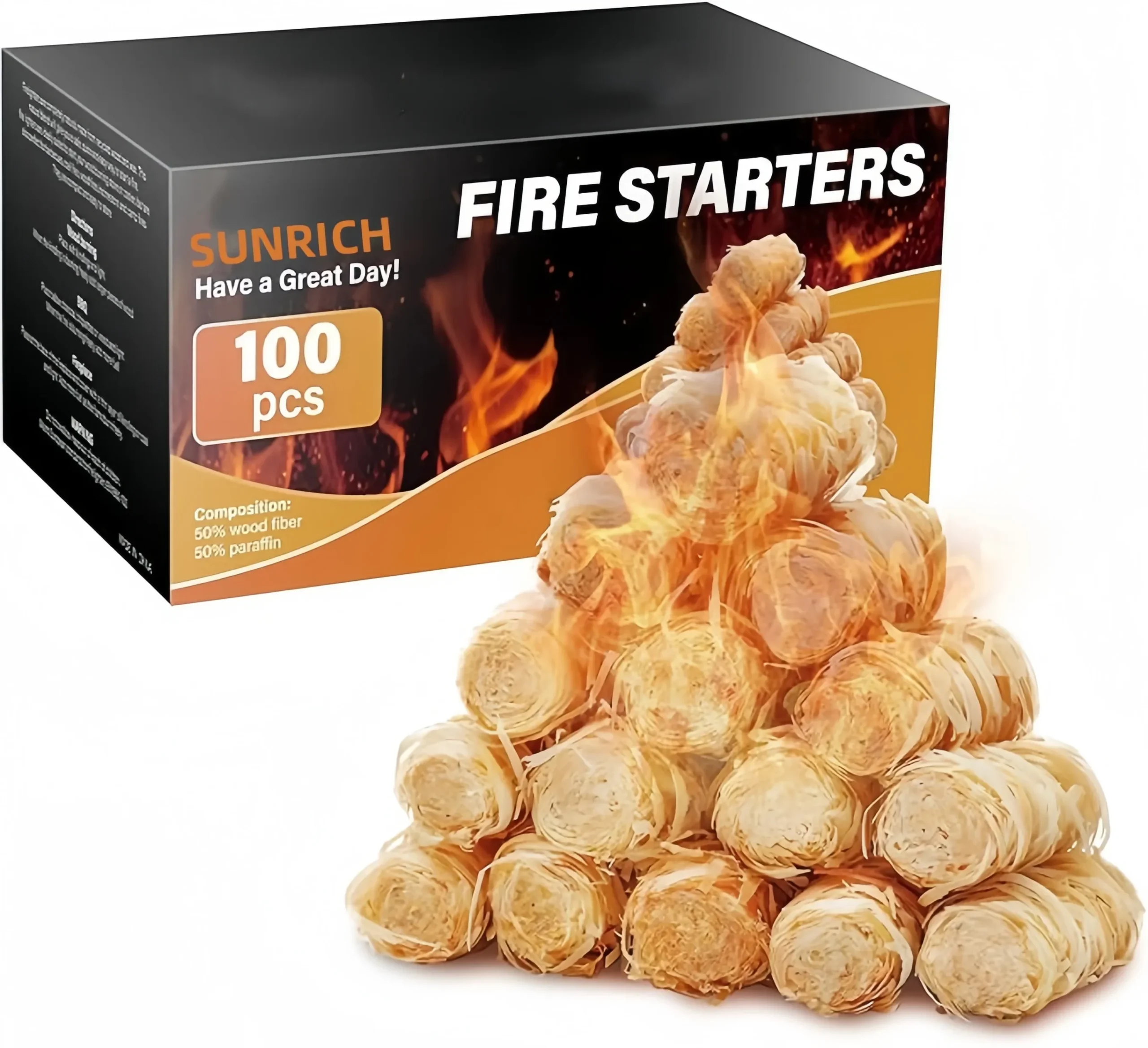
Light the starter indoors or in still air with a standard lighter. Record three numbers: seconds until it self-sustains without the lighter, flame height 2, and total burn time duration. A wax-dipped wood roll like ours should self-sustain within about 8 seconds and hold a 6–10 inch flame. Without this baseline, you cannot tell whether wind or moisture caused a later failure, or whether the product was simply weak from the start.
Then add stressors one at a time
Never combine wind and water in your first round. Wind snuffs a flame mechanically. Moisture blocks the ignition chemistry. If you stack both and the starter fails, you learn nothing about why. Test them separately, then combine them in a final "worst case" round.
Here is the framework I recommend to our B2B buyers:
| Test | Method | Pass Benchmark |
|---|---|---|
| Calm-air baseline | Light with a standard lighter, still air | Self-sustains in ≤8 seconds |
| Wetness test | Submerge 5 minutes, light immediately | Catches in ≤15 seconds, burns ≥90 seconds |
| Wind test | Variable-speed fan at fixed distance | Flame stabilizes in ≤20 seconds at 15–20 mph |
| Kindling transfer | Place under your actual kindling | Visible flame spread in ≤90 seconds |
| Cold-soak | Chill starter overnight before lighting | Matches baseline within 20% |
One more point: test spark compatibility. Ferrocerium rod compatibility matters for survival and bushcraft-focused brands, because a starter that only lights from a sustained lighter flame is useless when a customer's lighter fails in the field. Fluff a small section of the wood wool 3 and check whether low-energy sparks catch. Run every test at least five times per batch. One good result is luck. Five consistent results are data.
How can I confirm my supplier's fire starters perform consistently across damp and windy conditions?
There is a trade-off we weigh constantly in our Ningbo facility: paraffin coating thickness. Too thin, and moisture penetrates the wood fiber. Too thick, and spark ignition suffers. Consistency lives in that balance.
Confirm consistency by testing samples from at least three different production batches under identical damp and windy conditions. Use the same fan speed, water exposure, kindling, and ignition source every time. If time-to-ignite or burn duration varies more than 20% between batches, the supplier's process control is weak.

Consistency is where cheap suppliers fail. A single sample can be cherry-picked. A single batch can be lucky. What you need is evidence that the supplier's raw materials, wax ratios, and dipping process stay stable over time. In our 17-plus years of exporting, the buyers who avoided disasters were the ones who demanded multi-batch data, not the ones who negotiated hardest on price.
Control your variables ruthlessly
Repeatability is everything. Fix these before you start:
- Same ignition source (one lighter model, or one ferro rod).
- Same fan model, speed setting, and distance from the flame.
- Same water exposure time and water temperature.
- Same kindling species, size, and moisture level.
- Same ambient temperature and testing location.
Change one variable and your batch comparison becomes meaningless. I have seen buyers blame a supplier for "inconsistent" product when the real culprit was pine kindling in round one and damp oak in round two.
What "consistent" actually looks like
Run moisture content analysis 4 on the kindling with a cheap pin-type moisture meter so your fuel is comparable across sessions. Then log results per batch:
| Metric | Batch A | Batch B | Batch C | Acceptable Spread |
|---|---|---|---|---|
| Time to self-sustain (calm) | 6 s | 7 s | 6 s | ≤20% |
| Time to catch (after wetting) | 12 s | 14 s | 13 s | ≤20% |
| Wind stabilization at 15 mph | 15 s | 18 s | 16 s | ≤25% |
| Total burn time duration | 9 min | 8.5 min | 9 min | ≤15% |
Burn time matters more than most buyers realize. A starter generally needs 5 to 9 minutes of sustained flame to fully ignite fireplace logs, and damp kindling needs even more heat to evaporate internal moisture. A high flash point temperature 5 in the wax blend also matters here: it governs how the coating releases fuel to the flame and resists premature flare-off in gusts. If one batch burns nine minutes and the next burns five, your end customers will notice — and your returns department will too.
What certifications or lab reports should I request to validate wind and moisture resistance claims?
A UK fireplace brand once asked me why our quotes ran higher than a trading company's. I sent them our SGS report and asked the other supplier's buyer to do the same. Silence followed.
Request ISO 9001 certification for process control, BSCI for factory auditing, CE marking for European market access, and third-party SGS or Intertek test reports covering burn time, ignition performance, and material composition. For weatherproof claims specifically, ask for documented wind resistance testing and water-exposure test data.

Marketing language is cheap. "Waterproof" on a box costs nothing to print. Real documentation costs money and discipline, which is exactly why it separates serious factories from resellers. In our experience exporting to 30-plus countries, compliance paperwork is the first filter established importers apply — before price, before MOQ, before anything else.
Understand what each document actually proves
Buyers sometimes treat certificates as interchangeable stamps. They are not. Each answers a different question:
| Document | What It Proves | What It Does NOT Prove |
|---|---|---|
| ISO 9001 | The factory runs a controlled, repeatable quality system | That any specific product performs well |
| BSCI audit | Ethical and social compliance at the facility | Product performance |
| CE marking | Conformity with applicable EU requirements | Wind or water resistance |
| SGS / Intertek report | Third-party verified test results on the actual product | Future batch consistency (unless retested) |
This table shows why you need the full stack. ISO 9001 tells you the first sample will resemble mass production. The lab report tells you what the sample actually does. Neither alone is enough.
Push past the certificate to the data
For weatherproof ignition sources specifically, ask the supplier three pointed questions. First: what water exposure did the test use — a brief spray, a dunk, or full submersion? Published consumer tests have submerged starters for as long as seven minutes, and many "waterproof" products turned out to be merely water-resistant, needing drying time before lighting. Second: was wind performance measured with a defined airflow speed, or just described anecdotally? Third: does the report cover material composition 6? A declared blend — such as 50% wood fiber and 50% paraffin — lets you verify there are no undisclosed accelerants or harmful chemicals, which matters for retail shelf compliance and for eco-conscious end users worried about combustion residue. A supplier who answers these quickly, in clear English, with documents attached, is telling you something about how the rest of the relationship will go.
How do I set up a small trial order to test batch-to-batch consistency before committing to full production?
Flexible trial MOQs were one of the hardest policies to build into our factory workflow — small runs disrupt line scheduling — but a decade of buyer feedback convinced us they prevent far bigger problems downstream.
Set up a trial order of 500–2,000 units drawn from at least two separate production runs, spaced two to four weeks apart. Test random samples from each run under identical wind, wetness, and kindling conditions, verify packaging and labeling, and only scale up if performance variance stays under 20%.

A trial order is not just a small purchase. It is a controlled experiment on your supplier's entire operation — materials, process, packaging, and communication. Done right, it answers the one question a sample never can: does quality survive when the factory is producing at volume, on a normal schedule, with normal staff?
Structure the trial as a process, not a purchase
Here is the sequence I walk our new buyers through:
- Request samples from current stock first. Establish your baseline numbers before any money moves.
- Place a trial order across two production runs. Ask the supplier to note production dates on cartons. Runs spaced weeks apart expose drift in wax ratios, wood fiber sourcing, and dipping technique.
- Random-sample on arrival. Pull units from different cartons, not just the top layer. Pull from the middle of cartons too.
- Run your full protocol on each run separately. Baseline, wetness, wind resistance testing, and kindling transfer — identical conditions, logged results.
- Test storage behavior. Leave a portion of units in a non-airtight container for several weeks in a humid room. Hygroscopic resistance matters because starters can absorb atmospheric moisture 7 and degrade long before a customer ever strikes a flame. A proper paraffin coating should keep tinder material performance stable through months of shelf life.
- Audit the commercial details. Check private-label printing, warning labels 8, barcodes, and carton strength. A starter that performs perfectly but arrives in crushed retail boxes still fails at shelf.
Judge the supplier, not just the product
During the trial, track how the factory responds to questions. Do they share production dates willingly? Do they explain their batch QC checkpoints? When we run trial orders for camping brands, we include our internal batch records precisely because it shortens this evaluation. A supplier's transparency during a 1,000-unit trial predicts their behavior on a 100,000-unit order far better than any price sheet. If both product data and communication pass, scale with confidence — you have earned it through evidence, not hope. And for brands serving emergency fire lighting or bushcraft survival skills markets, that evidence is what stands behind every "reliable in any weather" claim you print on your packaging.
Conclusion
Weatherproof claims are cheap; proof is not. Test wood fire starters with staged wind and wetness protocols, demand real certifications, and use multi-batch trial orders before committing.
Ignition reliability is measurable. When you fix your variables, benchmark time-to-ignite and burn duration, and verify batch consistency, you stop gambling on marketing language. Choose a supplier who welcomes that scrutiny — because a factory confident in its process will hand you the data before you even ask. That is the difference between a fire starter that sells once and a product line your customers reorder every winter.
Footnotes
1. Provides general context on the history and types of fire starters used in outdoor settings. ↩︎
2. Scientific resource on fire behavior and dynamics, relevant for measuring flame characteristics during testing. ↩︎
3. Defines the material used in wood fire starters to explain its physical properties and ignition characteristics. ↩︎
4. Explains the scientific methods used to measure moisture levels in organic materials like wood. ↩︎
5. Authoritative standard for defining how flash points affect the safety and combustion of flammable materials. ↩︎
6. NIST guide for legal metrology and uniform laws regarding product packaging and labeling. ↩︎
7. Comprehensive NOAA resource explaining the water cycle, evaporation, and atmospheric moisture. ↩︎
8. Explains the regulatory requirements for safety and warning labels on consumer products. ↩︎


 English
 Spanish
 German
 French
 Arabic
 Portuguese
Join the Conversation