






Buyers ask us how to switch Magic Fire powder suppliers safely. On our production line, we have seen one bad transition ruin a brand's shelf reputation overnight.
To switch Magic Fire powder suppliers without consumers noticing, match flame color and burn performance through lab testing, verify certifications like SGS and SDS compliance, replicate packaging and branding exactly, and run a phased transition with buffer stock and parallel sample trials over 4–12 weeks.
Let me be clear about one thing first. The goal is not to deceive anyone. The goal is to keep the product so consistent that there is nothing for consumers to notice. That takes rigorous quality assurance protocols 1, not secrecy. Below, I will walk through the four questions every purchasing manager should answer before making the change.
How can I match my current flame color and burn performance exactly when switching suppliers?
Last spring, a German distributor sent us a rival's sachet and asked us to replicate its green flame. Our lab needed three formulation rounds before the hue matched under identical firewood conditions.
Match performance by requesting a full chemical composition analysis of the current powder, then running side-by-side burn tests for color hue, color intensity, burn time, and flare behavior. Confirm the new supplier meets the same particle mesh size and moisture specifications before approving any production lot.

Flame color comes from metal salts. Copper compounds produce blues and greens. Other salts shift the flame toward purple or orange. This means functional equivalence starts with the flame colorant formulation itself. If the new supplier uses a different salt ratio 2, purity grade, or carrier, the color will drift — and consumers absolutely notice a weaker blue or a shorter show.
Here is a trade-off worth naming. A cheaper powder may pass a quick visual check but fail on burn time performance. In our experience, buyers who only test color hue 3 get surprised three months later by complaints about duration. Test both, every time.
The variables you must lock down
| Variable | Why it matters | How to verify |
|---|---|---|
| Metal salt composition | Determines flame color hue | Chemical composition analysis, CoA review |
| Purity level | Affects color intensity standards | Certificate of Analysis per lot |
| Particle mesh size | Controls flare speed and reaction | Sieve analysis report |
| Moisture content | Impacts shelf life and ignition | Lab moisture testing |
| Volumetric density | Changes sachet weight and hand-feel | Weight-per-volume check |
| Burn time | Defines the consumer experience | Timed burn trials, multiple batches |
Test like a consumer, not just a chemist
We run our product consistency testing in real campfire and fireplace conditions, not only in the lab. Flame spectrometry can confirm the emission wavelength scientifically, but a side-by-side backyard burn tells you what the end user will actually see. Test at least three separate batches. Batch-to-batch variability is where weak suppliers reveal themselves — the first sample is often the best sample they will ever send you.
What certifications should I verify to ensure the new supplier meets my compliance standards?
Compliance is the first filter we apply, and the first one our buyers apply to us. Every export shipment we send to the US or EU travels with a full documentation pack.
Verify ISO 9001 quality management certification, third-party test reports from SGS or Intertek, a current Safety Data Sheet with correct GHS hazard classification, a Certificate of Analysis for a representative lot, and market-specific marks such as CE for Europe. Request original documents, not screenshots.

A lesson we learned early in our 17 years of exporting: paperwork problems surface at the worst possible moment — usually at customs, or after a retailer audit. A powder that burns beautifully but lacks Safety Data Sheet compliance can freeze your entire inventory at a port. That risk is far more expensive than any per-unit saving.
Some buyers push back here. They argue that certification checks slow the deal down, and that a fast swap protects them from a looming stockout. I understand the pressure. But a one-week documentation review is nothing compared to a rejected container or a mandatory relabeling of ten thousand retail boxes. Speed without rigor is how transitions fail.
The compliance checklist we recommend
| Document | What it proves | Red flag if missing |
|---|---|---|
| ISO 9001 certificate | Functioning quality management system | No systematic QC behind samples |
| SGS / Intertek test report | Independent product safety verification | Claims rest on supplier's word only |
| SDS with GHS classification | Correct hazard labeling for your market | Packaging warnings may be invalid |
| Certificate of Analysis | Lot-specific composition and purity | No traceability for raw material sourcing |
| BSCI audit report | Ethical and social compliance | Retail chains may reject the vendor |
| CE / market-specific marks | Legal market access in the EU | Import barriers, distributor liability |
One critical detail: align the new supplier's GHS hazard classification 4 with your existing packaging. If the classification changes, your warning labels 5 and safety icons must change too — and that becomes a material, visible difference on the shelf. Matching the SDS profile is what keeps your regulatory-facing packaging legitimately unchanged.
How do I keep my packaging and branding consistent during a supplier transition?
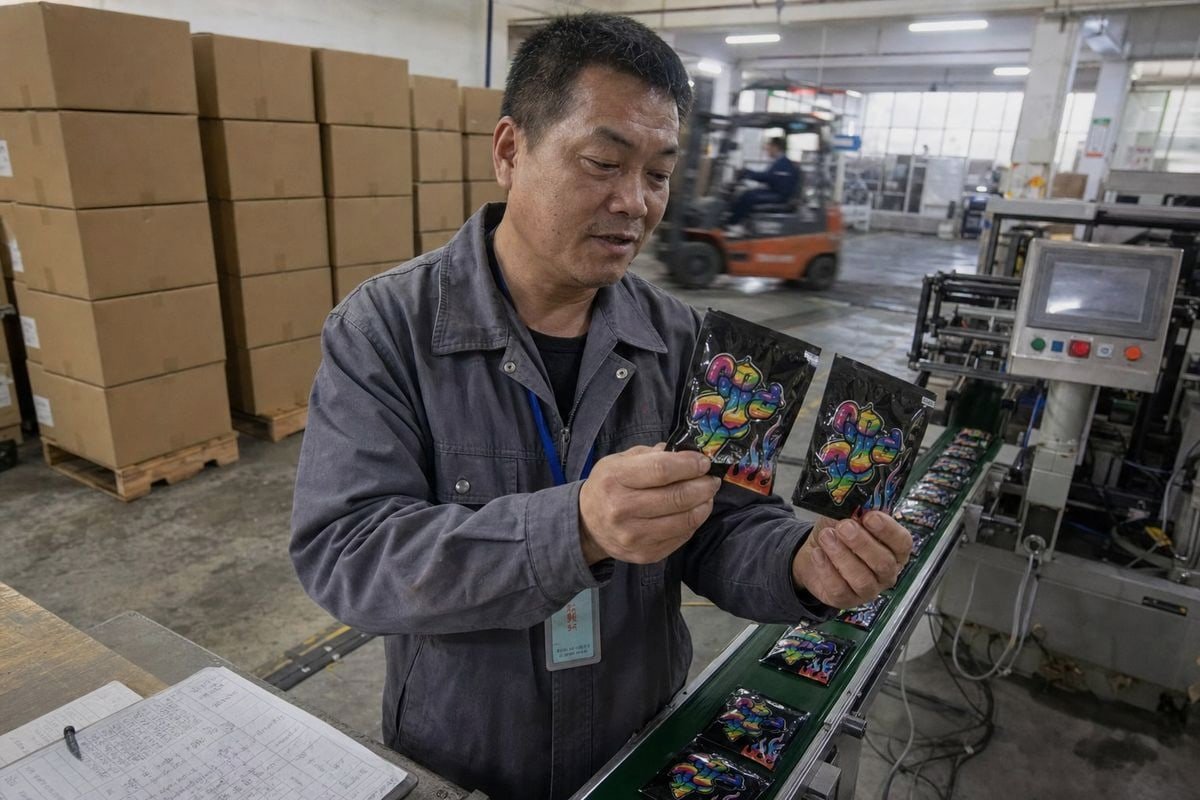
Private-label work makes up a large share of our OEM/ODM orders, so we routinely rebuild a client's existing pouch — down to the foil finish and the exact gradient on the flame graphics.
Keep packaging consistent by transferring exact print files, Pantone color codes, foil material specifications, and sealing dimensions to the new supplier. Use a Distributed By labeling format so the brand identity stays independent of the manufacturing source, and approve a physical pre-production sample before rollout.

Consumers judge continuity with their hands as much as their eyes. A glossy black foil sachet that suddenly feels thinner, crinkles differently, or weighs less signals a change even when the powder inside is identical. When we onboard a private-label client mid-transition, we ask for physical samples of their current retail packaging, not just artwork files. Print files miss the tactile details — film thickness, matte versus gloss lamination, heat-seal edge width.
A practical packaging handover process
- Collect physical samples of every current SKU: foil sachet, kraft stand-up pouch, display box, and jar.
- Transfer original artwork with Pantone references 6, fonts, and dieline files.
- Specify the substrate: foil gauge, lamination type, zip-closure style for resealable pouches.
- Calibrate fill weight and volumetric density so the sachet matches the familiar hand-feel — consumers often judge value by packet density.
- Approve a pre-production sample under retail lighting, side by side with the current pack.
- Confirm barcodes, batch coding position, and warning label placement match your compliance layout.
The Distributed By format deserves a note. Listing your company as the distributor on the label is a standard, legal practice in most markets. It keeps your brand identity stable across sourcing changes, provided the product itself remains compliant and consistent. It is transparency-compatible continuity — not concealment. Our factory produces custom boxes, warning labels, and barcodes in-house, which shortens this handover considerably.
What's the safest way to plan sample testing and order timing so my supply chain isn't disrupted?
A Canadian importer once asked us to complete qualification in two weeks before peak camping season. We declined and proposed a parallel-run plan instead. He later told us that answer won his trust.
Plan the supply chain transition in phases: hold six to eight weeks of buffer stock, run lab samples and pilot lots in parallel with your current supplier, and only move the new source into the critical path after full qualification. Standard transitions take 4–12 weeks; complex cases take 2–6 months.

The single biggest mistake we see is the hard cutover. A buyer exhausts old inventory, then depends entirely on an unproven source. If the first production lot fails burn time performance or arrives late, there is no fallback. Supplier switching research describes three stages — initiation, substitution, and stabilization — and some switches revert entirely when the new supply cannot meet requirements. Build your plan assuming a rollback might be needed.
A realistic transition timeline
| Phase | Typical duration | Key activities |
|---|---|---|
| Documentation review | 1–2 weeks | SDS, CoA, certifications, technical assessment |
| Sample procurement and testing | 2–4 weeks | Burn trials, product consistency testing, First Article Inspection |
| Internal approvals | 1–3 weeks | QA sign-off, approved vendor list update, spec version control |
| Logistics and account setup | 1–2 weeks | Payment terms, shipping lanes, incoming inspection plan |
| Parallel run and limited release | 2–4 weeks | Pilot lots sold alongside existing stock, monitoring |
Smoothing the rollout
A phased inventory transition 7 beats a big-bang launch. Some buyers use lot sequencing during the first rollout to smooth minor performance variations while the new source stabilizes. Keep incoming inspection tight for the first three to five shipments — that is when batch-to-batch variability shows up. Also weigh dual sourcing seriously. Yes, it adds complexity and overhead. But maintaining your outgoing supplier at low volume during stabilization gives you an escape hatch that single sourcing never will. Treat the switch as resilience planning for your raw material sourcing, not just a cost move.
Conclusion
A supplier switch consumers never notice is earned, not hidden. Match the formulation, verify compliance, replicate packaging, and phase the timing — then the product simply stays consistent.
Footnotes
1. Authoritative Wikipedia entry for the ISO 9001 quality management standard. ↩︎
2. Scientific explanation of how different chemical ratios and metal salts produce specific flame colors. ↩︎
3. Technical overview of the flame test used to identify metal ions based on emission spectra. ↩︎
4. Official OSHA resource for the global system of chemical classification and labeling requirements. ↩︎
5. Leading global service for verifying consumer product labeling and regulatory compliance standards. ↩︎
6. Stable and comprehensive overview of the Pantone Matching System. ↩︎
7. Comprehensive overview of supply chain strategies including inventory management and vendor transition planning. ↩︎



 English
  Spanish
  German
  French
  Arabic
  Portuguese
Join the Conversation