







Storing Magic Fire powder safely in RVs and outdoor boxes worries many of our buyers. On our production line, we design every sachet around this exact challenge — because heat, moisture, and ignition sources rarely announce themselves before they cause damage.
Store Magic Fire powder safely in RVs and outdoor boxes by keeping sachets in their original sealed packaging, inside a cool, dry, shaded compartment below 104°F (40°C), away from propane, batteries, fuels, and direct sunlight, with desiccant packets controlling humidity and containers locked away from children.
That is the short answer. Below, I break down the storage conditions, packaging choices, compliance requirements, and labeling standards that matter — both for end users and for the importers who put this product on shelves.
What Storage Conditions Keep Magic Fire Powder Stable During Long-Term RV Travel?
A distributor in Arizona once asked us why his demo stock clumped after one summer in a trailer. Our QC team traced it back to one thing: compartment heat, not product failure.
Magic Fire powder stays stable in RVs when stored below 104°F (40°C), under 50% relative humidity, in original sealed sachets, placed in a low-vibration interior cabinet away from propane appliances, battery banks, inverters, water heaters, and windows that receive direct sunlight.

Heat is the enemy that most travelers underestimate. An RV parked in summer sun can exceed safe storage temperatures within an hour. Powder-storage guidance warns that shelf life can drop by roughly one-third for every 10°C above 25°C. That means a sachet rated for years of stability may degrade in a single hot season. Moisture is the second threat. The metal salt colorants 1 inside — the compounds that create blue, green, and purple flames — absorb humidity, clump, and lose performance. Vibration is the third. Long drives on rough roads can cause micro-tears in sachets, so a padded, centralized, low-vibration cabinet beats a rattling exterior bay.
Best, Acceptable, and Avoid Locations in an RV
| Rating | Location | Why |
|---|---|---|
| Best | Interior cabinet, mid-vehicle, shaded | Cool, dry, low vibration, away from ignition sources |
| Acceptable | Under-bench storage away from appliances | Moderate temperature swings, but protected |
| Avoid | Near propane lines, fridge vents, or furnace | Direct ignition and heat sources nearby |
| Avoid | Exterior bays facing the sun | Rapid heat buildup, trapped humidity |
| Avoid | Engine compartment or battery area | Extreme heat plus electrical spark risk |
Practical Rules for Long Trips
Follow smokeless-powder style storage logic unless the product label says otherwise. Keep quantities small — several individual sachets in different spots are safer than one bulk mass. Follow basic campfire safety protocols 2 even in storage: no fuels nearby, no aerosols beside the powder, no loose storage on the floor. If the RV will sit unused in hot weather, move the powder out. RV fire-safety guidance already recommends removing combustible materials 3 like aerosol cans during storage, and this product deserves the same discipline.
Which Packaging Materials Should I Specify to Prevent Moisture Damage in Outdoor Storage Boxes?
When we developed our kraft-bag option for a German camping brand, the deciding factor was not looks — it was the moisture barrier layer hidden inside the laminate.
Specify multi-layer foil sachets with heat-sealed edges as primary packaging, backed by resealable moisture-proof packaging such as lined kraft pouches or plastic jars, then store everything in opaque, UV-stabilized, weatherproof storage bins with silica gel desiccant packets inside.
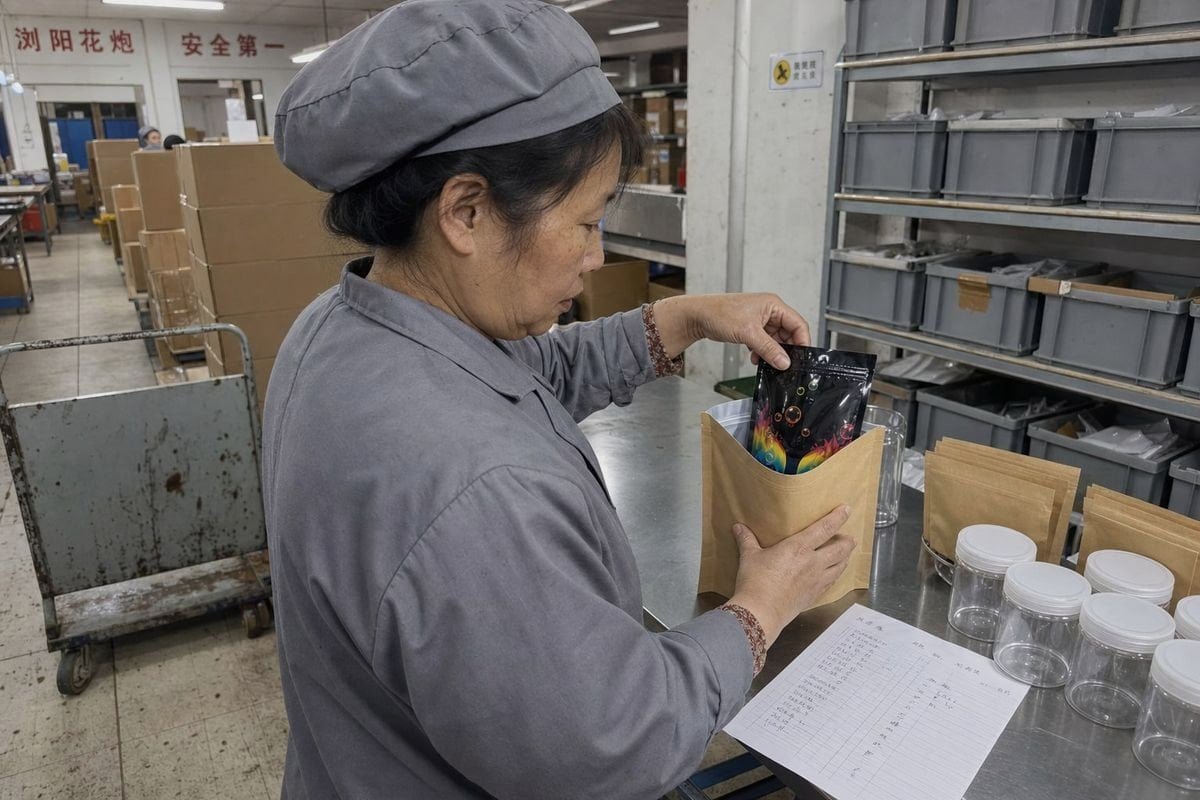
Outdoor boxes face a rougher environment than any RV cabinet. Rain, condensation, temperature swings, and UV exposure all attack packaging over time. In our experience exporting to humid markets like Brazil and the Middle East, the primary sachet does most of the work — which is why we heat-seal multi-layer foil pouches rather than single-layer plastic. Foil laminate blocks water vapor 4 far better than plain polyethylene. But primary packaging alone is not enough for months of outdoor storage. You need a layered defense.
The Three-Layer Defense System
- Primary layer: Sealed foil sachet. Never transfer powder into an unapproved container. The original packaging carries warnings, ingredient data, and the tested moisture barrier.
- Secondary layer: A resealable pouch or rigid jar. Our kraft stand-up pouches with zip tops work well here, as do sealed plastic jars for bulk display packs.
- Tertiary layer: An opaque, UV-stabilized outdoor bin, placed in full shade, off the ground, and away from sun-heated walls.
Comparing Outdoor Container Options
| Container Type | Moisture Protection | Heat Protection | Notes |
|---|---|---|---|
| Plastic tote (opaque, UV-stabilized) | Good with desiccant | Poor in direct sun | Must stay shaded |
| Metal ammo box | Excellent seal | Absorbs heat quickly | Fine short-term; watch heat |
| Wooden cabinet (vented) | Moderate | Better insulation | Needs rain protection |
| Airtight storage containers with silica gel | Excellent | Depends on placement | Best paired with hygrometer |
Here is a nuance buyers should understand. Hobbyists often say a sealed ammo can with desiccant solves everything. That works for short-term transport protection. For long-term storage, formal powder guidance is more cautious: it favors original containers and warns against fully confined storage that traps heat. A dry box does not fix a hot environment. The environment around the box matters more than the box material itself. Add silica gel, check it with a small hygrometer, and open the box occasionally to inspect for moisture, odor, or discoloration. A secondary containment liner, such as a silicone mat, also protects the box floor if a sachet ever fails — some metal salt colorants can be mildly corrosive to bare metal.
How Do I Ensure My Private-Label Packaging Meets Safety and Compliance Standards for Retail Shelves?
One trade-off we weigh on every OEM project is shelf appeal versus regulatory space. A beautiful design that leaves no room for mandatory warnings will fail a retail audit — we have seen it happen to competitors' products.
Ensure compliance by requiring your manufacturer to hold ISO 9001, BSCI, CE, and SGS or Intertek certifications, provide a current Material Safety Data Sheet, print all mandatory hazard warnings and ingredient disclosures on the packaging, and supply test reports before production begins.

Retail buyers in the US and Europe treat compliance as a hard gate, not a preference. Chemical fire colorants sit in a category that regulators watch closely, because the product contains combustible materials and metal salts. Our factory in Ningbo has spent 17+ years building the documentation stack that big-box sourcing teams demand, and the pattern is consistent across markets.
The Compliance Checklist for Private-Label Buyers
Start with the documents. Every private-label order should include a Material Safety Data Sheet covering the exact formulation in your sachets — not a generic template. If your product uses copper sulfate 5 or similar compounds for blue-green effects, the MSDS must name it, list handling precautions, and state first-aid measures. Then verify the factory itself. ISO 9001 confirms a working quality system. BSCI covers social compliance 6, which major EU retailers now require. CE marking matters for European shelves, and third-party test reports 7 from SGS or Intertek prove the product matches its claims batch after batch.
Packaging Design Requirements
Your artwork must reserve space for mandatory elements. In our OEM projects, we block these out before any creative work starts:
- Ingredient and hazard statements in the destination market's language
- "Keep away from children" warnings — colorful packets can resemble candy, so child-deterrent messaging and lockable retail hooks matter
- Batch codes and traceability marks for recalls
- Barcodes formatted to the retailer's specification
- Clear usage instructions separating the product from food, kitchenware, and pet supplies
One more point from experience: sample-to-production consistency is itself a compliance issue. If your first shipment differs from the tested sample, your certification no longer covers what is on the shelf. Strict batch-to-batch quality control is what makes the paperwork meaningful.
What Warning Labels and Certifications Should I Require From My Manufacturer Before Importing Bulk Orders?
Early in my export career, a Canadian importer taught me a hard lesson: his customs broker rejected a shipment because the hazard classification paperwork did not match the label wording. We rebuilt our labeling workflow after that.
Require CE marking, SGS or Intertek test reports, ISO 9001 and BSCI factory certificates, a product-specific MSDS, GHS-aligned hazard pictograms, child-safety warnings, "keep away from flame until use" statements, ingredient disclosure, batch traceability codes, and destination-market language compliance before importing bulk orders.

Bulk importing raises the stakes. A labeling gap on a trial carton is an inconvenience; the same gap on a 40-foot container is a costly detention at port. Hazardous material handling rules vary by market, so I always advise buyers to define their label requirements in the purchase contract, not after production. Here is the framework we use with our own B2B clients across the US, Germany, UK, and Australia.
Required Documents and Labels by Purpose
| Requirement | What It Proves | When You Need It |
|---|---|---|
| MSDS (product-specific) | Chemical composition and handling guidance | Customs clearance, retailer onboarding |
| SGS / Intertek test report | Product matches safety claims | Before first bulk payment |
| CE marking | EU conformity | All European shipments |
| ISO 9001 certificate | Factory quality system | Supplier qualification |
| BSCI audit report | Ethical production standards | EU and UK retail programs |
| GHS hazard pictograms | Standardized hazard communication | On-pack, all markets |
| Batch/lot codes | Recall traceability | On-pack and cartons |
Verifying Before You Wire the Deposit
Ask for certificate numbers and verify them directly with the issuing body — legitimate factories expect this. Request the actual test report, not a photo of a frame on an office wall. Confirm the report covers your exact SKU and formulation. Then check label proofs against your destination rules: warning text size, language, and pictogram placement all get audited. Finally, insist on a pre-shipment inspection that includes label verification, not just product function. A product that colors flames beautifully but wears the wrong label is still an import failure.
Conclusion
Safe storage comes down to cool, dry, original packaging away from ignition sources — and safe importing comes down to verified certifications, proper warning labels, and a manufacturer who treats compliance as non-negotiable.
Footnotes
1. Explains the chemical compounds used to create colored flames in pyrotechnic products. ↩︎
2. Provides official safety guidelines for managing fire-related materials in outdoor and camping environments. ↩︎
3. Official OSHA guide to managing and identifying chemical hazards and combustible materials in the



 English
  Spanish
  German
  French
  Arabic
  Portuguese
Join the Conversation