






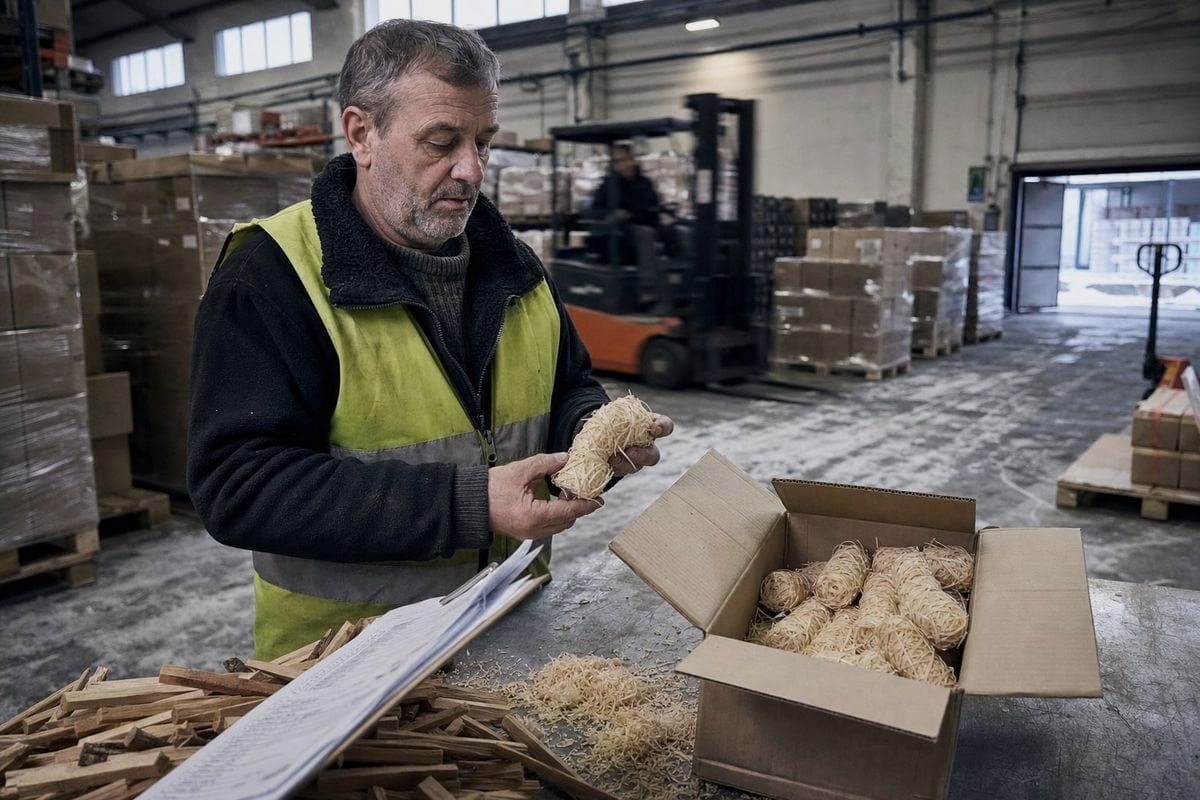
Seasonal return costs on wood fire starters quietly eat margins, and after 17+ years running our own production lines, I have watched buyers underestimate them every single winter.
Seasonal return costs affect profit margins on wood fire starters by stacking refunds, reverse shipping, inspection labor, and disposal losses on top of winter-inflated logistics. A 5–10% return rate can erase the entire gross profit on affected units, because returned flammable goods often cannot be resold.
Let me walk you through where these costs hide, how quality control and packaging reduce them, and how smarter MOQ planning keeps your season profitable.
Last December, a European distributor called us in a panic Intertek 1. His previous supplier's fire starters crumbled in transit, and his return costs had wiped out his Q4 profit. That call taught me a lot.
Hidden costs from seasonal returns include reverse shipping at peak-season carrier rates, hazmat-related freight surcharges, inspection and restocking labor, disposal fees for unsellable flammable stock, and lost customer lifetime value. Together these often exceed the original per-unit profit on wood fire starters.

The base unit price of a fire starter is rarely the real margin killer. The seasonal logistics stack is. Wood fire starters sell almost entirely in fall and winter. That means every mistake happens exactly when carriers are busiest, warehouses are fullest, and labor is most expensive. A return in January costs meaningfully more to process than the same return would in June.
There is a second problem that many buyers miss. Fire starters are combustible goods. Once a customer opens a box of wax-dipped wood rolls and sends it back, most retailers cannot legally or safely restock it. The return is not a recoverable asset. It is a total loss plus processing cost.
Breaking down the full cost of one returned unit
| Cost component | Typical impact | Why it hurts in winter |
|---|---|---|
| Refund to customer | Full retail price | Winter retail prices run 20–30% higher |
| Reverse shipping | Often exceeds unit profit | Peak-season carrier rates and surcharges |
| Inspection and restocking labor | Fixed labor per unit | Warehouse labor is tightest in Q4 |
| Disposal of unsellable stock | Full landed cost lost | Flammable goods usually cannot be resold |
| Lost repeat business | Hard to quantify, very real | One failed fire ruins trust in the brand |
When we quote B2B buyers, I always encourage them to model contribution margin 2 after returns, not headline gross margin. A cheap SKU with a 10% failure rate almost never beats a reliable SKU with a 1% failure rate, even at a noticeably higher purchase price. The math simply does not work in the cheap product's favor once winter reverse logistics enter the equation.
How can I reduce return rates by choosing a manufacturer with strict quality control?
The trade-off I weigh every day on our production floor is simple: tighter batch controls cost us time, but loose controls cost our buyers returns. We chose tighter controls years ago.
Choose a manufacturer with certified quality systems, batch-to-batch testing, and documented ignition and burn-time checks. Consistent wax saturation, moisture control, and structural integrity are the three factors that most directly prevent the "won't light" and "burns too fast" complaints driving returns.

Return data in this category tells a consistent story. The top complaint reasons are ignition failure, burning out too quickly, crumbling product, and inconsistent performance between units in the same box. Every one of those traces back to the factory floor, not the retailer.
At our facility in Ningbo, we learned this the hard way in our early years. Wood wool with slightly high moisture content 3 passes a visual check but fails an ignition test weeks later after sitting in a humid container. That is why we now test ignition and burn time on samples from every batch, not just the first production run. Our ISO 9001 4 process exists precisely so the sample you approve matches the pallet you receive six months later.
What to verify before you commit to a supplier
- Ask for certifications with actual documents, not claims. ISO 9001, BSCI 5, and third-party test reports from SGS 6 or Intertek should be available on request.
- Request batch QC records. A real factory can show you ignition-test logs and burn-time tolerances for recent production runs.
- Order a trial batch and test it yourself. Light units from different boxes. Consistency across boxes matters more than one perfect sample.
- Confirm moisture and wax-saturation controls. These determine whether the product still lights reliably after months in a warehouse.
- Check whether you are dealing with a factory or a trader. Traders cannot control the variables that cause returns.
Trading companies often cannot answer these questions because they never see the production line. In my experience exporting to the US and Germany, the buyers with the lowest return rates are the ones who audited the factory, approved a golden sample, and tied the purchase contract to that sample's specifications.
Does better packaging and compliance labeling help lower my seasonal return risk?
A US importer once showed me a photo of his competitor's crushed retail boxes on a store shelf. Half were returned unsold. Our display cartons ship with reinforced inner trays for exactly that reason.
Yes. Durable packaging prevents the transit damage—crushed wax pucks, broken sticks, leaked wax—that drives a large share of returns. Proper compliance labeling with warnings, composition details, and barcodes also prevents retailer chargebacks, customs delays, and forced pull-backs from shelves.

Packaging failures create two separate return streams, and buyers should model them separately. The first is consumer returns: a customer opens a box of crumbled fire starters and sends it back. The second is retailer-level rejection: a chain refuses a shipment because labeling does not meet market requirements, or boxes arrive too damaged to shelve. The second type is far more expensive because it involves whole pallets, not single units.
Compliance is the quieter risk. Fire starters sold in the EU and North America need correct warning language, composition disclosure, and often specific pictograms. When we develop private-label packaging for clients, our team handles warning labels, barcodes, and market-specific text as part of the OEM process, because a labeling mistake discovered after landing means relabeling costs at best and rejected inventory at worst.
Packaging choices and their return-risk impact
| Packaging factor | Weak approach | Return-reducing approach |
|---|---|---|
| Inner protection | Loose pucks in a carton | Trays or dividers holding each unit |
| Moisture barrier | Plain cardboard only | Sealed inner bag or wax coating |
| Outer carton strength | Single-wall board | Double-wall board rated for stacking |
| Warning labels | Generic English text | Market-specific compliant wording |
| Barcodes and retail data | Added by importer later | Printed at factory, verified pre-shipment |
There is also a subtle seasonal angle here. Fire starters often sit in warehouses through summer before selling in winter. Packaging that protects against humidity during those idle months preserves ignition performance. A product that lights perfectly at inspection but absorbs moisture over four months of storage will still generate winter returns, and the retailer will blame the brand, not the warehouse.
Should I adjust my MOQ and inventory planning to avoid costly end-of-season returns?
One lesson I have learned from serving distributors across 30+ countries: the buyers who order early and in staged volumes almost never face the brutal March clearance problem.
Yes. Order earlier at off-season pricing, split volume into a firm base order plus a flexible reorder, and negotiate trial MOQs before scaling. This limits end-of-season overstock, which otherwise forces discounting, storage costs, or supplier returns that destroy the year's margin.

End-of-season returns are usually a demand-forecasting failure 7, not a product failure. A buyer overestimates the winter, orders one large container in September, and by February is sitting on 40% of it. The options at that point are all bad: liquidate at a discount, pay to store it until next winter, or try to push it back up the supply chain at a loss.
The better approach is structural. First, buy earlier. Wood-related fuel products are commonly cheaper in summer, sometimes by a wide margin, so early orders lower your landed cost and give you a bigger buffer against later markdowns. Second, split the order. Place a conservative base order for guaranteed demand, then a fast-turn reorder once early-season sell-through data comes in. We support this pattern with flexible MOQs for trial and reorder volumes, precisely because it works for our long-term clients.
A staged ordering framework for the season
| Stage | Timing | Volume approach | Margin effect |
|---|---|---|---|
| Trial order | Spring | Small MOQ, test quality and market | Low risk, validates the SKU |
| Base order | Early summer | 60–70% of forecast demand | Off-season pricing, cheaper freight |
| Reorder | Early season | Based on actual sell-through | Matches supply to real demand |
| Clearance plan | Pre-set in autumn | Bundles, no-return promotions | Avoids reverse logistics entirely |
Two more tactics deserve mention. Bundling fire starters with kindling or matches lifts order value and lowers standalone return rates. And a clearly stated end-of-season clearance policy often preserves more margin than accepting returns and paying reverse-logistics costs on goods you cannot resell anyway. Watching weather forecasts for your key regions before finalizing the reorder adds one more layer of protection against a mild winter.
Conclusion
Seasonal return costs, not unit price, decide fire starter profitability. If you want a compliant, quality-controlled partner for your next season, I would be glad to talk.
Footnotes
1. Official site of Intertek, an independent testing and inspection company referenced for quality assurance. ↩︎
2. Defines contribution margin, the financial metric recommended for evaluating return-adjusted profitability. ↩︎
3. Background on moisture's role in material degradation, relevant to ignition failure discussed. ↩︎
4. Official ISO reference for the quality management standard mentioned as a supplier verification requirement. ↩︎
5. Links to the official amfori BSCI compliance program cited as a certification buyers should request. ↩︎
6. Official site of SGS, a global testing and certification body cited for supplier verification. ↩︎
7. Explains demand forecasting concept underlying the overstock and return problem described. ↩︎



 English
  Spanish
  German
  French
  Arabic
  Portuguese
Join the Conversation