







Buyers often ask me whether Magic Fire powder needs different specs for fireplaces versus bonfires. On our production line, we learned early that mixing up the two can sink a retail launch.
Magic Fire powder for indoor fireplaces requires stricter emissions testing, smaller dosage formats, ventilation warnings, and wood-fire-only labeling, while outdoor bonfire use demands larger or multiple packets, weather-resistant packaging, and stronger color intensity. The base formula can be identical, but compliance, dosage, and packaging requirements differ.
Let me walk you through the four areas where these requirements actually diverge. Each one affects how you spec, label, and sell the product.
What certifications should I check before using color-flame powder indoors versus outdoors?
During a BSCI audit 1 at our Ningbo facility a few years back, an auditor asked why our indoor-labeled sachets carried extra warning text. That question captures the whole issue.
For indoor use, verify SGS or Intertek emissions and heavy-metal test reports, CE marking, and explicit indoor-safe labeling. For outdoor use, CE and general chemical safety reports usually suffice. Both require REACH compliance in Europe and clear wood-fire-only warnings on the packaging.

The certification question matters more than most importers realize. In our 17+ years exporting to the US, Germany, the UK, and beyond, we have seen customs officers and retail compliance teams treat indoor fire additives with far more scrutiny than outdoor ones. The reason is simple. Indoor combustion happens in a semi-enclosed space. Any residue, fume, or particulate stays closer to people.
The certifications that actually get checked
Here is what buyers in our main markets typically request, broken down by use case:
| Requirement | Indoor Fireplace | Outdoor Bonfire |
|---|---|---|
| SGS 2/Intertek chemical test report | Essential | Recommended |
| Heavy-metal content screening | Essential | Recommended |
| CE marking 3 (EU markets) | Essential | Essential |
| REACH compliance 4 | Essential | Essential |
| Emissions/fume documentation | Often requested | Rarely requested |
| Indoor-safe label claim support | Essential | Not applicable |
| ISO 9001 factory certification | Expected by retail chains | Expected by retail chains |
A key point of tension exists in the market. Many retail listings claim products are safe for indoor use if the fireplace is properly ventilated. But seller statements are not independent certifications. When our clients pitch to large retail chains, the buyers ask for actual test reports, not marketing copy. That is why we keep SGS and Intertek 5 reports current for every formula batch.
One more distinction. Some cheaper formulations on the market use metal salts that produce vivid color but carry heavy-metal concerns. Outdoors, dispersal reduces the risk. Indoors, there is no such buffer. Insist on heavy-metal screening documentation for any product carrying an indoor claim. Our own formulas use eco-friendly compounds precisely because indoor compliance is the harder bar to clear, and clearing it covers outdoor use too.
How do burn time and flame intensity requirements change between fireplace and bonfire use?
We once ran side-by-side burn tests for a German fireplace distributor: the same 25-gram sachet that looked spectacular in a small firebox nearly disappeared inside a large open bonfire.
Indoor fireplaces need one small packet burning 20–30 minutes with subtle, contained color, because the firebox concentrates the effect. Outdoor bonfires need larger doses or 3–5 packets to achieve visible color, since bigger flames, wind, and open air dilute intensity quickly.
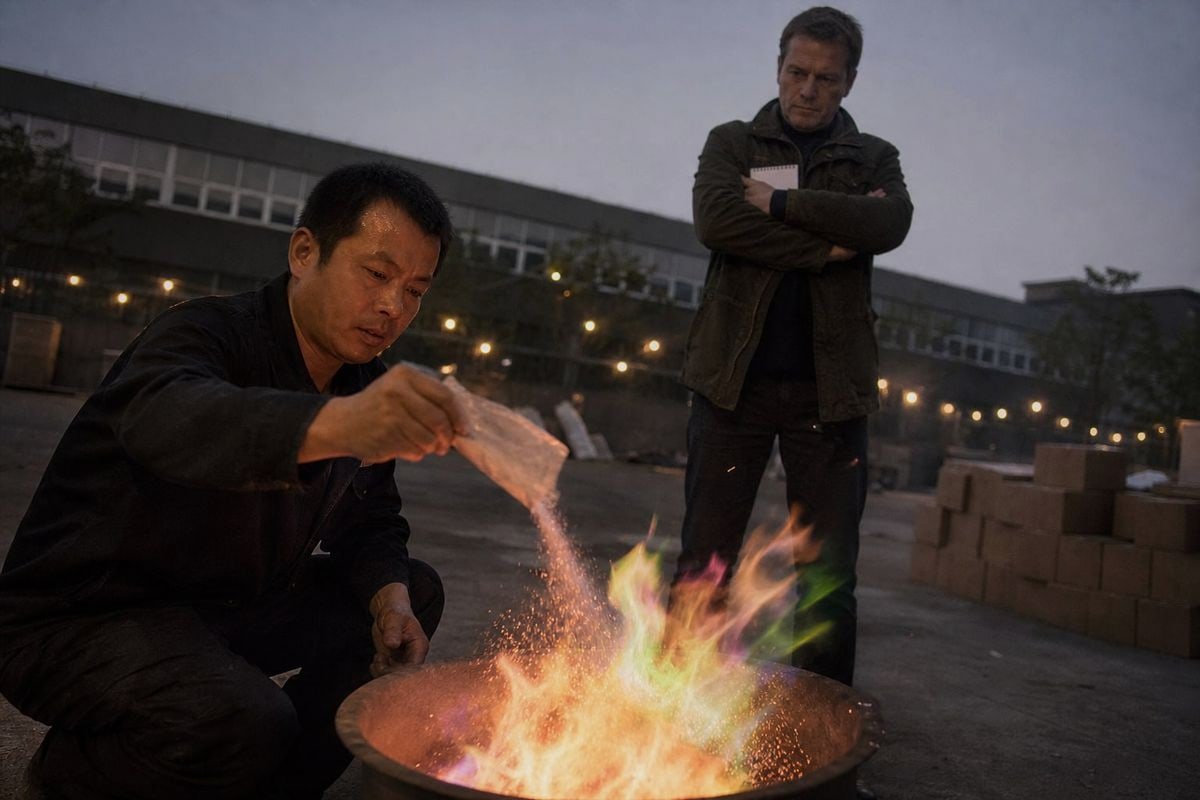
Burn time claims across the market range from about 20 minutes to an hour or more. Treat those numbers as estimates, not guarantees. From our QC burn tests, the real variables are fire size, fuel moisture 6, wind, and how many packets go in. The powder does not have a fixed clock. It vaporizes at the rate the fire allows.
Why the same packet performs differently
An indoor fireplace burns seasoned firewood at a relatively controlled temperature in a small, sheltered firebox. The colored flame sits right at eye level, framed by the hearth. Even a modest color shift reads clearly. A bonfire is the opposite. It burns hotter, bigger, and faster. Wind pushes flames around. Spectators stand farther away. Color that would dominate a fireplace becomes a faint tint in a two-meter fire.
Here is how we advise our B2B clients to spec dosage and burn expectations:
| Factor | Indoor Fireplace | Outdoor Bonfire |
|---|---|---|
| Typical packet count | 1 packet | 3–5 packets |
| Common pouch size | 25–50 g | 50–150 g or multi-pack |
| Realistic color duration | 20–30 minutes | 30–60 minutes with multiple packets |
| Color visibility | High (contained flame) | Depends on fire size and wind |
| Wind sensitivity | None | Significant |
| Heat consistency | Steady, moderate | Hot, variable |
For OEM projects, we adjust granule size and compound concentration to match the target use case. A fireplace-focused SKU gets a smaller, slower-releasing format. A bonfire SKU gets a heavier pouch or a bundled multi-pack. Same chemistry family, different delivery. That is the practical difference buyers should engineer into their product line rather than expecting one packet size to satisfy both scenarios equally.
What packaging and dosage formats work best for indoor safety compared to outdoor convenience?
Choosing between our plastic-bag, kraft-bag, and jar formats is the single most common packaging discussion I have with new distributors, and the answer always starts with where the product will burn.
Indoor products work best as small, single-dose, heat-sealed sachets thrown in unopened, with clear ventilation and wood-fire-only warnings printed on each packet. Outdoor products favor larger resealable kraft pouches, bulk jars, or multi-packet display boxes built for repeat use and camping conditions.

Packaging is not just marketing. It controls dosage, and dosage controls safety. The single most important instruction across every listing we have studied is the same one we print on our own sachets: do not open the packet. Throw it into the wood fire sealed. The foil melts, the powder releases, and no one handles loose chemicals near an open flame.
Matching format to use case
For indoor SKUs, the unopened single-dose sachet is the right format for three reasons. First, it prevents overdosing a small firebox. Second, it keeps warning text physically attached to each dose, which retail compliance teams in the US and EU appreciate. Third, it eliminates loose powder spilling onto hearth rugs or mantels.
For outdoor SKUs, convenience wins. Campers and fire-pit owners want repeat use across a weekend. Our kraft resealable stand-up pouches 7 and flip-top display boxes with multiple sachets serve that behavior. A 150-gram pouch or a box of ten sachets matches how bonfire users actually consume the product.
| Format | Best Use Case | Key Advantage | Watch Out For |
|---|---|---|---|
| Single foil sachet (25–50 g) | Indoor fireplace | Controlled dose, printed warnings | Higher per-unit packaging cost |
| Kraft resealable pouch (150 g+) | Outdoor bonfire, camping | Bulk value, weather-tolerant | Loose powder handling risk |
| Plastic jar | Fire pit at home, patio | Reusable, shelf presence | Not ideal for indoor claims |
| Multi-sachet display box | Retail, gifting, both uses | Shelf-ready, per-dose safety | Requires custom box tooling |
On the OEM side, we handle the full private-label package: custom warning labels, barcodes, multilingual instructions, and display boxes designed for the destination market. One lesson from years of shipping to 30+ countries: get the warning label language reviewed for each market before printing. A US-compliant label is not automatically a German-compliant one.
Can I source one Magic Fire powder formula that meets compliance standards for both indoor and outdoor markets?
A UK importer once asked us to quote two separate formulas, one indoor and one outdoor. After reviewing his requirements, we recommended one formula with two packaging programs, and it simplified his entire supply chain.
Yes. A single eco-friendly, heavy-metal-screened formula certified to indoor standards automatically qualifies for outdoor use, since indoor compliance is the stricter bar. Differentiation should happen at the packaging, dosage, and labeling level rather than through separate chemical formulations.

The logic here is straightforward. Indoor requirements are a superset of outdoor requirements. If a formula passes emissions and heavy-metal screening strict enough for a semi-enclosed fireplace, it will not suddenly fail in an open-air bonfire. The reverse is not true. An outdoor-only formula built with aggressive metal salts for maximum color punch may never clear an indoor claim.
Why one formula beats two for most buyers
From a sourcing perspective, a dual-certified single formula delivers real advantages:
- One set of test reports. You maintain one SGS or Intertek file instead of two, cutting compliance admin roughly in half.
- Simpler inventory. One bulk material feeds every SKU. Packaging lines create the differentiation.
- Lower MOQ pressure. Trial orders can mix indoor sachets and outdoor pouches against a single production run, which matters for distributors testing a new market.
- Consistent batch quality. With one recipe, batch-to-batch QC is tighter. Our process checks each production lot against the certified reference sample, so the sample you approve reflects the container you receive.
- Cleaner retail story. One formula, two clearly labeled use cases, no confusion at the shelf.
There are still non-negotiable rules that apply to both markets, and they must appear on every package regardless of format. Use only on wood fires. Never use with propane or gas-log fireplaces, because sealed gas units can trap residue and corrode components. Never cook food over colored flames. Follow the stated packet count. These rules are constant. Everything else, from pouch size to burn-time claims to display design, is a packaging and positioning decision, and a capable OEM partner should handle all of it under one roof.
Conclusion
Getting Magic Fire powder requirements wrong risks failed audits, blocked shipments, and shelf recalls. The fix is one certified formula with market-specific packaging and labeling.
Indoor fireplaces demand the strictest standard: verified test reports, single-dose sachets, ventilation warnings, and wood-fire-only labeling. Outdoor bonfires reward bigger doses, resealable bulk formats, and multi-packet convenience. In my years running production in Ningbo and shipping to distributors across the US and Europe, the buyers who succeed are the ones who certify to the indoor bar, differentiate through packaging, and partner with a factory that handles compliance, private labeling, and QC as one integrated process. If you are speccing a color-flame line for either market, start with the test reports, and the rest of the product decisions fall into place.
Footnotes
1. Official BSCI program page explains the audit standard mentioned in the article. ↩︎
2. Background on SGS, the independent testing and certification body referenced repeatedly. ↩︎
3. Official EU source explaining CE marking requirements mentioned for indoor and outdoor products. ↩︎
4. REACH is an EU chemical regulation directly referenced as a compliance requirement. ↩︎
5. Background on



 English
  Spanish
  German
  French
  Arabic
  Portuguese
Join the Conversation