Presenting Magic Fire Powder on a wholesale catalog page 1 is tricky. Our factory has seen great products fail because the page confused buyers instead of convincing them.
A strong Magic Fire Powder wholesale catalog page pairs one hero image of the colored flames with a benefit-led description, certifications (CE, SDS, SGS), full product specifications, packaging and private-label options, a tiered MOQ pricing table, and a clearly separated safety block.
That formula sounds simple. But each element needs to be done right. Below, I break down the four questions buyers ask us most often, and how to answer them on the page itself.
What certifications and test reports should I include to reassure wholesale buyers?
A German distributor once told me he deletes any fire-product catalog that lacks compliance documents 2 on page one. That single conversation reshaped how we build every catalog at our Liuyang headquarters.
Include CE marking, a Safety Data Sheet (SDS), third-party lab reports from SGS or Intertek, and factory audit credentials like ISO 9001 and BSCI. Display certification logos near the hero image and offer downloadable test reports so buyers can verify compliance instantly.

For a fire-adjacent product, compliance is not a footnote. It is the first filter every serious importer applies. In our 17+ years exporting color-flame products 3 to 30+ countries, we have never closed a deal with a US or European buyer who did not ask for documentation before asking for price. So put the documents where buyers cannot miss them.
Which documents matter in which markets
Different markets weight documents differently. Here is how we map them for our own buyers:
| Document | What it proves | Most critical for |
|---|---|---|
| CE marking | EU conformity for the product category | Germany, France, Netherlands, Poland |
| Safety Data Sheet (SDS) | Chemical composition, handling, transport class | All markets; required for customs and retailers |
| SGS / Intertek test report | Independent verification of burn behavior and materials | US, UK, Canada, Australia |
| ISO 9001 | Consistent quality management at the factory | Large retail sourcing channels |
| BSCI audit | Ethical and social compliance | European brands and big-box retailers |
How to present them without clutter
Do not paste full reports onto the page. Instead, use a slim "Compliance" strip under the specs block: small certification logos, the report numbers, and a QR code or link labeled "Download full test reports." This keeps the layout clean while signaling total transparency. On our own catalog pages, we also add one line stating that the powder uses eco-friendly materials with no harmful chemicals, because buyers for outdoor living supplies 4 increasingly screen for that. Transparency here is a sales asset. A buyer who can verify your claims in thirty seconds moves to the ordering conversation much faster than one who has to email and wait.
How can I showcase color-flame variety and burn performance in catalog photos?
When we shot our first color-flame catalog years ago, we made a classic mistake: beautiful pouches, no flames. Buyers kept asking, "But what does it actually look like burning?"
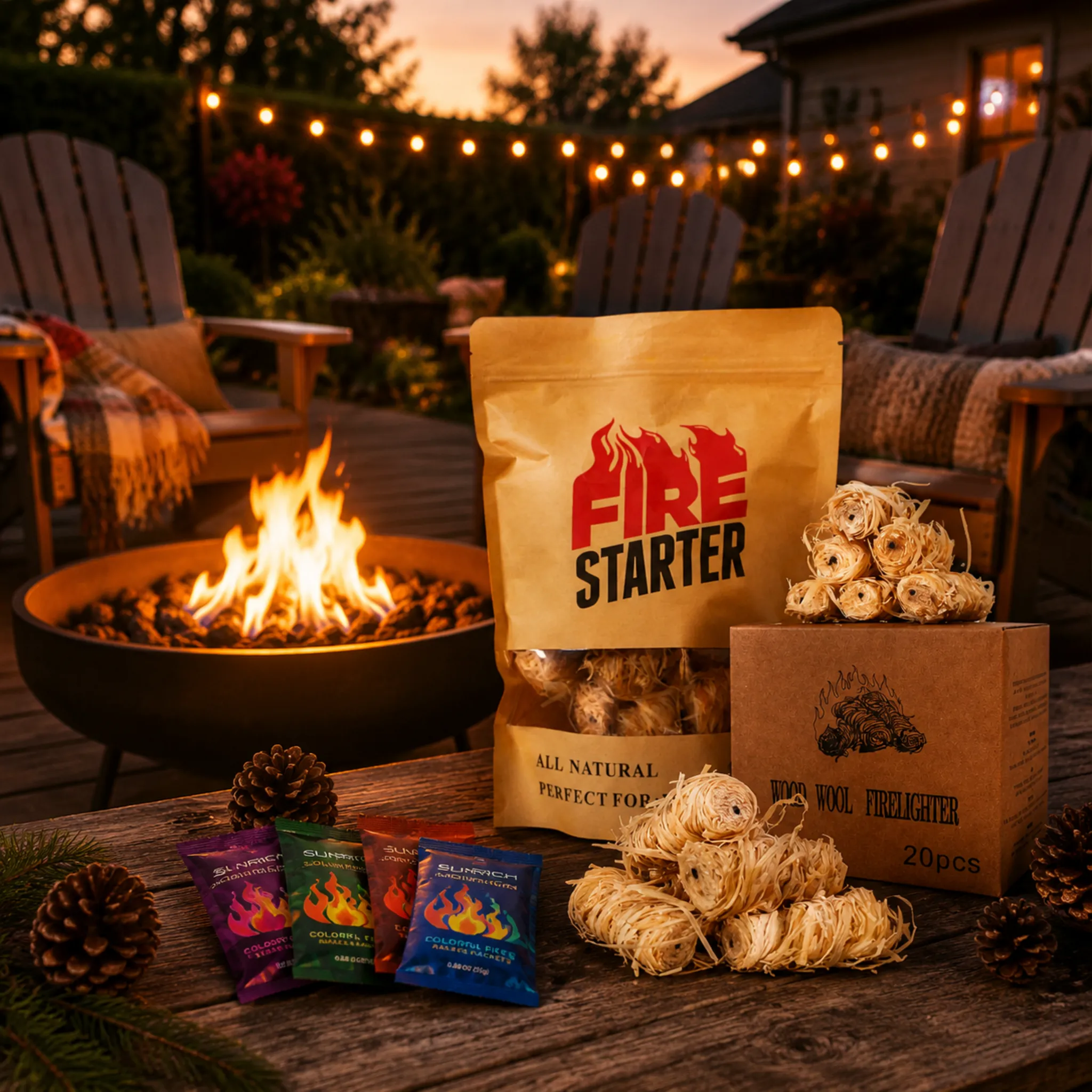
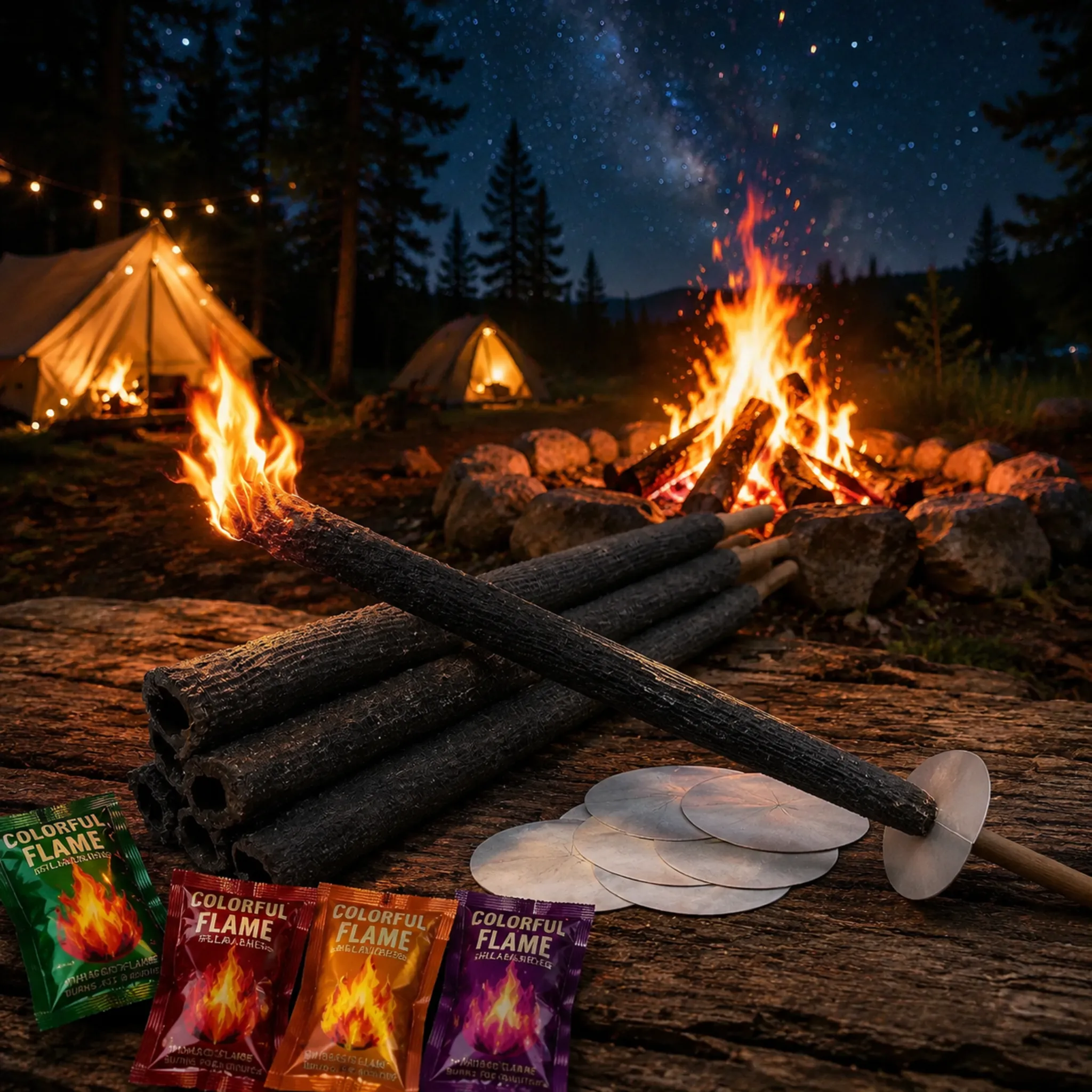
Show a hero shot of the pouch beside a real fire displaying green, blue, and purple flames, add a before-and-after split image of an ordinary campfire versus a colored one, and state burn duration per packet directly in the caption.
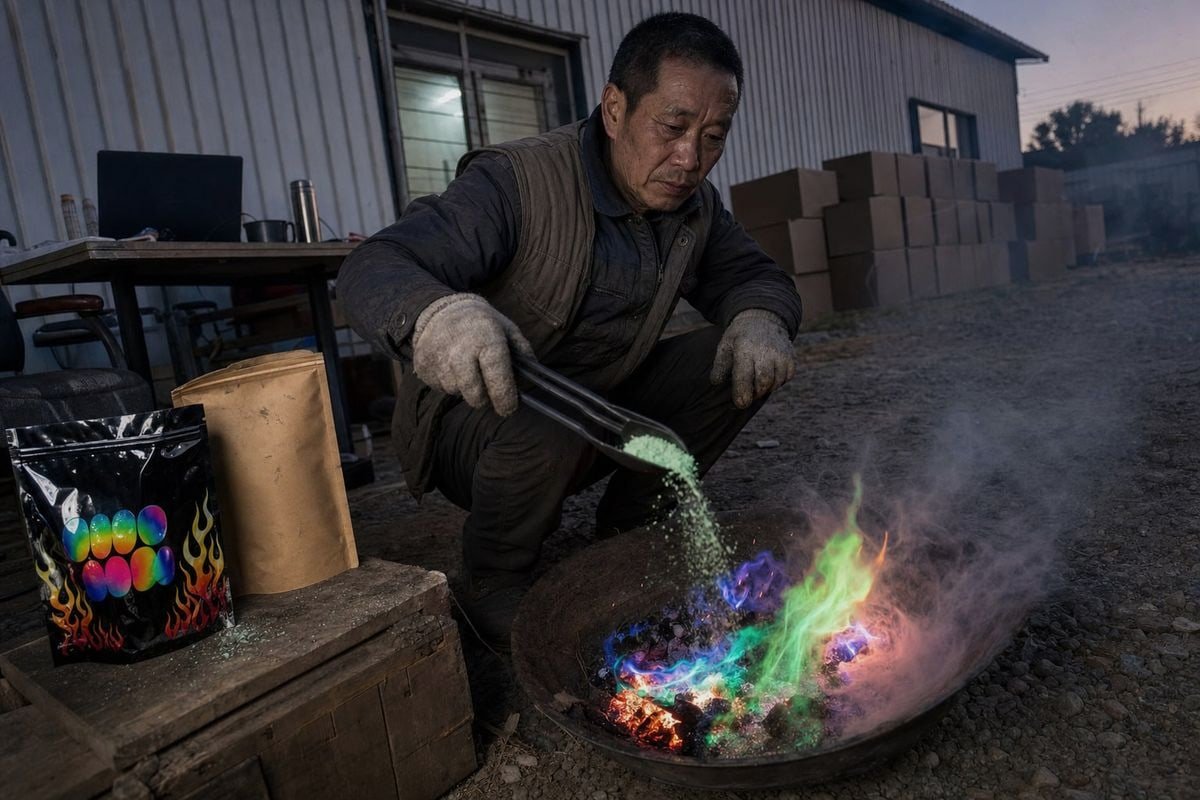
The effect is the product. A flame colorant 5 sells on visual proof, so your photography must demonstrate the transformation, not just the packaging. At the same time, wholesale buyers need consistency across the catalog. We hold every product photo to the same standard: same angle, same white space, same background, so the range looks professional rather than pieced together.
Build a three-image sequence
We recommend a simple sequence that answers the buyer's visual questions in order:
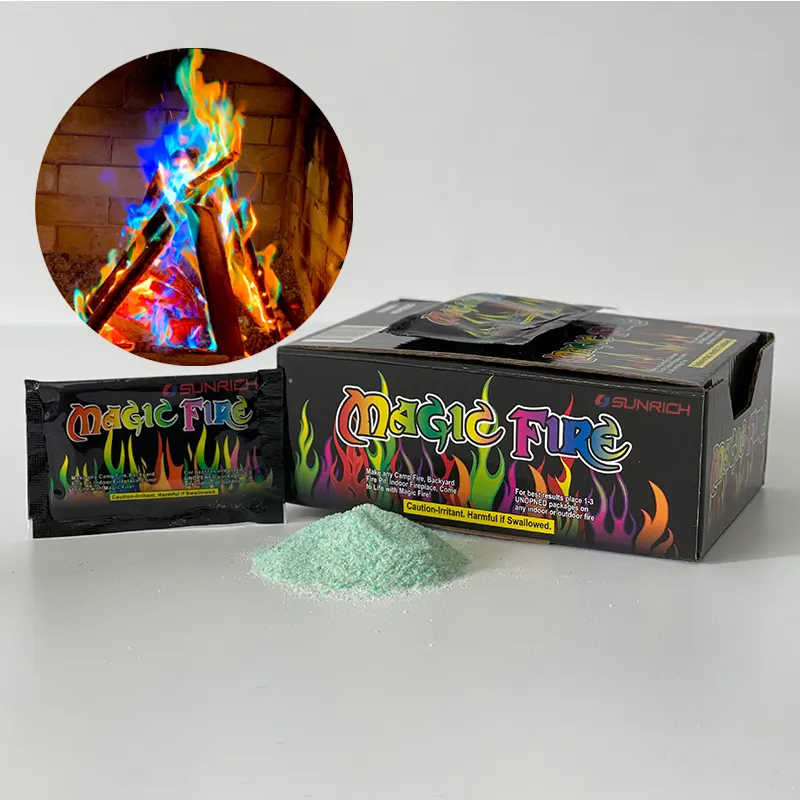
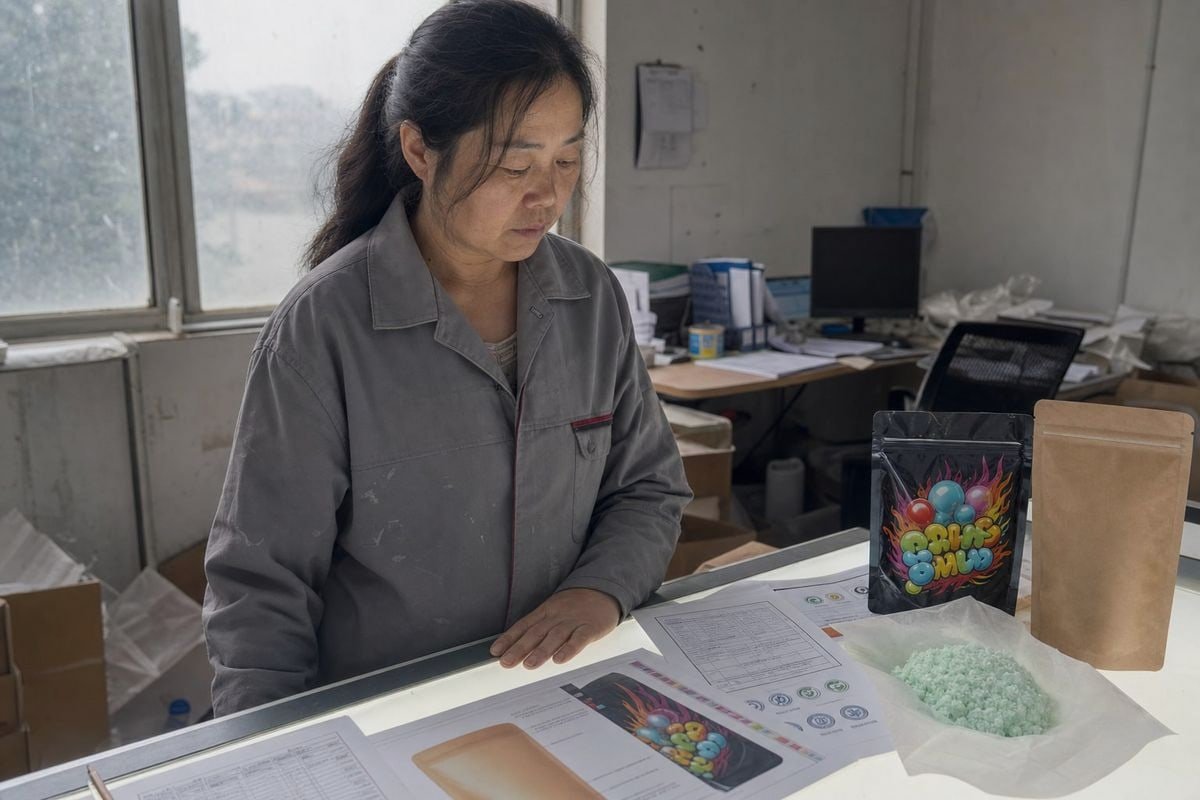
- Hero shot. The glossy black foil pouch with its rainbow bubble lettering, photographed on a clean white or marble surface. This is the shelf view a retailer will evaluate.
- Effect shot. The pouch standing beside a campfire glowing blue, green, and purple. This is the demo view that shows why customers buy it. Our own packaging carries a circular inset photo of colored flames for exactly this reason.
- Contents shot. A small pour of the pale mint crystalline powder next to the pouch. Buyers want to see texture and quantity, since the granules resemble coarse salt and reassure them the product is simple and clean.
State performance in numbers, not adjectives
"Amazing effect" convinces no one. Put burn performance next to the images: how many minutes of colored flame per sachet, the color spectrum produced, and the critical usage restriction — wood-burning fires only, never gas or propane. If your catalog is digital, a short looping video of the flame transition outperforms any still image. Buyers share these clips internally, and a shareable page travels further through a purchasing team than a static PDF ever will.
What packaging and private-label options should I highlight for distributors?
One trade-off we weigh constantly on our production line: showing too few packaging formats limits deals, but showing too many overwhelms the page. Our answer is a compact format gallery.
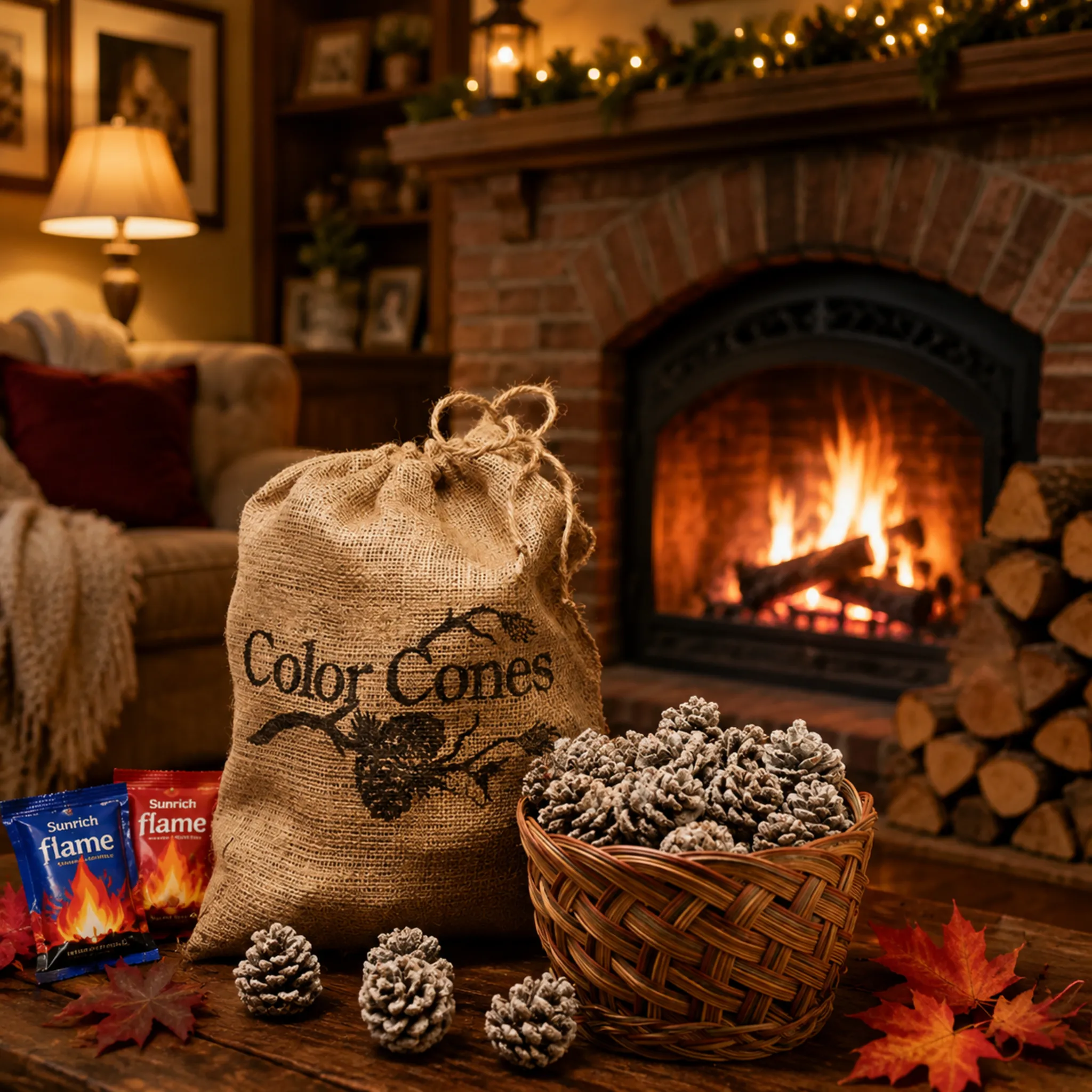
Highlight all available formats — single-use foil sachets, resealable kraft bags, plastic jars, and retail display boxes — plus OEM options: custom sachet printing, private-label branding, multi-language packaging, barcodes, warning labels, and retail-ready counter displays for point-of-purchase merchandising.

Distributors do not just buy a product. They buy a format that fits their channel. A camping brand wants single-use sachets clipped near the register. A fireplace distributor wants resealable kraft pouches or jars for repeat home use. A festival gift trader wants themed retail-ready packaging with strong shelf appeal. Your catalog page should let each buyer instantly find the version that fits their assortment.
Present formats as a gallery, not a paragraph
We use a small grid with one photo and one line per format:
| Format | Typical channel | Merchandising angle |
|---|---|---|
| Single-use foil sachet | Camping stores, impulse racks | Low price point, easy trial purchase |
| Kraft stand-up pouch (resealable) | Outdoor and fireplace retailers | Multi-use, natural rustic aesthetic |
| Plastic jar / shaker bottle | BBQ and hearth distributors | Premium repeat-purchase item |
| Flip-top display box with sachets | Big-box and gift channels | Point-of-purchase display, self-merchandising |
Make private-label feel low-effort
The strongest line you can add here is a promise of one-stop customization. On our pages we state plainly: we customize size, burn time, pouch printing, boxes, warning labels in local languages, and barcodes, and we optimize the export cartons for global logistics. We also note that because we run our own complete production lines in Ningbo, the private-label sample 6 a buyer approves is the same quality that ships in mass production. Batch-to-batch consistency is what separates a factory partner from a trading company 7, and distributors know the difference. If you offer marketing support — high-res photos or pre-made social videos retailers can reuse — mention it as a retailer success kit. It helps your wholesale partners sell through, which is what earns the reorder.
Which product specs and MOQ details do I need to list for a trial order decision?
A UK buyer once emailed us four separate times just to assemble basic specs from a competitor's vague catalog before switching to us. Every one of those emails was a lost day for him.
List SKU, net weight per sachet, burn time, units per case, carton dimensions and gross weight, barcode, lead time, and payment terms. Then add a tiered pricing table with a low minimum order quantity (MOQ) trial option so new buyers can test demand risk-free.

A trial order decision is a math problem for the buyer: margin, shelf space, freight, and risk. Your Magic Fire Powder wholesale catalog page should hand them every variable. Here, the research on catalog design points to a real tension — minimalist pages look elegant, but wholesale buyers need data density. The resolution is minimal design, not minimal information. Use a compact, scannable specs block so the page stays clean while answering every operational question.
The complete specs checklist
Group the data into three short blocks near the product image:
- Product specifications: SKU code, net weight, burn duration per sachet, flame colors produced, shelf life, and the compatibility restriction (wood fires only).
- Logistics data: units per inner box, cases per carton, carton dimensions, gross weight, and barcode — the numbers a warehouse manager needs.
- Commercial terms: wholesale price, suggested RRP, lead time, shipping terms, and payment terms.
Lower the barrier with tiered pricing
Bulk pricing tiers turn hesitation into action. A structure like this works well for campfire accessories entering wholesale distribution:
| Order tier | Quantity | What the buyer gets |
|---|---|---|
| Market tester | Low-MOQ counter display unit | Pre-packed point-of-purchase display to test local demand |
| Standard wholesale | One to several cartons | Standard tiered pricing, stock packaging |
| Volume / private label | Container-level or OEM runs | Best unit pricing plus full custom branding |
In our experience exporting to the US and Europe, the flexible trial MOQ is often the deciding factor. Established importers rarely gamble on a full container from a new supplier. Give them a low-risk first step, close the page with a clear call to action — "Request a sample" or "Order a trial display" — and put your contact details in a consistent spot on every page.
Conclusion
A weak catalog page loses buyers before you ever speak. Lead with certifications, prove the flame effect visually, showcase packaging and private-label depth, and publish clear specs with a low-risk trial MOQ. Do that, and your Magic Fire Powder page becomes your hardest-working salesperson.
Footnotes
1. Provides context on the role of catalogs in marketing and business-to-business sales. ↩︎
2. Explains the importance of regulatory compliance documents for international trade and distribution. ↩︎
3. Technical background on the chemical compounds used to create colored flames in pyrotechnic products. ↩︎
4. Authoritative source on wood-burning safety and environmental standards for outdoor heating products. ↩︎
5. Authoritative Wikipedia entry explaining the chemical compounds used to produce colored flames in pyrotechnics. ↩︎
6. Defines the business model of private labeling, a key service mentioned for distributors. ↩︎
7. Authoritative Wikipedia entry defining businesses that act as intermediaries between manufacturers and customers. ↩︎



 English
 Spanish
 German
 French
 Arabic
 Portuguese
Join the Conversation