







Negotiating a fair MOQ with Magic Fire powder suppliers frustrates many buyers supply chain management 1. I have watched promising deals collapse over quantity disputes that our production team could have solved in one honest phone call. The buyer wants 500 packets. The quote says 10,000. Both sides dig in, and a good partnership dies before it starts CE documentation 2. It does not have to end that way — and after 17 years of running color-flame production lines, I can show you exactly how to bridge that gap.
A fair MOQ with Magic Fire powder suppliers typically ranges from 3,000–10,000 sachets for standard packaging, negotiable down 30–70% for trial orders. Negotiate by asking what drives the MOQ, accepting stock packaging, offering higher unit prices, or committing to follow-on volume.
Let me break this down step by step. I will cover what MOQ numbers to expect, how to lower them for a first order, what makes suppliers flexible, and how to protect quality while you negotiate.
What MOQ Should I Expect When Sourcing Magic Fire Powder from a Certified Manufacturer?
Last spring, a German fireplace distributor emailed our factory asking why our sachet MOQ was higher than a jar quote he got elsewhere private-label packaging 3. The answer taught him how MOQ really works.
**Certified Magic Fire powder manufacturers typically quote 3,000–10,000 units for standard sachets, 1,000–3,000 for jars, and 5,000–20,000 for fully custom private-label packaging. MOQs reflect chemical batch-mixing capacity, packaging film runs, and compliance batch-testing costs — not arbitrary supplier preference.

The first thing I tell every new buyer is this: an MOQ is not a random number. At our Ningbo production facility, three real constraints set the floor for every quote. First, the chemical mixing batch. Color-flame compounds are blended in fixed batch sizes batch production 4, and splitting a batch wastes material and QC time. Second, the packaging run. Printed foil film for sachets comes from our film supplier with its own minimum, often enough for thousands of packets. Third, compliance. Every production batch we ship gets checked against our SGS and Intertek test standards, and that testing cost is spread across the whole run.
Typical MOQ Ranges by Packaging Format
Here is what buyers should realistically expect from a certified factory, based on our export experience across the US and Europe:
| Packaging Format | Typical MOQ Range | Why the Floor Exists |
|---|---|---|
| Standard foil sachet (stock design) | 3,000–10,000 pcs | Printed film roll minimums |
| Kraft stand-up pouch | 2,000–5,000 pcs | Pouch supplier minimums |
| Plastic jar (stock label) | 1,000–3,000 pcs | Jar molding and label runs |
| Full private-label custom box | 5,000–20,000 pcs | Custom printing plates + design setup |
| Display box with inner sachets | 1,000–3,000 boxes | Combined box + sachet runs |
Benchmark Before You Negotiate
Before you push back on any quote, gather three to five quotes from comparable certified factories. Note that uncertified workshops will quote lower MOQs — but they skip batch testing, which is exactly why their numbers look attractive. Compare like with like. A fair MOQ sits in the market range for certified, tested product. If a quote sits far above that range, ask why. If it sits far below, ask what testing was skipped.
How Can I Negotiate a Lower MOQ for My First Trial Order?
A UK camping brand once opened negotiations with us by asking a question I respect: not "can you go lower," but "what is driving your MOQ?" That single question changed everything.
**Lower your first trial MOQ by asking what drives the quoted minimum, accepting stock packaging instead of custom branding, offering a 10–20% higher unit price, increasing your deposit, or committing in writing to a larger follow-on order. Suppliers often accept 30–70% of standard MOQ under these terms.

The core principle is simple: reduce the supplier's risk, and the supplier will reduce your quantity. When a buyer just demands a lower number, I hear "I want you to lose money on setup costs." When a buyer offers a trade-off, I hear "let's find a structure that works." The second buyer almost always gets a deal.
The Six Trades That Actually Work
In our experience exporting to 30+ countries, these trades unlock lower first-order MOQs most reliably:
- Ask the reason first. If the bottleneck is printed film, switching to our stock sachet design removes it instantly. If it is the chemical batch, ordering at a multiple of the batch size may help.
- Accept stock packaging. Custom private-label film is the single biggest MOQ driver. Take our standard Magic Fire design for the trial, and brand the outer display box instead — box printing minimums are far lower.
- Offer a slightly higher unit price. A 10–20% premium on a small run offsets our setup economics. It is honest, and it works.
- Pay a higher deposit or full prepayment. Cash certainty makes small orders less risky for the factory.
- Commit to a second order. A written intent for follow-on volume within six to twelve months justifies a small pilot run.
- Mix variants to hit total value. Combine several flame-color or format variants in one order. Many factories, ours included, negotiate on total order value, not single-SKU quantity.
A Sample Request That Sounds Credible
Frame your email professionally. State your market, your distribution channel, your compliance requirements, and your growth plan. Then propose: "We would like a trial order of X units at your stock packaging, at a unit price you consider fair for this volume, with intent to move to Y units on reorder." That message gets a serious reply from any real factory. A one-line "lowest MOQ price?" message does not.
What Factors Influence MOQ Flexibility When Working with a Magic Fire Powder Supplier?
Timing matters more than most buyers realize. Our Ningbo lines run near capacity before the autumn fireplace season, but in late spring we have open machine time — and far more room to flex on minimums.
**MOQ flexibility depends on packaging complexity, whether your colors match standard batch formulas, seasonal production capacity, raw material stock levels, order structure across variants, payment terms, and your credibility as a long-term buyer. Simple, well-timed, well-documented requests get the most flexibility.
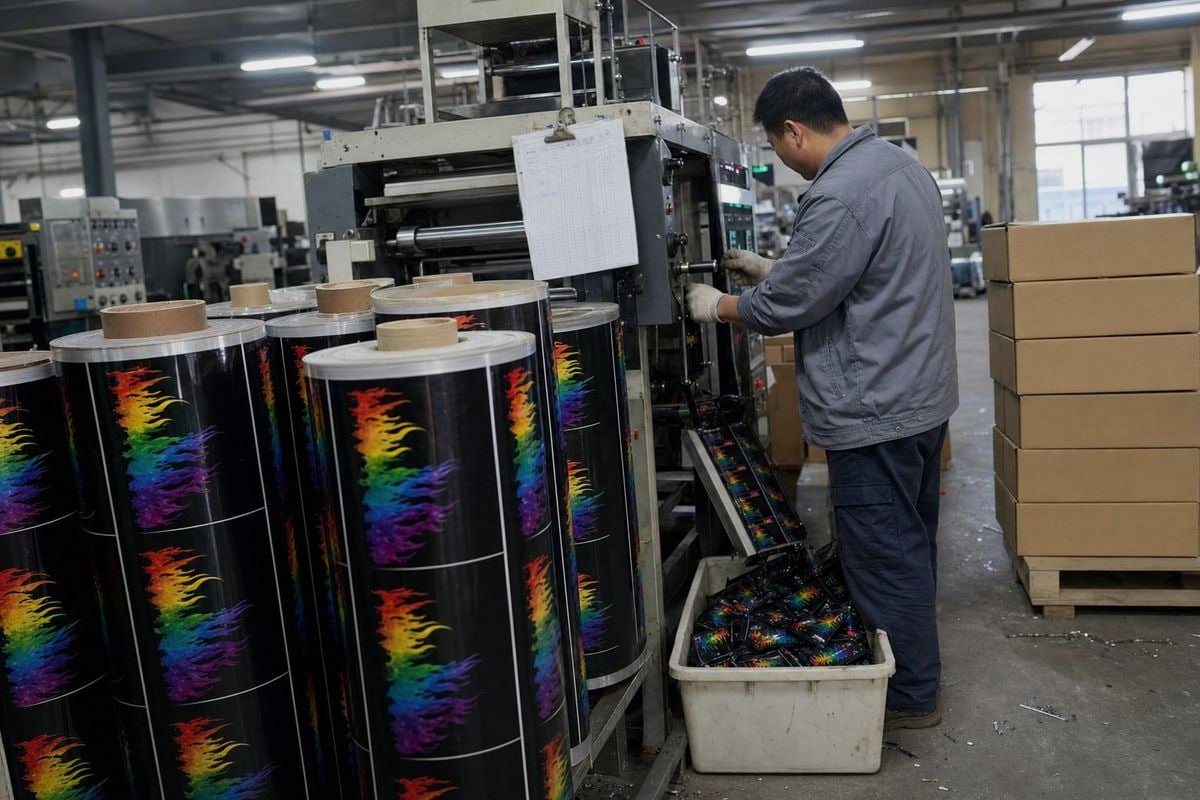
Not every MOQ is equally movable. Over the years, I have learned to sort the drivers into two buckets: constraints we can work around, and constraints that are structural. Understanding which is which tells you where to push and where to compromise.
Flexible vs. Fixed MOQ Drivers
| Factor | Flexibility | What the Buyer Can Do |
|---|---|---|
| Custom printed packaging | High | Accept stock packaging for the first run |
| Seasonal capacity | High | Order in off-peak months (spring for fire products) |
| Existing raw material stock | High | Ask if the supplier has surplus compound batches |
| Multiple SKU variants | Medium | Combine variants to hit total order value |
| Payment terms | Medium | Offer prepayment or higher deposit |
| Chemical batch-mix size | Low | Order at a multiple of the standard batch |
| Compliance batch testing | Low | Accept the cost; do not ask to skip it |
| Hazmat/shipping documentation | Low | Consolidate variants into one shipment |
Timing and Relationship Leverage
Approach fire-product suppliers between February and June, when Western fireplace and holiday demand is quiet. Factories protect their off-season utilization, and a small order that keeps a line running is welcome then. It is far less welcome in September.
Your credibility also moves the number. When a buyer shows us a real distribution channel, asks about our ISO 9001 5 and BSCI documentation, and talks about reorder cycles, we treat the trial order as the start of a relationship. When a buyer shows nothing, we quote the standard MOQ and hold it. Suppliers flex for partners, not for anonymous inquiries.
Shipping Consolidation as Hidden Leverage
One point buyers often miss: documentation and logistics costs are partly fixed per shipment. If you combine several flame-color variants under one consolidated shipment with one set of export documents, the supplier's per-unit overhead drops. That efficiency gain is real money — and it gives the factory room to accept smaller per-SKU quantities without losing margin.
How Do I Balance Low MOQ Requests with Consistent Quality and Compliance Standards?
A hard lesson from our early export years: the cheapest way to hit a tiny MOQ is to skip batch testing. We refused then and refuse now — and buyers who understand why become our longest-standing customers.
**Balance low MOQ with quality by never negotiating away batch testing, certifications, or safety labeling. Trade on packaging, price, timing, and payment terms instead. Verify the supplier holds ISO 9001, CE, and third-party test reports, and confirm samples match mass-production formulas.

There is a right way and a wrong way to get a small first order. The wrong way pressures the supplier until something invisible gives — usually the thing you cannot see from a product photo. The right way keeps every compliance element intact and finds savings elsewhere. For a product that goes into someone's campfire or fireplace, this distinction is not academic. It is your brand liability.
What Is Negotiable and What Is Not
| Element | Negotiate? | Reason |
|---|---|---|
| Packaging customization | Yes | Stock designs cut setup cost, not safety |
| Unit price vs. quantity | Yes | Fair trade of economics, not quality |
| Delivery scheduling | Yes | Staggered shipments help cash flow |
| Batch-to-batch QC testing | No | This guarantees the trial matches mass production |
| Safety and warning labels | No | Required for retail compliance 6 in US/EU markets |
| Certified material formulas | No | Eco-friendly, tested compounds are the product's core |
| Third-party test reports 7 | No | Your customs and retail buyers will demand them |
How to Verify Before You Commit
Ask for the supplier's ISO 9001 certificate, BSCI audit result, CE documentation 8, and recent SGS or Intertek test reports — and check that the reports match the actual product, not a different SKU. Then order paid samples and burn-test them yourself. Check color intensity, burn duration, and residue. At our factory, we hold batch formulas tight enough that the sample you approve is the product you receive at 10,000 units. That consistency is what a certification-backed process buys you.
Here is the honest closing point. If a supplier agrees to a rock-bottom MOQ instantly, with no trade-offs and no explanation, be suspicious. A factory that cannot explain its MOQ probably cannot explain its quality control either. A fair MOQ, clearly justified and reasonably negotiated, is itself a quality signal.
Conclusion
A fair MOQ covers the supplier's real costs while letting you test your market. Ask what drives the number, trade risk instead of demanding discounts, protect compliance, and treat your first order as the start of a partnership.
Footnotes
1. Background concept underlying MOQ negotiation and sourcing strategy discussed throughout. ↩︎
2. Official EU source clarifying CE marking requirements referenced in supplier verification. ↩︎
3. Wikipedia background on private-label branding referenced as a packaging option. ↩︎
4. Explains the manufacturing concept driving chemical batch-mixing MOQ constraints. ↩︎
5. ISO 9001 is referenced as a key certification buyers should verify before ordering. ↩︎
6. FDA consumer updates relate to safety labeling requirements for retail products. ↩︎
7. Intertek is cited as a certification body verifying product safety and compliance. ↩︎
8. CE marking is an EU compliance standard buyers must confirm for retail markets. ↩︎



 English
  Spanish
  German
  French
  Arabic
  Portuguese
Join the Conversation