






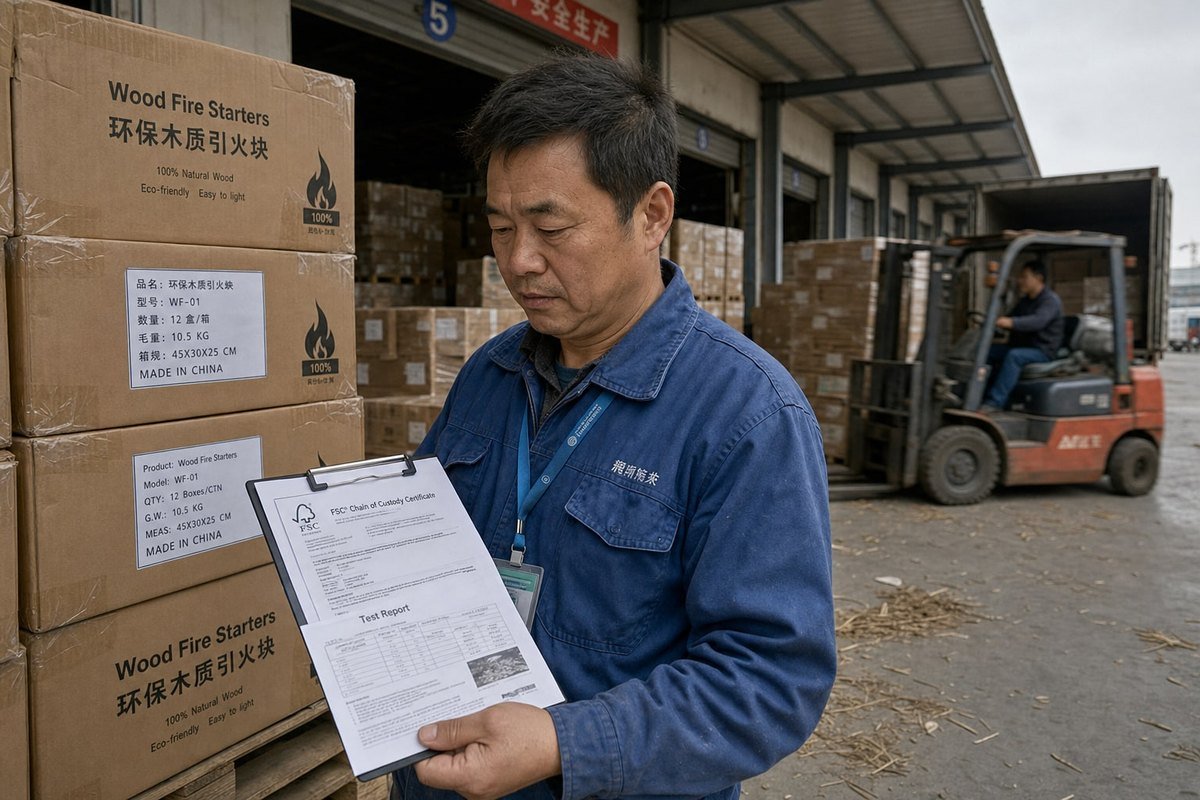
Supply chain risks when sourcing wood fire starters look invisible until a shipment gets rejected at customs. I have watched buyers learn this the hard way before they found our production line.
To identify and mitigate supply chain risks when sourcing wood fire starters, verify FSC or PEFC chain of custody documents, audit the factory's certifications and QC systems, confirm wood moisture content controls, diversify suppliers, and lock quality and lead-time terms into contracts before mass production.
That answer is the short version. Below, I break each part down into practical questions you can ask any supplier this week. Let's start with certifications, because that is where most risk hides.
What certifications should I verify before trusting a wood fire starter supplier?
A German distributor once asked me for our full test-report folder before he even asked for a price. In our seventeen years exporting fire products, that request has become the norm, not the exception.
Before trusting a wood fire starter supplier, verify ISO 9001 for quality management, BSCI for ethical sourcing standards, CE marking where applicable, third-party SGS or Intertek test reports, and FSC certification or equivalent chain of custody proof for the wood inputs.
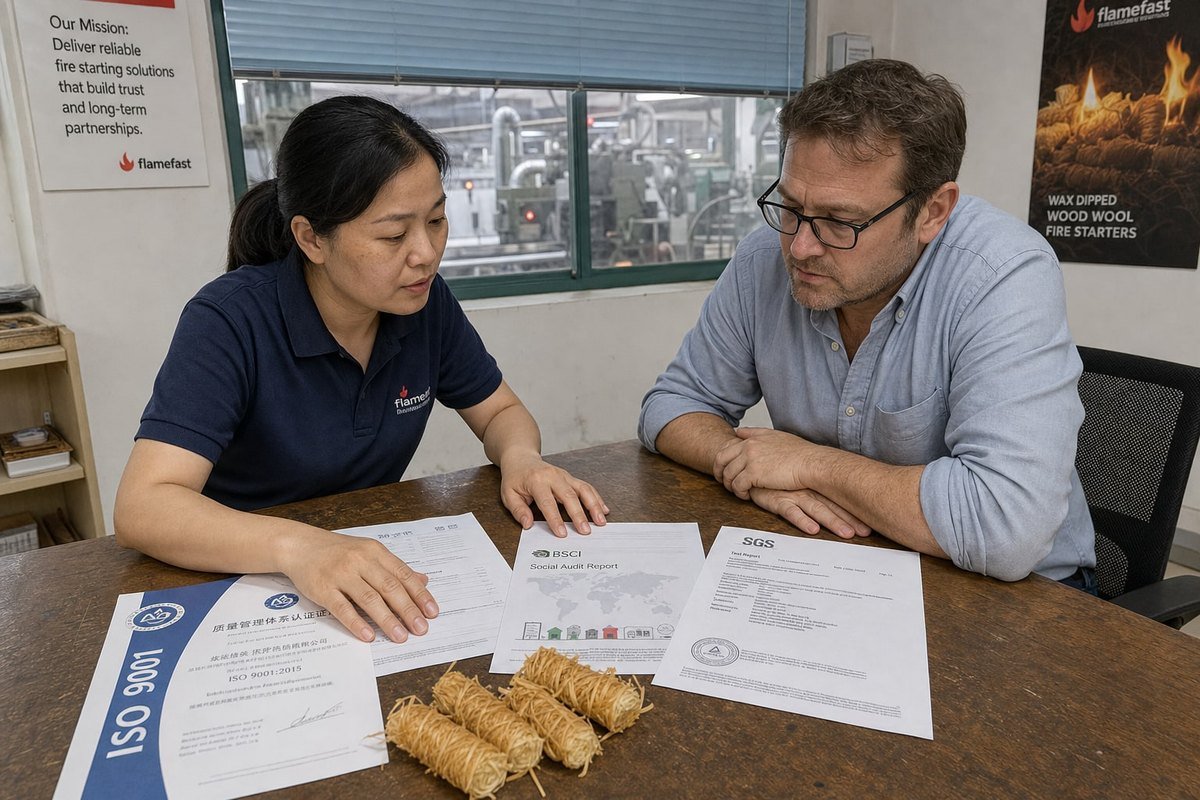
Certifications matter for one simple reason. Wood fire starters sit at the crossroads of two regulated worlds: forestry products 1 and consumer combustibles. A weak paper trail on either side can stop your goods at the border or pull them off shelves.
The core documents to request
Start with the wood itself. Ask whether the supplier holds FSC certification 2 or sources under the Sustainable Forestry Initiative framework. If they claim recycled or by-product wood wool, ask for chain of custody records that trace the material back to the mill. This is also your first line of defense for Lacey Act compliance 3 if you import into the US, because you must declare the species and country of harvest.
Then move to the factory floor. ISO 9001 shows a working quality system. BSCI covers labor conditions and ethical sourcing standards 4, which matter to major retail buyers. Finally, ask for Safety Data Sheets covering the wax coating and any binders, plus confirmation of the product's hazardous materials classification for sea and air freight.
| Certification / Document | What it proves | Risk if missing |
|---|---|---|
| FSC / PEFC chain of custody | Legal, deforestation-free wood origin | Customs seizure, greenwashing claims |
| ISO 9001 | Repeatable quality management | Batch inconsistency |
| BSCI audit report | Ethical sourcing standards | Retailer delisting |
| SGS / Intertek test reports | Product safety and burn performance | Recalls, liability |
| Safety Data Sheets | Correct hazardous materials classification | Shipping refusals, fines |
One warning from experience: ask for the certificate number and verify it on the issuing body's website. We hand ours over freely because they are real. Suppliers who stall on this step usually have a reason.
How can I avoid quality inconsistencies between samples and mass production orders?
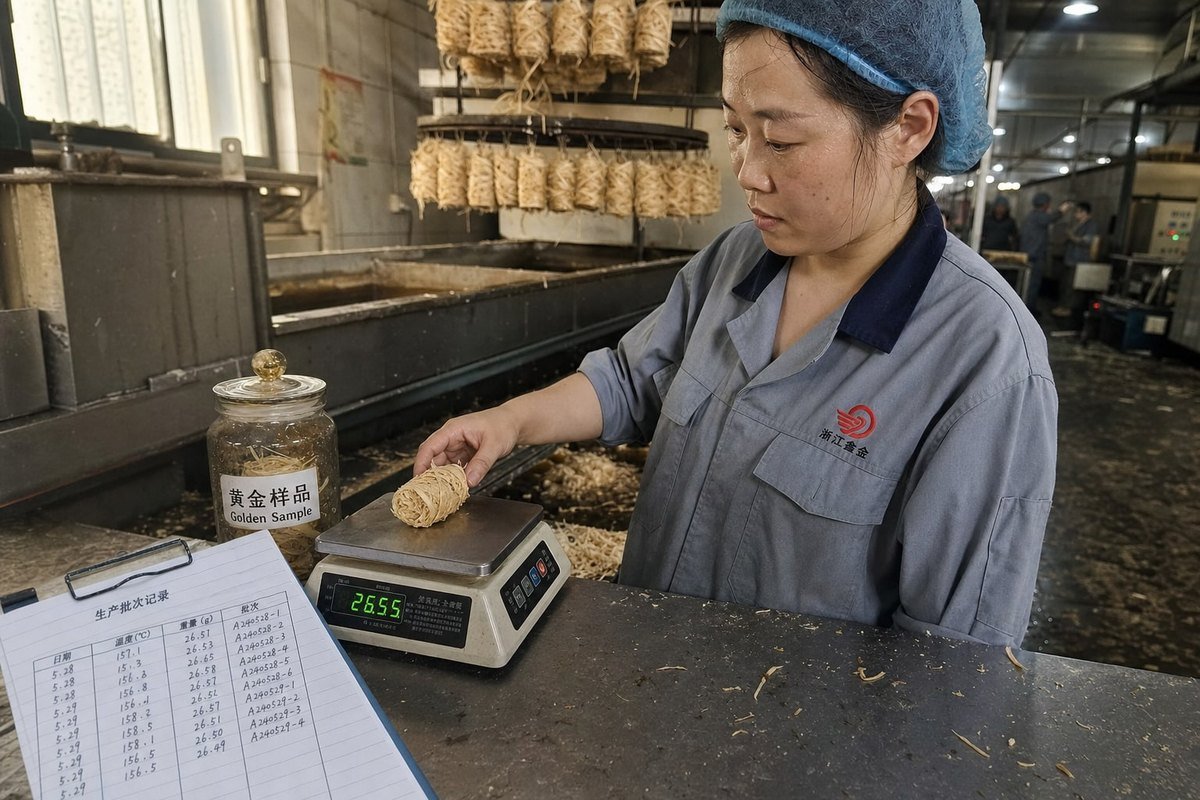
Our QC team rejects entire wax-dipping batches when the coating weight drifts outside tolerance, even when the rolls look fine to the eye. That discipline exists because we learned early that "looks fine" is not a specification.
To avoid sample-versus-production gaps, write a measurable spec sheet covering wood moisture content, wax coating weight, burn time, and dimensions, then require golden samples, batch-level QC records, and pre-shipment third-party inspection rights in your purchase contract.
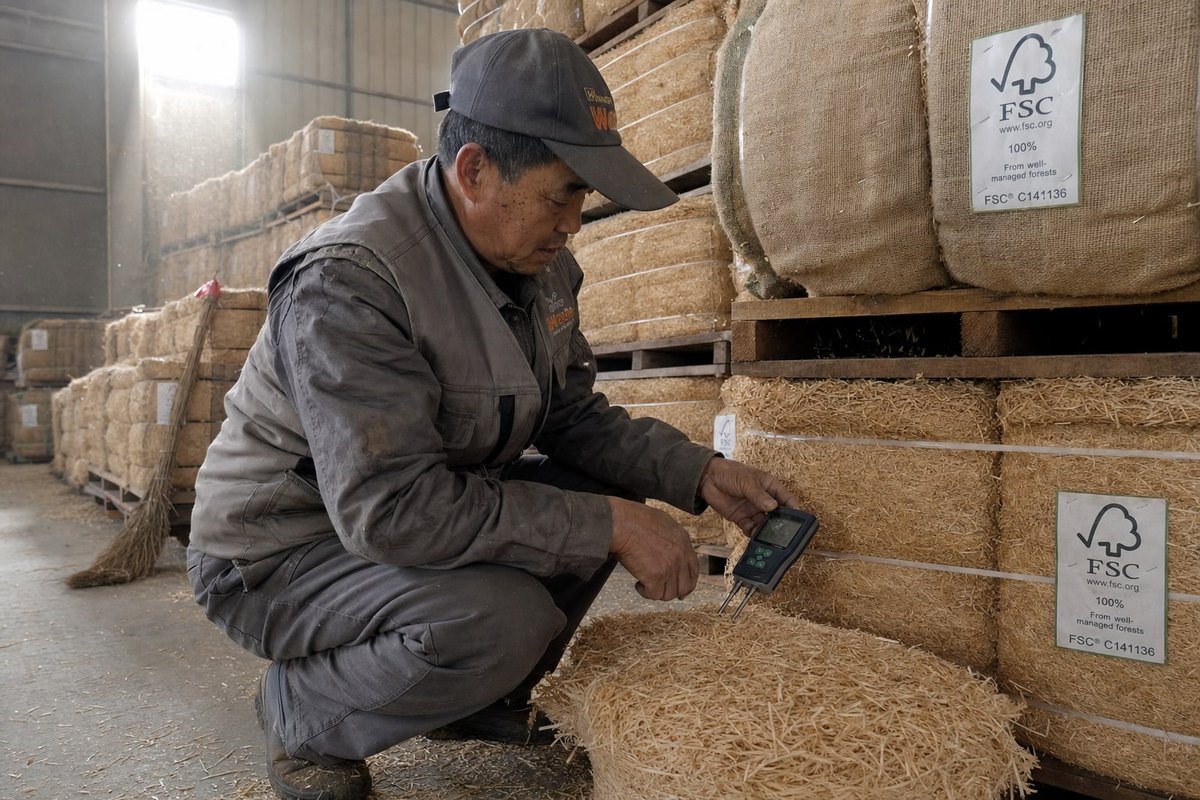
Quality drift in this category has physical causes, not mysterious ones. Wood wool is a natural fiber. Its density and wood moisture content 5 change with the season, the mill, and the storage conditions. Wax viscosity changes with dipping temperature. If a factory does not control these variables batch by batch, the tenth container will not match the first sample.
Turn the sample into a contract
Here is the process we recommend to every new buyer, because it protects both sides:
- Define the spec in numbers. Burn time in minutes, unit weight in grams, wax coverage, moisture ceiling, and ignition performance. Vague words like "good quality" are unenforceable.
- Approve a golden sample. Both parties sign and keep sealed reference units. Every production batch is compared against them.
- Demand batch records. A real factory logs dipping temperatures, moisture readings, and burn tests per lot. Ask to see a sample log before ordering.
- Reserve inspection rights. Write pre-shipment inspection into the PO, with a clear AQL level and the right to use SGS or Intertek.
- Order a pilot run. A small first production order, not just a courier sample, reveals how the factory behaves at scale.
There is one more issue buyers rarely ask about: storage safety. Loose wood wool and sawdust create a combustible dust hazard 6, and poorly ventilated warehouses risk heat buildup in stacked wax product. A supplier with real manufacturing depth will show you their dust management and thermal monitoring practices without being prompted. When we walk buyers through our Ningbo facility, that part of the tour often earns more trust than the certificates do.
What sourcing red flags suggest a factory might cause shipment delays or compliance issues?
A buyer from the Netherlands once told me he had been "ghosted" for three weeks by a previous supplier right before peak fireplace season. That story is common, and the warning signs were visible long before the delay happened.
Key red flags include refusal to share verifiable certificates, no traceability for wood origin, single-source raw material dependence, vague answers on hazardous materials classification, trading-company behavior disguised as factory ownership, and inconsistent communication before any money changes hands.
Red flags cluster into three groups: documentation, operations, and behavior. Treat each group as a separate screening pass during supplier audit protocols.
Documentation red flags
If a supplier cannot name the country of origin of their wood wool, they cannot support your Lacey Act compliance or EU due-diligence needs. If their Safety Data Sheets are missing, outdated, or clearly copied from another product, freight forwarders may refuse the cargo. And if their "certificates" arrive as low-resolution images with no certificate numbers, assume they are decorative.
Operational red flags
Fire starter raw materials are often sawmill by-products. That means the supplier's stability depends on the health of upstream mills. Ask where their wood wool comes from and whether they have a backup source. A factory with one mill, one region, and no buffer stock will pass every localized disruption straight to you.
| Red flag | What it usually means | What to do |
|---|---|---|
| No verifiable chain of custody | Untraceable or illegal wood risk | Walk away or demand third-party verification |
| One raw material source | Fragile supply, cascading delays | Require a documented backup plan |
| No batch QC records | Quality drift is likely | Insist on inspection rights |
| Evasive on factory address | Likely a trading company | Request a live video factory tour |
| Slow replies pre-order | Slower replies post-payment | Test responsiveness deliberately |
Behavioral red flags
Pre-sale behavior predicts post-sale behavior. Slow English communication, dodged questions, and prices far below market all signal trouble. In our export work across thirty-plus countries, we have found that buyers who test communication speed with detailed technical questions filter out weak suppliers faster than any audit checklist.
How do I choose a manufacturer that can reliably support private-label and custom packaging needs?
Custom packaging requests are where we see the widest gap between suppliers who say yes and suppliers who can deliver. When we develop a private-label box for a client, the artwork approval alone runs through several checkpoints for warning labels 7, barcodes, and regional compliance text.
Choose a manufacturer with proven OEM/ODM capability: in-house customization of size, burn time, and branding, experience producing retail-ready boxes with compliant warning labels and barcodes, flexible MOQs for trial runs, and documented exports to your target market.

Private-label sourcing adds a second supply chain on top of the product itself: printed boxes, display packaging, inserts, and labels. Each element can delay your shipment or create a compliance problem if the factory treats it as an afterthought.
What real OEM/ODM support looks like
A capable partner should handle the full stack, not just slap your logo on a stock carton. That means adjusting the product itself — roll size, wax coating, burn time — and then building packaging that survives retail scrutiny. Warning labels must match destination-market rules. Barcodes must scan. Master cartons must fit pallet and container math for your logistics plan.
| Capability | Basic supplier | True OEM/ODM partner |
|---|---|---|
| Product customization | Stock sizes only | Custom size, burn time, formulation |
| Packaging | Generic boxes | Custom retail boxes, displays, kraft or jar options |
| Compliance labeling | Buyer's problem | Warning labels, barcodes, regional text handled |
| Trial orders | High rigid MOQ | Flexible MOQs for market testing |
| Logistics | Ex-works only | Optimized global shipping support |
Test before you commit
Ask for photos of past private-label projects with sensitive details blurred. Ask how they handle artwork revisions and who owns the print plates. Ask whether they can produce a small trial run under your brand before you commit to a full container. In our experience serving outdoor brands and BBQ distributors across the US and Europe, the suppliers who welcome trial orders are the ones confident their mass production will match. The ones who push you straight into large MOQs are transferring their risk onto your shelf.
Finally, confirm export experience in your specific market. A factory that has shipped fire products to Germany already knows the documentation, hazardous materials classification questions, and labeling norms you will face. That knowledge shortens your launch by months.
Conclusion
Wood fire starters look simple, but sourcing them safely is not. One weak certificate or one drifting batch can cost you a season.
The fix is systematic: verify FSC and chain of custody documents, audit quality systems against measurable specs, screen for red flags before payment, and choose a partner with genuine OEM/ODM depth. In our seventeen years building fire products for buyers across thirty-plus markets, the pattern is clear — the cheapest quote is rarely the lowest total cost. The safest supply chains belong to buyers who demand proof, test small, and build long-term relationships with factories that treat compliance as a hard requirement. Do that, and your wood fire starters will light fires for your customers, not for your procurement team.
Footnotes
1. Wikipedia entry defining the various materials derived from forests for commercial use and regulation. ↩︎
2. Official Forest Stewardship Council page explaining the standards for responsible forest management and product labeling. ↩︎
3. USDA APHIS resource explaining the legal requirements for declaring plant products to prevent illegal logging. ↩︎
4. Official amfori page detailing the Business Social Compliance Initiative standards for monitoring social performance in supply chains. ↩︎
5. Wikipedia entry explaining how wood interacts with environmental humidity, affecting its physical properties and performance. ↩︎
6. OSHA safety guide on preventing fires and explosions caused by fine particulate matter in industrial settings. ↩︎
7. Wikipedia overview of the legal and safety requirements for cautionary information on consumer product packaging. ↩︎



 English
  Spanish
  German
  French
  Arabic
  Portuguese
Join the Conversation