







Choosing a magic fire powder supplier based on polished photos is risky. I have seen buyers receive dull, off-color flames after trusting marketing images. Our factory fixes that with proof.
To confirm a magic fire powder supplier produces your desired flame colors, request the SDS and colorant details, review third-party test reports, burn physical samples under your real-use conditions, and verify the supplier runs documented batch-to-batch quality control before approving bulk production.
That is the short answer. Below, I break each step down so you can vet any supplier with confidence, whether you sell to campers, fireplace retailers, or festival gift channels.
How Can I Verify Flame Color Accuracy Before Placing a Bulk Order?
A German distributor once asked us why a competitor's "vivid blue" packet burned mostly orange in his fireplace. The answer sat in the chemistry, not the marketing copy.
Verify flame color accuracy by asking the supplier to disclose the colorant system, share unedited burn videos filmed under your intended fuel and conditions, and explain their test method. Flame color depends on specific metal salts plus temperature, fuel, and airflow — not marketing claims alone.
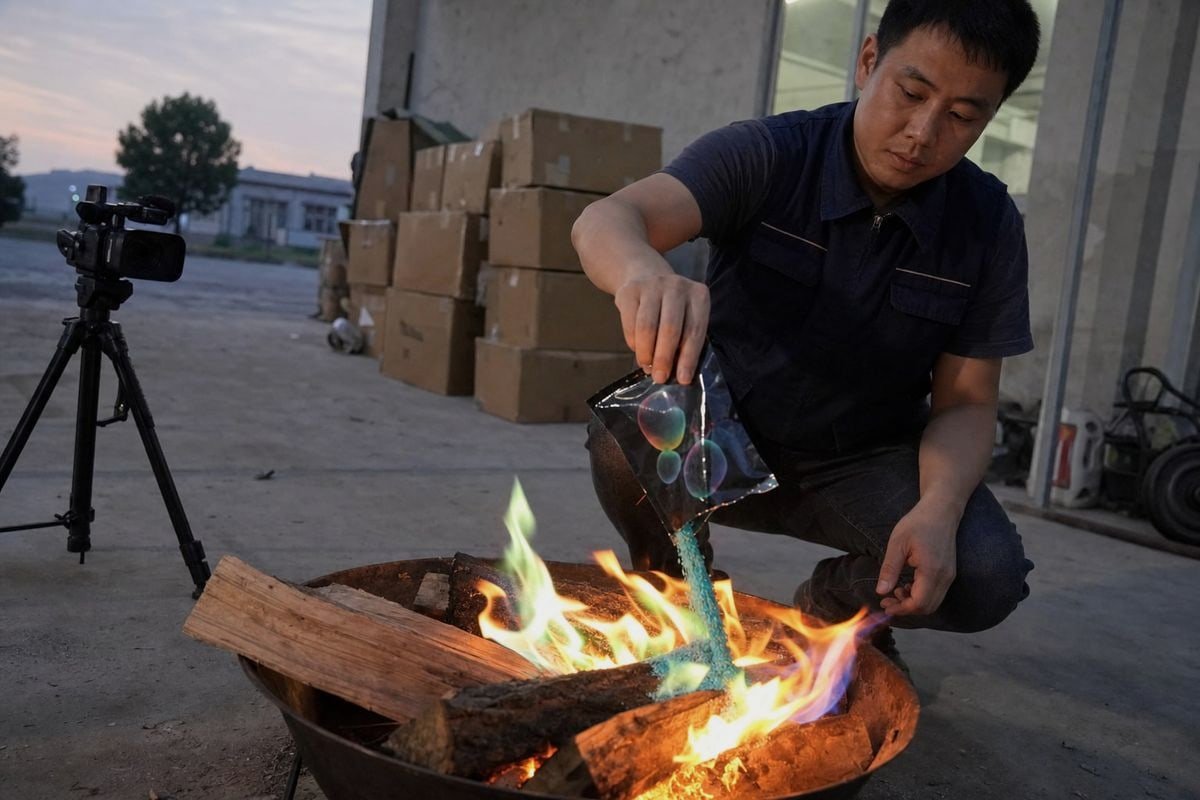
Flame color is chemistry, not magic. Each color comes from a specific compound. When the compound heats up, its electrons emit light at fixed wavelengths 1. That is why a serious supplier talks about colorant systems 2, while a vague one only says "rainbow effect."
Here is the standard reference chart we use when discussing color expectations with buyers:
| Desired Flame Color | Typical Colorant System | Difficulty to Reproduce |
|---|---|---|
| Yellow | Sodium compounds | Easy |
| Crimson red | Lithium or strontium compounds | Moderate |
| Green / blue-green | Copper compounds | Moderate |
| Apple green | Barium compounds | Moderate |
| Purple / lilac | Potassium compounds | Hard (sodium contamination 3 shifts it) |
| Orange-red | Calcium compounds | Hard (naturally weak color) |
Why the Same Powder Can Look Different in Different Fires
The observed color also shifts with flame temperature, oxygen supply, fuel type, and lighting. A powder validated over gel fuel may look weaker on damp firewood. In our Ningbo production facility, we validate every color formula on real wood fires, because that is how end users burn our Magic Fire packets. Before you order, ask your supplier one direct question: "What fuel and flame did you use to validate this color?" If the answer does not match your product's real use case — campfire, fireplace, or fire pit — the demo footage proves very little.
Also ask which colors are hardest. An honest supplier will tell you purple is contamination-sensitive and calcium orange is faint. A supplier who promises every color equally vividly is selling hope, not chemistry.
What Test Reports or Certifications Should I Request to Confirm Color Consistency?
When we prepare export files for US and EU buyers, the documentation folder is often thicker than the sample box. That paperwork is exactly what separates factories from resellers.
Request the SDS, a technical data sheet stating performance claims, SGS or Intertek third-party test reports, ISO 9001 quality system certification, batch traceability records, and finished-product inspection records. Together these prove the color formula is defined, safe, and consistently reproduced.

Documents do two jobs. First, they prove safety and legality for import. Second, they prove the supplier controls the process well enough to repeat the same color, order after order. In our seventeen-plus years exporting to more than thirty countries, buyers who checked documents up front almost never faced quality disputes later.
Here is the document checklist I recommend, in priority order:
| Document | What It Proves | Red Flag If Missing |
|---|---|---|
| SDS 5 / MSDS | Chemical composition and hazards | Supplier hides what is in the powder |
| Technical data sheet | Intended use, burn time, color claims | Claims exist only in marketing copy |
| SGS / Intertek test report | Independent verification of safety | No third-party accountability |
| ISO 9001 certificate | A documented quality management system | No system to keep batches consistent |
| BSCI audit | Factory ethics and working conditions | Risk for retail-channel compliance |
| Batch / lot traceability record | Raw materials can be traced per batch | Color drift cannot be diagnosed |
| CE marking documentation 6 | EU market conformity | Customs and retailer rejection risk |
Compliance Is Also About the Colorants Themselves
Some metal salts face import restrictions in certain regions. Ask your supplier to confirm every colorant complies with regulations in your destination market. At our Liuyang headquarters, we treat this as a hard requirement because large retail channels demand it — a Home Depot-type buyer will not touch an undocumented fire product. If a supplier refuses to share an SDS, walk away. That refusal usually means they do not know their own formula, or they are trading someone else's product.
Can I Get Physical Samples to Check the Flame Colors Myself?
Sample requests are the emails I welcome most. A buyer who tests before ordering usually becomes a long-term partner, because expectations get aligned before money moves.
Yes — any credible magic fire powder supplier should provide sample packets before a bulk order. Burn them under your real conditions, compare colors side by side in dim lighting, record video for reference, and repeat the test across multiple fires to confirm consistency.
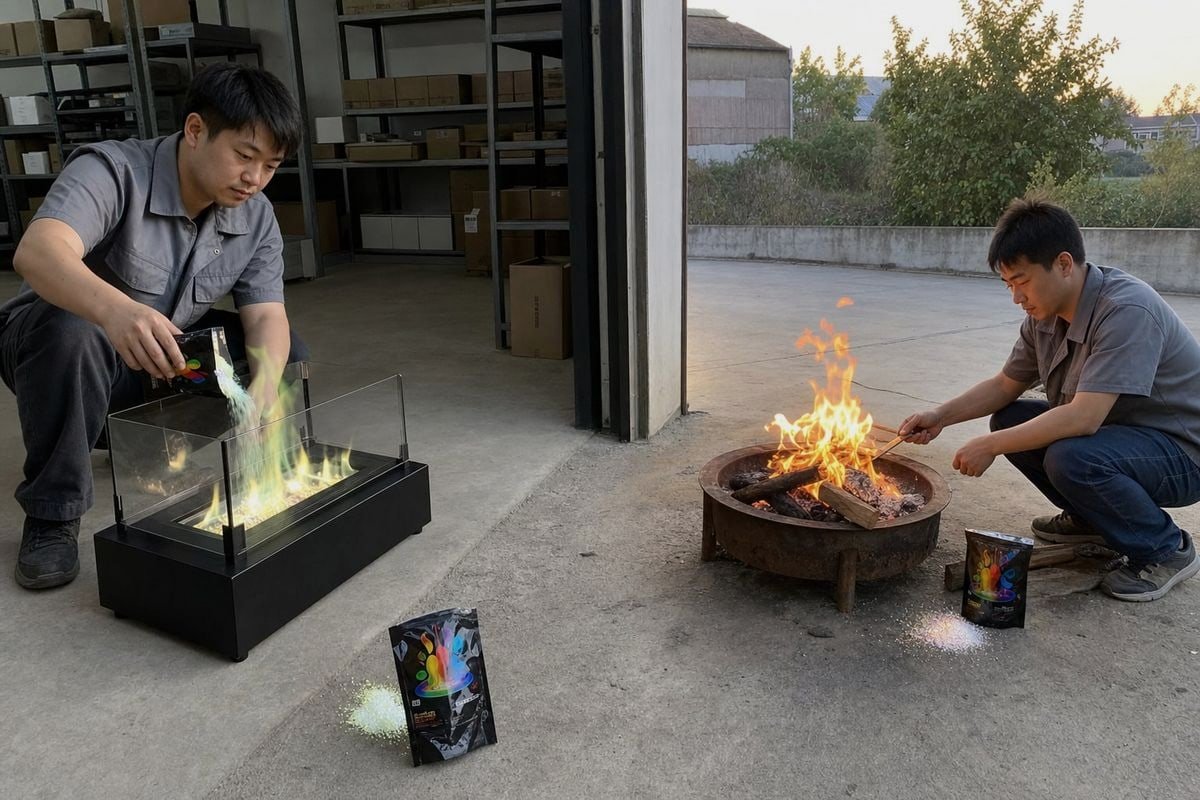
Sample testing only works if you test properly. A quick glance at one flame tells you little. Treat it as a controlled comparison exercise. Here is the protocol I share with our distributors:
- Request the supplier's exact test setup. Ask what fuel, flame size, and application method they used to validate the color.
- Replicate your real use case. If your customers use campfires, test on wood — not a gas burner or spray demo.
- Test in dim lighting. Flame colors read far stronger at dusk or night. Daylight tests undersell every product.
- Burn side by side. Compare the sample against a known reference product or a previously approved lot.
- Record photos and video. Cameras document subtle differences your memory will not hold. Note that white balance can distort hues, so keep camera settings fixed.
- Repeat at least two or three times. One burn can mislead; repeated burns reveal true consistency.
- Test across fuels if relevant. Wood, charcoal, and gel fuel burn at different temperatures and shift the visible color.
Watch Out for the Demo-Versus-Reality Gap
Spray-bottle and lab-style demos make colors look dramatic. A real campfire is messier — variable temperature, smoke, and wood contamination all mute the effect. When we develop new Magic Fire formulas, our team burns them in ordinary outdoor fire pits, because that gap between demo and reality is where buyer complaints are born. We also keep trial MOQs flexible so importers can run a small pilot order after sample approval instead of jumping straight to a full container.
How Do I Ensure Every Production Batch Matches My Approved Flame Color Standard?
Years ago, we traced a slight green-shift complaint back to a raw material supplier who changed copper salt purity without notice. That lesson reshaped our incoming inspection process permanently.
Ensure batch consistency by locking a golden sample as the reference standard, requiring raw material purity checks, demanding documented batch burn tests before shipment, and requesting per-lot traceability so any color drift can be identified and corrected at the source.

Color consistency is a process problem, not a promise problem. Metal salt purity varies between raw material lots, and even small impurity changes can shift a flame hue. Sodium contamination, for example, can wash a delicate purple toward yellow. So the real question for any supplier is: what system catches drift before the goods ship?
Here is how a disciplined production flow controls color from raw material to container:
| QC Stage | Control Action | What It Prevents |
|---|---|---|
| Incoming materials | Verify colorant identity and purity per lot | Hue shift from raw material substitution |
| Formulation | Weigh against the locked formula record | Batch-to-batch recipe drift |
| In-process check | Burn-test samples mid-production | Catching errors before full runs |
| Pre-shipment | Compare finished lot against the golden sample | Off-color goods leaving the factory |
| Traceability | Record lot codes on cartons and records | Untraceable complaints later |
Lock a Golden Sample Before Mass Production
Approve a physical reference sample in writing, and require the supplier to retain a sealed counterpart. Every future batch gets judged against that standard, not against memory or photos. In our production lines, the approved sample governs mass production — that is why we tell buyers the first sample reliably reflects what arrives in the container. For private-label programs, extend the standard beyond color: packaging print, warning labels, and barcodes should all be locked in the same approval file, so your shelf-ready product stays uniform across reorders.
Conclusion
Do not ask whether the powder is magical. Ask for the SDS, third-party reports, real samples, and batch QC proof — then partner with the supplier who provides all four.
Footnotes
1. Explains the physics of light emission at specific wavelengths behind flame coloration. ↩︎
2. Background on colorant chemistry that determines flame hue in pyrotechnic powders. ↩︎
3. NIH chemical database detailing sodium properties relevant to flame color contamination. ↩︎
4. NIST spectral database supporting claims about metal salts producing specific flame colors. ↩︎
5. OSHA's authoritative guidance on Safety Data Sheets required for chemical product imports. ↩︎
6. Official EU source explaining CE marking requirements for product market conformity. ↩︎



 English
  Spanish
  German
  French
  Arabic
  Portuguese
Join the Conversation