







Le prix erroné de Magic Fire Powder a failli faire échouer l'une de nos premières transactions d'exportation BSCI 1. Fixez la marge brute trop mince, et les coûts de conformité rongent silencieusement votre profit avant même que le conteneur ne soit expédié.
Pour Magic Fire Powder, visez une marge brute d'environ 50% entre le prix de gros et le prix de détail. Fixez votre prix de gros à environ la moitié du prix de détail suggéré par le fabricant, en laissant les détaillants appliquer une tarification clé (2× le prix de gros) tout en protégeant votre propre marge du coût réel débarqué.
C'est la réponse courte. Mais la marge et la majoration ne sont pas la même chose, et les produits à flamme colorée entraînent des coûts que les articles fantaisie ordinaires n'ont pas. Laissez-moi vous expliquer comment obtenir les bons chiffres.
Comment calculer une marge brute réaliste pour la Poudre Magique de Feu sans me disqualifier du marché par mes prix ?
Un distributeur allemand m'a montré sa feuille de calcul après notre première série d'échantillons. Son prix de détail fonctionnait, mais seulement parce que nous avions fixé le prix de nos sachets à partir du coût total, et non des seules matières premières.
Calculez la marge brute en soustrayant votre coût unitaire entièrement chargé — matériaux, main-d'œuvre, emballage, conformité et fret — de votre prix de gros, puis en divisant par le prix de gros. Visez 40 à 50 % au niveau du prix de gros tout en maintenant le prix de détail à environ 2 fois votre prix de gros.

La première erreur que je vois commettre par les acheteurs et les nouvelles marques est de confondre majoration et marge. La majoration est calculée sur le coût. La marge est calculée sur le prix de vente. Une majoration de 100 % sur le prix de gros équivaut à une marge de 50 % sur le prix de détail. De nombreux guides de prix disent "doubler la clé" ou "2 fois le prix de gros", et c'est une règle de majoration, pas une règle de marge. Si vous mélangez les deux, votre pourcentage de profit brut sera inférieur à celui que vous aviez prévu.
Commencez par votre pile de coûts complète
Pour les sachets de colorant pour feu de camp, votre Coût des marchandises vendues 2 doit inclure plus que de la poudre et de la feuille d'aluminium. Dans notre planification de production, nous prenons toujours en compte :
- Matières premières directes (composé colorant, sachet en aluminium ou sac en papier kraft)
- Main-d'œuvre et temps de ligne de remplissage
- Emballage, boîtes d'exposition, étiquettes d'avertissement, codes-barres
- Tests de conformité et documentation
- Allocation des frais généraux
- Fret, droits de douane et exécution
- Allocation pour retours et dommages
Trois modèles de tarification pratiques
| Modèle | Comment ça marche | Idéal pour |
|---|---|---|
| Modèle de clé | Prix de gros = 50 % du prix de détail ; prix de détail = 2 fois le prix de gros | Distribution standard, la plupart des canaux de vente au détail |
| Modèle de remise flexible | Prix de gros à 40–60 % de rabais sur le PDSF | Stratégie de prix B2B par paliers de volume |
| Modèle axé sur la marge | Fixez le prix de gros à partir du coût unitaire pour atteindre une marge brute cible | Produits à forte conformité ou positionnés haut de gamme |
Si votre coût unitaire tout compris par sachet est modeste, une marge brute de gros de 50 % est réaliste et correspond aux normes de distribution standard. Si les coûts sont plus élevés en raison des tests ou de l'emballage, vous devrez peut-être augmenter votre PDSF plutôt que de réduire la marge du détaillant. Les détaillants s'attendent toujours à une marge de clé, sinon le canal résistera au produit.
Quelle fourchette de prix de gros devrais-je attendre lors de l'approvisionnement en poudre de flamme colorée auprès d'un fabricant certifié?
Un compromis dont nous discutons avec presque tous les nouveaux importateurs est le volume par rapport au prix unitaire. Une commande d'essai à une quantité minimale de commande flexible coûte plus cher par sachet, mais elle réduit le risque de votre première saison.
Attendez-vous à ce que les prix de gros de la poudre certifiée à flamme colorée se situent entre 40 et 60 % en dessous du prix de détail cible, les coûts de production pour un sachet standard de 25 g étant généralement compris entre 0,25 et 0,40 £ avant l'ajout de l'emballage, de la conformité et du fret.
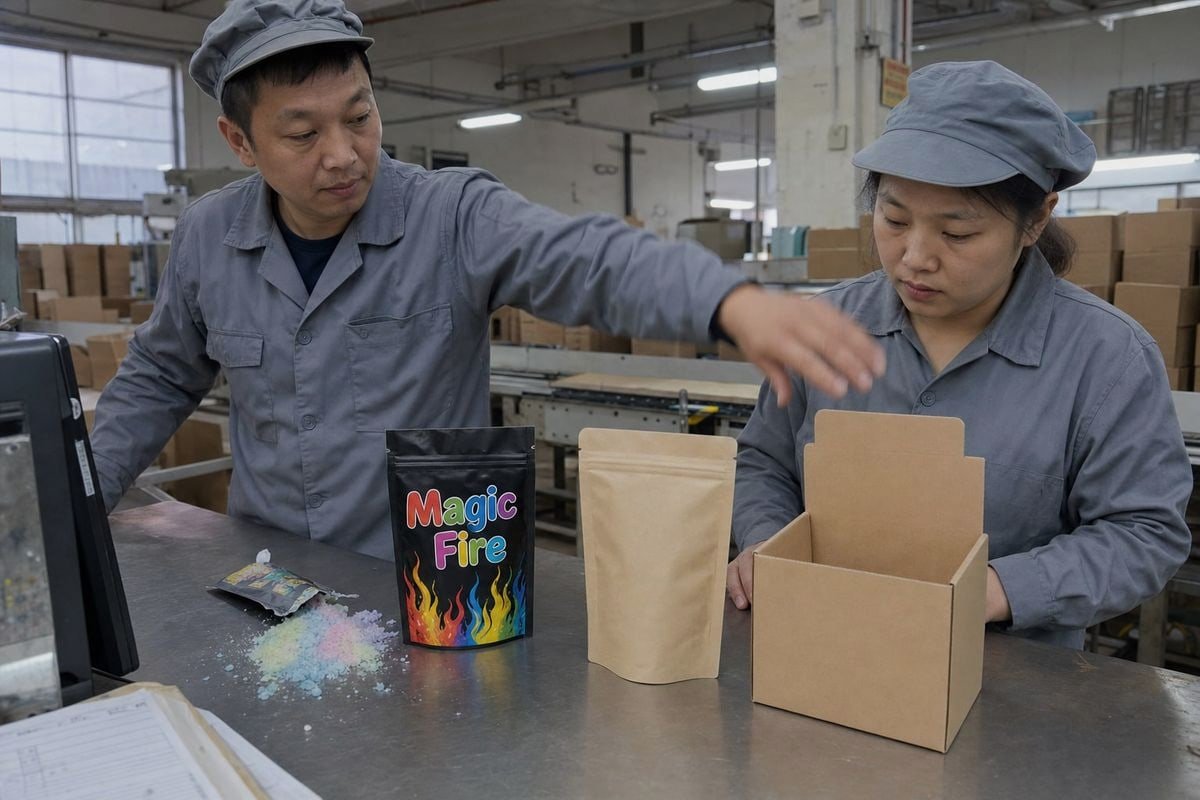
Le prix de gros de Magic Fire Powder n'est pas un chiffre unique. Il évolue avec le volume de commande, le format d'emballage et le niveau de personnalisation. D'après notre expérience d'exportation aux États-Unis, en Allemagne, au Royaume-Uni et en Australie, le même produit de base peut avoir des prix de gros significativement différents selon la manière dont il est expédié et dont il se vend en rayon.
Ce qui fait varier le prix de gros
Le volume de commande est le plus grand levier. Des volumes plus élevés répartissent les coûts d'installation, de test et de logistique sur plus d'unités. C'est pourquoi la quantité minimale de commande est si importante pour les articles fantaisie à bas prix : en dessous d'un certain volume, les coûts d'exécution érodent l'économie déjà étroite par unité.
Le format d'emballage est le deuxième levier. Un sachet simple en aluminium est le moins cher. Une pochette en papier kraft refermable coûte plus cher. Une boîte d'exposition de détail avec un couvercle rabattable — le format Point d'Achat que les détaillants adorent pour les sections d'achats impulsifs — coûte encore plus cher, mais elle justifie également un PDSF plus élevé.
| Formater | Coût de gros relatif | Position de détail typique |
|---|---|---|
| Sachet individuel en aluminium | Le plus bas | Ajout impulsif, présentoir de comptoir |
| Pochette refermable en papier kraft (multi-usage) | Moyen | Étagère camping et plein air |
| Boîte d'exposition POP (12–24 sachets) | Plus élevé par expédition, efficace par unité | Sections de caisse et de cadeaux |
| Pot sous marque privée | Le plus haut | Détail de cadeaux de luxe et de cheminée |
Un avantage supplémentaire qui vaut la peine d'être pris en compte : les sachets à flamme colorée ont un fort rapport poids-valeur. Ils ajoutent une valeur perçue à la commande d'un client sans faire passer les expéditions dans une catégorie de fret supérieure. Cela contribue aux coûts de votre canal de distribution et à l'économie d'expédition du détaillant sur les commandes de places de marché.
Comment les certifications et les coûts de conformité affectent-ils mes calculs de marge pour les produits de lutte incendie importés ?
Un acheteur britannique m'a dit un jour que le produit de son fournisseur précédent avait été retenu à la douane pour manque de documentation de test. Il a perdu une saison de vente complète. Cette histoire a façonné la manière dont nous gérons la conformité dans notre usine.
Les coûts de conformité — marquage CE, tests SGS ou Intertek, documentation FDS et étiquettes d'avertissement — ajoutent généralement plusieurs points de pourcentage à votre coût des marchandises vendues, mais ils soutiennent également une prime de prix de 15 à 20 % et évitent les retards douaniers, les rappels et les rejets de canaux qui détruisent les marges.

La conformité est là où les puristes de la tarification au coût majoré et les tarificateurs à la règle du pouce se trompent tous les deux. Le camp du coût majoré dit de fixer le prix à partir de l'économie unitaire seule. Le camp de la clé dit de simplement doubler le prix de gros. Aucune des deux approches ne capture ce que la conformité fait réellement aux marges des produits de sécurité incendie. Cela augmente votre base de coûts, oui. Mais cela augmente également votre pouvoir de fixation des prix — et cela élimine le risque de perte catastrophique.
Notre propre exploitation supporte ISO 9001 3, certification BSCI et CE, avec des rapports de test SGS et Intertek pour nos lignes de flammes colorées. Pour nos acheteurs B2B aux États-Unis et en Europe, c'est une exigence stricte, pas un avantage. Les grands canaux d'approvisionnement de détail n'incluront pas un produit d'allumage non certifié, quel qu'en soit le prix. La vraie question n'est donc pas de savoir s'il faut absorber les coûts de conformité, mais comment les intégrer dans vos calculs de marge dès le premier jour.
Comment la conformité change la donne
Voici comment je recommande aux importateurs de réfléchir. FDS pré-vérifiées et documentation CE 4 vous permet de vendre dans des canaux peu risqués — lieux d'entreprise, centres de villégiature, grandes chaînes — qui paient des tarifs de gros plus élevés précisément parce que la paperasse est faite. L'éco-positionnement renforce cela : les paquets étiquetés sans métaux lourds ou non toxiques, fabriqués à partir de matériaux écologiques, soutiennent actuellement une prime de marge de 15 à 20 % par rapport aux alternatives chimiques génériques. Cette prime dépasse généralement le coût de conformité lui-même.
Concrètement, allouez la conformité comme une ligne par unité dans votre coût des marchandises vendues. Amortissez les frais de test sur votre volume annuel prévu, pas sur une seule commande. Cela maintient votre pourcentage de marge brute honnête et évite une mauvaise surprise lorsque vous récommandez une quantité différente.
Quelles stratégies de marge commerciale fonctionnent le mieux pour les produits à flamme colorée sur mon marché ?
Après avoir regardé nos partenaires de marque privée vendre les mêmes paquets dans des chaînes de camping, des boutiques de cadeaux et des places de marché, j'ai appris une chose : le produit change à peine, mais le pourcentage de majoration de détail gagnant change avec chaque canal.
Tarification clé (2× prix de gros, une marge de détail de 50%) sert de référence, mais les produits à flamme colorée prennent souvent en charge des marges de détail de 55 à 80% comme les feux d'artifice. Adaptez votre majoration au canal : plus élevée dans la vente au détail de cadeaux et d'expériences, protégée par les politiques MAP sur les places de marché.

Magic Fire Powder se comporte davantage comme un article spécialisé adjacent aux feux d'artifice qu'une marchandise générique. Les détaillants dans la catégorie des feux d'artifice ciblent souvent des marges de 55 à 80 %, ce qui indique que le pouvoir de fixation des prix est supérieur aux normes de détail ordinaires. Le pourcentage de majoration de détail qui fonctionne dépend fortement de l'endroit où se situe le produit.
Guide de majoration par canal
| Canal | Majoration typique sur le prix de gros | Notes |
|---|---|---|
| Camping / vente au détail extérieure | 2.0–2.2× | Base de la clé ; élevé taux de rotation des stocks 5 en saison |
| Magasins de cadeaux et boutiques | 2.5–3.0× | Le positionnement de nouveauté soutient un PDSF premium |
| Places de marché de type Amazon | 1.8–2.2× | Les frais compriment la marge ; la politique MAP est essentielle |
| Boîtes d'abonnement / d'expérience | 2,5x+ effectif | Le positionnement organisé augmente le prix de gros effectif |
Trois stratégies qui protègent la marge de chacun
Premièrement, appliquez une politique de prix minimum annoncé 6. Le dumping agressif sur les places de marché est le moyen le plus rapide de perdre vos partenaires physiques. Une politique MAP claire protège les marges de détail qui incitent les détaillants physiques à recommander.
Deuxièmement, utilisez des boîtes d'affichage POP pour stimuler le chiffre d'affaires. Les formats d'achat impulsif près des caisses dans les sections camping et cadeaux augmentent considérablement le taux de rotation des stocks, ce qui est aussi important pour un détaillant que la marge elle-même. Une marge de 50 % qui tourne huit fois par an bat une marge de 65 % qui tourne deux fois.
Troisièmement, envisagez des lots saisonniers. Placer des paquets dans des boîtes d'abonnement "expérience en plein air" transforme le produit d'une nouveauté autonome en un essentiel de style de vie organisé — et augmente le prix de gros effectif sans toucher votre prix catalogue. La saisonnalité coupe les deux sens, cependant, alors planifiez les délais de production en fonction des pics de demande avant les saisons de camping d'été et de cheminée d'hiver.
Conclusion
Sous-estimez Magic Fire Powder et les coûts de conformité tueront silencieusement votre profit. Au lieu de cela, fixez le prix à partir du coût d'atterrissage réel, ciblez une marge brute de gros de 50 % et préservez une marge de clé pour les détaillants.
Notes de bas de page
1. Amfori BSCI est le programme de certification de conformité sociale détenu par le fournisseur. ↩︎
2. Définition de fond du concept COGS central aux calculs de coûts de l'article. ↩︎
3. Entrée Wikipedia faisant autorité pour la norme internationale de gestion de la qualité. ↩︎
4. Source officielle de l'UE expliquant les exigences de marquage CE référencées pour les coûts de conformité. ↩︎
5. Guide complet de Wikipedia sur le calcul et la compréhension du chiffre d'affaires des stocks. ↩︎
6. Explique le concept de politique MAP utilisé pour protéger les marges de détail sur les canaux. ↩︎



 English
  Spanish
  German
  French
  Arabic
  Portuguese
Rejoignez la conversation