







Pricing Magic Fire Powder wrong nearly sank one of our earliest export deals BSCI 1. Set the gross margin too thin, and compliance costs quietly eat your profit before the container even ships.
For Magic Fire Powder, target roughly a 50% gross margin between wholesale and retail price. Set your wholesale price at about half of the Manufacturer's Suggested Retail Price, letting retailers apply keystone pricing (2× wholesale) while you protect your own margin from true landed cost.
That is the short answer. But margin and markup are not the same thing, and color-flame products carry costs that ordinary novelties do not. Let me break down how to get the numbers right.
How do I calculate a realistic gross margin for Magic Fire Powder without pricing myself out of the market?
A German distributor once showed me his spreadsheet after our first sample run. His retail price worked, but only because we had priced our packets from fully loaded cost, not raw materials alone.
Calculate gross margin by subtracting your fully loaded unit cost — materials, labor, packaging, compliance, and freight — from your wholesale price, then dividing by wholesale price. Aim for 40–50% at the wholesale level while keeping retail at roughly 2× your wholesale price.

The first mistake I see buyers and new brands make is confusing markup with margin. Markup is calculated on cost. Margin is calculated on selling price. A 100% markup on wholesale equals a 50% margin at retail. Many pricing guides say "double keystone" or "2× wholesale," and that is a markup rule, not a margin rule. If you mix the two up, your gross profit percentage will come in lower than you planned.
Start From Your Full Cost Stack
For campfire colorant packets, your تكلفة البضائع المباعة 2 must include more than powder and foil. In our production planning, we always account for:
- Direct materials (colorant compound, foil pouch or kraft bag)
- Labor and filling-line time
- Packaging, display boxes, warning labels, barcodes
- Compliance testing and documentation
- تخصيص النفقات العامة
- Freight, duties, and fulfillment
- Returns and damage allowance
Three Practical Pricing Models
| نموذج | كيف يعمل | الأفضل لـ |
|---|---|---|
| Keystone model | Wholesale = 50% of retail; retail = 2× wholesale | Standard distribution, most retail channels |
| Flexible discount model | Wholesale at 40–60% off MSRP | Volume-tiered B2B pricing strategy |
| Margin-first model | Set wholesale from unit cost to hit a target gross margin | Compliance-heavy or premium-positioned products |
If your all-in unit cost per packet is modest, a 50% wholesale gross margin is realistic and matches standard distribution norms. If costs run higher because of testing or packaging, you may need to raise your MSRP rather than squeeze the retailer's side. Retailers still expect room for keystone pricing, or the channel will resist the product.
What wholesale price range should I expect when sourcing color-flame powder from a certified manufacturer?
One trade-off we discuss with nearly every new importer is volume versus unit price. A trial order at a flexible Minimum Order Quantity costs more per packet, but it de-risks your first season.
Expect wholesale prices for certified color-flame powder to land at 40–60% below the target retail price, with production costs for a standard 25g packet typically between $0.25 and $0.40 before packaging, compliance, and freight are added.
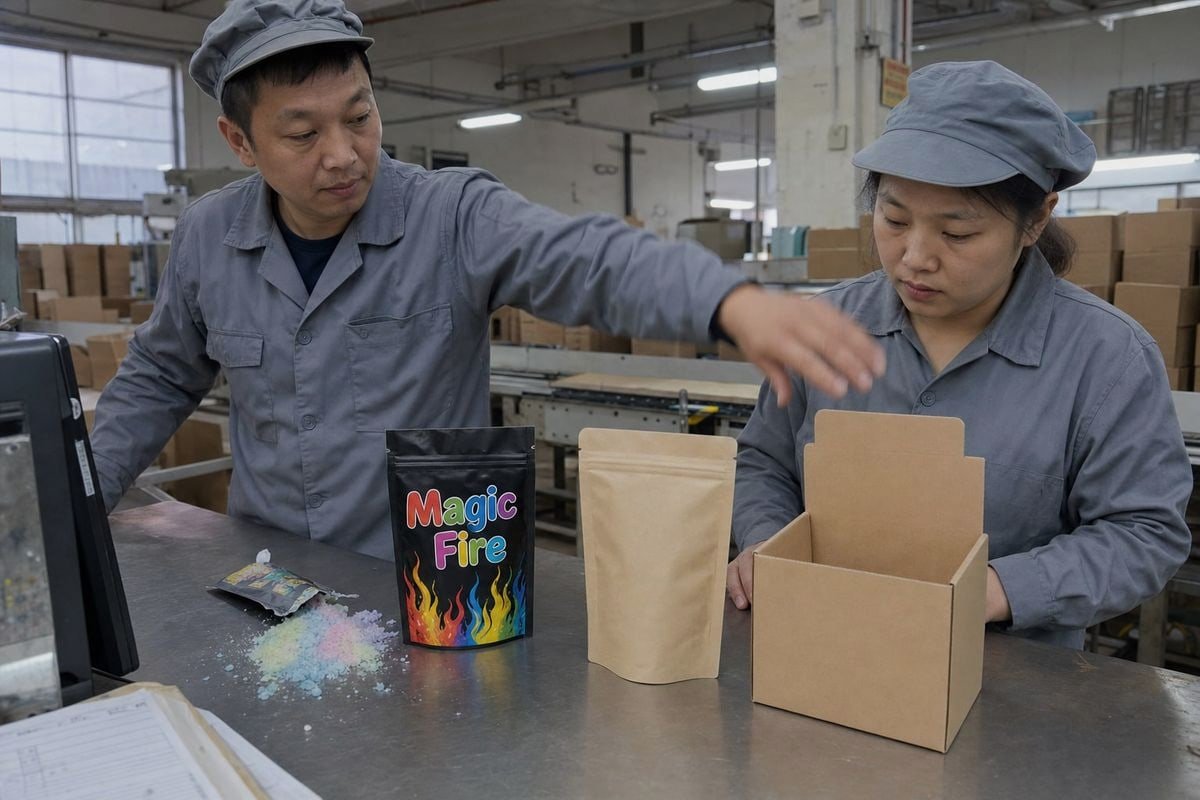
Wholesale pricing for Magic Fire Powder is not a single number. It moves with order volume, packaging format, and customization level. From our export experience across the US, Germany, the UK, and Australia, the same base product can carry meaningfully different wholesale prices depending on how it ships and how it sells on the shelf.
What Moves the Wholesale Price
Order volume is the biggest lever. Higher volumes spread setup, testing, and logistics costs across more units. That is why Minimum Order Quantity matters so much for low-cost novelty items: below a certain volume, fulfillment costs erode the already narrow per-unit economics.
Packaging format is the second lever. A plain foil sachet is the cheapest. A kraft stand-up pouch with a resealable zip costs more. A retail display box with a flip-top lid — the Point-of-Purchase format retailers love for impulse-buy sections — costs more again, but it also justifies a higher MSRP.
| تنسيق | Relative Wholesale Cost | Typical Retail Position |
|---|---|---|
| كيس رقائق فردي | الأدنى | Impulse add-on, counter display |
| Kraft resealable pouch (multi-use) | متوسط | Camping and outdoor shelf |
| POP display box (12–24 sachets) | Higher per shipment, efficient per unit | Checkout and gift sections |
| Private-label jar | الأعلى | Premium gift and fireplace retail |
One more advantage worth pricing in: color-flame packets have a strong weight-to-value ratio. They add perceived value to a customer's order without pushing shipments into a higher freight bracket. That helps both your distribution channel costs and the retailer's shipping economics on marketplace orders.
How do certifications and compliance costs affect my margin calculations for imported fire products?
A UK buyer once told me his previous supplier's product was held at customs for missing test documentation. He lost a full selling season. That story shaped how we handle compliance at our factory.
Compliance costs — CE marking, SGS or Intertek testing, MSDS documentation, and warning labels — typically add several percentage points to your Cost of Goods Sold, but they also support a 15–20% price premium and prevent margin-destroying customs holds, recalls, and channel rejections.

Compliance is where cost-plus pricing purists and rule-of-thumb pricers both go wrong. The cost-plus camp says to price from unit economics alone. The keystone camp says to just double wholesale. Neither approach captures what compliance actually does to fire-product margins. It raises your cost base, yes. But it also raises your pricing power — and it removes catastrophic downside risk.
Our own operation carries ISO 9001 3, BSCI, and CE certification, with SGS and Intertek test reports for our color-flame lines. For our B2B buyers in the US and Europe, this is a hard requirement, not a nice-to-have. Large retail sourcing channels will not list an uncertified fire product at any price. So the real question is not whether to absorb compliance costs, but how to build them into your margin math from day one.
How Compliance Changes the Equation
Here is how I recommend importers think about it. Pre-verified MSDS and وثائق CE 4 lets you sell into risk-averse channels — corporate venues, resorts, major chains — that pay higher wholesale rates precisely because the paperwork is done. Eco-positioning compounds this: packets branded as heavy-metal-free or non-toxic, made from eco-friendly materials, currently support a 15–20% margin premium over generic chemical alternatives. That premium usually exceeds the compliance cost itself.
Practically, allocate compliance as a per-unit line in your Cost of Goods Sold. Amortize testing fees across your expected annual volume, not a single order. That keeps your gross profit percentage honest and prevents a nasty surprise when you reorder at a different quantity.
What retail markup strategies work best for color-flame products in my market?
After watching our private-label partners sell the same packets through camping chains, gift shops, and marketplaces, I have learned one thing: the product barely changes, but the winning retail markup percentage changes with every channel.
Keystone pricing (2× wholesale, a 50% retail margin) works as the baseline, but color-flame products often support 55–80% retail margins like fireworks. Match your markup to the channel: higher in gift and experience retail, protected by MAP policies on marketplaces.

Magic Fire Powder behaves more like a fireworks-adjacent specialty item than a generic commodity. Retailers in the fireworks category often target 55–80% margins, which tells you the pricing power here is above ordinary retail norms. The retail markup percentage that works depends heavily on where the product sits.
Channel-by-Channel Markup Guide
| القناة | Typical Markup on Wholesale | مصادر الأكواز الخام |
|---|---|---|
| التخييم / البيع بالتجزئة الخارجي | 2.0–2.2× | Keystone baseline; high معدل دوران المخزون الخاص بك 5 in season |
| Gift and boutique stores | 2.5–3.0× | Novelty positioning supports premium MSRP |
| Amazon-style marketplaces | 1.8–2.2× | Fees compress margin; MAP policy is essential |
| Subscription / experience boxes | Effective 2.5×+ | Curated positioning raises effective wholesale price |
Three Strategies That Protect Everyone's Margin
First, enforce a سياسة الحد الأدنى لسعر الإعلان 6. Aggressive undercutting on marketplaces is the fastest way to lose your brick-and-mortar partners. A clear MAP policy protects the retail margins that keep physical retailers reordering.
Second, use POP display boxes to drive turnover. Impulse-buy formats near checkouts in camping and gift sections significantly increase the inventory turnover rate, which matters as much to a retailer as the margin itself. A 50% margin that turns eight times a year beats a 65% margin that turns twice.
Third, consider seasonal bundling. Placing packets into "outdoor experience" subscription boxes shifts the product from standalone novelty to curated lifestyle essential — and lifts the effective wholesale price without touching your list price. Seasonality cuts both ways, though, so plan production lead times around demand spikes before summer camping and winter fireplace seasons.
خاتمة
Underprice Magic Fire Powder and compliance costs will quietly kill your profit. Instead, price from true landed cost, target a 50% wholesale gross margin, and preserve keystone room for retailers.
ملاحظات ختامية
1. Amfori BSCI is the social compliance certification program the supplier holds. ↩︎
2. Background definition of the COGS concept central to the article's cost calculations. ↩︎
3. Authoritative Wikipedia entry for the international quality management standard. ↩︎
4. Official EU source explaining CE marking requirements referenced for compliance costs. ↩︎
5. Comprehensive Wikipedia guide on calculating and understanding inventory turnover. ↩︎
6. Explains the MAP policy concept used to protect retail margins across channels. ↩︎



 English
  Spanish
  German
  French
  Arabic
  Portuguese
انضم إلى المحادثة