






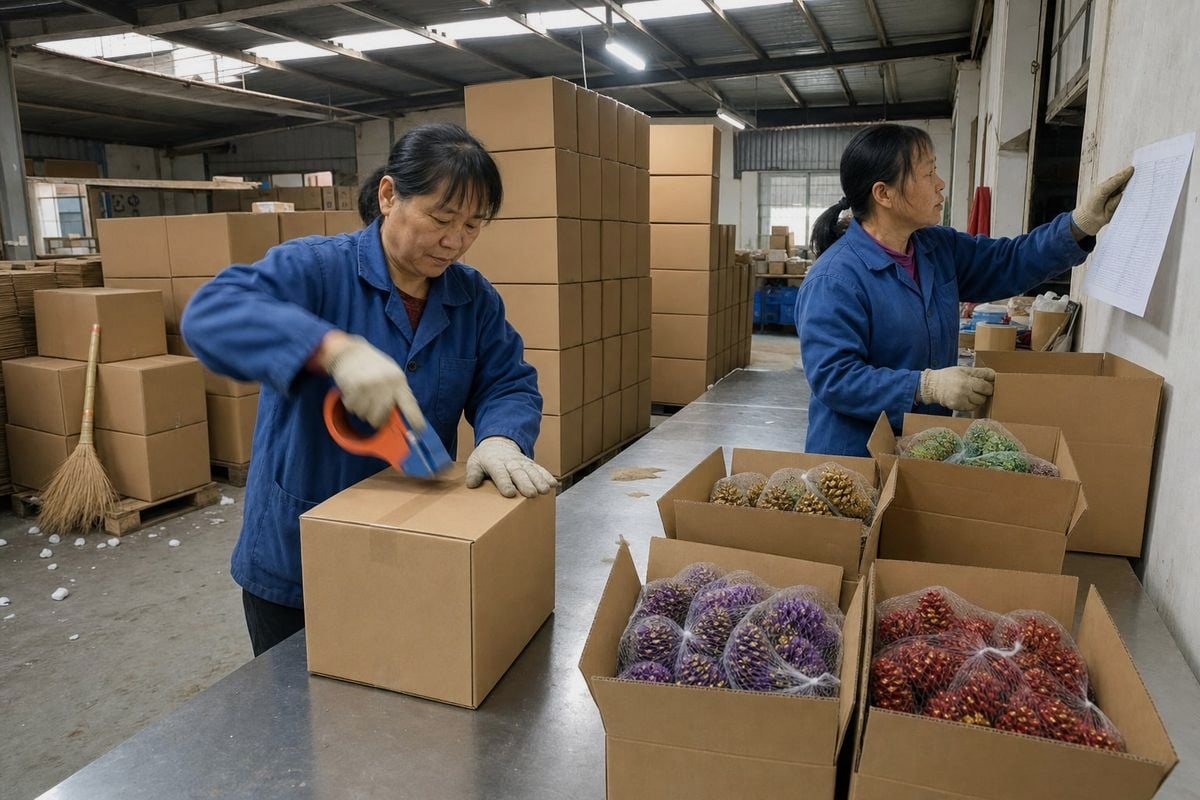
Choosing pack sizes and box specs for colored pine cones sounds simple — until a container of crushed cones arrives UPC barcodes 1. On our packing lines, we solved that problem years ago.
Colored pine cones for retail typically come in 12-count, 24-count, 25-count, and 100-count packs, or weight-based 1 lb, 2 lb, and 5 lb bags for fireplace color cones. Common box specs include 13x13x13" or 17x11x9" master cartons, with breathable, moisture-safe packaging materials.
Below, I break down the standard formats, the box specs that survive shipping, private-label options, and how each choice changes your landed cost.
What pack sizes do colored pine cones typically come in for retail shelves?
A German distributor once asked us to quote "one bag of colored cones" — and we had to explain that this category actually splits into two very different products before any pack size makes sense.
Retail colored pine cones are commonly packed in 12-count picks, 24-count decor sets, 25-count craft bags, and 100-count wholesale boxes. Fireplace and campfire color-flame cones are sold by weight instead, most often in 1 lb, 2 lb, 2.5 lb, and 5 lb bags.

The first thing I tell buyers is to separate the market into two lanes. Craft and decor cones — painted, snow-tipped, or gold-lacquered — sell by piece count. Fireplace color-flame cones, like the ones we produce for campfire and hearth use, sell by weight. The logic is practical. Decor buyers care about how many cones fill a bowl or wreath. Fire-use buyers care about how many burns they get per bag.
Standard count-based formats for decor cones
Count-based packs work best when cone size is uniform. Here are the formats we see most often across US and EU retail shelves:
| Format de l'emballage | Typical cone size | Common use case |
|---|---|---|
| 12-count picks | 1–1.5" cones on stems | Holiday floral supplies, wreath making |
| 24-count sets | 1.6–2.4" | Consumer craft and tabletop decor |
| 25-count bags | 2–3" medium | Bulk craft supply aisles |
| 100-count boxes | 2–6" mixed or graded | Wholesale bulk quantities |
Weight-based formats for color-flame cones
For our color-flame pinecones, we standardize around 1 lb, 2 lb, and 5 lb retail bags. A 5 lb bag suits seasonal gift and value shoppers, while 1 lb pouches move well as impulse buys near fireplace tools. Some clients also request 8 oz mini formats for subscription boxes. One caution: natural cones 2 vary in size, so the same weight can contain a different visual volume. We manage that with size grading before packing, so a 2 lb bag looks consistent bag to bag.
Which box specs and packaging materials work best for shipping and display?
During a QC review last winter, we opened a returned carton from a trial shipment and found the real culprit behind crushed scales: dead air space 3, not rough handling.
The best box specs for colored pine cones are snug master cartons around 13x13x13" or 17x11x9" that minimize dead air, paired with breathable inner packaging — mesh bags, kraft pouches with windows, or perforated polybags — to prevent moisture damage during transit and shelf storage.
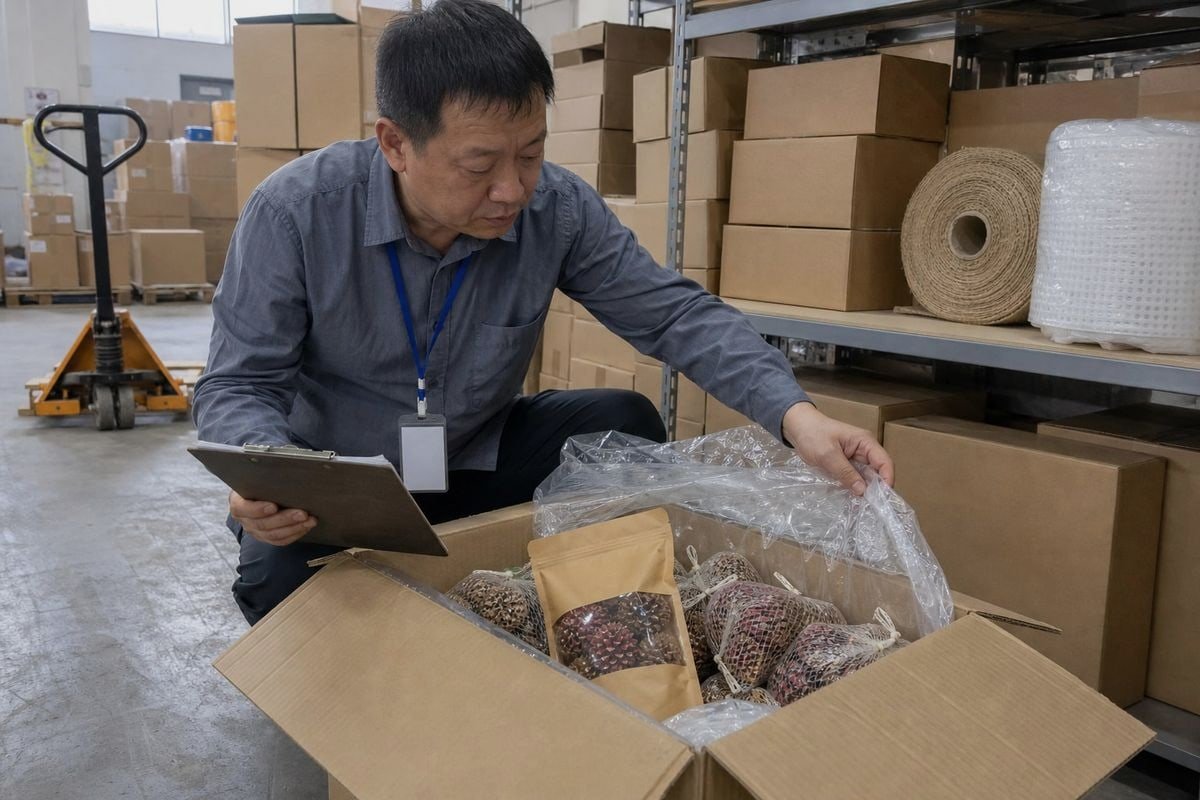
Pine cones are hygroscopic. They absorb moisture, and trapped humidity inside a sealed carton can warp cardboard, dull painted finishes, and even open or close the scales. So packaging material matters as much as carton size. In our export cartons, we favor breathable formats: cotton mesh bag packaging, burlap drawstring sacks for a rustic look, and kraft stand-up pouches with clear windows for shelf appeal. For humid destination markets like Brazil and parts of the Middle East, we add moisture-barrier liners inside the master carton rather than sealing the retail unit airtight.
Carton dimensions and weight guidelines
Dimensional weight charges punish oversized boxes. We size case pack dimensions to the retail unit, not the other way around:
| L'intensité de la couleur fonctionne de la même manière. Les clients de l'hôtellerie choisissent généralement une ou deux couleurs signature qui correspondent à leur intérieur — un bleu profond pour une station balnéaire côtière, un émeraude pour un lodge — et s'attendent à une correspondance lot par lot. Les acheteurs de détail à domicile veulent le contraire : des packs variés multicolores, car les flammes arc-en-ciel se vendent mieux sur une étagère. | Fourchette typique | Pourquoi c'est important |
|---|---|---|
| Master carton size | 13x13x13" or 17x11x9" | Reduces dead air and DIM weight fees |
| Master carton weight | 10–15 kg max | Safe manual warehouse handling |
| Configuration de la palette | ~24 cases per pallet | Maximizes freight density |
| Retail ship box (24-pack) | ~5.4x4.6x4.4" | Fits e-commerce small parcel tiers |
Shelf-ready and display formats
For large retail sourcing channels, we increasingly supply shelf-ready packaging 4: PDQ trays that go from pallet to shelf without repacking each unit. For scented decorative accents, heat-sealed inner liners lock fragrance in for months of shelf life. And clip-strip 3-count mini-packs are a rising format — they hang beside fireplace tools or wreath displays and drive impulse purchases. One clarification we always give buyers: e-commerce listings often show shipping carton dimensions, not product size. Confirm which one you are quoting before you plan planograms.
Can I customize pack counts and box dimensions for my private label?
A UK fireplace brand recently came to us with an odd request: 18-count bags sized to fit their existing gift box line. Two sample rounds later, it was on their shelves.
Yes. Reputable factories offer full private label manufacturing for colored pine cones, including custom pack counts, bag and box dimensions, branded pouches, polybag with header card formats, warning labels, UPC barcodes, and display-ready cartons — usually from moderate trial-order MOQs.

Customization is where a real factory earns its keep. On our OEM/ODM line, we adjust three layers of packaging independently: the retail unit, the inner pack, and the master carton. That flexibility matters because your retail unit is a branding decision, but your carton spec is a logistics decision. They should be optimized separately.
What you can typically customize
- Pack count or weight — 12, 24, 25, custom counts, or 8 oz through 5 lb weights.
- Retail packaging form — kraft pouches with windows, burlap sacks with jute ties, jars, or a polybag with header card for pegboard display.
- Branding and compliance — printed logos, multilingual warning labels, UPC barcoding requirements for US retail, and EAN codes for Europe.
- Carton and display specs — custom case pack dimensions, PDQ trays, and subscription-box flat-packs under 2 inches tall for lower postal tiers.
- Spécifications du produit — for color-flame cones, we also tune burn time and flame color mix, which is a manufacturing customization most trading companies cannot offer.
One tradeoff I flag honestly: highly custom packaging raises tooling and print plate costs on small runs. For trial orders, we often recommend a stock pouch with a custom sticker label first, then invest in fully printed packaging once sell-through is proven. Compliance stays non-negotiable at every stage — our CE marking, SGS/Intertek test reports, and BSCI audit documentation 5 ship with every private-label program, because US and EU retail buyers will ask for them before the first PO.
How do pack size and box specs affect my per-unit cost and MOQ?
The trade-off I weigh most often with new buyers is this: smaller retail packs earn higher margins per ounce, but they multiply your packaging cost, labor, and labeling steps per shipped pound.
Larger pack sizes lower per-unit cost because packaging, labeling, and handling are spread across more product. Smaller packs raise per-unit cost but improve retail margin and shelf velocity. MOQs are usually set per SKU, so fewer pack-size variants means easier trial orders.

Cost behaves predictably once you see where money actually goes. For colored pine cones, raw cones are cheap. The cost drivers are color treatment, packaging materials, labor, and freight. Every extra bag, header card, and barcode label adds touches on the line. So a 5 lb bulk bag might cost far less per pound than five 1 lb pouches of the same product — yet the 1 lb pouch often earns more at retail.
Cost comparison by pack format
| Format de l'emballage | Relative per-unit cost | Retail margin potential | Freight efficiency |
|---|---|---|---|
| 1 lb pouch | Le plus haut | Highest markup | Modéré |
| 2 lb bag | Moyen | Fort | Bonne |
| 5 lb sac en vrac | Lowest per lb | Value positioning | Best |
| 100-count wholesale box | Faible | Depends on resale format | Best |
| 12-count clip-strip pack | Élevé | Impulse-buy premium | Weakest |
How MOQs really work
We set MOQs per SKU, not per total order. A buyer ordering one pack size in one packaging design hits MOQ faster than one splitting the same volume across four variants. My practical advice for trial orders: start with one or two pack formats, use our stock packaging structures with your label, and consolidate into full cartons on the 24-case pallet standard. Freight also rewards discipline. Snug case pack dimensions and correct master carton weight keep you out of dimensional-weight penalties 6, and a well-planned pallet can cut your landed cost per unit more than any factory price negotiation will. We have seen buyers save more by fixing carton specs than by squeezing quotes.
Conclusion
Wrong pack sizes and box specs quietly drain margin through damage, DIM fees, and slow shelf turns. Get the format right first, then let a compliant factory execute it.
Notes de bas de page
1. Official global standards for product identification and barcoding required for retail distribution. ↩︎
2. Provides biological context on the variability of conifer cones which impacts weight-based packaging consistency. ↩︎
3. Authoritative Wikipedia entry explaining dunnage, the material used to fill dead air space in shipping. ↩︎
4. Defines industry standards for retail packaging that transitions directly from shipping to store shelves. ↩︎
5. Explains the social compliance standards for monitoring and improving working conditions in global supply chains. ↩︎
6. Authoritative Wikipedia entry explaining how dimensional weight affects shipping costs and penalties. ↩︎



 English
  Spanish
  German
  French
  Arabic
  Portuguese
Rejoignez la conversation