






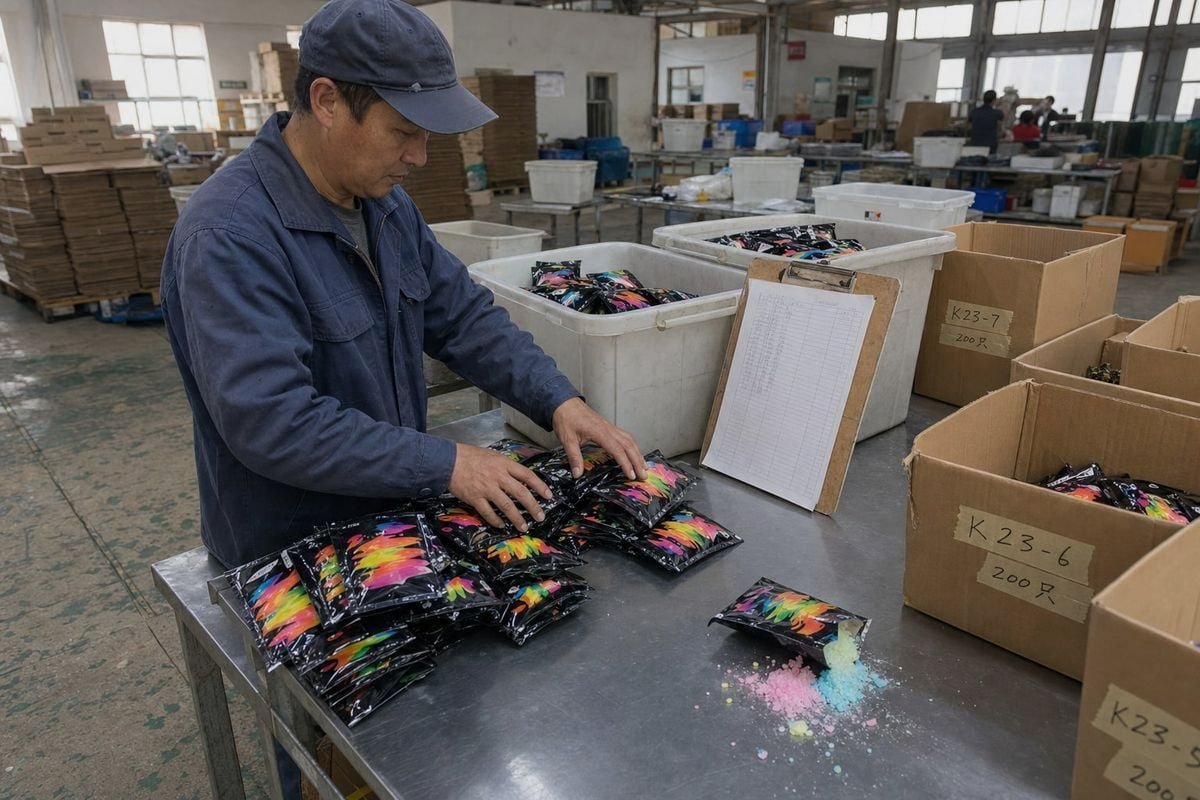
Splitting SKUs and setting stocking ratios for Magic Fire Powder color variants confuses many buyers. I see it constantly when importers order our campfire colorant packets, and messy SKUs quietly drain their margins through stockouts, dead stock, and fulfillment errors.
Split Magic Fire Powder into one unique SKU per sellable color variant using a parent-child structure like MFP-BLUE. Then set stocking ratios from demand data: weight best-sellers such as blue and green at 30–40% each, and cap slow colors at 10–15% until sales velocity justifies more.
That is the short answer. The full picture needs more detail. Below, I break down how many colors to launch with, how to weight your order, how to set MOQs per color, and when a trial order makes sense.
How do I decide how many color variants to include in my initial Magic Fire Powder SKU lineup?
Last spring, a German distributor asked our team to quote all nine flame colors we produce. We talked him down to five. His sell-through data a season later proved that call right.
Start with three to five color variants for your initial Magic Fire Powder lineup: blue, green, and a rainbow or multi-color mix as the core, plus one or two accent colors. Fewer SKUs simplify demand planning; you can expand once variant-level sales data confirms demand.
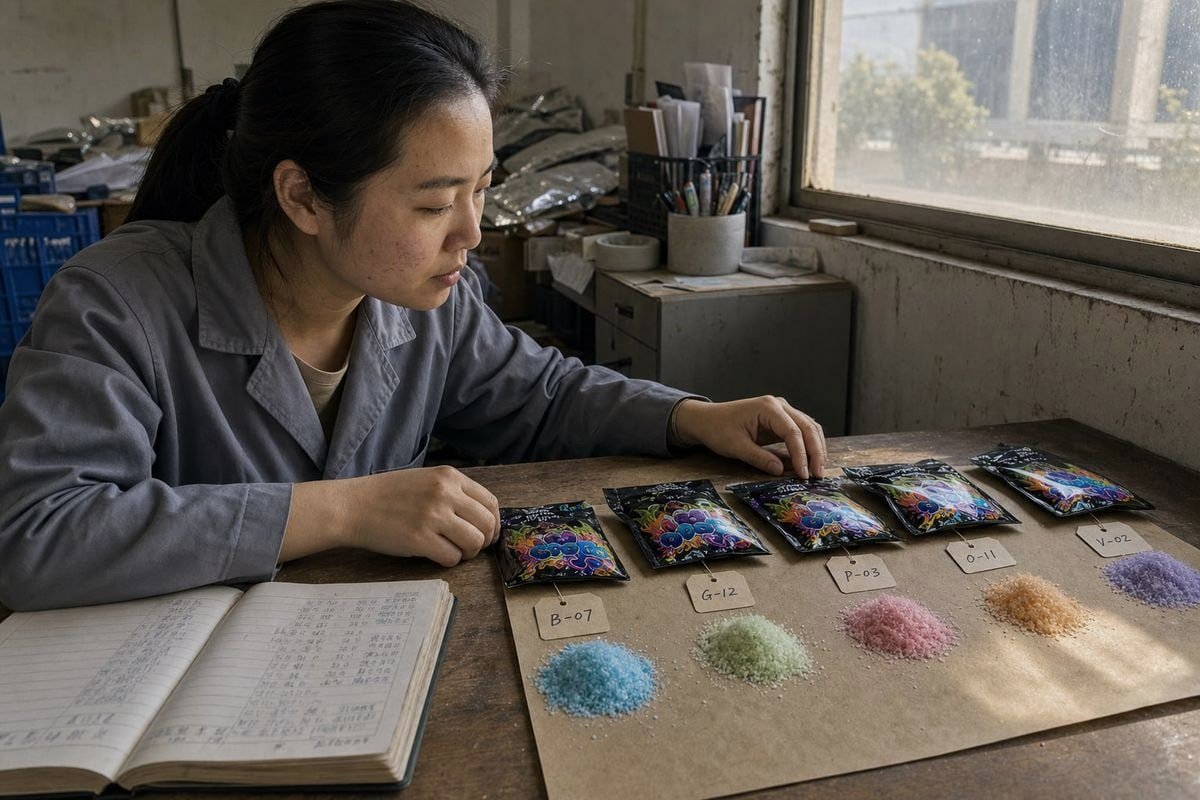
Every color you add is not just a new listing. It is a separate inventory line 1, a separate reorder decision, and a separate slice of your cash. In our 17+ years supplying color-flame products to buyers in the US, Germany, the UK, and beyond, the pattern is consistent: catalogs with tight lineups turn inventory faster than catalogs that launch every possible shade at once.
Start from what a SKU actually represents
A SKU is one physical sellable unit 2, not a blended color family. If blue packets and green packets sit in different cartons in your warehouse, they need different SKUs. This is standard product variation management practice across ecommerce and retail systems, and platforms like Shopify assign SKUs at the variant level for exactly this reason.
Use a parent-child SKU architecture
We recommend a parent-child SKU architecture from day one. The parent represents the Magic Fire Powder family. Each child SKU is a specific color. A durable pattern looks like this:
| Référence | Parent | Couleur | Format de l'emballage |
|---|---|---|---|
| MFP-BLU-25 | MFP | Bleu | 25g foil sachet |
| MFP-GRN-25 | MFP | Vert | 25g foil sachet |
| MFP-RBW-25 | MFP | Rainbow mix | 25g foil sachet |
| MFP-RED-25 | MFP | Rouge | 25g foil sachet |
| MFP-PUR-25 | MFP | Violet | 25g foil sachet |
Keep the code short and stable. Encode color and pack size, because those are physical attributes. Do not encode volatile details like price tier or current supplier batch. If you later add kraft bags or jars — formats we produce on the same lines — extend the suffix rather than rebuilding the whole codebook.
One more decision: should each color be a variant under one product page, or a separate product? For storefront display, splitting colors into separate listings can improve merchandising and navigation. But backend inventory should stay one-SKU-per-color either way. Display-level splitting and catalog-level splitting are different tools; confusing them creates SEO cannibalization and reporting gaps.
What stocking ratio should I use between best-selling and slower-moving flame colors?
A recurring trade-off shapes every purchase order we help buyers plan: over-weight the proven color and risk missing a surprise seller, or spread evenly and tie cash up in slow shades.
Weight your Magic Fire Powder order toward proven colors: roughly 35% blue, 25% green, 20% rainbow mix, and 10% each for two accent colors. High-contrast blue and green flames typically outsell warm tones, so avoid equal splits unless you have zero sales history.
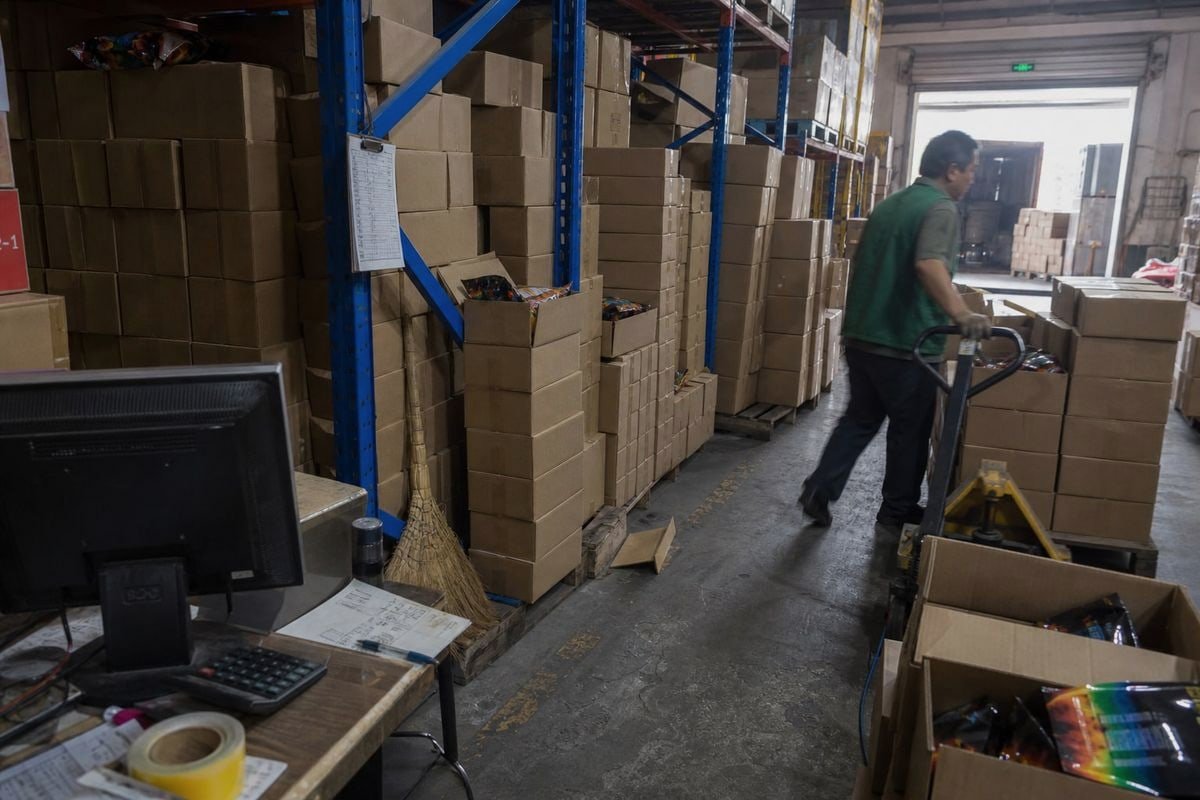
A stocking ratio is simply the share of units you allocate to each color in a purchase order. It is not a fixed rule. It is a hypothesis you refine every reorder cycle using sales velocity by variant. Across the 30+ countries we export to, we consistently see demand concentrate on high-contrast cool tones — blue and green flames photograph better and feel more "magic" to consumers — which is why some buyers carry those variants at 40% higher inventory levels than warm tones.
Three ratio models depending on your data
| Modèle | Quand l'utiliser | Example split (5 colors) |
|---|---|---|
| Historical mix | You have one or more seasons of variant-level sales | Match last season's actual percentages, adjusted for stockouts |
| Weighted launch | New product, no data, but market signals exist | 35 / 25 / 20 / 10 / 10 favoring blue, green, rainbow |
| Even split | Pure test with zero signals | 20 / 20 / 20 / 20 / 20, small total quantity |
Adjust for season and supply chain
Two adjustments matter beyond raw demand. First, seasonal hue shifting: warm tones like red and orange lift during winter fireplace months 4, while blue and green peak with summer camping. If your reorder lands before a season change, shift 5–10 points toward the incoming season's colors. Second, lead time replenishment risk: copper-based blue and green colorants sit on more volatile raw-material supply chains 5 than sodium-based warm tones. We advise buyers to hold slightly higher niveaux de stock de sécurité on blue and green — they are both your fastest movers and your hardest colors to expedite.
Then close the loop. Every cycle, compare each color's sell-through and inventory turnover ratio. A color turning twice as fast as the group earns a bigger share next order. A color sitting past two reorder cycles gets rationalized down — or cut.
How do I set MOQs per color variant without overcommitting my inventory budget?
A Canadian camping brand once told me they nearly walked away from color-flame products entirely because a previous supplier demanded a full-container MOQ per color. That conversation changed how we structure our own quotes.
Negotiate a total-order MOQ with flexible color allocation rather than a rigid per-color minimum. Ask your Magic Fire Powder supplier to let one production run split across colors — for example, 10,000 units total divided 4,000/2,500/2,000/1,000/500 — so slow colors stay small.
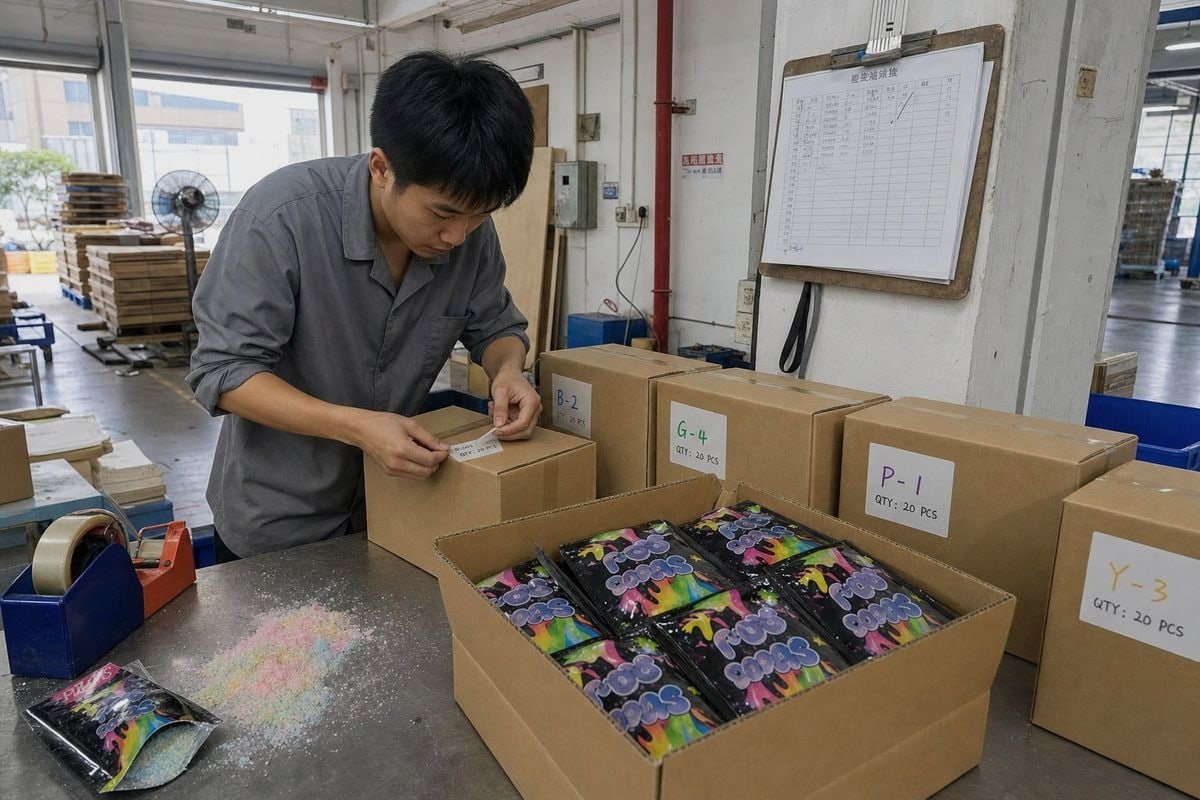
MOQ pressure is where good SKU planning meets real money. On our production side, the honest driver of minimums is changeover: each color means a separate colorant blend, a separate filling run, and separate printed packaging. But because we run complete production lines in-house, we can batch several colors within one order far more flexibly than a trading company reselling fixed stock. That is exactly the flexibility you should push for.
A budget-first allocation process
Work backward from cash, not forward from the supplier's number:
- Set your total inventory budget for this product family.
- Divide the budget by landed cost per unit to get total units.
- Apply your stocking ratio percentages to get target units per color.
- Compare each color's target against the supplier's per-color minimum.
- Where a slow color's target falls below the minimum, either drop that color this cycle, or fold it into a multi-color assortment.
Use bundles to absorb slow-color minimums
A multi-pack bundling strategy solves the last-mile problem neatly. Bundle SKUs — say a 5-color variety pack 6 — deduct inventory from individual color units, so a purple overrun becomes variety-pack content instead of dead stock. We build display boxes and variety-pack packaging for buyers precisely for this reason; it is part of why one-stop OEM matters more than unit price.
| Situation | MOQ tactic |
|---|---|
| Slow color below per-color minimum | Fold into variety pack or skip one cycle |
| Two similar slow colors | Keep one, defer the other, revisit with data |
| Fast color near stockout | Shift budget from slowest color's allocation |
| New unproven color | Piggyback smallest allowable run on a regular order |
Also confirm compliance early. Every color variant still needs correct warning labels, barcodes, and test documentation 7 for your market — our CE and SGS/Intertek reports cover the full color range, so adding a color does not restart your compliance clock. Ask any supplier the same question before committing budget.
Should I test new color SKUs with a trial order before adding them to my regular stocking plan?
Years of watching purchase orders come back for reorders taught our export team a simple lesson: the colors buyers guess will win and the colors that actually win overlap less often than anyone expects.
Yes. Test every new Magic Fire Powder color with a small trial order — typically 500 to 1,000 units — sold through your real channels for one full season. Only promote a color into your regular stocking plan when its sell-through matches or beats your current slowest permanent color.

A trial order is cheap insurance against a structural mistake. Adding a color to your permanent lineup is a recurring commitment: shelf space, reorder cash, and forecasting attention, cycle after cycle. A trial converts that open-ended commitment into a one-time, capped experiment.
Run the trial like an experiment, not a soft launch
Give the trial color a proper child SKU inside your parent-child SKU architecture from the very first unit. Do not lump it under a generic "assorted" code. Without its own SKU, you cannot measure its sales velocity, return rate, or contribution — which defeats the purpose. Then define pass and fail thresholds before the stock arrives. A workable rule: the trial color must sell through at least as fast as your current slowest permanent color, at comparable margin, within one season. If it passes, assign it a starting ratio of 8–12% of your next order and let data move it from there. If it fails, clear remaining units through your variety pack and close the SKU cleanly.
Two objections come up. First, some buyers argue trials waste time when a color "obviously" fits their market. In practice, obvious losers occasionally surprise and obvious winners occasionally flop; the trial costs one season, while a wrong permanent SKU costs several. Second, buyers worry small trial batches will not match mass-production quality. That concern is fair with some suppliers. It is exactly why we run strict batch-to-batch quality control on the same lines for trial and volume orders — your 500-unit test should burn identically to your 50,000-unit reorder. Make sample-to-production consistency an explicit question when you choose a partner, because your inventory forecasting is only as good as the product consistency behind it.
Conclusion
Messy color SKUs quietly cost you sales and cash. One SKU per color, data-driven stocking ratios, flexible MOQs, and disciplined trials turn Magic Fire Powder variants into a predictable, profitable lineup.
Notes de bas de page
1. Wikipedia entry for Stock Keeping Units, the basis for individual inventory lines. ↩︎
2. Authoritative Wikipedia entry defining SKU as a distinct sellable item. ↩︎
3. Professional finance resource defining sales velocity and its importance in retail performance. ↩︎
4. The Hearth, Patio & Barbecue Association provides data on seasonal trends for fireplace-related products. ↩︎
5. Wikipedia overview of supply chain structures, including raw material sourcing and volatility. ↩︎
6. Wikipedia entry for product bundling, relevant to creating variety packs for inventory management. ↩︎
7. SGS is a global leader in providing testing and compliance documentation for consumer goods. ↩︎



 English
  Spanish
  German
  French
  Arabic
  Portuguese
Rejoignez la conversation