






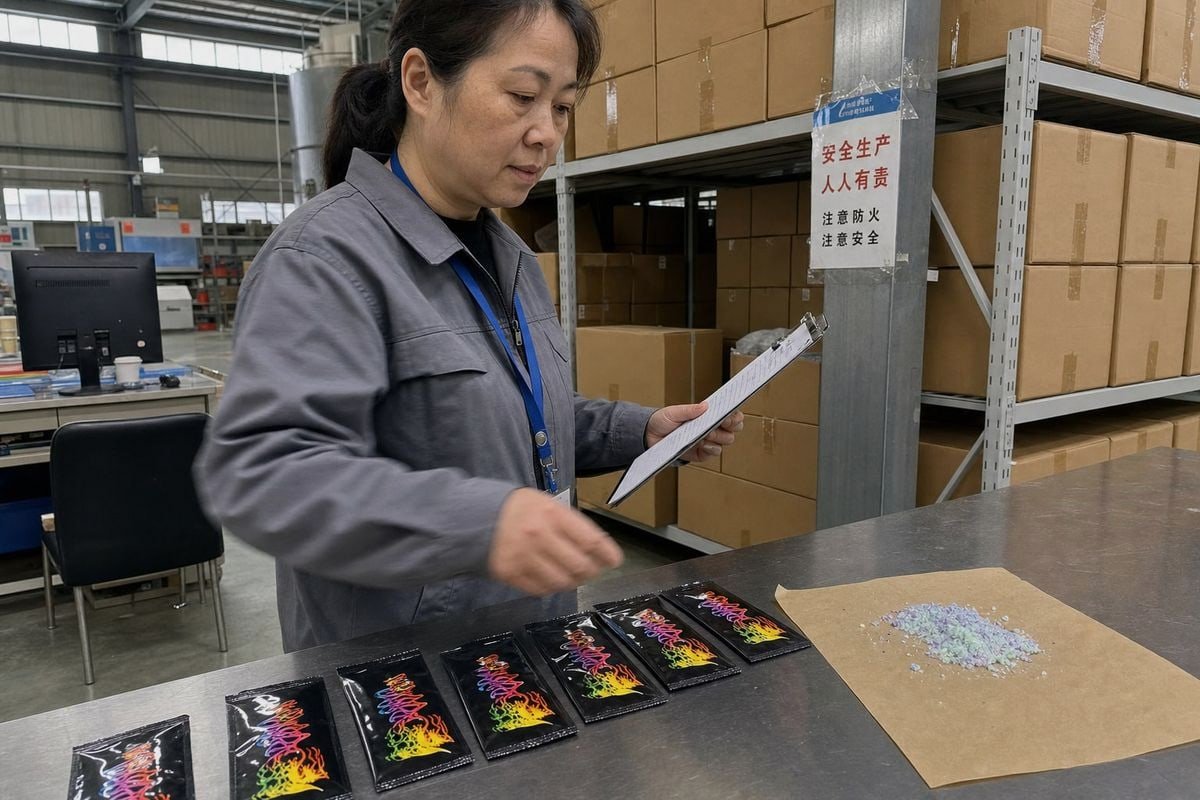
A vague quality acceptance standard for Magic Fire Powder is a lawsuit waiting to happen limite de qualité acceptable 1. I've watched buyers lose entire seasons over "acceptable quality" clauses that our production team could never have measured.
An enforceable quality acceptance standard for Magic Fire Powder suppliers must combine a written product specification, required certifications and batch test reports, numeric tolerances for flame color and burn performance, defined sampling rules, and contractual remedies that trigger automatically when a lot fails inspection.
That sounds like a lot of paperwork. It is not, once you break it into four layers. Below, I walk through each layer in the order a purchasing manager would actually build it.
What certifications and test reports should I require before approving a Magic Fire Powder supplier?
During a factory audit last year, a German distributor asked our QC lead a simple question: "Show me the report, not the logo." That one sentence should guide every supplier approval you make Certificat d'analyse 2.
Before approving a Magic Fire Powder supplier, require ISO 9001 quality-system certification, a full SDS with ingredient disclosure, third-party lab reports from SGS or Intertek covering heavy metals and combustion safety, CE or destination-market compliance documents, and a batch-level Certificate of Analysis policy.

Certificates fall into two groups, and mixing them up is the most common approval mistake I see. System certificates prove the supplier runs a controlled factory. Product test reports prove the actual powder is safe and legal. You need both. A supplier can hold a beautiful ISO 9001 3 certificate and still ship powder with barium levels that get seized at customs. Our Liuyang headquarters sits in China's fireworks cluster, so we deal with compliance-heavy documentation daily — and we have learned that buyers who ask for the raw lab data, not just the certificate cover page, avoid nearly all downstream disputes.
The document checklist that actually protects you
| Document | Ce qu'elle prouve | Signal d'alarme en cas d'absence |
|---|---|---|
| Certificat ISO 9001 | The factory has a working QMS | No process control; batch drift likely |
| BSCI or social audit | Ethical production, retail-channel readiness | Big-box retailers may reject the listing |
| FDS (Fiche de Données de Sécurité 4) | Full ingredient and hazard disclosure | Hidden or substituted chemicals |
| SGS 5 / Intertek test report | Heavy metals, REACH/RoHS limits, combustion behavior | Customs seizure and liability exposure |
| CE / destination-market docs | Legal sale in EU or target market | Product cannot be sold at retail |
| Batch COA commitment | Every lot is tested, not just the first one | First shipment good, third shipment fails |
Verify, don't collect
A stack of PDFs means nothing if you never verify them. Call the lab. Check the report number on the SGS or Intertek portal. Confirm the report covers the exact formula you are buying, not a sister product. In our experience exporting to 30+ countries, roughly one in five "certificates" buyers receive from unvetted trading companies reference a different product entirely. Also demand a change-control clause: the supplier must notify you in writing before changing raw materials, formula, or production site. Without that clause, your approved test reports quietly expire the day the factory switches an ingredient.
What quality metrics and tolerances should I define in my acceptance criteria for color-flame consistency and burn performance?
Numbers settle arguments; adjectives start them. Our engineers learned this the hard way years ago, when "vivid blue flame" meant one thing in our test pit and something else in a buyer's showroom fireplace.
Define numeric tolerances for flame color hue against an approved master sample, burn duration with an allowed variance range, ignition delay time, moisture content limit, granule size range, ash residue percentage, and packaging net weight tolerance — all written as pass/fail values, never adjectives.
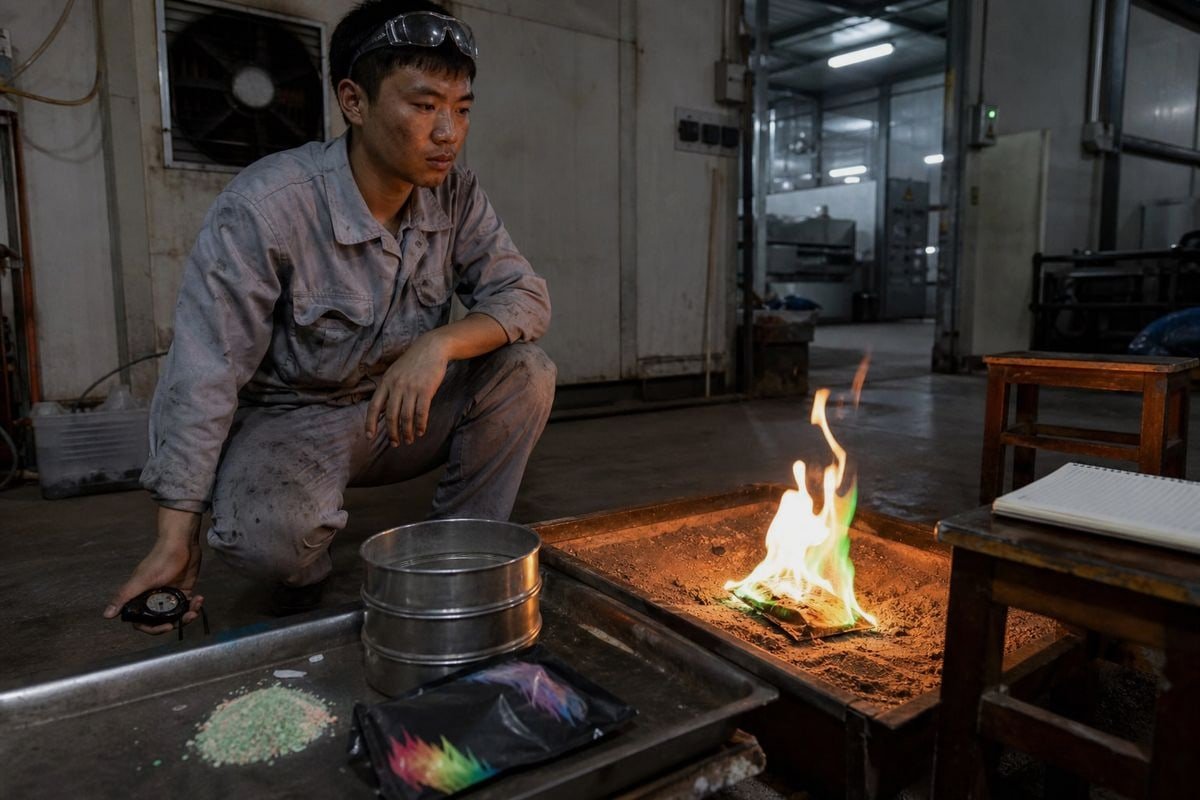
The core principle is simple: if two inspectors could disagree about it, it is not an acceptance criterion. "Good color" is a wish. "Green flame visible within 30 seconds of application, sustained for 25–35 minutes per 25g sachet" is a standard. When we develop custom burn times for OEM clients, we lock these numbers into the spec sheet before the first trial order ships, because both sides need the same target.
Separate your defects by severity
Not every deviation deserves the same response. Classify each characteristic before you set tolerances:
- Critical (safety) — prohibited substances, unexplained substitutions, packaging leakage of active granules. Tolerance: zero. One failure rejects the lot.
- Major (function) — burn time outside range, weak or wrong flame color, ignition failure, moisture above limit. Tolerance: tight AQL 6, typically 1.0 or stricter.
- Minor (cosmetic) — slight print misalignment, small sachet crimp irregularities. Tolerance: looser AQL, typically 2.5–4.0.
A workable metric table for Magic Fire Powder
| Métrique | Example specification | Test method |
|---|---|---|
| Couleur de la flamme | Matches master sample; verified by side-by-side burn or colorimeter reading | Controlled burn test |
| Durée de combustion | 30 min ± 5 min per sachet | Timed burn, standard fire conditions |
| Ignition onset | Color effect within 60 seconds | Timed observation |
| Teneur en humidité | Below defined % limit | Moisture analyzer |
| Granule condition | No clumps above defined size; free-flowing | Sieve and visual check |
| Ash residue | Below defined % of net weight | Post-burn weighing |
| Net weight | Label weight ± 2% | Calibrated scale |
Attach a physical master sample to the standard. Seal one at your office and one at the factory. Every future dispute gets settled against that retained sample, not against memory.
How can I verify that mass-production batches will match the approved sample every time?
The trade-off I weigh most often in production planning is speed versus batch verification. Skipping a batch check saves two days; a failed container costs two months. That math never changes.
Verify batch consistency by requiring lot-coded production, a Certificate of Analysis for every batch, retained samples from each lot, AQL-based incoming sampling inspection, periodic third-party pre-shipment inspection, and a contractual golden-sample clause that makes the approved sample the binding reference standard.

Sample-to-mass-production drift is the single biggest complaint I hear from buyers who switch to us from trading companies. The trial sachet burns a brilliant rainbow; container three burns a weak orange. The cause is almost never fraud. It is usually uncontrolled raw-material sourcing, no batch testing, or a factory that made the sample by hand and the bulk order by a different process. Genuine manufacturing depth is the fix. Our production lines in Ningbo run batch-to-batch QC precisely so the first sample reflects what a full container will look like — and you should demand the same discipline, in writing, from any supplier.
The golden-sample system
Make the approved sample legally central. Your contract should state that the sealed, signed master sample — not the catalog photo, not the spec sheet alone — is the reference for color, burn, and packaging. Keep three sealed sets: one at your office, one at the factory, one with your inspection agency. Each production lot must carry a printed lot code linking back to production date, raw-material batches, and its own COA.
Layer your verification, don't rely on one gate
| Verification layer | Quand cela se produit | Étape de CQ |
|---|---|---|
| Batch COA review | Before shipment release | Chemical or moisture drift |
| Retained sample burn test | Each production lot | Color and burn-time variation |
| Inspection préalable à l'expédition par un tiers 7 | Avant le chargement du conteneur | Packaging, labeling, quantity, random burn checks |
| Incoming AQL sampling | On receipt at your warehouse | Transit damage, missed defects |
| Periodic re-testing | Annually or after any change notice | Slow formula or supplier drift |
No single layer is enough. Together, they make drift nearly impossible to hide. And insist on humidity and shelf-life stability data — colored-flame granules are moisture-sensitive, and a batch that passes at the factory can fail after six weeks in a humid container if packaging integrity is weak.
What inspection process and documentation should I put in place to make quality standards legally enforceable in my contracts?
A UK buyer once told me his previous supplier dispute collapsed because his contract said only "goods shall be of merchantable quality." His lawyer had nothing measurable to argue with. We rebuilt his quality agreement together, clause by clause.
Make quality standards legally enforceable by attaching the technical specification and defect classification to the contract as binding annexes, defining AQL sampling per ANSI/ASQ Z1.4, granting inspection and rejection rights with deadlines, tying payment release to passed inspection, and specifying remedies: replacement, refund, corrective action, and termination for repeat failures.

Enforceability comes from structure, not from tough-sounding language. A judge or arbitrator needs three things: what was promised, how conformity was measured, and what remedy was agreed. Build your documentation to answer those three questions without ambiguity.
The five-step inspection and enforcement process
- Pre-shipment inspection. A third-party agency (SGS, Bureau Veritas, TÜV) or your own QC inspects against the annexed spec, with photo and video records of burn tests. The inspection report becomes evidence, dated and signed.
- Shipment documentation. Every lot ships with its COA, lot codes, packing list, and — for a fire-effect product — compliant hazard labeling and transport documentation where required. Missing documents equal nonconforming delivery, stated explicitly in the contract.
- Incoming inspection window. Define your inspection period after receipt, your AQL sampling plan, and the notification method for defects. Silence past the window means acceptance, so make the window realistic.
- Nonconformance procedure. Failed lots go to quarantine. The supplier receives a formal nonconformance report with evidence. The contract then triggers defined remedies by defect class: critical defects allow immediate lot rejection and refund; major defects allow replacement or rework at supplier cost; minor defects above AQL allow negotiated credit.
- Escalation and exit. Require a written corrective-action response within a set number of days. Two repeat failures on the same root cause trigger re-qualification or disqualification. Tie a portion of payment to inspection release, because payment leverage is the most practical remedy in cross-border trade.
Keep every record — reports, COAs, correspondence, retained samples — for the product's shelf life plus your market's liability period. When we support private-label clients with custom warning labels and barcodes, this document trail is what lets them answer a retailer audit or a consumer complaint in hours instead of weeks.
Conclusion
An enforceable Magic Fire Powder standard rests on four layers: verified certifications, numeric tolerances, batch-level verification, and contract-backed inspection. Build all four, and quality stops being a promise — it becomes proof.
Notes de bas de page
1. Background concept explaining AQL terminology used throughout the inspection process. ↩︎
2. Explains the COA document type central to batch verification claims. ↩︎
3. Authoritative source defining the quality management system standard referenced repeatedly. ↩︎
4. Background reference explaining the SDS document format and purpose. ↩︎
5. Official page for the third-party testing lab repeatedly cited for compliance verification. ↩︎



 English
  Spanish
  German
  French
  Arabic
  Portuguese
Rejoignez la conversation