






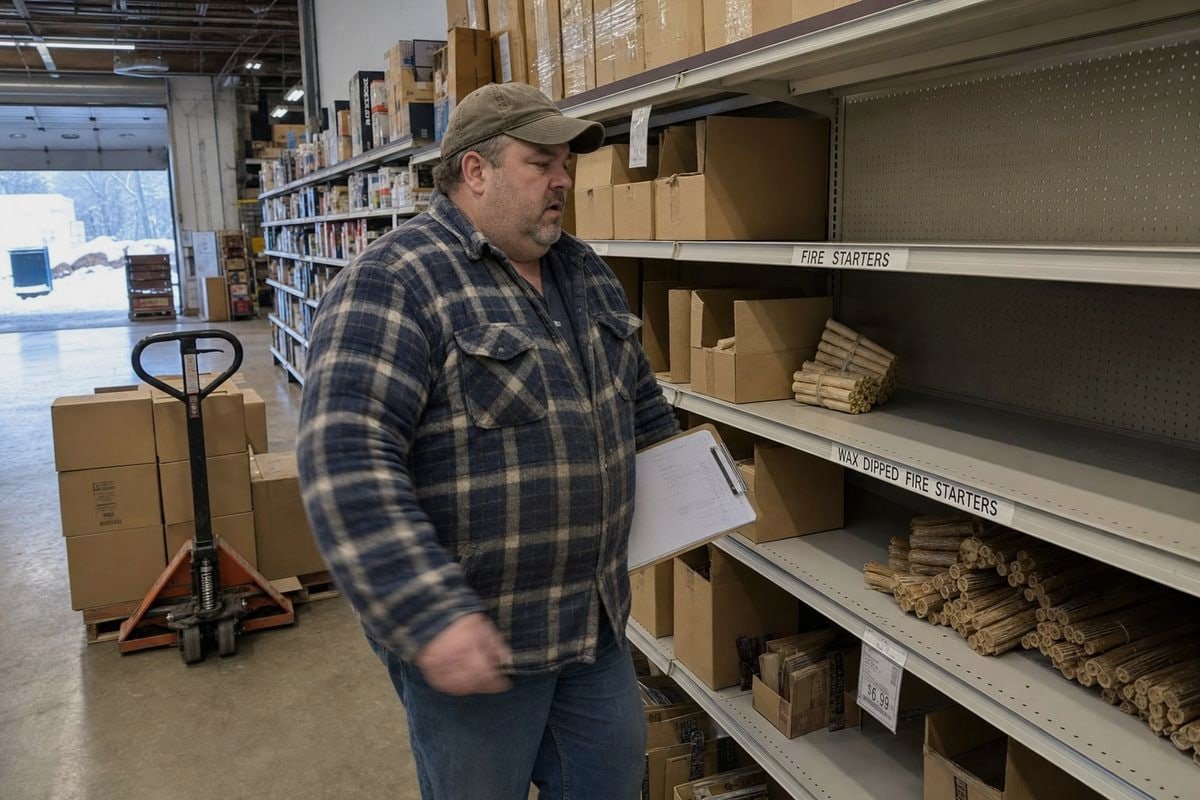
Wood fire starter replenishment sounds simple until January hits and shelves empty out. On our production line, we watch panic orders pile up every winter — and late orders mean lost sales.
Schedule wood fire starter replenishment around your regional heating season: place bulk orders in late summer for cold northern climates, early fall for temperate zones, and smaller staged buys for mild regions. Add a mid-season inventory check and a late-winter top-up to cover cold snaps.
The logic is straightforward. Heating seasons differ by region, so consumption differs too. Below, I break down demand calculation, lead times, stock balancing, and supplier selection — step by step.
How do I calculate wood fire starter demand for each regional heating season?
Every autumn, our export team compares forecast orders from Canadian buyers against those from Australian distributors — and the gap is enormous. Regional climate drives everything in this category.
Calculate demand by estimating fires per week for each climate zone, multiplying by the length of the local heating season in weeks, then by starters used per fire. Add a 20–30% buffer for failed ignitions, cold snaps, and shoulder season demand spikes.

The most reliable way to size demand is to stop guessing and start with weather data. Jours de chauffage 1 give you an objective measure of how cold a region gets and for how long. A zip code with 7,000+ annual heating degree days behaves nothing like one with 2,000. Distributors who map their sales territories against this data forecast far more accurately than those who rely on last year's gut feel.
A simple three-step formula
First, estimate the heating season length. Northern climates often burn from October through April — roughly 28 weeks. Southern regions may see only 10–14 weeks of intermittent use. Second, estimate fires per week. Primary wood-heat households light fires daily. Occasional users may light two or three weekend fires. Third, multiply by starter usage per fire, typically one to two units, and add your buffer.
| Region type | Season length | Fires per week (typical) | Starters per household per season |
|---|---|---|---|
| Cold / northern | 26–30 weeks | 7–14 | 250–450 |
| Temperate / mid-Atlantic | 18–24 weeks | 3–7 | 100–220 |
| Mild / southern | 10–14 weeks | 1–3 | 30–70 |
| Mountain / high-altitude | 28–32 weeks | 7–14 | 280–500 |
Adjust for fuel and appliance variables
Wood quality changes the math. Seasoned hardwood dried below 20% moisture ignites cleanly, while green wood can double starter consumption per fire. Encourage your customers to use a firewood moisture meter 2, but plan inventory assuming many will not. Appliance type matters too. A modern fireplace insert efficiency rating 3 above 70% means fewer relights, while open fireplaces with weak drafts burn through starters faster. Dense hardwoods like oak deliver excellent BTU heat output 4 but need more sustained ignition heat than pine, so hardwood-heavy markets consume more starters per fire.
What lead times should I plan for wood fire starter replenishment before peak season hits?
Last October, a UK buyer asked us to rush a container of wax-dipped wood rolls "before Christmas." Our factory in Ningbo could produce it — but ocean freight could not bend the calendar.
Plan 90–120 days of total lead time for imported fire starters: 25–40 days for manufacturing, 30–45 days for ocean freight, plus customs, inland distribution, and buffer. That means confirming pre-season purchase orders by June for October shelf dates.

Lead time is where most seasonal supply plans quietly fail. The retail shelf date is fixed by the weather, so every upstream delay compresses your margin for error. In our 17+ years exporting to 30+ countries, the buyers who never miss a season all share one habit: they work backward from the first frost date, not forward from when they feel ready to order.
Work backward from your regional start date
Northern and mountain markets need stock on shelves by late September. Southern and coastal markets can stretch to late October. Now subtract each stage of the chain.
| Étape | Durée typique | Notes |
|---|---|---|
| Sample approval & PO confirmation | 1–3 semaines | Faster with a repeat SKU |
| Production | Mêmes QMC | Longer for custom private-label packaging |
| Ocean freight (Asia to US/EU) | 30–45 jours | Peak-season congestion adds time |
| Customs & port handling | 3–10 jours | Compliance documents prevent holds |
| Inland distribution to DC/stores | 1–2 semaines | Coordinate with bulk fuel delivery cycles where possible |
Why compliance paperwork affects speed
One overlooked lead-time killer is customs documentation. Fire-related products get scrutiny. When we ship with complete SGS or Intertek test reports and CE marking already in the file, containers clear ports with far fewer inspection holds. Buyers sourcing from uncertified suppliers often lose one to three weeks at customs — right when the season is starting. Build your calendar around a supplier who has the paperwork ready before the container leaves, and reserve a two-week buffer for the unexpected anyway.
How can I avoid overstock or stockouts when scheduling seasonal wood fire starter orders?
There is a trade-off we discuss with nearly every distributor: order everything early and risk dead stock in April, or order lean and risk empty shelves in January. Neither extreme wins.
Use a hybrid schedule: secure 60–70% of forecast volume in a pre-season bulk buy, hold 30% for a mid-season top-up triggered by actual sell-through, and keep a small reserve for late-winter cold snaps. This balances stockout risk against storage and cash-flow costs.

The core problem is uncertainty. Winter severity swings year to year, and consumer burn habits shift with energy prices. A rigid single-order strategy bets everything on one forecast. A staged strategy lets real data correct your plan mid-stream. Here is how the three common approaches compare:
| Approach | Idéal pour | Pros | Cons |
|---|---|---|---|
| Monthly refill | Mild regions, occasional users | Low storage burden, better cash flow | High stockout risk during cold snaps |
| Seasonal bulk buy | Cold regions, heavy users | Lowest shortage risk, simple planning | Storage cost, overbuy risk in warm winters |
| Hybride | Most distributors | Data-driven, flexible, balanced risk | Requires two planning checkpoints |
Set trigger points, not calendar dates alone
Smart replenishment uses signals. Some of our long-term partners set a restocking trigger when their region crosses roughly 500 cumulative heating degree days — an early-winter marker that arrives before the mid-winter peak. Others tie the mid-season review to sell-through rate: if 50% of stock moves before 40% of the season passes, they top up immediately.
Protect the shoulder season
Do not forget the shoulder season on both ends. Early fall and late spring generate frequent short fires for dampness control, and these micro-seasons can absorb 25–30% of annual starter volume. Reserving inventory for them prevents the classic mistake of clearing out stock in February, then missing March demand entirely. Storage discipline matters too: winter fuel storage principles apply, so keep bulk cartons dry, ventilated, and off concrete floors so leftover stock carries cleanly into next season. Our wax-coated wood wool firestarters are formulated to resist humidity, which gives buyers in damp markets like the Pacific Northwest a realistic multi-season shelf life.
Which supplier qualities matter most for reliable year-round wood fire starter replenishment?
A German importer once told me why he switched suppliers: not price, but a batch that ignited differently from the approved sample. That conversation shaped how we run QC in our factory to this day.
Prioritize suppliers with verified certifications (ISO 9001, BSCI, CE, SGS/Intertek), consistent batch-to-batch quality, realistic stated lead times, flexible MOQs for trial orders, and full private-label OEM support. Reliability and compliance protect your season far more than a lower unit price.

Seasonal products punish supplier failure harshly. If a shipment of electronics arrives late, you sell it next month. If fire starters arrive in December instead of October, the season is half gone. So the supplier evaluation should focus on failure modes, not just quotes.
The qualities that actually protect your season
- Compliance you can verify. Ask for current test reports, not claims. Products crossing into the US or EU without proper documentation risk customs holds during your most time-sensitive window. We treat ISO 9001 5, BSCI, CE, and third-party SGS/Intertek testing as hard requirements because our buyers do.
- Batch consistency. The first sample must reflect mass production. Consistent wax ratios, burn times, and ignition behavior come from complete in-house production lines and strict batch QC — not from trading companies assembling goods from rotating workshops.
- Honest lead times. A supplier who quotes 20 days and delivers in 45 destroys your replenishment calendar. A supplier who quotes 35 days and hits it lets you plan.
- Product range depth. Year-round programs benefit from variety: wood wool firestarters and wax-dipped rolls for everyday ignition, plus resin-rich bois d'allumage gras 6 alternatives for low-pressure days when chimney draft is weakest. A supplier covering multiple formats simplifies your sourcing.
- True OEM/ODM capability. Custom burn times, retail-ready display boxes, warning labels, barcodes, and image de marque de distributeur 7 should come from one partner. Shelf-ready packaging out of the container saves weeks of repacking during your busiest period.
- Responsive communication. Mid-season top-ups only work if your supplier answers within hours, holds materials for repeat SKUs, and can compress production when winter turns severe.
Evaluate suppliers on these six points before comparing prices. In this category, the cheapest quote is usually the most expensive mistake.
Conclusion
Missed seasons cost more than any unit price saving. Schedule wood fire starter replenishment by regional heating season, stage orders with a hybrid plan, and partner with a certified, batch-consistent manufacturer.
Notes de bas de page
1. Explains the metric used for measuring regional heating demand and climate intensity. ↩︎
2. Provides guidance on using moisture meters to ensure firewood is properly seasoned for burning. ↩︎
3. Official EPA Burn Wise guide for selecting efficient wood-burning appliances and checking certification. ↩︎
4. Defines the standard unit of heat energy used to measure fuel output. ↩︎
5. Comprehensive and accessible overview of the ISO 9001 quality management standard. ↩︎
6. Technical background on resin-saturated heartwood used as a natural fire starter. ↩︎
7. Explains the concept of retailer-branded products manufactured by a third party. ↩︎



 English
  Spanish
  German
  French
  Arabic
  Portuguese
Rejoignez la conversation