






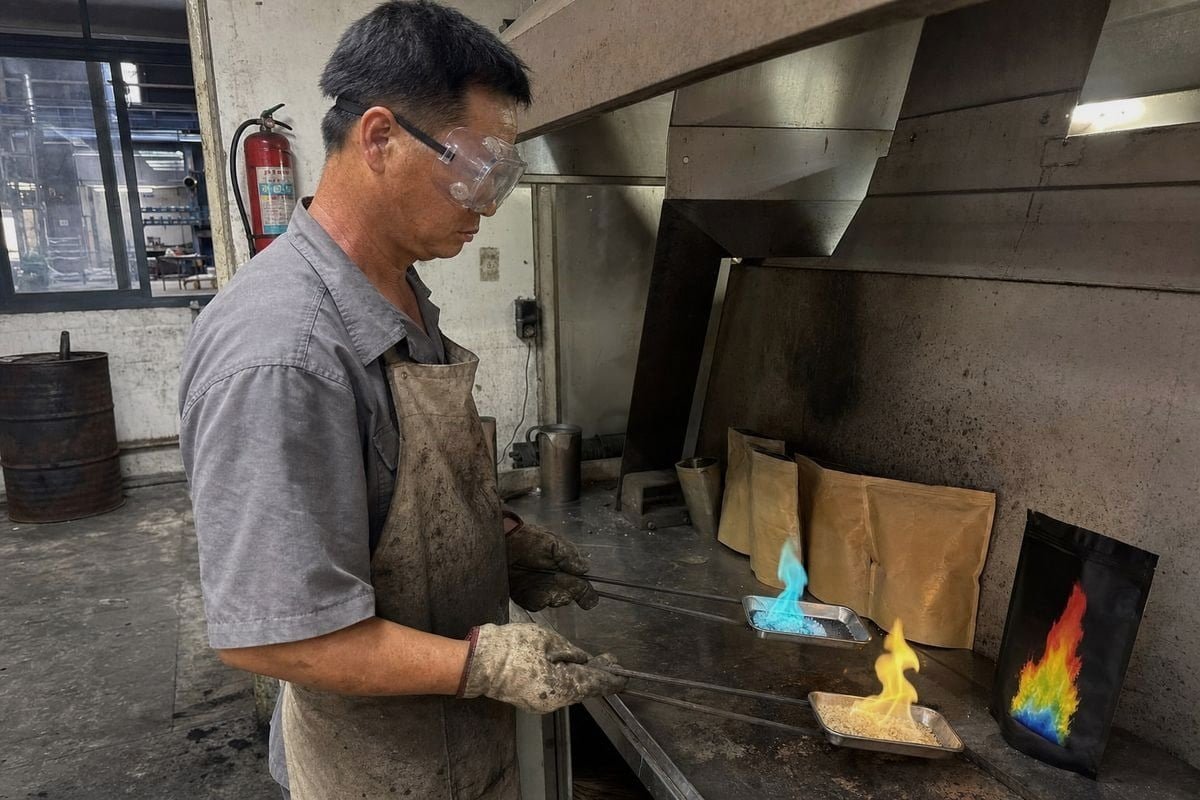
Flame color consistency is the complaint I hear most from importers. On our production line, I have seen exactly why one batch dazzles and the next batch disappoints — and it hurts your brand.
Push suppliers to improve Magic Fire powder flame color consistency by requiring a written specification for metal salt purity, moisture limits, and particle size, demanding lot-by-lot Certificates of Analysis, auditing their blending and packaging process, and validating everything through standardized sample and trial-order testing.
That answer sounds simple, but each step has traps. Below, I will walk through certifications, quality control verification, sample testing, and trial order 1s one by one, based on what actually works.
What Certifications Should I Require to Guarantee Flame Color Consistency Batch After Batch?
A German distributor once told me he had three suppliers with "certificates" — and three different shades of green. That conversation shaped how our factory documents every single lot.
Require a lot-specific Certificate of Analysis confirming metal salt identity, 98%+ purity, and moisture content, plus ISO 9001 process certification, SGS or Intertek third-party test reports, and BSCI social audits. System certificates prove process discipline; the CoA proves each batch actually meets the flame color spec.
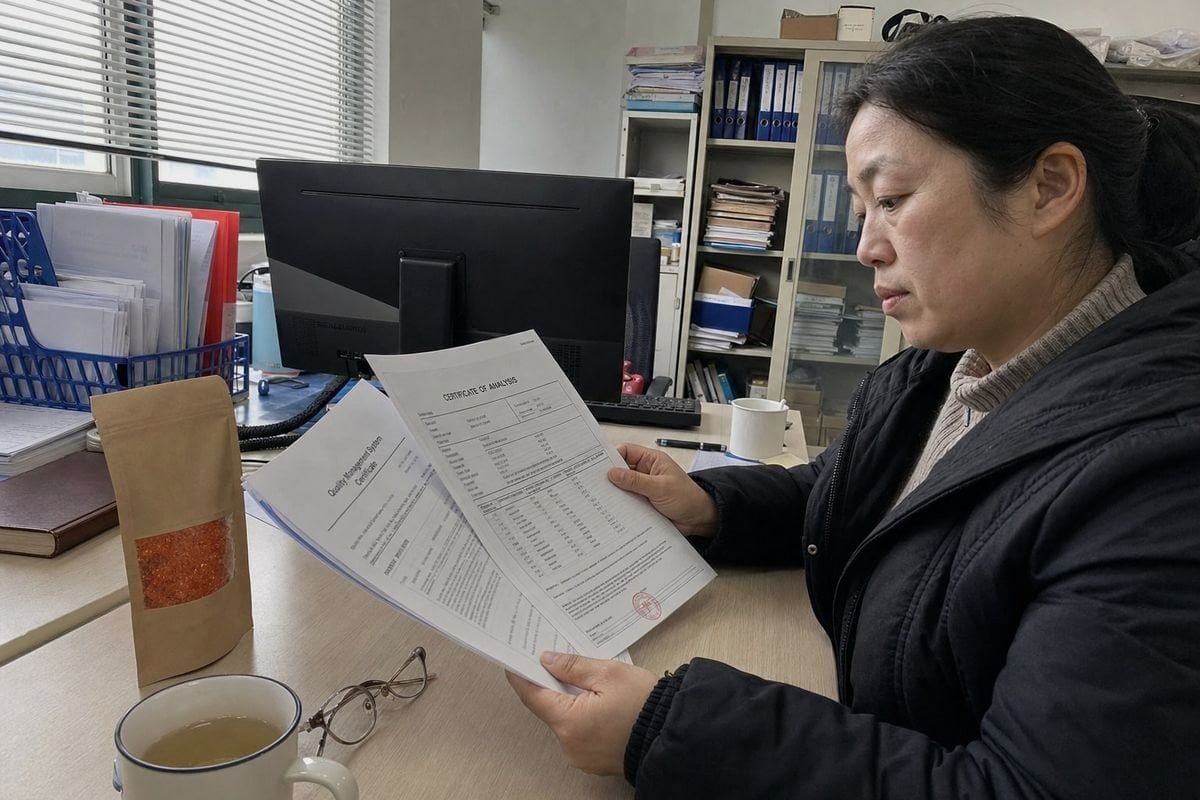
Here is the key distinction most buyers miss. There are two families of paperwork, and you need both. One family certifies the supplier's system. The other certifies the actual batch you are buying.
System Certifications vs. Batch Documents
A supplier can hold ISO 9001 2 and still ship you an off-color lot. Why? Because ISO 9001 proves they have a documented process, not that lot #2024-117 contains the right copper salt at the right concentration. That is what a Certificat d'analyse 3 (CoA) is for. In our 17+ years exporting to the US and Europe, the buyers who avoid color drift are the ones who tie payment to lot-level documents, not just framed certificates.
| Document | Ce qu'il prouve | How It Protects Flame Color |
|---|---|---|
| ISO 9001 | Système de gestion de la qualité existant | Blending and inspection follow written procedures |
| CoA (per lot) | Chemical purity standards met for that batch | Confirms metal salt identity, purity, moisture |
| Rapport SGS / Intertek | Third-party laboratory verification | Independent check on composition and safety |
| CE / safety marks | Conformité du marché | Keeps product legally shelf-ready in the EU |
| BSCI | Audit de production éthique | Signals a stable, audited factory, not a reseller |
What the CoA Must Actually State
A vague CoA that says "conforms to standard" is worthless. Demand specifics: the active colorant named by chemical identity (for example, copper compounds for blue-green, strontium or lithium compounds for red, chlorure de potassium 4 for purple), the target metal salt concentrations, a purity figure of 98% or higher, and a moisture limit. Sodium contamination is the silent killer here — even trace sodium washes the whole flame toward yellow. That is exactly why chemical purity standards belong in your contract, not in a hopeful email.
Demandez également des rapports sur raw material traceability 5. If the supplier cannot tell you which mineral precursor lot went into which finished lot, they cannot investigate a failure — and neither can you.
How Do I Verify a Supplier's Quality Control Process Before Placing a Bulk Order?
When buyers visit our Ningbo production site, I always take them to the blending room first — because that is where flame color consistency is won or lost, long before packaging.
Verify quality control by auditing four checkpoints: raw material intake testing, blending homogeneity controls, moisture management with sealed storage and desiccants, and lot-level burn testing with retained samples. Request batch records, in-process inspection logs, and evidence that the QC lab actually runs these checks routinely.
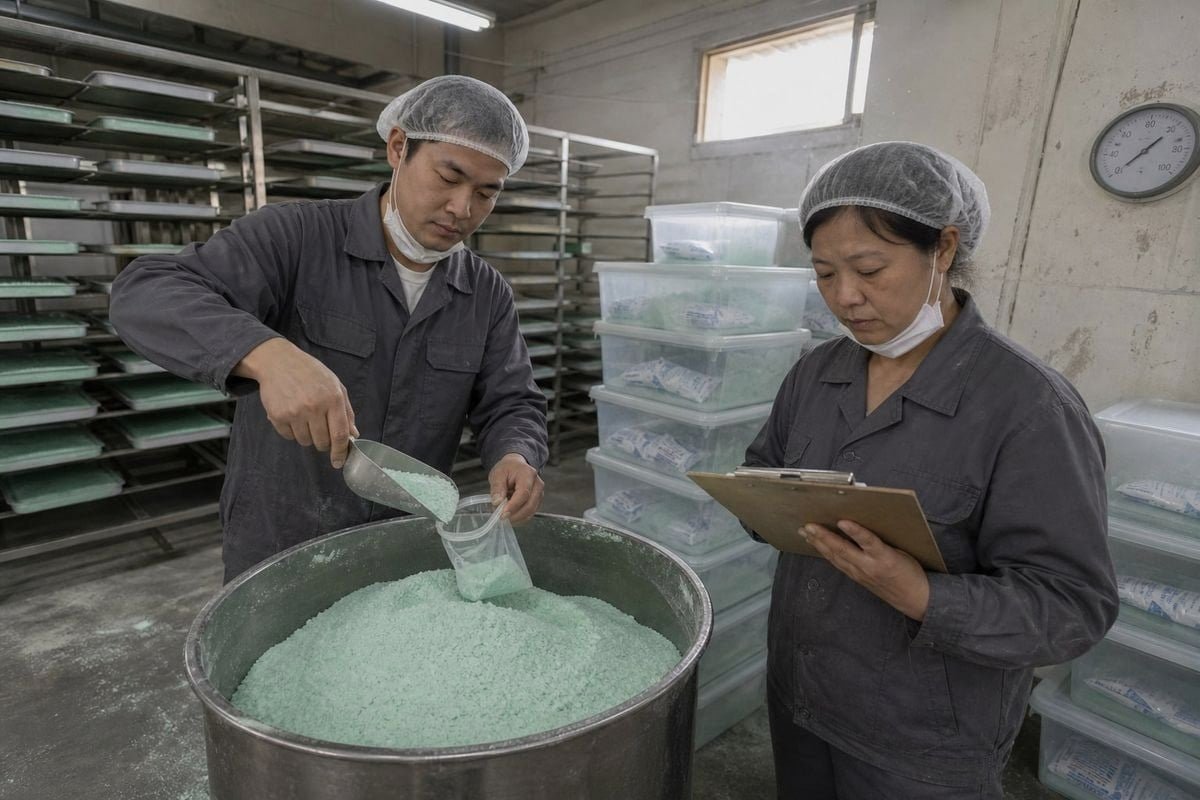
You cannot verify quality control from a sales deck. You verify it by following the powder through the factory, either in person, by video audit, or through a third-party inspector. Manufacturing process audits sound expensive, but a half-day remote audit costs far less than one rejected container.
The Four Checkpoints That Decide Color Consistency
Walk the process in order, and ask for evidence at each stage.
- Raw material intake. Does the factory test incoming metal salts for identity and purity, or just trust the drum label? Ask to see intake test records for the last three months. This is where sodium contamination sneaks in.
- Blending. Colorant and carrier must be homogeneously mixed. Poor blending causes "color spotting" — one packet burns vivid, the next burns pale. Ask what mixing equipment they use, how long each blend runs, and how they prevent segregation of different particle sizes during transfer.
- Moisture control. Most colorant salts are hygroscopiques 6. They pull water from the air, clump, and lose reactivity. Check for climate-controlled storage, sealed intermediate containers, and desiccant use. On our line, we treat humidity control as seriously as formulation, because a perfect formula stored badly still fails.
- Lot testing and retention. Every lot should get a standardized burn test, and the factory should keep retained samples from each lot for dispute resolution. If a customer complaint arrives six months later, the retained sample proves whether the fault was production or shipping.
Questions That Expose Weak QC
Ask these directly, and watch how fast the answers come:
- Quelle est votre particle size uniformity 7 target, and how do you measure it?
- Can you show me batch records linking finished lots to raw material lots?
- Who signs off a lot before release, and against what quality control benchmarks?
- When did a lot last fail internal testing, and what happened to it?
That last question is the most revealing. A supplier who claims zero failed lots either does not test or does not tell the truth. A real factory can describe a failure and the corrective action that followed. Batch-to-batch consistency is not the absence of problems — it is the discipline of catching them before shipment.
What Should I Look for in Sample Testing to Catch Color Inconsistency Early?
Early in our export history, we learned a hard lesson: a sample that burns beautifully once proves almost nothing. Repeatability under stress is the only test that predicts shelf performance.
Test samples from multiple packets and lots under identical fire conditions, and score hue, brightness, time-to-color onset, and color duration. Then stress-test after humidity exposure and shipping simulation, and inspect packet seals and fill weights — because single-burn "wow" tests hide batch-to-batch variation.
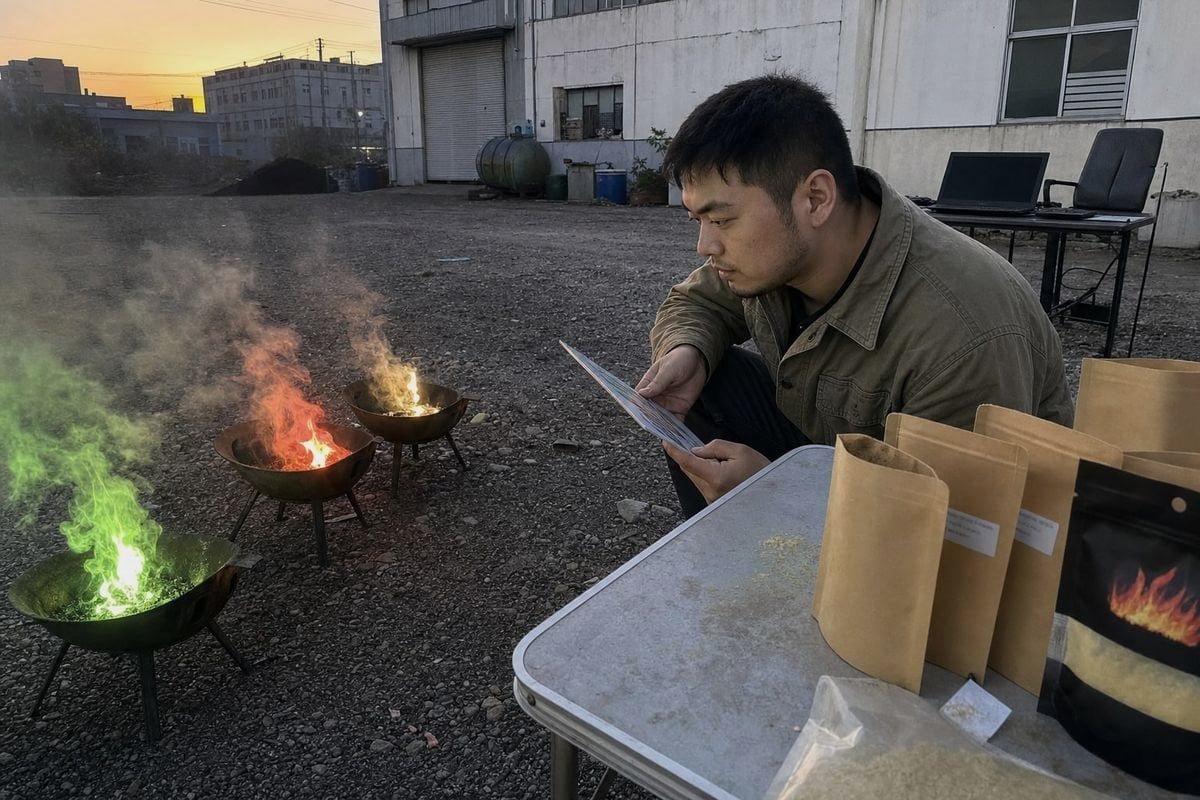
Sample testing fails when it is treated as a demo instead of an experiment. To catch color inconsistency early, you need a controlled setup, defined metrics, and enough repetitions to see variation. Here is the protocol I recommend to our own OEM buyers.
Standardize the Fire First
Combustion is sensitive. Fuel type, flame temperature, airflow, and where the packet sits in the fire all change the visible color. So fix these variables: same wood type and load, same fire maturity, same packet placement, same viewing distance and lighting. If you change the fire every burn, you are testing the fire, not the powder. This also answers a fair objection some buyers raise: yes, open-flame products will always vary somewhat because end users build wildly different fires. That is true — but it is precisely why your acceptance test must remove fire variation, so any remaining variation you see belongs to the supplier.
Score What Consistency Actually Means
"Bright colors" is not a spec. Break the performance into measurable attributes:
| Attribut | Ce qu'il faut mesurer | Signe avant-coureur |
|---|---|---|
| Hue | Does blue stay blue across packets? | Drift toward yellow suggests sodium contamination |
| Brightness | Visual intensity vs. a reference photo | Pale color suggests damp or under-dosed powder |
| Onset time | Seconds from placement to full color | Slow onset suggests clumping or coarse granules |
| Durée | Minutes de couleur soutenue | Short burns suggest uneven fill weight |
| Packet uniformity | Weight and texture of each packet | Variation reveals weak dosing control |
Serious suppliers can go further with spectroscopic color analysis, verifying emission wavelengths against a target profile, or a digital colorimetry scorecard to quantify visual drift. For most buyers, though, a disciplined visual panel — several observers scoring blind against reference photos — catches the failures that matter.
Stress the Samples Before You Judge Them
Burn some packets fresh. Then expose others to high humidity for several days, and put a third group through a drop-and-vibration shipping simulation 8. Compare results. A powder with fine particle size uniformity and proper moisture-barrier packaging should perform nearly the same across all three groups. If the humidity-exposed packets burn dull, the packaging or the formulation will fail in real-world retail conditions — better to learn that now than after ten thousand units land in a warehouse.
Can a Trial Order Help Me Confirm Reliable Flame Color Performance Before Scaling Up?
One US camping brand we supply started with a single-pallet trial order and a written acceptance standard. Three years later, they order by the container — and they still spot-check every lot.
Yes. A trial order across two or more production lots is the strongest pre-scale check, because it tests real production, packaging, and shipping — not a hand-picked sample. Define acceptance criteria in writing, burn-test packets from multiple cartons, and confirm the trial matches the approved sample.
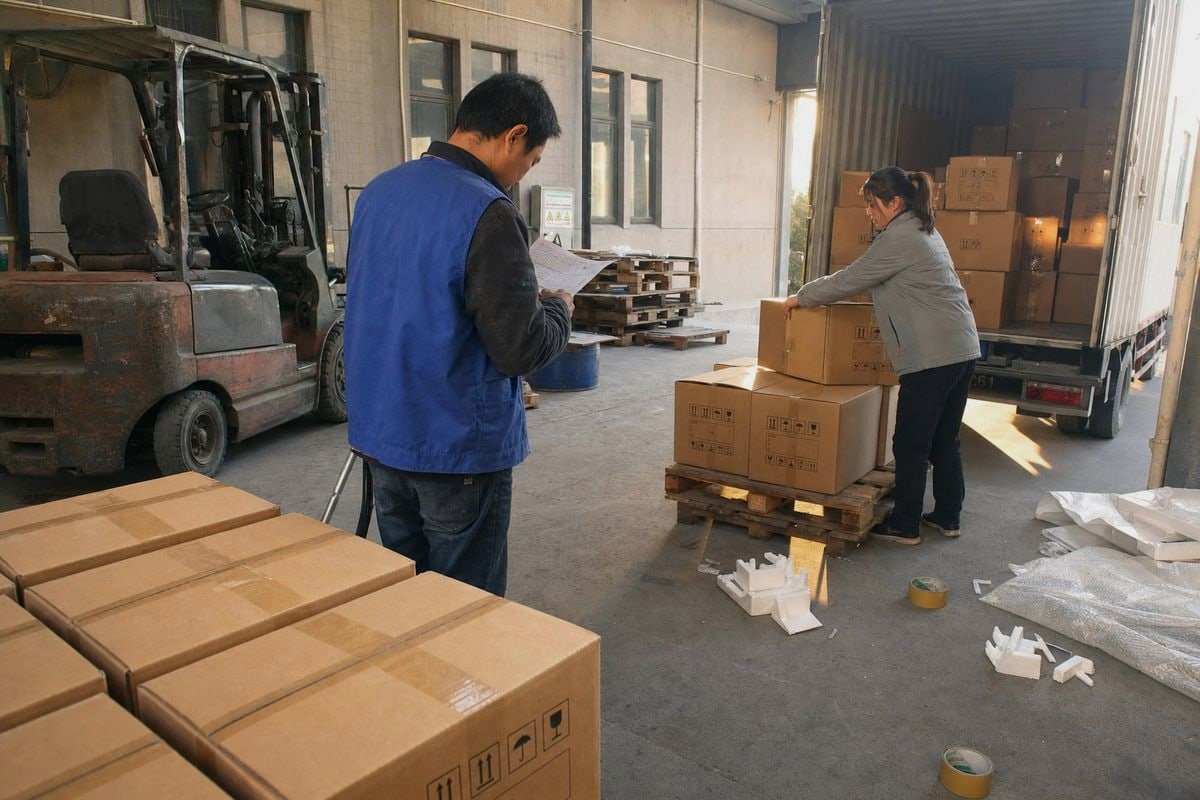
Samples show what a supplier can do at their best. Trial orders show what they do routinely. The gap between those two is exactly where flame color consistency lives, and it is why we deliberately keep flexible MOQs for first-time buyers — a supplier who resists trial orders is usually hiding that gap.
Structure the Trial So It Actually Proves Something
A trial order only works if you design it to expose variation. Follow this sequence:
- Split the trial across lots. Request that the trial quantity come from at least two separate production runs. One lot proves nothing about batch-to-batch consistency; two lots let you compare.
- Lock the spec first. Attach the specification sheet — colorant identity, metal salt concentrations, moisture limit, particle size range, packet fill weight — to the purchase order. Attach the approved sample as the visual reference standard.
- Set a numeric acceptance standard. For example: at least 95% of tested packets must produce the target color within a defined onset window in a standardized test fire. A number forces clarity; "good color" invites argument.
- Test on arrival, not from the factory. Burn-test packets pulled randomly from multiple cartons after real ocean or air freight. This validates the moisture-barrier packaging and seals under actual transit stress.
- Document everything. Photograph and video the burns under consistent lighting. This becomes your baseline evidence for future lots and your leverage if quality slips.
Use the Trial to Build Ongoing Leverage
The trial order is not just a gate — it is the start of a scorecard. Track each subsequent shipment against the trial baseline: color match, onset time, packet weight, seal integrity, defect complaints with photos. When you present a supplier with dated evidence that lot 12 drifted from lots 1 through 11, the conversation shifts from opinion to data. In our experience serving distributors across 30+ countries, the buyers who maintain scorecards get priority attention, faster corrective action, and — over time — genuinely better product, because their feedback loop makes the factory's own QC sharper.
Conclusion
Inconsistent flame color quietly destroys repeat sales and brand trust. The fix is leverage: written specs, lot-level CoAs, process audits, disciplined sample testing, and multi-lot trials. Demand data, not promises — reliable suppliers will welcome it.
Notes de bas de page
1. Global sourcing platform explains standard trade practice of trial orders before scaling purchases. ↩︎
2. Official standard defining quality management systems referenced for supplier certification. ↩︎
3. Background on CoA documents used to verify batch-level chemical composition. ↩︎
4. Chemical background on the metal salt used to produce purple flame color. ↩︎
5. Global standards for traceability systems in supply chains provided by GS1. ↩︎
6. Explains hygroscopic materials absorbing moisture, relevant to colorant salt degradation. ↩︎
7. Detailed explanation of particle size distribution and its measurement in materials science. ↩︎
8. Official updated ASTM D4169 standard for performance testing of shipping containers. ↩︎



 English
  Spanish
  German
  French
  Arabic
  Portuguese
Rejoignez la conversation