






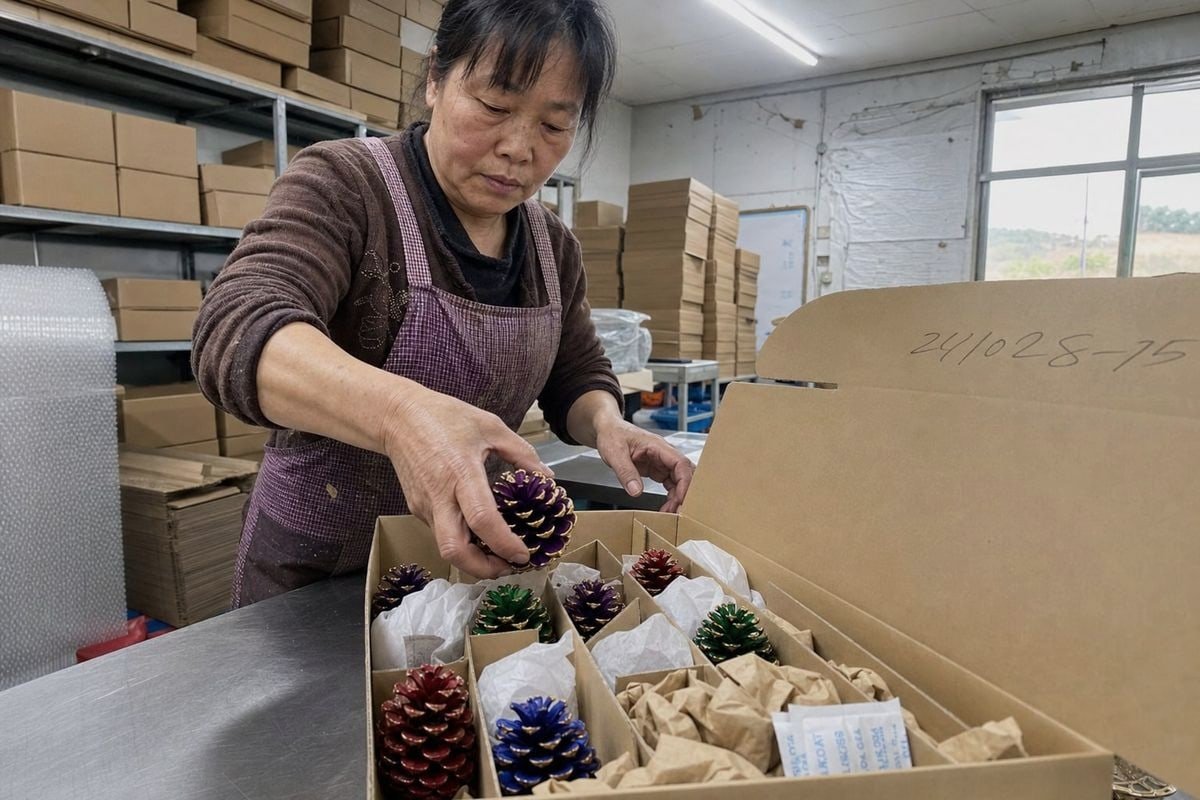
Écailles écrasées, perte de poudre, finitions ruinées — J'ai vu des conteneurs entiers de pommes de pin colorées au feu arriver endommagés sachets de gel de silice 1. Sur notre chaîne de production, les défaillances d'emballage coûtent aux acheteurs plus cher que les défauts de produit.
Pour emballer des pommes de pin colorées pour la cheminée et éviter qu'elles ne soient écrasées, utilisez des cartons extérieurs rigides avec des séparateurs en carton ondulé, enveloppez les pommes de pin individuellement dans du papier de soie sans acide, ajoutez des matériaux de rembourrage de tous les côtés, incluez des sachets de gel de silice pour le contrôle de l'humidité et imposez des limites strictes de poids d'empilage pendant le stockage.
C'est la réponse courte. Les détails comptent davantage. Ci-dessous, je détaille les matériaux, la conception des cartons, les normes des fournisseurs et les options d'emballage personnalisées — le même cadre que nous utilisons pour emballer les commandes d'exportation pour nos clients B2B.
Quels matériaux d'emballage fonctionnent le mieux pour protéger les pommes de pin de cheminée de l'écrasement pendant l'expédition longue distance ?
Une expédition que nous avons emballée pour un distributeur allemand il y a quelques années a enseigné une dure leçon à notre équipe : l'emballage souple seul ne suffit jamais image de marque de distributeur 2. La structure extérieure détermine si les pommes de pin survivent.
Les meilleurs matériaux sont du papier de soie sans acide pour l'emballage individuel, des séparateurs en carton ondulé pour créer des alvéoles de protection, des feuilles de mousse entre les couches, du papier kraft froissé pour combler les vides, des sachets de gel de silice pour le contrôle de l'humidité et un carton extérieur en double cannelure pour la résistance structurelle.
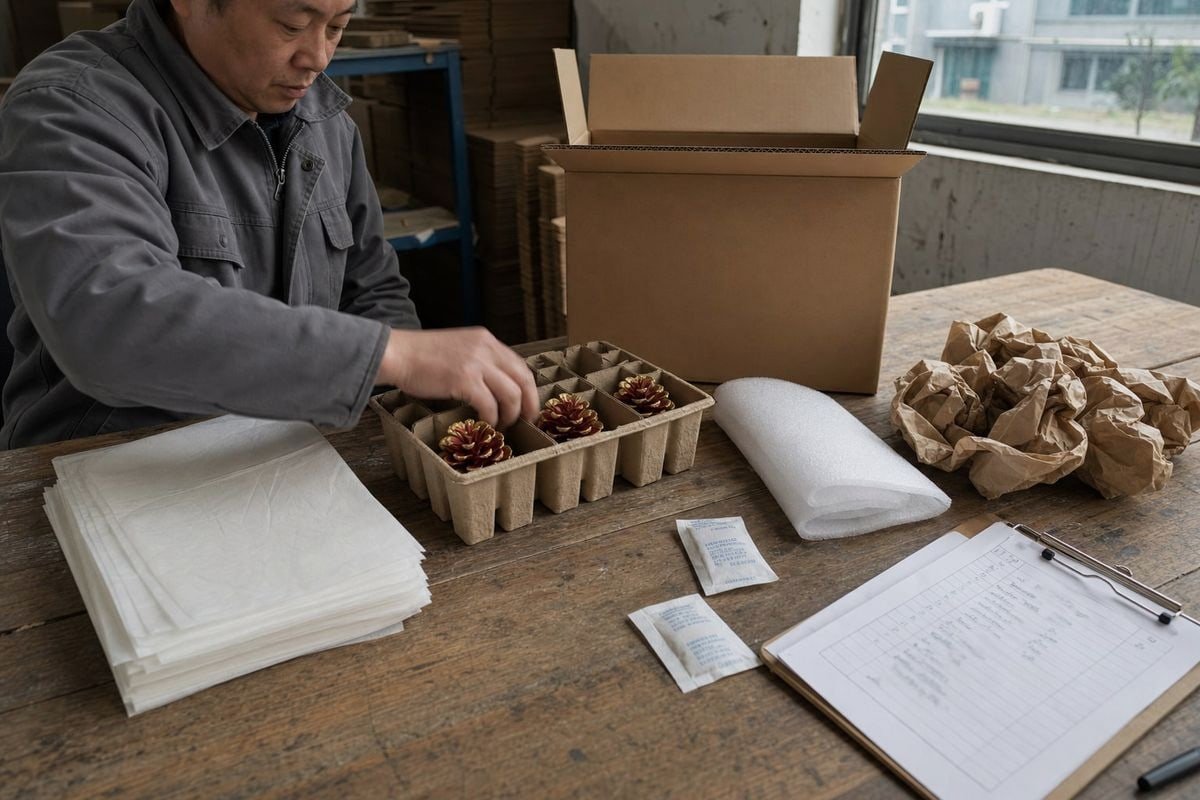
Les pommes de pin sont structurellement fragiles. Leurs écailles superposées se plient, se cassent ou se détachent lorsqu'elles sont comprimées. Ajoutez une couche de sels colorants ignifuges et une finition peinte ou laquée, et vous avez un produit qui peut perdre à la fois sa forme et sa fonction à cause d'un empilement négligent. D'après notre expérience d'exportation vers les États-Unis et l'Europe, la plupart des dommages surviennent à deux endroits : pendant le fret maritime 3 les vibrations et pendant l'empilage en entrepôt. Vos choix de matériaux doivent tenir compte des deux.
Le principe de protection à deux couches
Nous recommandons toujours un système à deux couches. La couche intérieure protège la finition de surface. La couche extérieure résiste à la force d'écrasement. Aucune des deux ne fonctionne seule.
| Couche | Matériau | Ce contre quoi elle protège |
|---|---|---|
| Emballage individuel | Papier de soie sans acide ou papier kraft | Interverrouillage des écailles, rayures de finition, frottement de la poudre |
| Séparation des cellules | Séparateurs en carton ondulé 4 (style boîte à œufs ou séparateur de bouteilles de vin) | Écrasement latéral, contact pomme de pin sur pomme de pin |
| Rembourrage des couches | Feuilles de mousse ou papier bulle | Vibrations, impacts verticaux entre les couches |
| Remplissage des vides | Papier kraft froissé ou déchiqueté | Mouvement à l'intérieur du carton |
| Variation acceptable | Sachets de silice absorbant l'humidité | Fibres de bois ramollies, dégradation du revêtement |
| Enveloppe extérieure | Carton ondulé à double paroi | Pression d'empilage, chutes lors de la manipulation |
Une règle générale issue des meilleures pratiques d'expédition est d'environ 8 cm d'amorti autour du contenu fragile, avec une double boîte pour les articles les plus délicats. Nous appliquons cette norme aux pommes de pin décoratives peintes à la main — comme notre gamme décorative à pointe dorée — car leur finition brillante se raye facilement.
Pourquoi le contrôle de l'humidité compte comme protection contre l'écrasement
Cela surprend de nombreux acheteurs. Les sels colorants ignifuges sont hygroscopiques 5 — ils absorbent l'humidité de l'air. Les pommes de pin humides développent des fibres de bois ramollies, et les écailles molles s'écrasent beaucoup plus facilement que les sèches. Les sachets de silice absorbant l'humidité ne servent donc pas seulement à préserver l'effet de couleur. Ils maintiennent la pomme de pin structurellement rigide. Nous les insérons dans chaque conteneur de stockage hermétique et chaque pochette refermable que nous produisons, et nous nous assurons que les pommes de pin sont entièrement séchées avant l'emballage afin que les sacs scellés ne piègent jamais l'humidité résiduelle.
Certains acheteurs demandent si le papier bulle est essentiel partout. Il ne l'est pas. Pour les pommes de pin colorées simples, le rembourrage à base de papier est moins cher, plus respirant et plus facile à recycler. Réservez le papier bulle pour les pommes de pin avec des ajouts décoratifs fragiles, tels que des pointes de peinture métallique.
Comment puis-je choisir la bonne conception de carton et le bon amorti pour les commandes en gros de pommes de pin ?
Il y a un compromis que nous évaluons sur chaque commande en gros : un emballage plus serré réduit le coût de fret par unité, mais les cartons surchargés pressent les pommes de pin les unes contre les autres et contre le couvercle. Trouver le bon équilibre est tout le travail.
Choisissez des cartons à double paroi dimensionnés de manière à ce que les cônes reposent en couches uniques séparées par des séparateurs, laissez un petit espace sous le couvercle, limitez le poids du carton pour une manipulation sûre et spécifiez un emballage individuel en cellule ou des sandwichs en mousse entre les couches pour absorber les vibrations de transit et les charges d'empilage.
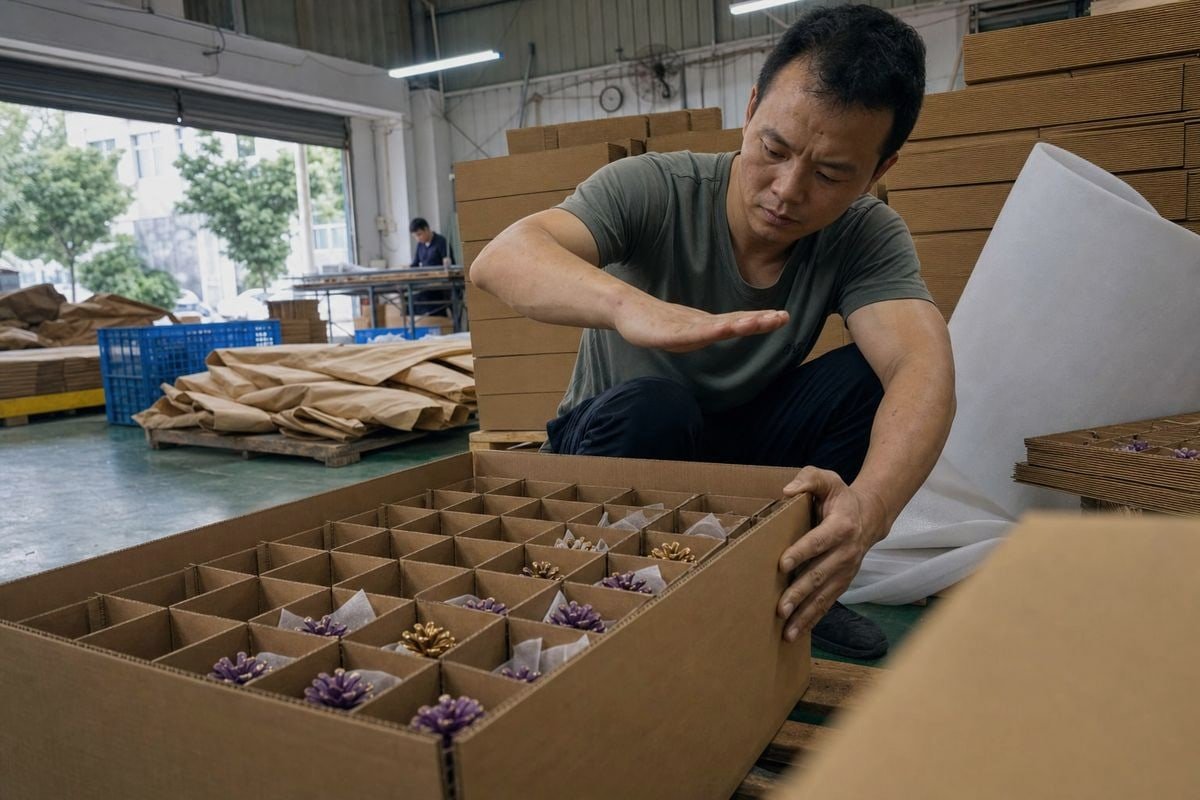
Les commandes en gros échouent pour des raisons prévisibles. Le carton est trop haut, donc les couches inférieures supportent trop de poids. Le carton est surchargé, donc le couvercle appuie directement sur la couche supérieure. Ou il n'y a pas de séparateurs, donc les écailles s'emboîtent et se cassent pendant les vibrations. Chacune de ces situations est une décision de conception, et chacune est évitable au stade de la spécification.
Une checklist pratique de conception de carton
Voici la séquence que nous suivons avec les acheteurs avant de confirmer l'emballage en gros :
- Définir le nombre de couches. Trois à quatre couches par carton est notre limite pratique pour les pommes de pin colorées en vrac. Plus de couches concentrent le poids sur la rangée du bas.
- Ajouter un emballage individuel par cellule lorsque le produit le justifie. Les plateaux de style boîte à œufs ou les grilles de séparation pour bouteilles de vin isolent chaque pomme de pin et empêchent l'écrasement latéral. Pour les pommes de pin peintes à la main haut de gamme, les cellules valent le coût.
- Intercaler les couches. Une feuille de mousse ou un tampon ondulé entre chaque couche redirige la charge verticale vers la structure de séparation, et non vers les écailles horizontales fragiles des pommes de pin.
- Laisser de l'espace libre. Un petit espace en haut garantit que le couvercle n'appuie jamais sur les pommes de pin. Remplissez-le de papier froissé pour que rien ne bouge.
- Définir les limites de poids d'empilage. Imprimer la hauteur maximale d'empilage sur le carton. Nous limitons généralement l'empilage des palettes à un niveau que le carton inférieur peut supporter sans déformation.
- Testez avant d'expédier. Nous effectuons des tests de chute et des contrôles de compression sur les nouvelles conceptions de cartons tests de compression 6 avant que tout conteneur ne quitte notre usine de Ningbo.
Faire correspondre les spécifications du carton au type de commande
| Type de commande | Carton recommandé | Approche d'amortissement |
|---|---|---|
| Pochettes prêtes pour la vente au détail (sacs à fermeture éclair refermables et autonomes) | Carton double paroi standard | Les pochettes s'auto-amortissent ; ajouter un coussin supérieur uniquement |
| Cônes en vrac non emballés pour le reconditionnement | Carton double paroi, 3 à 4 couches maximum | Séparateurs en carton plus calage en papier |
| Cônes premium peints à la main | Carton double paroi avec alvéoles | Emballage individuel en alvéoles plus sandwichs en mousse |
| Ensembles mixtes (cônes plus allume-feux trempés dans la cire) | Carton compartimenté | Compartiments séparés, sachets de silice dans chacun |
Un point de plus tiré de notre expérience d'exportation : le climat est important pendant le transport. Les conteneurs maritimes connaissent de larges variations de température, et la dilatation et la contraction répétées sollicitent les écailles des cônes. Un emballage ventilé mais protégé de l'humidité — papier kraft plus silice, plutôt que du plastique entièrement scellé autour d'un produit humide — gère cela mieux que le film hermétique seul.
Quelles normes d'emballage dois-je exiger de mon fournisseur pour garantir des produits prêts pour l'étalage et sans dommage ?
Un directeur des achats des Pays-Bas m'a un jour posé une question que je pose maintenant à chaque nouvel acheteur : "Comment savoir si le carton cinquante ressemble au carton un ?" Cette question porte en réalité sur les normes, pas sur l'emballage.
Exiger des spécifications d'emballage documentées, un contrôle qualité lot par lot sur le produit et l'emballage, des tests de chute et de compression avant expédition, une vérification de la teneur en humidité avant scellage, des étiquettes d'avertissement et des codes-barres conformes, et des certifications telles que l'ISO 9001, le BSCI et des rapports de test tiers SGS ou Intertek.

Prêt pour la vente signifie plus que "arrivé intact". Cela signifie que l'unité de vente au détail — pochette, pot ou sac en toile de jute — ressemble exactement à ce qui a été approuvé, porte le bon étiquetage et n'a pas besoin d'être reconditionnée dans votre entrepôt. Le reconditionnement est l'endroit où les coûts cachés s'accumulent. Si votre équipe doit ouvrir les cartons, jeter les cônes cassés et réemballer le produit, votre coût réel d'atterrissage augmente rapidement et vos réclamations pour dommages deviennent compliquées.
Les normes qui méritent d'être inscrites dans votre bon de commande
Dans notre usine, nous encourageons les acheteurs à spécifier les exigences d'emballage dans le bon de commande lui-même, et non dans un fil d'e-mails. Voici ce qui y appartient :
| Rouleau standard | Ce qu'il faut spécifier | Pourquoi c'est important |
|---|---|---|
| Fiche de spécifications d'emballage | Matériaux, nombre de couches, type de séparateur, calage, quantité de silice | Rend l'emballage vérifiable et répétable |
| Vérification de l'humidité | Cônes entièrement séchés avant scellage ; processus de séchage documenté | Empêche la moisissure, les odeurs et le ramollissement des écailles dans les conteneurs de stockage hermétiques |
| Tests de transit | Rapports de tests de chute et de compression par nouvelle conception de carton | Confirme la survivabilité dans le monde réel avant la production de masse |
| Conformité de l'étiquetage | Étiquettes d'avertissement, instructions d'utilisation, codes-barres, marques d'origine | Les produits à base de cônes font face à des exigences strictes en matière de vente au détail et de douanes |
| Dossier de certification | ISO 9001 7, rapports de tests BSCI, CE, SGS/Intertek sur demande | Non négociable pour les canaux de vente au détail américains et européens |
| Cohérence des lots | Le premier échantillon doit correspondre à la production de masse | Protège votre marque contre la dérive de qualité au fil des récommandes |
Pourquoi la conformité et la protection contre l'écrasement sont liées
Ce lien est facile à manquer. Les pommes de pin colorées sont des produits inflammables. Les détaillants et les autorités douanières 8 sur nos principaux marchés — les États-Unis, l'Allemagne, le Royaume-Uni, la France — attendent une communication appropriée sur les dangers et une documentation de test. Un fournisseur suffisamment discipliné pour maintenir des processus ISO 9001 et réussir les audits BSCI est généralement suffisamment discipliné pour suivre une spécification d'emballage sur le carton quatre cents. Un fournisseur qui improvise sur les étiquettes improvisera également sur les matériaux d'amortissement. En plus de 17 ans d'exportation vers plus de 30 pays, nous avons constaté que les défaillances d'emballage et les défaillances de conformité proviennent presque toujours de la même cause profonde : aucun processus documenté.
Insistez également sur une étiquette de ségrégation claire. Les cônes colorés ne doivent jamais être confondus avec de la nourriture ou une simple décoration, les étiquettes doivent donc indiquer clairement l'utilisation pour cheminée et les avertissements de tenir hors de portée des enfants.
Les solutions d'emballage personnalisées peuvent-elles aider à réduire les taux de casse tout en préservant l'intégrité de ma marque privée ?
Lorsque nous développions notre sachet refermable à fond plat — le sachet kraft brun avec la fenêtre transparente — le brief de conception avait deux objectifs qui semblaient concurrents : protéger les cônes et les mettre en valeur. Il s'est avéré que la même structure peut faire les deux.
Oui. Les emballages personnalisés réduisent la casse en adaptant la structure à votre produit — sachets refermables à fond plat, pots rigides ou boîtes cadeaux compartimentées — tout en portant votre marque privée, votre logo, vos couleurs, vos codes-barres et vos étiquettes d'avertissement, de sorte que la protection et la présence en rayon proviennent du même design.

Les emballages standardisés forcent votre produit dans les dimensions de quelqu'un d'autre. L'emballage personnalisé commence par le cône lui-même — sa taille, son revêtement, sa fragilité — et se construit vers l'extérieur. C'est là que les taux de casse diminuent réellement. Notre travail OEM/ODM couvre l'ensemble de la chaîne : conception structurelle, image de marque imprimée, étiquettes d'avertissement, codes-barres et emballages de présentation, afin que les acheteurs n'aient pas à coordonner trois fournisseurs pour obtenir un produit prêt à être mis en rayon.
Trois formats personnalisés que nous fabriquons le plus souvent
Sachets refermables à fond plat. Le sachet kraft avec une fenêtre transparente sur le produit est notre format le plus demandé pour les marques de camping et d'activités de plein air. La base à soufflets maintient les cônes droits, la fermeture refermable protège les cônes inutilisés de l'humidité après ouverture, et les parois flexibles absorbent les impacts mineurs. La zone d'impression dégradé arc-en-ciel raconte l'histoire de la marque tandis que la finition mate et texturée signale un positionnement écologique.
Sacs en toile de jute avec cordon de serrage. Pour les canaux de cheminée et les cadeaux, le sac rustique en toile de jute avec cordon de jute et logo imprimé vend le sentiment artisanal. Structurellement, nous l'associons à une doublure intérieure et recommandons des cartons avec des séparateurs, car le tissu seul offre peu de résistance à l'écrasement. Le sac est l'image de marque ; le carton assure la protection.
Bocaux rigides et boîtes cadeaux compartimentées. Pour les cônes peints à la main haut de gamme — violets avec pointes dorées métalliques, rouges, émeraude, bleu profond — un contenant rigide avec des alvéoles individuelles protège la finition laquée. Chaque cône est enveloppé dans du papier de soie sans acide à l'intérieur de son propre compartiment. Ce format commande des prix de détail plus élevés et survit à une manipulation plus rude en magasin.
La décision de personnalisation, en pratique
Une objection courante de l'acheteur : " L'emballage personnalisé augmente mon coût unitaire. " Vrai au niveau unitaire — mais la comparaison est incomplète. Comparez le coût total livré, y compris la casse, la main-d'œuvre de reconditionnement, les retours et la perte d'attrait en rayon. Un sachet qui réduit les dommages de notables à négligeables se rentabilise généralement en une ou deux récommandes. Nous appliquons également des techniques d'emballage protecteur et un renforcement structurel au niveau du produit — séchage approprié, scellage transparent optionnel sur les cônes décoratifs — afin que l'emballage ne combatte pas seul un produit fragile. Et comme nous gérons des lignes de production complètes plutôt que d'externaliser, votre échantillon approuvé, votre sachet imprimé et votre cinq millième carton proviennent du même processus contrôlé.
Conclusion
Les cônes écrasés détruisent les marges et la confiance de la marque. La solution est systématique : cartons rigides, séparateurs, emballage individuel, contrôle de l'humidité et normes documentées du fournisseur. Obtenez la spécification d'emballage correcte une fois, et chaque récommande arrive prête à être mise en rayon.
Notes de bas de page
Explique les propriétés desséchantes pertinentes pour les affirmations de contrôle de l'humidité faites dans l'article. ↩︎
Contexte sur le concept de marque privée référencé pour les services d'emballage personnalisés. ↩︎
La ressource de facilitation des échanges de l'OMC concerne la logistique d'exportation et les normes d'expédition discutées. ↩︎
Le contexte sur la structure du carton en fibres ondulées explique pourquoi il résiste aux forces d'écrasement. ↩︎
Définit l'hygroscopie, la propriété scientifique sous-jacente aux affirmations d'absorption d'humidité. ↩︎
Article faisant autorité sur Wikipédia expliquant les tests de compression des conteneurs utilisés pour évaluer la résistance des emballages et la durabilité de l'empilage. ↩︎
Aperçu faisant autorité sur Wikipédia de la norme de gestion de la qualité ISO 9001 et de ses exigences de mise en œuvre mondiales. ↩︎
La page de valorisation en douane de l'OMC concerne les exigences de conformité pour les expéditions d'exportation mentionnées. ↩︎

 English
  Spanish
  German
  French
  Arabic
  Portuguese
Rejoignez la conversation