







Shipping for Magic Fire powder gets rejected more often than buyers expect. On our export line in Ningbo, we've watched carriers refuse pallets over one missing document — costing weeks.
Choose shipping for Magic Fire powder by first classifying the product with its Safety Data Sheet, confirming its UN number and hazard class, then selecting a carrier that legally accepts it — usually ground or sea freight — with UN-rated packaging, hazard labels, and complete dangerous goods paperwork.
That sounds like a lot. It is manageable once you break it into steps. Below, I walk through classification, customs documents, freight modes, and packaging — in that order, because the order matters.
What Hazmat Classification Applies to My Magic Fire Powder Shipments?
Early in our export history, a European buyer asked us for the "fireworks class" of our color-flame packets. That question taught me how much confusion the product name creates.
Most color-flame powders are classified based on their exact chemical composition, not their marketing name. Depending on the formula, they may fall under Class 4.1 flammable solids classification with a specific UN number, or qualify as non-hazardous — only the Safety Data Sheet and lab testing can confirm which.

The phrase "magic fire powder" is a commercial label. Regulators do not care about it. Customs officers do not care about it. Carriers do not care about it. What they all care about is the chemistry inside the sachet. So classification is step one, and everything else depends on it.
Start With the Safety Data Sheet
Le Fiche de Données de Sécurité 1 (SDS) is the foundation of every shipping decision. It tells you the composition, the hazard statements, and — critically — Section 14, which covers transport information. That section lists the UN number identification 2, the proper shipping name, the hazard class, and the packing group. In our experience exporting to 30+ countries, buyers who request the SDS before the price quote are the ones who avoid customs holds later.
Here is why this matters so much for color-flame products specifically:
| Type de produit | Typical Classification | Shipping Implication |
|---|---|---|
| Metal-salt colorant powder (non-pyrotechnic) | Often non-hazardous or Class 4.1 | May ship with fewer restrictions if tested |
| Pyrotechnic powder / flash powder | Classe 1 explosifs | Severely restricted; most parcel carriers refuse |
| Consumer fireworks | Division 1.4G | Requires EX approvals and specialty carriers |
| Oxidizer-based additives | Class 5.1 | Segregation rules apply during transport |
Why Testing Beats Assumptions
We put our Magic Fire packets through SGS and Intertek testing precisely so buyers can present real classification data, not guesses. A test report answers the carrier's first question definitively. Without it, most carriers default to treating the product as hazardous materials shipping — the most restrictive assumption — or reject it outright. One classification report costs far less than one returned container. Get the classification in writing before you compare a single freight quote.
Which Documents Do I Need to Clear Customs for Color-Flame Products?
A German distributor once told me his previous supplier's shipment sat in Hamburg for six weeks over a missing test certificate. That conversation shaped how we prepare export files today.
Customs clearance for color-flame products typically requires a commercial invoice, packing list, Safety Data Sheet, laboratory test reports, a dangerous goods declaration if classified as hazardous, certificates of origin, and any destination-specific approvals — plus CE marking documentation for European Union markets.

Documentation is where most delays happen — not at the factory, not on the ship, but at the border. Customs officers cannot see inside a sachet. Paper is all they have. So the paper must tell a complete, consistent story.
L'ensemble de documents de base
Every color-flame shipment we prepare travels with a layered file. Each document answers a different official's question:
| Document | Qui le demande | Ce qu'il prouve |
|---|---|---|
| Facture commerciale et liste de colisage | Customs valuation officers | What is shipped and its declared value |
| Fiche de Données de Sécurité (FDS) | Customs, carrier, importer | Composition and hazard profile |
| Rapports de test SGS / Intertek | Customs and retail buyers | Independent verification of safety claims |
| Dangerous goods declaration | Carrier and port authorities | Correct classification, if hazmat applies |
| Certificat d'origine | Import customs | Duty rates and trade agreement eligibility |
| documentation CE | EU market surveillance | Compliance with EU product requirements |
Consistency Is the Hidden Requirement
Here is the lesson 17+ years of exports taught us: documents must match each other exactly. If the invoice says "novelty flame colorant" and the SDS says "pyrotechnic composition," you have created a red flag. If the declared weight differs from the packing list, expect an inspection. We keep product descriptions, HS codes, and net weights identical across every document in the file.
Also plan for destination-specific quirks. The US, Germany, and Australia each interpret DOT compliance standards 3 or their local equivalents differently. Some ports want the dangerous goods declaration even for products testing non-hazardous, simply because the product category looks suspicious. Working with an experienced international freight forwarding partner who has moved flame products before is worth more than any discount from a generalist forwarder.
How Do I Choose Between Air, Sea, and Ground Freight for Restricted Items?
Freight mode is a trade-off we weigh with every buyer: speed against acceptance. For restricted powders, the fastest option is usually the least available one.
Sea freight is the default choice for restricted flame powders because air transport under IATA Dangerous Goods Regulations prohibits or heavily limits most flammable solids. Ground freight works for domestic distribution, while air is realistic only for small, tested, non-hazardous samples with full documentation.

Start with the mode comparison, because it frames every downstream decision:
| Freight Mode | Acceptance for Flame Powders | Vitesse | Coût | Meilleur cas d'utilisation |
|---|---|---|---|---|
| Sea (FCL/LCL) | Highest — most hazard classes accepted with proper declaration | Slow (25–45 days) | Le plus bas par unité | Container orders, restocking programs |
| Ground (truck/rail) | High for domestic and regional moves | Modéré | Modéré | Last-leg distribution, US/EU inland |
| Air cargo | Low — IATA Dangerous Goods Regulations restrict solides inflammables 4 | Rapide | Highest, plus carrier surcharge fees | Small compliant samples only |
| Parcel carriers | Very low — fireworks and many powders prohibited | Rapide | Variable | Non-hazardous, pre-approved items only |
Why Air Is Usually Off the Table
Cargo holds experience pressure and temperature swings. Regulators treat flammable solids conservatively in that environment. Even when a color-flame product tests as low-risk, airlines often refuse the category on sight. USPS, for example, prohibits all flammable solids in international mail and domestic air transport. Do not assume that a refusal from one carrier means another will accept the item — many restrictions come from law, not company policy.
The Practical Playbook We Recommend
For our B2B buyers, the pattern that works looks like this: sea freight for the main order, arranged through a forwarder experienced with declared goods; ground trucking for inland distribution once the container clears; and air only for small sample quantities backed by test reports showing non-hazardous status. We optimize this routing as part of our one-stop logistics support, because a purchasing manager should not have to become a dangerous goods specialist to launch a color-flame SKU.
One more factor buyers overlook: seasonal route restrictions. Some regional carriers suspend flammable-solid transport through high-risk wildfire zones during peak summer. Build buffer time into Q3 orders.
What Packaging and Labeling Standards Keep My Shipments Compliant?
Our QC team in Ningbo checks seal integrity on every sachet batch before cartoning. That habit started after we learned how carriers treat even a trace of sifted powder: as evidence of a leak.
Compliant shipments use UN-rated outer packaging such as 4G fiberboard boxes, sealed moisture-barrier inner sachets, correct hazard class labels or limited quantity marks, proper shipping name and UN number on the carton, and destination-language warning labels — all verified before carrier handover.
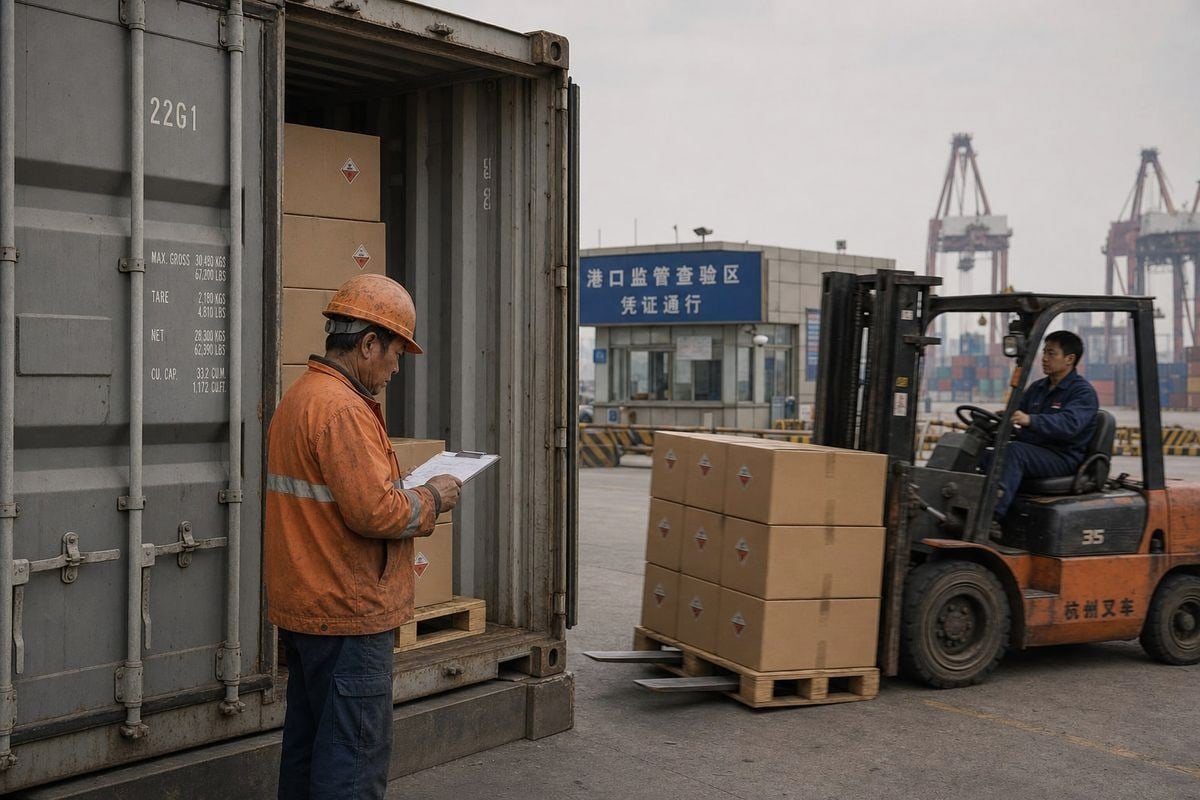
Packaging often decides acceptance more than the product itself. A perfectly legal product in the wrong box gets refused. A borderline product in flawless packaging with complete paperwork usually sails through. Here is how we structure it, layer by layer.
Inner Packaging: Containment First
Fine crystalline colorant salts are hygroscopiques 5. They pull moisture from humid air, which can cause clumping and, in some formulations, instability. Sealed foil sachets with a moisture-vapor barrier solve this. On our production lines, we heat-seal every packet and spot-test seals per batch, because one sifting sachet can contaminate a whole carton and trigger a rejection at the port.
Outer Packaging: Meeting Hazmat Packaging Requirements
If the product is classified as hazardous, hazmat packaging requirements call for UN specification cartons 6 — typically 4G fiberboard boxes tested for drops, stacking, and compression. Even for non-hazardous classifications, we recommend the same construction quality. Ocean containers get stacked, dropped, and left in humid ports. Cheap cartons fail there.
Labels and Marks: The Checklist
- Proper shipping name and UN number on two sides of the carton, if classified.
- Hazard class diamond 7 label matching the declaration exactly.
- Limited quantity exceptions mark, where small consumer-sized packets qualify — this can reduce labeling burden and some surcharges.
- Destination-language warning text and usage instructions, which we print as part of our private-label OEM service.
- Barcodes and retail-ready display packaging that match the buyer's shelf requirements.
One final point: segregation. During LTL consolidation, flammable solids must not be palletized next to Class 5.1 oxidizers. We flag this on our shipping instructions so forwarders load correctly. It is a small line on a document that prevents a serious incident.
Conclusion
Restricted powders punish assumptions. Classify with the SDS, prepare consistent documents, default to sea freight, and package to UN standards — and Magic Fire shipments arrive without surprises. We handle this daily for buyers worldwide.
Notes de bas de page
1. OSHA's official hazard communication standard explains SDS requirements referenced throughout classification. ↩︎
2. Authoritative Wikipedia entry explaining the UN numbering system for hazardous materials. ↩︎
3. PHMSA is the US authority defining DOT hazmat compliance rules referenced for shipping. ↩︎
4. Provides background on flammability hazard classification relevant to Class 4.1 shipping restrictions. ↩︎
5. Background reference explaining why hygroscopic powders require moisture-barrier packaging solutions. ↩︎
6. ISO oversees packaging testing standards underlying UN specification carton requirements for hazmat goods. ↩︎
7. Wikipedia explains hazard class diamond labeling conventions used across dangerous goods transport. ↩︎



 English
  Spanish
  German
  French
  Arabic
  Portuguese
Rejoignez la conversation