







Choosing between FCL, LCL, or air freight when sourcing pine cones from China trips up even seasoned buyers NIMP 15 1. On our loading dock, I see the same costly mistake repeated: pine cones look light, so importers quote by weight — then the CBM calculation comes back triple what they expected, the freight bill explodes, and their holiday launch window slips away. The fix is a simple volume-and-timing framework, which I will walk you through below.
Choose LCL for pine cone orders between roughly 2 and 13 CBM, FCL once volume passes about 14–18 CBM, and air freight only for urgent samples or restocks under 1–2 CBM. Pine cones are bulky and low-density, so volume and seasonal timing — not weight — should drive the decision.
Those thresholds are the short answer. The full answer depends on your order size, your deadline, and your landed cost. Let me break down each mode the way I explain it to our own buyers.
What Order Volume Do I Need Before FCL Shipping Makes Sense for My Business?
A German distributor once asked me to squeeze his 11 CBM pinecone order into a 20-foot container "for safety." I ran the numbers with our freight forwarder first — and the math surprised him.
FCL typically makes sense for pine cone orders above 14–18 CBM, where full-container pricing beats accumulated LCL per-CBM charges. Because pine cones are low-density, a 20ft container holds roughly 26–28 CBM of usable space, so mid-sized wholesale orders often reach FCL territory faster than buyers expect.

Le break-even point between LCL and FCL is a range, not a hard line. It shifts with the route, destination terminal fees, and the season. But volume in CBM is still the single biggest trigger, so start there.
The Volume Bands That Matter
Here is the decision matrix I share with buyers who are comparing quotes:
| Shipment Volume | Best-Fit Mode | Pourquoi |
|---|---|---|
| Under 1–2 CBM | Fret aérien | Minimum ocean charges make sea inefficient at this size |
| 2–13 CBM | LCL | You pay only for the space you use |
| 13–18 CBM | Gray zone — quote both | Crossover varies by lane and local fees |
| Above 18 CBM | FCL | Full-container rate beats stacked LCL fees; fewer handling steps |
Why Pine Cones Hit These Thresholds Early
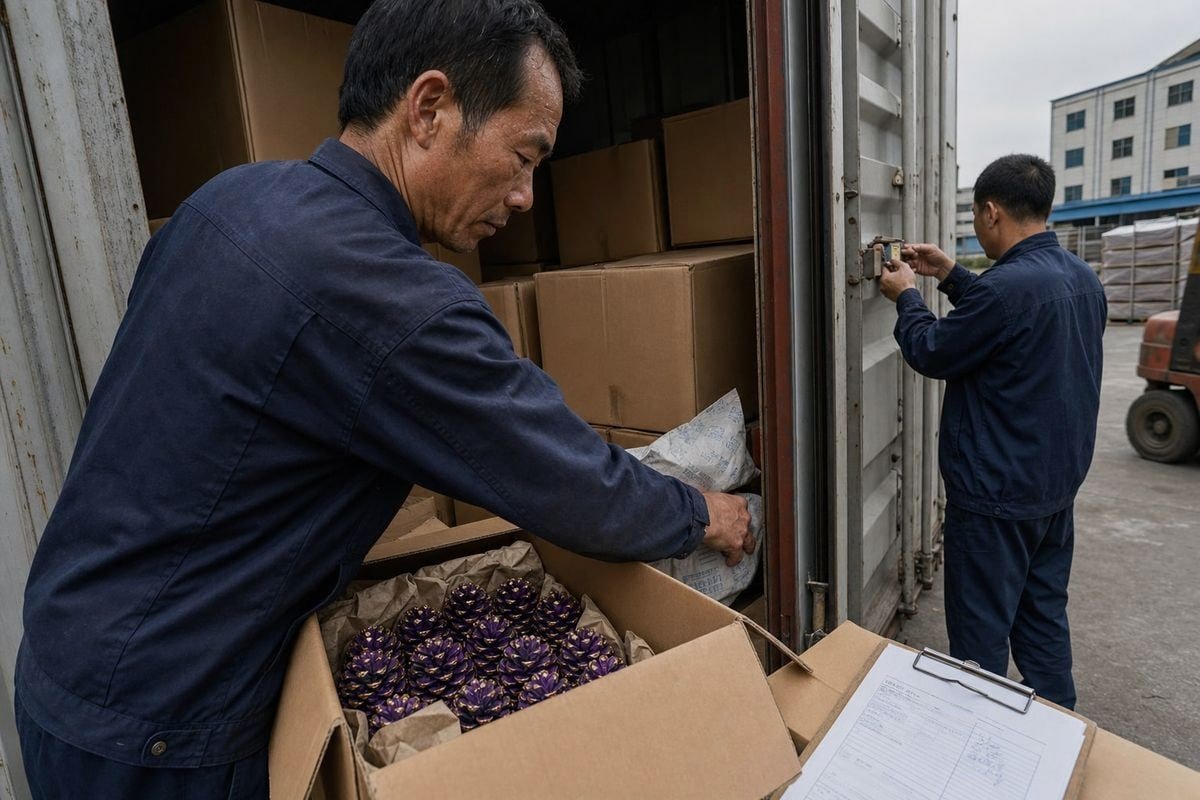
Pine cones are the definition of bulky cargo. A carton of our color-flame pinecones weighs little, but the cones cannot be crushed flat, and retail packaging — stand-up pouches, display boxes, drawstring sacks — adds even more air. In our experience exporting to the US and Germany, an order that looks "small" on the invoice often lands at 15+ CBM once packed, pushing it straight into FCL range.
There is a second reason FCL wins earlier than the raw rate suggests. LCL destination charges — deconsolidation, drayage, terminal handling — pile up per CBM. At 14 or 15 CBM, a partially empty 20ft container is frequently cheaper than the same load moving LCL. And FCL gives you a sealed container from our Ningbo facility to your door, which matters for a natural, moisture-sensitive product. For long voyages we load industrial-grade desiccants because organic forest products are vulnerable to container rain and mold. Fewer touches also means fewer chances for a mislabeled pallet or a damaged carton. One Bill of Lading, one container, one clean handover.
How Can I Tell If LCL Is the Right Fit for My Trial or Sample Orders?
Most first orders that leave our Ningbo production line travel LCL. New buyers testing color-flame pinecones in their market rarely need a full container — and paying for empty space helps nobody.
LCL fits trial and early repeat orders between roughly 2 and 13 CBM. You share container space with other cargo and pay per CBM, keeping upfront freight low. Accept one trade-off: consolidation and deconsolidation add one to two weeks of transit time and extra handling.

LCL is the sensible default for a trial order, but it comes with mechanics you should understand before booking. Your cargo moves through a Container Freight Station (CFS) in China, gets loaded alongside strangers' goods, sails, then gets pulled apart at another CFS at destination. Every one of those steps costs time and adds a touch point.
What LCL Really Costs You
Recent China-to-US pricing hovers around $130 per CBM for LCL, which sounds cheap. But the quoted ocean rate is only part of the story. Destination handling, documentation, and customs clearance fees stack on top. Ask your freight forwarder for an all-in quote to your door under clear Incoterms 2020 2 terms — FOB versus DDP changes who pays which fees, and surprises at destination are the number one complaint I hear from first-time importers.
Protecting Fragile Natural Cargo in Shared Containers
The extra handling in LCL matters more for pine cones than for, say, steel brackets. Natural cones have delicate scales, and our hand-painted decorative cones carry a lacquered finish that chips if cartons are thrown around a CFS warehouse. This is why we insist on proper palletization for LCL shipments — shrink-wrapped, corner-boarded, and clearly labeled — even though pallets add CBM. We learned that lesson years ago after a loose-loaded LCL trial order arrived in the UK with crushed display boxes. Since then, every LCL pallet leaving our line gets edge protection as standard. Also budget for cargo insurance; on a shared container, it is inexpensive relative to the risk.
One more practical tip: if your trial order is under 2 CBM, get an air quote too. Minimum LCL charges can make tiny sea shipments surprisingly poor value.
Is Air Freight Worth the Extra Cost When I Need Color-Flame Pinecones Fast?
Every October, at least one buyer calls us in a mild panic: a retailer moved up a holiday reset date, sea freight will not land in time, and they need color-flame pinecones on shelves in two weeks. That is when the air freight conversation gets real.
Air freight is worth it only for small, urgent shipments — samples, emergency restocks, or launch quantities under about 1–2 CBM. Pine cones trigger volumetric weight pricing, often billing at 3–5 times actual weight, which makes air prohibitively expensive for any bulk order.
The core issue is chargeable weight. Airlines bill you on actual weight or volumetric weight, whichever is higher. Volumetric weight is calculated as length × width × height in centimeters, divided by 6,000. A carton of pinecones might weigh 8 kg but bill as 30 kg. At roughly $7.40 per kg on China-to-US lanes, that math punishes bulky cargo brutally.
When the Premium Pays for Itself
But "expensive per kilo" is not the same as "wrong for the business." Compare the freight premium against the cost of an empty shelf:
| Scénario | Air Freight Verdict | Reasoning |
|---|---|---|
| Pre-launch samples for retail buyer review | Oui | Small volume, deal-critical timing |
| Emergency restock before Christmas peak | Usually yes | Le coût de rupture de stock dépasse la prime de fret |
| First trial order of 3–5 CBM | Rarement | LCL saves heavily; plan 5–6 weeks ahead |
| Regular seasonal replenishment | Non | Sea freight with proper lead time wins |
Transit times tell the rest of the story: air moves door-to-door in roughly 5–10 days, versus 28–40 days for LCL sea freight. For seasonal fire products, missing the window can mean carrying inventory for a full year. When a Canadian camping brand faced exactly that squeeze, we split the order — an air shipment covered the retailer's reset date while the balance followed by sea. That hybrid approach is often smarter than an all-or-nothing choice, and our team routinely coordinates both legs so the paperwork and customs clearance stay aligned.
How Do I Calculate the Real Landed Cost of Each Shipping Method for My Import Business?
The hardest lesson I pass on to new importers is this: the freight quote is not the cost. After 17+ years shipping fire products to 30+ countries, I have seen "cheap" quotes turn expensive at the destination port more times than I can count.
Real landed cost equals product cost plus freight, origin and destination charges, customs clearance, import duties, compliance documentation, insurance, and final delivery. For pine cones, add phytosanitary certification and heat-treatment costs — then divide the total by units received to compare modes fairly.

Comparing FCL, LCL, and air on the headline rate alone is how importers get burned. Build a full landed cost model instead. Here are the components, and where each mode hides its surprises:
| Composant du coût | FCL | LCL | Air |
|---|---|---|---|
| Fret de base | Per container | Per CBM | Per chargeable kg (volumetric weight) |
| Frais d'origine | Modéré | CFS consolidation fees | Airport handling |
| Destination charges | Terminal + drayage | Deconsolidation + drayage + handling | Airport fees, usually lower |
| Risque de manipulation | Low (sealed container) | Higher (multiple touches) | Low-moderate |
| Typical transit | 20–35 jours | 28–45 days | 3–10 jours |
Compliance Costs You Cannot Skip
Natural pine cones are regulated agricultural products. Your shipment needs a certificat phytosanitaire 3 issued by China's plant protection authority, and many destinations enforce fumigation requirements or proof of heat treatment. Beyond standard NIMP 15 4 treatment for wooden pallets, we kiln-dry our pinecone products to destroy pests like the pinewood nematode 5 — skip that step with a cheaper supplier and you risk immediate seizure or destruction at the border. Also check your code SH 6 carefully: natural cones and decorated or artificial versions classify under different headings, and import duties differ accordingly. As an ISO 9001 and BSCI certified factory, we prepare SGS or Intertek test reports and complete export documentation as standard, because one missing certificate can hold a container for weeks.
A Simple Five-Step Comparison Process
- Get your exact packed CBM and gross weight from your supplier before requesting quotes.
- Request all-in, door-to-door quotes for all three modes under the same Incoterms 2020 7 basis.
- Add duty, compliance, and cargo insurance costs to each quote.
- Divide each total by sellable units to get per-unit landed cost.
- Weigh the per-unit difference against your deadline and stockout risk — then decide.
One advanced tactic worth knowing: if you also import heavier goods like stone or metal décor, pine cones make excellent filler cargo in the container's upper dead space, effectively riding along at near-zero marginal ocean cost.
Conclusion
Freight mistakes with bulky, seasonal pine cones cost margin and missed selling windows. Match volume to mode — air under 2 CBM, LCL to 13, FCL beyond — then verify with full landed cost quotes.
Notes de bas de page
1. Official IPPC standard document defines ISPM 15 wood packaging treatment requirements. ↩︎
2. Official ICC reference clarifies buyer/seller cost responsibilities under Incoterms 2020 terms. ↩︎
3. IPPC governs the plant health certification required for agricultural pine cone exports. ↩︎
4. Official international standard governing wood packaging treatment referenced in the article. ↩︎
5. Background on the regulated pest that heat treatment and kiln-drying aim to destroy. ↩︎
6. Official US tariff schedule lookup relevant to classifying pine cone import duties. ↩︎
7. Background on trade terms that determine who pays which freight and customs fees. ↩︎



 English
  Spanish
  German
  French
  Arabic
  Portuguese
Rejoignez la conversation