







Demander aux fournisseurs des schémas d'utilisation sur les emballages de poudre Magic Fire semble simple — jusqu'à ce que les maquettes arrivent en retard, incorrectes ou non conformes. J'ai vu des demandes vagues bloquer des lancements entiers sur notre chaîne de production.
Demandez aux fournisseurs des schémas d'utilisation en spécifiant le nom du produit, le type de conditionnement, le marché cible, les langues requises, le format de fichier et la date limite dans une seule demande écrite. Demandez des fichiers vectoriels, des pictogrammes d'instructions étape par étape, les avertissements de sécurité requis et les rapports de tests de conformité du fournisseur avant d'approuver les illustrations.
C'est la réponse courte. Ci-dessous, je vais détailler exactement ce qu'il faut demander, comment vérifier la conformité, ce qu'il faut envoyer à votre fournisseur et comment confirmer l'exactitude avant l'impression.
Quelles informations dois-je demander aux fournisseurs pour des diagrammes d'utilisation conformes sur les emballages Magic Fire ?
Un acheteur d'Allemagne nous a un jour envoyé un courriel avec trois mots : "Envoyer schéma d'utilisation". Nous avons passé deux semaines à échanger. Dans notre usine de Ningbo, nous donnons maintenant à chaque nouveau client une liste de contrôle de demande en premier.
Demander la séquence d'application étape par étape, les pictogrammes d'instruction, les avertissements de sécurité des produits requis, les symboles de danger pertinents SGH, les illustrations de distance de sécurité, les icônes de stockage et d'élimination, la fiche de données de sécurité et les formats de fichiers vectoriels modifiables. Demander également les exigences linguistiques et l'emplacement de chaque élément sur la pochette.
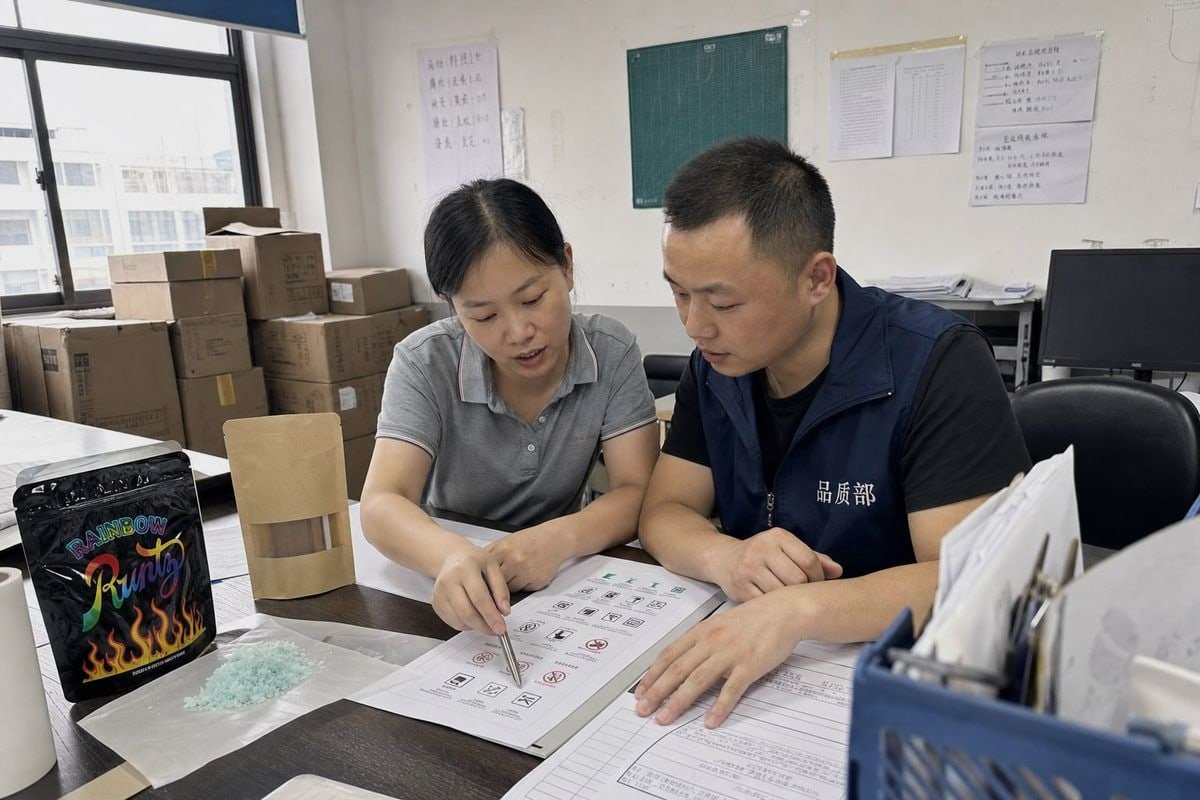
Un schéma d'utilisation n'est pas juste une décoration. Sur un sachet de colorant pour flamme, c'est le moyen le plus rapide pour un client d'apprendre la méthode "à jeter" : garder le sachet scellé, le placer sur le feu, reculer et profiter du des flammes colorées 1. Comme la plupart de nos sachets sont expédiés dans plus de trente pays, nous concevons des pictogrammes d'instruction 2 sans texte dans la mesure du possible. Les icônes franchissent les barrières linguistiques ; les paragraphes ne le font pas.
Alors, que doit contenir exactement votre demande ? D'après notre expérience, un premier courriel complet évite au moins deux cycles de révision plus tard.
Les éléments clés à demander
| Élément à demander | Pourquoi c'est important |
|---|---|
| Séquence d'utilisation étape par étape | Le fournisseur connaît l'ordre de manipulation correct ; vous ne devriez pas le deviner |
| Pictogrammes d'instruction (sans texte) | Fonctionne sur les marchés américain, européen et du Moyen-Orient sans traduction |
| Illustration de la distance de sécurité | Montre aux utilisateurs à quelle distance se tenir après avoir jeté le sachet |
| Icônes de stockage et d'élimination | Garde les sachets à l'abri de la chaleur et des enfants ; soutient la conformité de détail |
| Fiche de Données de Sécurité 3 | Le document source pour toutes les avertissements sur le paquet |
| Formats de fichiers vectoriels (AI ou EPS) | Empêche la distorsion lorsque les schémas sont mis à l'échelle pour de petites pochettes |
| Bibliothèque d'icônes existante | Un ensemble de symboles standardisés pré-approuvés réduit le délai de conception |
Renseignez-vous également sur le format de l'emballage
Le contenu du schéma varie avec l'emballage. Un petit sachet en aluminium n'a presque pas de place, nous donc le détail vers un code QR menant à une courte vidéo de démonstration. Une pochette à rabat en papier kraft ou une boîte d'exposition à rabat offre de la place pour un panneau complet en quatre étapes. Indiquez à votre fournisseur le format que vous achetez — sac en plastique, sac en papier kraft ou pot — et demandez comment il adapte le schéma pour chacun. Demandez également si un accord de confidentialité est nécessaire avant qu'il ne partage des maquettes propriétaires. C'est une question légitime, et un fournisseur professionnel y répondra directement.
Comment puis-je vérifier que les schémas d'utilisation d'un fournisseur respectent les exigences d'étiquetage américaines et européennes ?
La conformité est la première chose que les acheteurs sérieux nous demandent — souvent avant le prix. Notre documentation ISO 9001, BSCI, CE et SGS/Intertek est demandée dans presque toutes les demandes initiales, et à juste titre.
Vérifier la conformité en recoupant le schéma avec la Fiche de Données de Sécurité du produit, en confirmant les exigences d'étiquetage SGH pour les pictogrammes de danger, en demandant le marquage CE et les rapports de test de tiers tels que SGS ou Intertek, et en faisant examiner le texte d'avertissement par votre propre conseiller réglementaire pour chaque marché de destination.

Ne croyez jamais un fournisseur sur parole que la maquette est "conforme". Demandez-lui de vous montrer comment il le sait. Lorsque nous préparons la documentation des normes de conformité d'emballage pour un client américain ou européen, nous remettons les rapports de test avec la maquette afin que leur équipe d'assurance qualité puisse vérifier les deux en même temps. Si un fournisseur ne peut pas produire une Fiche de Données de Sécurité ou un rapport de test tiers, considérez cela comme un signal d'alarme, pas un retard de paperasse.
Ce qu'il faut vérifier pour chaque marché
| Région | Vérifications clés pour les schémas d'utilisation et les étiquettes |
|---|---|
| États-Unis | Déclarations d'avertissement conformes à la FDS ; langage de mise en garde clair ; formulation de sécurité pour les enfants ; poids net exact |
| Union européenne | Documentation pertinente pour la CE le cas échéant ; exigences d'étiquetage SGH pour toute substance classifiée ; texte d'avertissement multilingue pour les pays cibles |
| Les deux marchés | Avertissements de sécurité du produit placés près du schéma ; instructions de stockage ; consignes d'élimination ; traçabilité des lots sur l'emballage |
Trois étapes de vérification qui détectent la plupart des problèmes
Premièrement, faites correspondre chaque élément du schéma à la Fiche de Données de Sécurité. Si la FDS indique une condition de stockage, l'emballage doit la refléter. Deuxièmement, vérifiez si les pictogrammes de danger conformes au SGH 4 sont requis. Nos sachets Magic Fire utilisent des formulations écologiques sans produits chimiques nocifs, donc la classification diffère des colorants industriels bruts — mais vous devez le vérifier avec des rapports de test, pas des affirmations marketing. Troisièmement, faites examiner par votre propre contact juridique ou réglementaire les instructions de manipulation des produits chimiques et la formulation des avertissements pour chaque destination. Une objection d'acheteur que nous entendons souvent : "Le fournisseur ne devrait-il pas assumer toute la responsabilité de la conformité ?" En pratique, la responsabilité est partagée. Le fournisseur certifie le produit et fournit des documents sources précis ; l'importateur confirme l'étiquetage spécifique au marché. Convenez de cette répartition par écrit avant le début de la conception, et vous éviterez les renvois de responsabilité qui font dérailler les délais.
Quels détails dois-je fournir à mon fournisseur pour personnaliser les diagrammes pour ma marque ?
Le compromis dont je discute le plus avec les clients de marque privée est le contrôle par rapport à la vitesse. Certaines marques veulent concevoir tout en interne pour la cohérence ; d'autres nous confient un logo et un code Pantone 5. Les deux fonctionnent — si le brief est complet.
Fournissez votre logo en format vectoriel, les couleurs de la marque avec les références Pantone, le type et les dimensions d'emballage choisis, les marchés cibles et les langues, les codes-barres requis, vos spécifications de conception graphique, et tout style d'étiquette d'avertissement spécifique à la marque. Confirmez le flux d'approbation et le format de livraison des fichiers à l'avance.
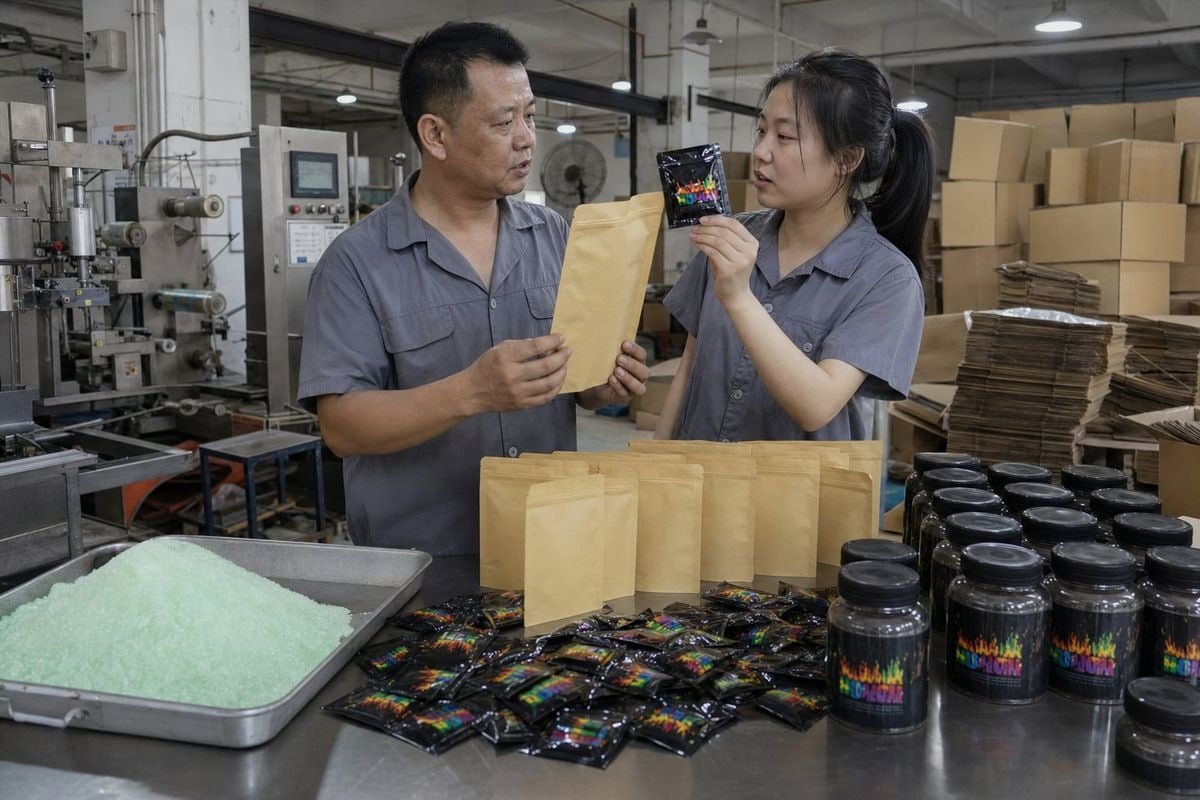
La fabrication en marque privée 6 ne fonctionne correctement que lorsque le fournisseur reçoit tous les éléments dans un seul package organisé. Notre équipe OEM à Liuyang a traité des centaines de briefs personnalisés, et ceux qui sont incomplets suivent toujours le même schéma : un logo basse résolution, aucune confirmation de ligne de découpe et aucune décision sur les langues. Chaque lacune ajoute des jours.
Construisez votre brief dans cet ordre
- Actifs de marque. Fichiers de logo vectoriels, polices de marque (avec licences) et valeurs de couleur exactes. Les couleurs de l'écran changent sur les pochettes métallisées, les références Pantone sont donc importantes.
- Sélection de l'emballage. Sac en plastique, sac en papier kraft, bocal ou boîte d'exposition — et demandez les lignes de découpe vectorielles originales en retour afin que votre designer puisse voir la zone d'impression réelle, les scellages et les trous de suspension.
- Liste des marchés et des langues. Cela détermine si les diagrammes restent purement pictographiques ou portent blocs de texte traduits.
- Direction du style du diagramme. Une exécution à fort contraste est importante pour notre catégorie de produits. Les produits de feu de camp sont utilisés au crépuscule, donc l'impression blanc sur fond sombre maintient le diagramme lisible dans des conditions de faible luminosité.
- Suppléments. Codes-barres, codes QR pour des démonstrations vidéo, emplacement du code de lot et toute exigences spécifiques au détaillant provenant de canaux tels que les grandes chaînes de bricolage.
- Chaîne d'approbation. Nommez une personne de contact ayant l'autorité de signature. Les comités produisent des boucles de révision ; un seul approbateur produit des lancements.
Une objection courante, résolue
Certains acheteurs préfèrent construire les diagrammes en interne pour protéger la cohérence de la marque. C'est raisonnable — et nous le soutenons. Dans ces cas, demandez plutôt à votre fournisseur les ingrédients bruts : la séquence d'utilisation correcte, les fiches techniques, les données de distance de sécurité et les lignes de découpe. Votre équipe gère la couche visuelle ; le fournisseur garantit la couche d'exactitude. Cette division maintient la marque cohérente sans inventer de contenu de sécurité.
Comment puis-je confirmer l'exactitude des diagrammes d'utilisation avant le début de la production de masse ?
Une leçon que nous avons apprise il y a des années : un diagramme qui semble parfait sur un moniteur peut échouer sur une soudure de pochette métallisée sertie. Une première série de production nous a appris à ne jamais approuver d'illustrations à partir d'un simple PDF plat.
Confirmez l'exactitude en demandant une maquette 3D numérique ou un échantillon physique de pré-production, en vérifiant le placement du diagramme par rapport aux sceaux et aux plis, en vérifiant le poids minimum de la ligne et la saturation de l'encre pour l'impression à haute vitesse, en testant les codes QR et en obtenant la validation interfonctionnelle de l'assurance qualité, du service juridique et de la conception avant la publication.
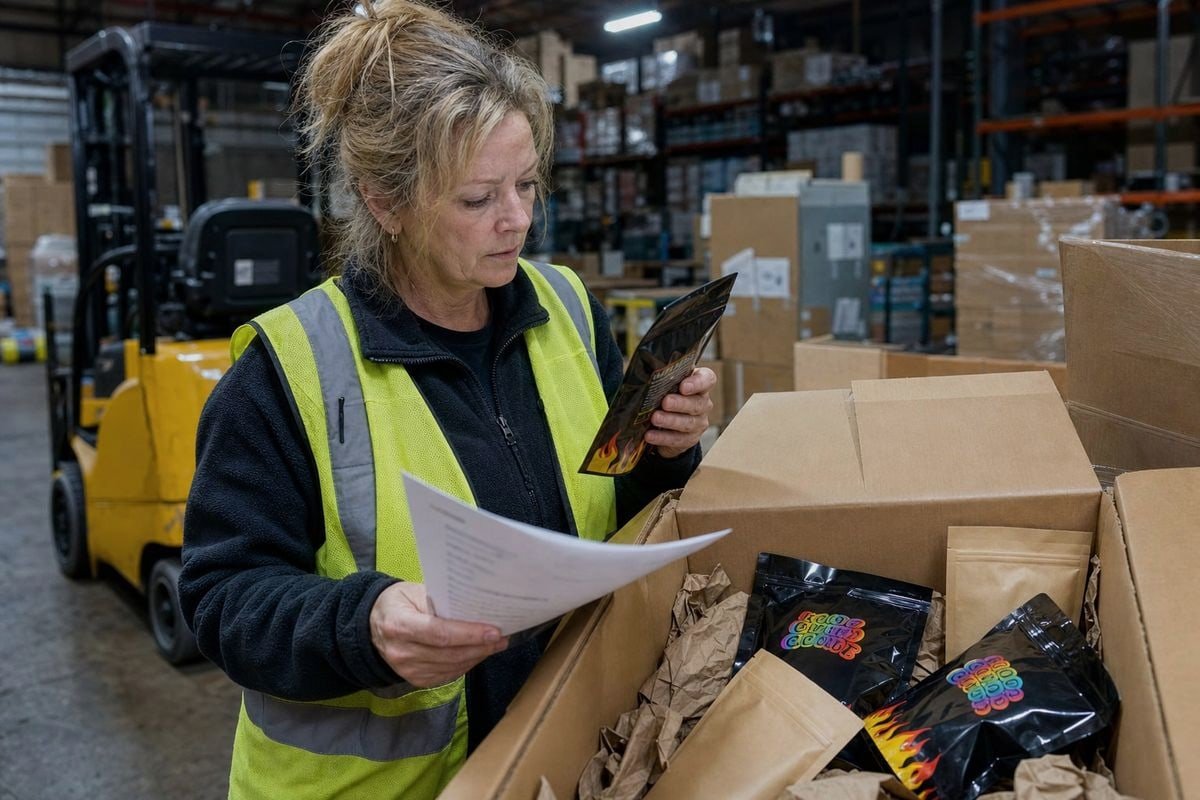
Parce que notre usine gère des lignes de production complètes avec contrôle qualité lot par lot 7, le premier échantillon que nous envoyons reflète véritablement la production de masse. Cette cohérence est exactement ce que vous devriez exiger de tout fournisseur — et ensuite la vérifier avec une vérification structurée.
La séquence de vérification pré-production
Commencez par une maquette 3D ou un échantillon "vierge" imprimé. Tenez-le. Vérifiez si les bords sertis, les fermetures éclair ou les trous de suspension coupent dans la zone du diagramme. Les pochettes métallisées se plissent au niveau des scellages, et les fines lignes placées là se déformeront ou disparaîtront.
Ensuite, examinez les spécifications techniques d'impression. Les petites pochettes sont produites sur des lignes à grande vitesse, donc les lignes fines s'estompent et l'encre dense déborde. Demandez à votre fournisseur de confirmer le poids minimum de la ligne et les limites de saturation de l'encre, et de montrer une épreuve d'impression, pas seulement un rendu numérique. Si la durabilité est importante pour votre canal de vente au détail, confirmez également le type d'encre — les encres à base de soja stables à la chaleur et non toxiques résistent mieux sur les produits stockés près des zones de feu et soutiennent un positionnement écologique.
Ensuite, effectuez les tests fonctionnels ci-dessous.
| Vérifier | Condition de réussite |
|---|---|
| Placement du diagramme | Aucune étape cachée par des scellages, des plis ou des trous de suspension |
| Test de lisibilité | Lisible à bout de bras dans un éclairage tamisé |
| Scan du code QR | Les liens s'ouvrent correctement sur iOS et Android à partir de l'échantillon imprimé |
| Cohérence des avertissements | Correspond exactement aux données SDS et au texte réglementaire approuvé |
| Précision des couleurs | L'échantillon imprimé correspond aux références Pantone dans les tolérances |
| Scan du code-barres | Se lit du premier coup sur les scanners de détail standard |
Enfin, faites passer l'échantillon par une signature interfonctionnelle — les achats, l'assurance qualité, le juridique et le design initialisent chacun le même échantillon physique. Conservez cet échantillon signé comme référence principale pour la production de masse. Tout litige futur sur les lots sera réglé par rapport à celui-ci, et non par rapport à la mémoire.
Conclusion
Les demandes vagues entraînent des réimpressions coûteuses. Envoyez aux fournisseurs un brief complet, vérifiez les diagrammes par rapport aux données SDS et aux rapports de test, fournissez tous les actifs de marque, et approuvez uniquement les échantillons physiques. Des demandes claires permettent de créer des emballages Magic Fire conformes et prêts pour les étagères.
Notes de bas de page
Explique la chimie derrière les produits de coloration de flammes comme la poudre Magic Fire pour les lecteurs. ↩︎
L'arrière-plan de la conception des pictogrammes soutient la stratégie d'étiquetage sans texte de l'article. ↩︎
Page de destination officielle de l'OSHA pour les normes de communication des dangers et de fiche de données de sécurité (SDS). ↩︎
Source officielle de l'UNECE définissant le Système Général Harmonisé de classification et d'étiquetage des produits chimiques pour l'étiquetage des dangers. ↩︎
Clarifie le système de correspondance des couleurs Pantone référencé pour la cohérence de la marque. ↩︎
Liens vers une plateforme d'approvisionnement leader pertinente pour la fabrication sous marque de distributeur et les briefs OEM. ↩︎
Aperçu faisant autorité de la norme ISO 9001 pour le maintien d'une gestion cohérente de la qualité. ↩︎



 English
  Spanish
  German
  French
  Arabic
  Portuguese
Rejoignez la conversation