







Asking suppliers for usage diagrams on Magic Fire powder packaging sounds simple — until artwork arrives late, wrong, or non-compliant. I have watched vague requests stall entire launches on our production line.
Ask suppliers for usage diagrams by specifying the product name, package type, target market, required languages, file format, and deadline in one written request. Ask for vector files, step-by-step instructional pictograms, required safety warnings, and the supplier's compliance test reports before approving artwork.
That is the short answer. Below, I will break down exactly what to request, how to verify compliance, what to send your supplier, and how to confirm accuracy before printing.
What information should I request from suppliers for compliant usage diagrams on Magic Fire packaging?
A buyer from Germany once emailed us three words: "Send usage diagram." We spent two weeks going back and forth. At our Ningbo facility, we now give every new client a request checklist first.
Request the step-by-step application sequence, instructional pictograms, required product safety warnings, GHS-relevant hazard symbols, safe-distance illustrations, storage and disposal icons, the Safety Data Sheet, and editable vector file formats. Also ask for language requirements and where each element must appear on the pouch.

A usage diagram is not just decoration. On a flame colorant packet, it is the single fastest way a customer learns the "toss-in" method: keep the packet sealed, place it on the fire, step back, and enjoy the اللهب الملون 1. Because most of our packets ship to more than thirty countries, we design text-free instructional pictograms 2 wherever possible. Icons cross language barriers; paragraphs do not.
So what exactly should your request contain? In our experience, a complete first email prevents at least two revision rounds later.
The core items to request
| Item to request | لماذا هو مهم |
|---|---|
| Step-by-step usage sequence | The supplier knows the correct handling order; you should not guess it |
| Instructional pictograms (text-free) | Works across the US, EU, and Middle East markets without translation |
| Safe-distance illustration | Shows users how far to stand back after tossing the packet in |
| Storage and disposal icons | Keeps packets away from heat and children; supports retail compliance |
| صحيفة بيانات السلامة 3 | The source document for all warning language on the pack |
| Vector file formats (AI or EPS) | Prevents distortion when diagrams are scaled to small pouches |
| Existing icon library | A pre-approved set of standardized symbols cuts design lead time |
Ask about the packaging format too
Diagram content changes with packaging. A small foil sachet has almost no space, so we push detail to a QR code linking to a short video demonstration. A kraft stand-up pouch or a flip-top display box gives room for a full four-step panel. Tell your supplier which format you are buying — plastic bag, kraft bag, or jar — and ask how they adapt the diagram for each. Also ask whether an NDA is needed before they share proprietary artwork. It is a fair question, and a professional supplier will answer it directly.
How can I verify a supplier's usage diagrams meet US and EU labeling requirements?
Compliance is the first thing serious buyers ask us about — often before price. Our ISO 9001, BSCI, CE, and SGS/Intertek documentation gets requested in nearly every initial inquiry, and rightly so.
Verify compliance by cross-checking the diagram against the product's Safety Data Sheet, confirming GHS labeling requirements for hazard pictograms, requesting CE marking and third-party test reports such as SGS or Intertek, and having your own regulatory advisor review warning text for each destination market.

Never take a supplier's word that artwork is "compliant." Ask them to show you how they know. When we prepare packaging compliance standards documentation for a US or EU client, we hand over the test reports alongside the artwork so their QA team can verify both at once. If a supplier cannot produce a Safety Data Sheet or third-party test report, treat that as a red flag, not a paperwork delay.
What to check for each market
| المنطقة | Key checks for usage diagrams and labels |
|---|---|
| الولايات المتحدة الأمريكية | Warning statements consistent with the SDS; clear cautionary language; child-safety wording; accurate net weight |
| الاتحاد الأوروبي | CE-relevant documentation where applicable; GHS labeling requirements for any classified substance; multi-language warning text for target countries |
| Both markets | Product safety warnings placed near the diagram; storage instructions; disposal guidance; batch traceability on pack |
Three verification steps that catch most problems
First, map every diagram element back to the Safety Data Sheet. If the SDS lists a storage condition, the pack should reflect it. Second, confirm whether GHS-compliant hazard pictograms 4 are required at all. Our Magic Fire packets use eco-friendly formulations with no harmful chemicals, so classification differs from raw industrial colorants — but you must verify this with test reports, not marketing claims. Third, have your own legal or regulatory contact review the chemical handling instructions and warning phrasing for each destination. A buyer objection we hear often: "Shouldn't the supplier carry all compliance responsibility?" In practice, responsibility is shared. The supplier certifies the product and provides accurate source documents; the importer confirms market-specific labeling. Agree on this split in writing before artwork begins, and you avoid the finger-pointing that sinks timelines later.
What details do I need to provide my supplier to customize diagrams for my brand?
The trade-off I discuss most with private-label clients is control versus speed. Some brands want to design everything in-house for consistency; others hand us a logo and a Pantone code 5. Both work — if the brief is complete.
Provide your logo in vector format, brand colors with Pantone references, the chosen packaging type and dimensions, target markets and languages, required barcodes, your graphic design specifications, and any brand-specific warning label style. Confirm the approval workflow and file delivery format upfront.
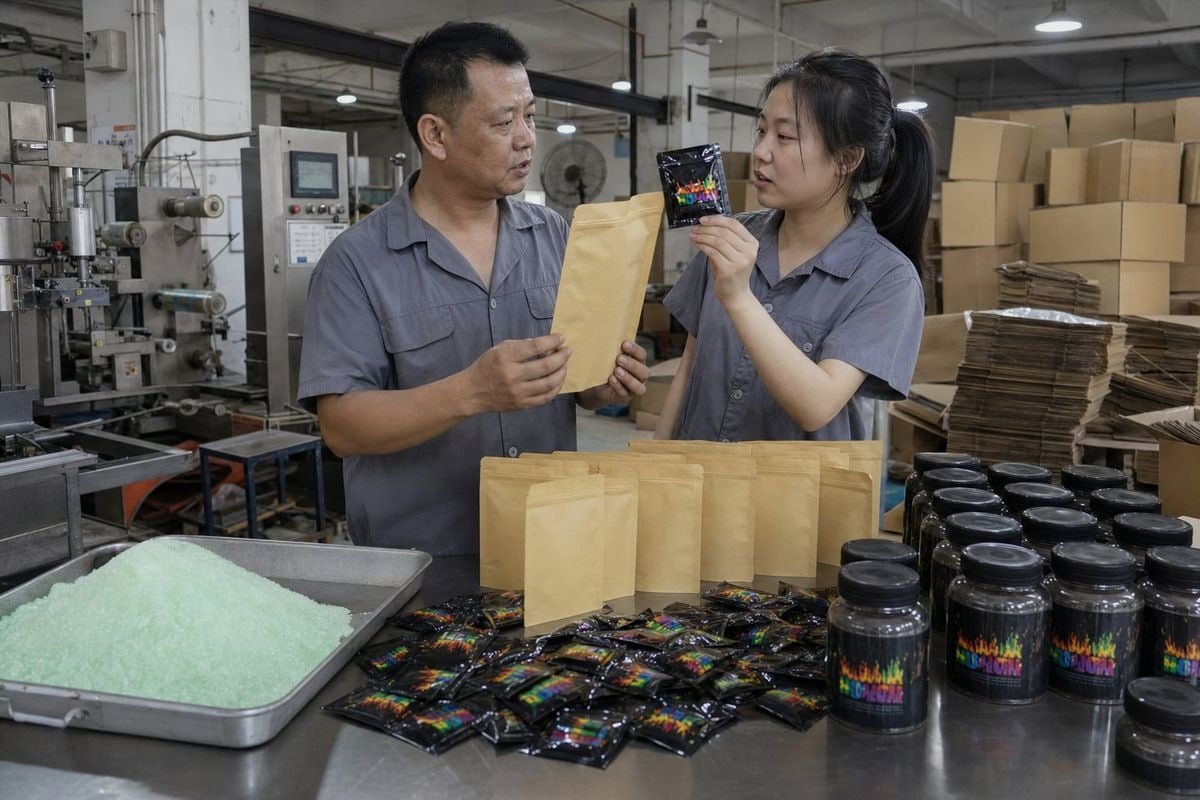
تصنيع العلامة التجارية الخاصة 6 only runs smoothly when the supplier receives every asset in one organized package. Our OEM team in Liuyang has processed hundreds of custom briefs, and the incomplete ones always follow the same pattern: a low-resolution logo, no dieline confirmation, and no decision on languages. Each gap adds days.
Build your brief in this order
- أصول العلامة التجارية. Vector logo files, brand fonts (with licenses), and exact color values. Screen colors shift on foil pouches, so Pantone references matter.
- Packaging selection. Plastic bag, kraft bag, jar, or display box — and request the original vector dielines back so your designer can see the true printable area, seals, and hang holes.
- Market and language list. This determines whether diagrams stay purely pictographic or carry translated text blocks.
- Diagram style direction. High-contrast execution matters for our product category. Campfire products get used at dusk, so white-on-dark printing keeps the diagram legible in low light.
- Extras. Barcodes, QR codes for video demonstrations, batch code placement, and any retailer-specific requirements from channels like large home-improvement chains.
- Approval chain. Name one contact person with sign-off authority. Committees produce revision loops; a single approver produces launches.
A common objection, answered
Some buyers prefer building diagrams internally to protect brand consistency. That is reasonable — and we support it. In those cases, ask your supplier for the raw ingredients instead: the correct usage sequence, spec sheets, safe-distance data, and dielines. Your team handles the visual layer; the supplier guarantees the accuracy layer. That division keeps branding tight without inventing safety content.
How do I confirm the accuracy of usage diagrams before mass production begins?
A lesson we learned years ago: a diagram that looks perfect on a monitor can fail on a crimped foil seam. One early production run taught us to never approve artwork from a flat PDF alone.
Confirm accuracy by requesting a digital 3D mockup or physical pre-production sample, checking diagram placement against seals and folds, verifying minimum line weight and ink saturation for high-speed printing, testing QR codes, and completing cross-functional sign-off from QA, legal, and design before release.

Because our factory runs complete production lines with مراقبة الجودة من دفعة إلى أخرى 7, the first sample we send genuinely reflects mass-production output. That consistency is exactly what you should demand from any supplier — and then verify it with a structured check.
The pre-production verification sequence
Start with a 3D mockup or a printed "blank" sample. Hold it. Check whether the crimped edges, zip closures, or hang holes cut into the diagram area. Foil pouches crinkle at the seals, and fine line art placed there will distort or disappear.
Next, review the technical printing specifications. Small pouches run on high-speed lines, so thin lines blur and dense ink floods. Ask your supplier to confirm minimum line weight and ink saturation limits, and to show a press proof, not just a digital render. If sustainability matters to your retail channel, confirm ink type as well — heat-stable, non-toxic soy-based inks hold up better on products stored near fire zones and support eco-friendly positioning.
Then run the functional tests below.
| فحص | Pass condition |
|---|---|
| Diagram placement | No steps hidden by seals, folds, or hang holes |
| Legibility test | Readable at arm's length in dim lighting |
| QR code scan | Links open correctly on iOS and Android from the printed sample |
| Warning consistency | Matches the SDS and approved regulatory text exactly |
| دقة اللون | Printed sample matches Pantone references within tolerance |
| Barcode scan | Reads first time on standard retail scanners |
Finally, route the sample through cross-functional sign-off — procurement, QA, legal, and design each initial the same physical sample. Keep that signed sample as your golden reference for the mass-production run. Any future batch dispute gets settled against it, not against memory.
خاتمة
Vague requests cause costly reprints. Send suppliers one complete brief, verify diagrams against the SDS and test reports, provide full brand assets, and approve only physical samples. Clear asks build compliant, shelf-ready Magic Fire packaging.
ملاحظات ختامية
1. Explains the chemistry behind flame-coloring products like Magic Fire powder for readers. ↩︎
2. Background on pictogram design supports the article's text-free labeling strategy. ↩︎
3. Official OSHA landing page for Hazard Communication and Safety Data Sheet (SDS) standards. ↩︎
4. Official UNECE source defining the Globally Harmonized System for hazard labeling. ↩︎
5. Clarifies the Pantone color-matching system referenced for brand consistency. ↩︎
6. Links to a leading sourcing platform relevant to private label manufacturing and OEM briefs. ↩︎
7. Authoritative overview of the ISO 9001 standard for maintaining consistent quality management. ↩︎



 English
  Spanish
  German
  French
  Arabic
  Portuguese
انضم إلى المحادثة