






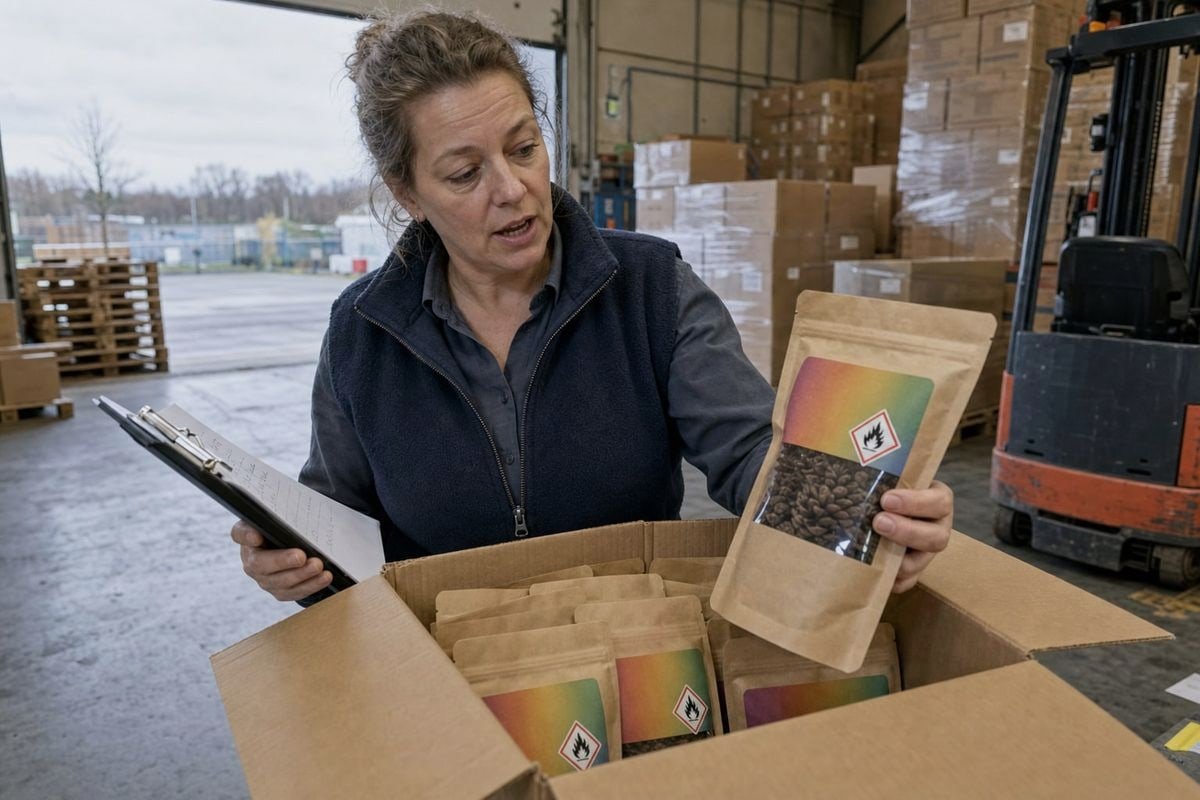
Verifying CLP compliant packaging for fireplace colored pine cones trips up many EU importers Regulation (EC) No 1272/2008 1. I have seen shipments held at customs over one missing label element — and our factory learned those lessons early.
To verify CLP compliant packaging for fireplace colored pine cones in the EU, obtain the Safety Data Sheet, confirm the hazard classification of the colorant mixture, check all required label elements and languages, inspect packaging integrity and child-safety features, and keep test reports and supplier documentation on file.
That sounds like a lot. But it breaks down into four clear checks. I will walk you through each one, in the order I use with our own EU buyers.
What CLP Labeling Elements Must I Check on Colored Pine Cone Packaging Before Importing?
A German distributor once sent me a competitor's pouch to review before placing a trial order with us Pictogramas GHS 2. The label looked polished, yet three mandatory CLP elements were missing. Pretty printing is not compliance.
Before importing, check that the packaging shows the EU supplier's name, address, and phone number, the product identifier, nominal quantity, correct GHS pictograms, the signal word, hazard statements, precautionary statements in the local language, and any required UFI code — all firmly attached and legible.

The key point to understand is this: "colored fireplace pine cones" is not a legal category under EU law Aquatic Chronic categories 3. What matters is the chemical treatment on the cones. Most color-flame products use metal salts — compuestos de cobre 4 for blue and green, strontium for red, and so on. If that mixture meets any hazard classification criteria under Regulation (EC) No 1272/2008 5, then full CLP labeling applies, no matter how decorative the product looks.
At our Ningbo production site, we design consumer-facing packaging for over 30 export markets, and the EU label check is always the longest part of the artwork approval. Here is what I tell buyers to verify, element by element.
Los elementos de etiquetado obligatorios
| Elemento de Etiqueta | Qué comprobar |
|---|---|
| Identidad del proveedor | Name, full address, and telephone number of the EU-based supplier or importer |
| Identificador del producto | Name of the mixture and the hazardous ingredients driving classification |
| Nominal quantity | Net content stated on consumer packages |
| Pictogramas de peligro | Correct GHS diamonds (e.g., flame, environment) matching the classification |
| Palabra de señalización | "Danger" or "Warning" — never both, never neither if classified |
| H-statements | Hazard statements matching each assigned hazard class |
| P-statements | Precautionary statements, selected and limited to the most relevant |
| UFI code | Unique Formula Identifier where poison centre notification 6 applies |
| Idioma | Official language(s) of every member state where you sell |
Presentation Rules Matter Too
Content is only half the job. The label must be firmly fixed to the packaging, readable horizontally when the pack sits normally on a shelf, and durable enough to stay legible through storage and handling. Pictograms must stand out clearly against the background — a red diamond printed over a rainbow gradient graphic, like the ones common on color-flame pouches, can fail a visibility check. When we prepare private-label artwork for EU clients, we always place pictograms on a plain field for exactly this reason.
One more trap: language. A pouch labeled only in English is not compliant in Germany, France, or Poland. Multi-market sellers need multi-language panels or market-specific artwork.
Which Certifications and Test Reports Should I Request From My Manufacturer to Confirm CLP Compliance?
There is a trade-off I discuss with every new EU buyer: cheaper suppliers quote lower prices partly because they skip third-party testing. That saving evaporates the first time a market surveillance authority asks for a report you do not have.
Request the Safety Data Sheet compiled under REACH Annex II, third-party test reports from accredited labs such as SGS or Intertek confirming the classification, the supplier's quality certifications like ISO 9001 and BSCI, poison centre notification confirmation with the UFI, and packaging integrity test results.

Over 17 years of exporting fire-themed products, we have built our documentation package around what EU importers actually get asked for during checks. Not every certificate carries the same weight, so it helps to know what each document proves — and what it does not.
The Document Stack, Ranked by Importance
| Documento | Lo Que Demuestra | Quién lo emite |
|---|---|---|
| Hoja de Datos de Seguridad (SDS) | Composition, hazard classification, handling and safety data | Manufacturer or its regulatory consultant |
| Informe de prueba de terceros | Independent verification of composition and classification | Accredited labs (SGS, Intertek, Bureau Veritas, TÜV) |
| Poison centre notification proof | Formula submitted to national poison centres with valid UFI | Submitting company via ECHA portal |
| ISO 9001 7 certificado | Gestión de calidad constante desde la muestra hasta la producción en masa | Organismo de certificación acreditado |
| Informe de auditoría BSCI | Social compliance of the production site | Organismo de auditoría |
| Packaging test data | Closure integrity, leakage resistance, label durability | Manufacturer QC or third-party lab |
How to Read These Documents Critically
An SDS alone is a claim, not proof. I have reviewed SDS documents from other factories that listed "no hazardous ingredients" for products clearly coated in copper salts. That is why we pair our SDS with informes SGS e Intertek 8 — an independent lab confirms what is actually on the cones. When you receive a test report, check three things: the report references your exact product and formulation, the lab is accredited, and the tested batch date is recent. A five-year-old report on a "similar" product proves nothing about the pouch you are importing this season.
Also ask whether the manufacturer supports poison centre notification. If the mixture is classified for health or physical hazards, the UFI on the label must match a real submission. We prepare this data package for our EU clients as part of our OEM service, because a UFI printed on a bag with no notification behind it is a fast route to a compliance failure.
How Do I Verify That My Supplier's Hazard Classification Matches the Actual Product Formula?
A Dutch buyer once asked me a sharp question during a factory visit to our Liuyang headquarters: "How do I know your SDS describes the cones in my container, not just the cones in your sample room?" It was the right question to ask.
Cross-check every colorant listed in the SDS against the ECHA C&L Inventory for harmonized classifications, verify concentration thresholds for mixture classification, request batch-specific composition data, and confirm environmental hazards like Aquatic Chronic categories are assessed — especially for copper-based colorants.
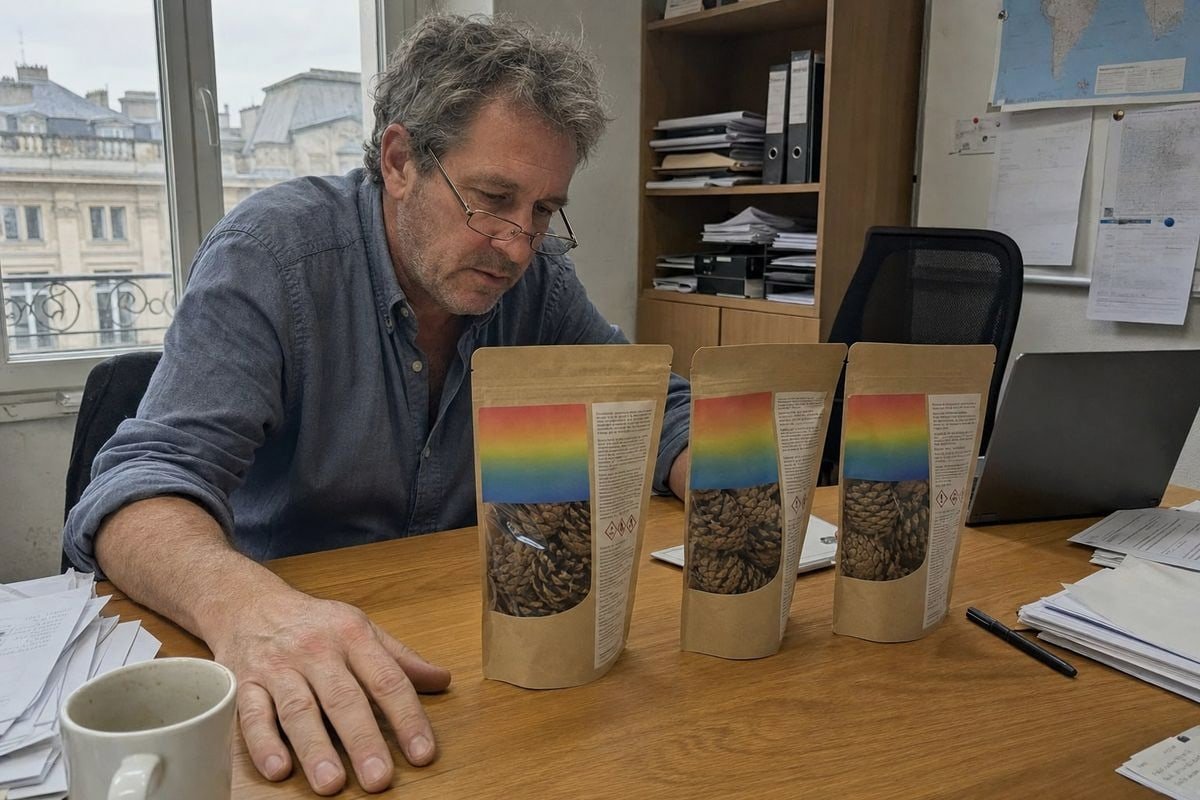
This is the step most importers skip, because it feels technical. But under EU rules, the importer is the responsible person. You cannot outsource that legal duty to your Chinese supplier's paperwork. The good news: the verification process is systematic, and you do not need a chemistry degree to run the basic checks.
Un proceso de verificación de cinco pasos
- Obtenga la lista completa de ingredientes. Ask your supplier for the identity and concentration of every substance in the colorant treatment, with CAS numbers. A serious factory will provide this under NDA.
- Check each substance in the ECHA C&L Inventory. Search by CAS number. If a harmonized classification exists, the supplier must use it — self-classification cannot override it.
- Compare concentrations against thresholds. A mixture is classified as hazardous when hazardous ingredients exceed the applicable concentration limits. Verify the supplier's math, or have a regulatory consultant do it.
- Look specifically at environmental hazards. Copper compounds commonly used for blue and green flames can trigger Aquatic Chronic classification. This is the most frequently missed hazard class we see on competitor labels, and it changes the required pictograms.
- Match the result to the label. The classification you verified in steps 1–4 must produce exactly the pictograms, signal word, and statements printed on the pack. Any gap means either the SDS or the label is wrong.
Watch for Dual-Hazard Blind Spots
Many suppliers classify for flammability and stop there. In our experience developing color-flame pinecones and Magic Fire packets for EU distributors, the environmental classification of metal salts is where self-classified products most often go wrong. If your supplier's SDS shows no aquatic hazard for a copper-based formula, ask them to show their reasoning or their test data. A confident manufacturer will explain; an evasive one is telling you something important.
Batch consistency matters here too. A classification is only as valid as the formula behind it, so ask how the factory controls colorant loading between batches. Our production lines run batch-to-batch composition checks precisely so the SDS stays accurate across every shipment — the first sample must reflect the thousandth carton.
What Documentation Should I Keep on File to Prove CLP Compliance During EU Customs or Market Checks?
Early in our export history, a French client called us in a mild panic: a market surveillance authority had requested his compliance file, and he had only a commercial invoice and a photo of the label. We rebuilt his file together in a week. Since then, we ship a documentation pack with every EU order.
Keep the current SDS, the full classification rationale, third-party test reports, poison centre notification and UFI records, label artwork approvals in each market language, packaging integrity test results, supplier certificates, batch records, and purchase documentation — retained and retrievable for at least ten years.

Think of your compliance file as insurance you build before you need it. Customs officers and market surveillance authorities do not just look at the label text — they can question packaging safety, closure performance, child-safety features, and whether the pack design could mislead consumers or attract children. Your file needs to answer all of it.
The Complete Compliance File
| Categoría | Documents to Retain | Why Authorities Ask |
|---|---|---|
| Clasificación | SDS, classification rationale, ECHA C&L cross-checks | Proves the hazard assessment behind the label |
| Pruebas | Accredited lab reports, batch test records | Independent evidence the formula matches claims |
| Etiquetado | Approved artwork per language, print proofs | Shows label content and legibility were verified |
| Notification | UFI records, poison centre submission confirmations | Confirms legally required notifications were made |
| Empaquetado | Leakage and closure tests, child-resistance certification if applicable | Demonstrates physical packaging compliance |
| Supply chain | Supplier certificates, purchase orders, batch traceability | Links each shipment to verified documentation |
Organize by Batch, Not by Year
The most practical tip I can give: file documents by production batch, not just by calendar date. When an authority questions a specific pouch pulled from a shelf, you need to trace it back to its batch, its test report, and its SDS version within hours, not weeks. We print batch codes on every carton and pouch we produce for exactly this purpose, and we archive matching documentation on our side as a backup for our clients.
Also keep records of your own verification work — emails asking your supplier for clarification, notes from your ECHA cross-checks, artwork revision history. As the EU importer, you must show you independently verified compliance rather than passively trusting manufacturer claims. A dated paper trail of your due diligence is often the difference between a quick check and a formal investigation.
Conclusión
Verify CLP compliant packaging by classification, label content, and packaging performance — never by appearance. Build the document file before customs asks, and partner with a factory that supplies proof, not promises.
Notas al pie
1. Official EU legal text defining CLP hazard classification criteria referenced in the article. ↩︎
2. Background on the globally harmonized hazard pictogram system mentioned as a mandatory label element. ↩︎
3. Background on GHS hazard categories including aquatic chronic classification for copper-based colorants. ↩︎
4. Reference database for chemical properties of copper compounds used as colorants in fireplace products. ↩︎
5. Background on the EU CLP Regulation referenced as the core legal framework. ↩︎
6. Official ECHA poison centre portal explaining UFI submission requirements mentioned repeatedly. ↩︎
7. Official ISO page describing the quality management standard cited as a supplier certification. ↩︎
8. Links to accredited testing body cited for independent verification of hazard classification claims. ↩︎



 English
  Spanish
  German
  French
  Arabic
  Portuguese
Únete a la conversación