






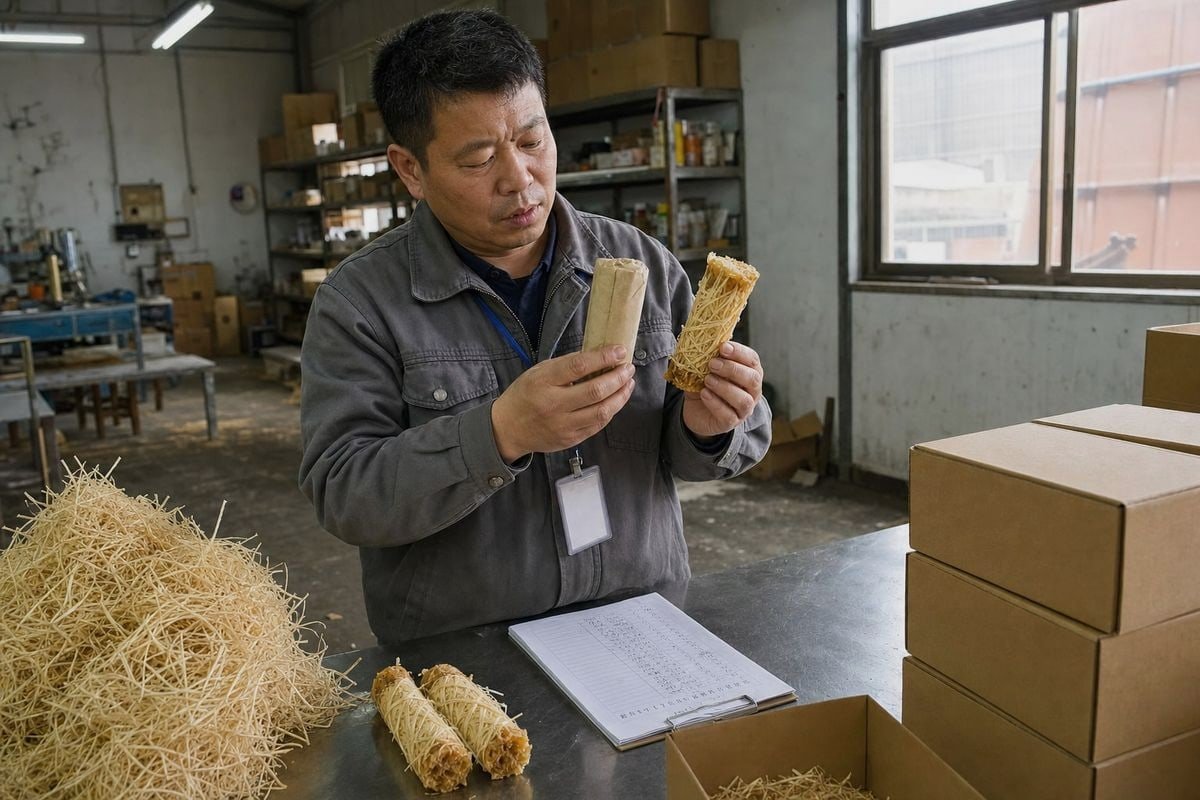
Wood fire starters look almost identical on a shelf, yet some hide chemical accelerants. On our production line, I have seen how easily buyers get misled by pretty packaging.
You cannot identify chemical accelerants in wood fire starters by sight alone. Instead, check the ingredient list and Safety Data Sheet for petroleum distillates, smell for solvent odors, watch for black smoke and oily residue, and demand third-party test reports before buying.
Below, I break this down into four practical questions every importer should ask. Each one gives you a concrete way to verify what is really inside the product.
What certifications should I request to confirm my wood fire starters are chemical-free?
A German distributor once told me he had rejected two suppliers before finding us — both promised "natural" wood fire starters but neither could produce a single valid test report. That conversation shaped how we document everything at our factory.
Request SGS or Intertek chemical composition test reports, a full Material Safety Data Sheet, CE marking documentation, and factory audit certificates such as ISO 9001 and BSCI. Together, these confirm the fire starters contain no petroleum distillates, heavy metals, or hidden accelerants.

Certifications matter because marketing words 1 like "natural" and "eco-friendly" are not regulated in most markets. Anyone can print them on a box. Documents from accredited labs are much harder to fake, and serious suppliers keep them current.
Los documentos centrales y lo que cada uno demuestra
| Certificación / Documento | Lo que verifica | Señal de alerta si falta |
|---|---|---|
| Informe de prueba SGS / Intertek | Actual chemical composition; screens for petroleum distillates and heavy metals | Supplier may not know or disclose true ingredients |
| Hoja de Datos de Seguridad del Material | Hazard classification, VOC content, handling risks | Product may be classified as dangerous goods |
| ISO 9001 | Consistent production and quality management | Batch quality may drift after your first order |
| Auditoría BSCI | Operaciones éticas de fábrica | You may be dealing with a trading company, not a factory |
| Documentación CE | Conformidad del mercado de la UE | Riesgo de incautación aduanera en Europa |
In our experience exporting to more than 30 countries, buyers in the US and EU treat these as a hard requirement, not a nice-to-have. Retail chains especially will not stock fire products without a complete compliance file.
Also check the report date and scope. A test report from five years ago, or one covering a different SKU, proves nothing about the pallet arriving at your warehouse. Ask whether the lab tested for compuestos orgánicos volátiles 2 specifically, since VOC off-gassing is the clearest chemical fingerprint of solvent-boosted starters. Finally, verify the report number directly with SGS or Intertek. Legitimate labs let you confirm authenticity online, and a supplier who hesitates when you ask for that number is telling you something important.
Which ingredients or materials indicate a wood fire starter is safe and eco-friendly?
When we developed our wax-dipped wood rolls, we tested dozens of wax blends before settling on a formulation that burns clean. That trial-and-error taught me exactly which materials separate safe products from problem ones.
Safe wood fire starters contain only compressed wood fiber, excelsior wood wool, sawdust, or plant fibers bound with food-grade paraffin, vegetable wax, or natural resin. Avoid products listing kerosene, mineral spirits, lighter fluid, methanol, synthetic gels, or nitrate-based oxidizers.

The ingredient list is your single most reliable tool. Sensory checks help, but composition tells the full story. Here is how the two categories compare side by side.
Safe materials versus warning-sign materials
| Categoría | Safe and Eco-Friendly | Harmful or High-Risk |
|---|---|---|
| Material base | Wood wool, excelsior, sawdust, compressed wood fiber | Chemically treated wood, unknown fiber blends |
| Binder / fuel | Food-grade paraffin, vegetable wax, beeswax, natural resin content | Kerosene, mineral spirits, lighter fluid, methanol gels |
| Aditivos | None needed | Nitrate oxidizers, synthetic wicking agents, unlisted "boosters" |
| Sin escamas sueltas ni grietas | Mild woody or waxy scent | Gasoline-like or solvent smell |
| Humo | Light, low-smoke burn | Thick black smoke, harsh toxic fumes |
Why the wax type matters so much
Paraffin itself is not automatically dangerous. Parafina de grado alimenticio is refined, stable, and burns predictably. The problem starts when suppliers cut costs with crude petroleum distillates 3 or add liquid hydrocarbon boosters to make ignition look impressive. Those additives release volatile organic compounds, leave oily residue, and produce dirty combustion byproducts that ruin indoor air quality.
Quick sensory checks that support the label
A genuine wood-and-wax starter smells faintly of wax or pine. It feels dry or lightly waxy, never greasy. It needs a few seconds of flame contact to catch. By contrast, a dense block that ignites instantly without any fluffing usually contains a hidden chemical wicking agent. Also try the water slick test: drop a small piece in water, and chemical-soaked starters will release an iridescent oil film on the surface. Natural resin content, like the sap in fatwood, gives a mild piney scent — completely different from the sharp bite of alcohol or gasoline.
How can I test a supplier's sample before placing a bulk order?
Before any bulk run leaves our Ningbo facility, our QC team burns samples from every batch — and I always encourage buyers to do the same tests on their side. A sample tells the truth that a sales pitch cannot.
Test samples by smelling the sealed package for solvent odors, burning one unit to check smoke color and flame behavior, doing the water slick test for oil film, inspecting for greasy residue, and timing the burn against the supplier's stated specification.
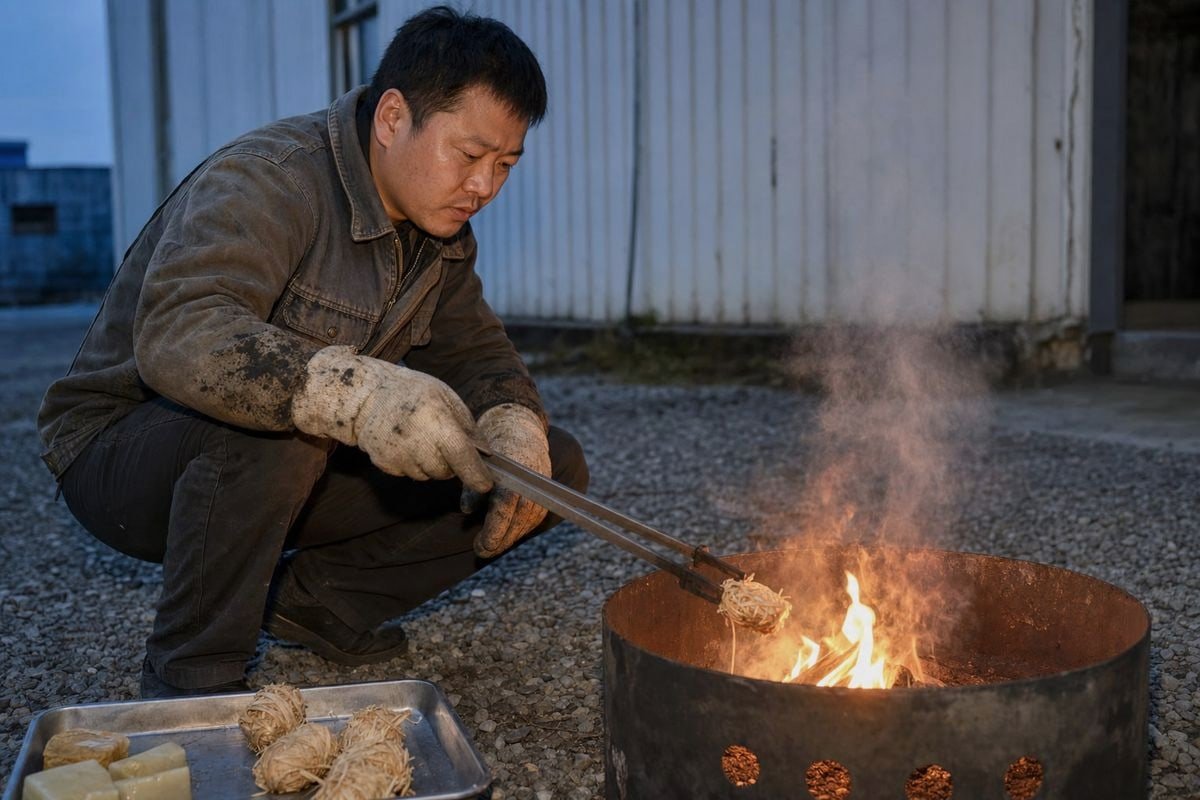
You do not need a laboratory for a first-pass evaluation. A structured hands-on protocol catches most problems before your money is at risk. I recommend this five-step sequence.
A five-step sample testing protocol
- The sealed-container smell test. Open the shipping bag or box and smell immediately. Concentrated chemical odors 4 inside sealed packaging indicate high VOC off-gassing even at rest. A natural product smells like wood and wax, nothing sharper.
- The visual and touch inspection. Look for oily stains on the packaging. Press the starter with a paper towel. Grease marks signal liquid hydrocarbon boosters soaked into the fiber.
- The water slick test. Submerge a broken piece in a clear bowl of water. An iridescent, rainbow-colored film spreading on the surface means petroleum distillates are present.
- The controlled burn test. Ignite one starter outdoors. Watch the first thirty seconds. Thick black smoke means incomplete combustion of petroleum derivatives. Aggressive, instant flare-up suggests accelerant content. A clean starter builds flame gradually with pale smoke.
- The burn-time verification. Time the full burn with a stopwatch. Compare against the datasheet. Suppliers who inflate burn-time claims often cut corners elsewhere too.
Beyond the product itself, test the supplier. Ask a detailed technical question in English and time the response. Then order a second sample batch a few weeks later and repeat all five steps. Consistency between samples is the strongest predictor of consistency in mass production. In our 17-plus years, the first sample we send is pulled from standard line output 5, not a hand-polished showpiece — and that is exactly the standard you should hold every supplier to. One more caution: chemical vapors from solvent-boosted starters can poison the catalytic combustors in modern EPA-certified stoves, so if your customers use catalytic appliances, a clean burn test is non-negotiable.
What documentation should my supplier provide to prove compliance for import into my market?
Shipping fire products across borders taught us a hard lesson early on: a great product with an incomplete paper trail is worthless at customs. We now build the compliance file before the first carton is packed.
Your supplier should provide an SDS, third-party chemical test reports, a certificate of origin, transport classification documents confirming non-dangerous-goods status, CE documentation for the EU, compliant warning labels, and Proposition 65 disclosures for California-bound shipments.

Different markets demand different papers. A file that clears German customs may still fail a US retail chain's onboarding audit. The table below maps the essentials by destination.
Compliance documentation by target market
| Mercado | Mandatory Documents | Additional Retail Requirements |
|---|---|---|
| Estados Unidos | SDS, transport classification, customs invoice | Proposition 65 warning for California; barcode and warning labels for chains |
| UE (Alemania, Francia, NL, Polonia) | CE documentation, SDS, REACH-relevant declarations | EN-standard firelighter labeling; multilingual warnings |
| Reino Unido | Documentación alineada con UKCA, SDS | Retailer-specific safety datasheets |
| Canadá / Australia | SDS, bilingual or local-standard labels | State-level fire safety notices |
| Middle East / Brazil | Certificate of origin, conformity certificates | Import-license support documents |
Transport classification is the hidden trap
Fire starters with chemical accelerants may be classified as dangerous goods, which triggers restricted shipping, higher freight costs, and carrier refusals. Genuine wood-fiber and wax products typically ship as normal cargo. Ask your supplier for the transport classification in writing. If they cannot state it clearly, assume the worst.
Labeling that survives shelf audits
Retail sourcing channels check labels harshly. Your compliance file should include artwork proofs showing warning text, usage instructions, ingredient disclosure, and batch coding. Honest labeling should also acknowledge that even eco-friendly firelighters produce combustion byproducts like monóxido de carbono 6 and soot — a "natural" claim does not mean smoke-free, and mature buyers know it. Poorly formulated starters also worsen la acumulación de creosota 7 in chimneys, so some markets expect usage guidance on ventilation and flue maintenance. At our factory, we prepare custom warning labels, barcodes, and display packaging as part of the OEM package, because a shelf-ready product means the paperwork is shelf-ready too. Keep every document versioned and matched to the exact SKU and production batch. When a customs officer or retail auditor asks a question, the answer should already be in your file.
Conclusión
Hidden accelerants risk your brand, your customers, and your customs clearance. Verify ingredients, burn-test samples, and demand full documentation — then partner with a factory that proves compliance, not just promises it.
Notas al pie
1. FTC guidance on environmental marketing claims and the regulation of terms like "natural." ↩︎
2. EPA information on volatile organic compounds and their impact on indoor air quality. ↩︎
<span


 English
  Spanish
  German
  French
  Arabic
  Portuguese
Únete a la conversación