







Confirming the UN number and packing group for Magic Fire Powder trips up many importers UN Dangerous Goods List 1. I have watched buyers lose whole containers at port because our competitors guessed instead of testing.
To confirm the UN number and packing group for Magic Fire Powder, request the full SDS with Section 14 transport data, the complete ingredient list, and an accredited lab test report. Classification depends on composition, so verify against IMDG or IATA rules — never assume from the product name.
The trade name tells you nothing about the hazard class. Let me walk you through exactly what to ask for, and how to check the answers you get.
What documents should I request from my supplier to verify the UN number and packing group?
A German distributor once emailed our Liuyang office asking for "just the UN number." We sent him a full document pack instead — and he later told us that habit saved his booking.
Request the English SDS with a completed Section 14, the full ingredient disclosure with concentrations, an accredited third-party test report (SGS or Intertek), a Dangerous Goods Declaration or a Certificate of Non-Dangerous Goods, and the supplier's export compliance certificates before booking any shipment.

In our 17 years of exporting color-flame packets to the US, Germany, the UK, and 30-plus other markets, we have learned that the document pack matters more than any verbal promise. A serious factory should hand over these papers without hesitation. When a supplier stalls, that is your first red flag.
El paquete de documentos principal
Here is the full list we prepare for every new B2B buyer, and what each document proves.
| Documento | What it must contain | Lo que prueba |
|---|---|---|
| SDS (English, 16 sections) | Section 14 with UN number, proper shipping name, class, packing group | The supplier's declared transport classification |
| Divulgación de ingredientes | Every chemical component and concentration range | Whether classification matches the real formula |
| Informe de prueba de terceros | Flammability, oxidizing, self-heating results per UN Manual of Tests and Criteria | Independent evidence behind the classification |
| DGD or Non-DG certificate | Signed declaration or lab-issued non-regulated statement | What the carrier and customs will actually accept |
| Factory certificates | ISO 9001 2, BSCI, CE, SGS/Intertek audit records | The supplier can maintain consistency batch to batch |
Why Section 14 is the heart of it
Section 14 of the SDS lists the UN number, the proper shipping name Hoja de datos de seguridad 3, the hazard class, and the packing group for each transport mode. Read it carefully. Some SDS documents mark transport as "not applicable" for genuinely non-regulated products. Others list UN3077, Class 9, Packing Group III for environmentally hazardous solids. Both can be legitimate — but only if a test report backs the claim. At our factory, we keep SGS and Intertek reports on file for every formulation precisely because buyers in the US and EU treat this as a hard requirement, not a nice-to-have. Ask for the test report date, too. A report older than the current formulation proves nothing.
How do I know if my Magic Fire Powder is classified correctly for international shipping?
Early in our export history, we compared SDS sheets from three factories selling nearly identical flame colorants. One said non-regulated, one said UN3077, one said Class 4.1. That comparison changed how we test.
Your Magic Fire Powder is correctly classified only when the declared UN number matches the tested properties of the actual formula. Cross-check the ingredient list against the UN Dangerous Goods List, verify with IMDG or IATA tables, and confirm the packing group reflects lab-measured hazard severity.

The uncomfortable truth is that "Magic Fire Powder" is a marketing name, not a transport classification. The same colorful-flame effect can come from very different chemistry. Our own color-flame packets use sales metálicas ecológicas sin químicos dañinos, and our test reports confirm non-regulated status. But other products sold under similar names contain oxidizer blends or metal powders. That difference decides everything.
The four product profiles behind one trade name
Before you can judge the classification, identify which category your product actually falls into.
| Product profile | Typical composition | Likely classification outcome |
|---|---|---|
| Non-dangerous flame colorant | Stable metal salts, eco-friendly carrier | No regulado para el transporte |
| Environmentally hazardous solid | Copper or other salts above threshold | UN3077, Class 9, Packing Group III |
| Flammable or oxidizing powder | Organic fuels or nitrate/perchlorate salts | Class 4.1 or 5.1, PG II or III |
| Pyrotechnic composition | Fireworks-type mixtures, flash powder | UN0333–UN0337 or UN0094, Class 1 |
How to run the cross-check yourself
Work through these steps in order. First, take the ingredient list and look up each component in the UN Model Regulations. Second, check whether the dominant hazard is an oxidizing salt or a sólido inflamable 5, because that changes the UN entry completely. Third, open the Código IMDG 6 for sea freight or the IATA DGR for air freight and confirm the declared entry exists and carries the stated packing group. Fourth, remember that explosives use hazard divisions rather than the familiar PG I–III system, so a "Packing Group" claim on a fireworks-type product should raise questions. In our experience shipping to Rotterdam, Hamburg, and Los Angeles, sea and air interpretations can differ slightly, so always verify against the mode you will actually use.
Can my supplier provide test reports that confirm the packing group classification?
Every time we develop a new burn-time formulation in Ningbo, we send samples out for third-party testing before the first sales sample ever leaves the building. That sequence is deliberate.
Yes — a legitimate supplier can commission accredited labs such as SGS, Intertek, Bureau Veritas, or CTI to run UN Manual of Tests and Criteria procedures. The resulting report states the hazard class and packing group, or certifies the product as non-regulated for transport.
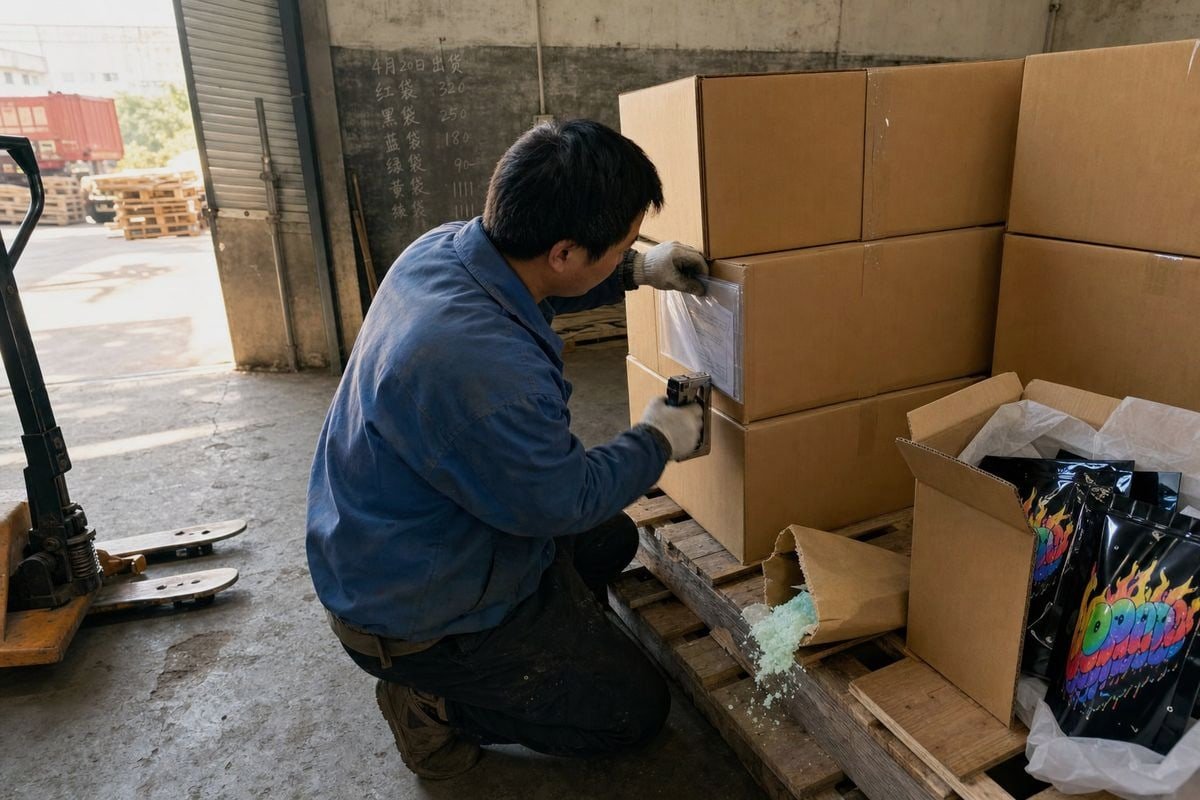
A packing group is not an opinion. It is assigned from measurable data: burn rate for flammable solids, oxidizing test results against reference mixtures, and self-heating behavior. Marketing descriptions and visual demos prove nothing. When our buyers in the US and Germany ask how we support the non-regulated status of our color-flame packets, we point to the SGS and Intertek reports tied to the exact formulation and batch, not to a brochure.
What a credible test report contains
Check the report for these elements before you accept it. The lab name and accreditation must be visible. The tested sample must match your product's formula and production date. The test methods must reference the UN Manual of Tests and Criteria. The conclusion must state either the class, division, and packing group, or a clear non-regulated finding.
How packing groups map to tested severity
| Packing group | Danger level | What the test data shows |
|---|---|---|
| PG I | High danger | Severe results, such as very fast burn rates or strong oxidizing effect |
| PG II | Medium danger | Moderate hazard results; common for many regulated solids |
| PG III | Low danger | Mild results; example: UN3077 environmentally hazardous solids |
| No PG | Class 1 or non-regulated | Explosives use divisions instead; non-DG products need no PG |
One more caution from our side of the trade: some B2B platform listings self-declare "non-hazardous" simply to make export logistics easier. We compete against those listings every week. If a supplier claims non-DG status but cannot produce the lab certificate behind it, ask them to commission the test — or commission it yourself before the goods ship. A trial-order-sized test cost is trivial next to a rejected container.
What happens if the UN number on my shipment doesn't match customs requirements?
A Canadian importer once came to us after his previous supplier's cargo was held at origin for a mismatched declaration. He had paid demurrage for three weeks before switching factories.
A mismatched UN number triggers carrier rejection, customs holds, fines, forced re-testing, and possible cargo destruction or return at your cost. Misdeclared dangerous goods can also void insurance and expose the importer — not just the supplier — to legal liability.

The consequences escalate fast, and they land on the importer of record. Here is the typical chain of events, based on what we have seen buyers go through before they came to us.
The escalation sequence
- The carrier's DG desk spots the discrepancy between the booking, the SDS, and the cargo. The booking is rejected or the container is pulled for inspection.
- The port or customs authority places a hold World Trade Organization 7. Storage and demurrage charges start accumulating daily, and they are rarely small.
- Authorities may order re-testing at an approved lab, at your expense, before releasing or re-declaring the cargo.
- If the goods are found to be misdeclared dangerous goods, fines follow. In serious cases, the cargo is returned or destroyed.
- Your insurance may refuse the claim, because misdeclaration typically voids coverage. Your carrier relationship suffers, and future bookings get extra scrutiny.
How to protect yourself before booking
Never book cargo under an assumed UN number. Match the SDS, the test report, the DGD, and the booking details word for word. Check whether Limited Quantity or Excepted Quantity thresholds apply to small consumer-pack sachets, because our compact foil pouches often qualify for reduced marking under IMDG when the product is regulated at all. If anything is unclear, escalate to a qualified dangerous-goods classifier or the competent authority rather than guessing. And choose a freight forwarder who handles novelty fire products regularly. When we optimize logistics for private-label buyers, we align the shipping documents with the retail packaging, warning labels, and barcodes at the factory stage — so nothing at the port contradicts anything on the shelf.
Conclusión
Guessing a UN number risks fines, holds, and lost cargo. Demand the SDS, formula, and accredited test reports — then verify against IMDG or IATA before you book.
Notas al pie
1. General reference explaining dangerous goods classification system referenced for cross-checking. ↩︎
2. Official ISO page for the quality management standard listed among factory certificates. ↩︎
3. Explains standardized SDS structure referenced throughout for Section 14 transport data. ↩︎
4. Background on GHS framework underlying SDS Section 14 transport classification standards. ↩︎
5. Explains flammability hazard concept underlying packing group test criteria described. ↩︎
6. Official IMO source governing the IM



 English
  Spanish
  German
  French
  Arabic
  Portuguese
Únete a la conversación