






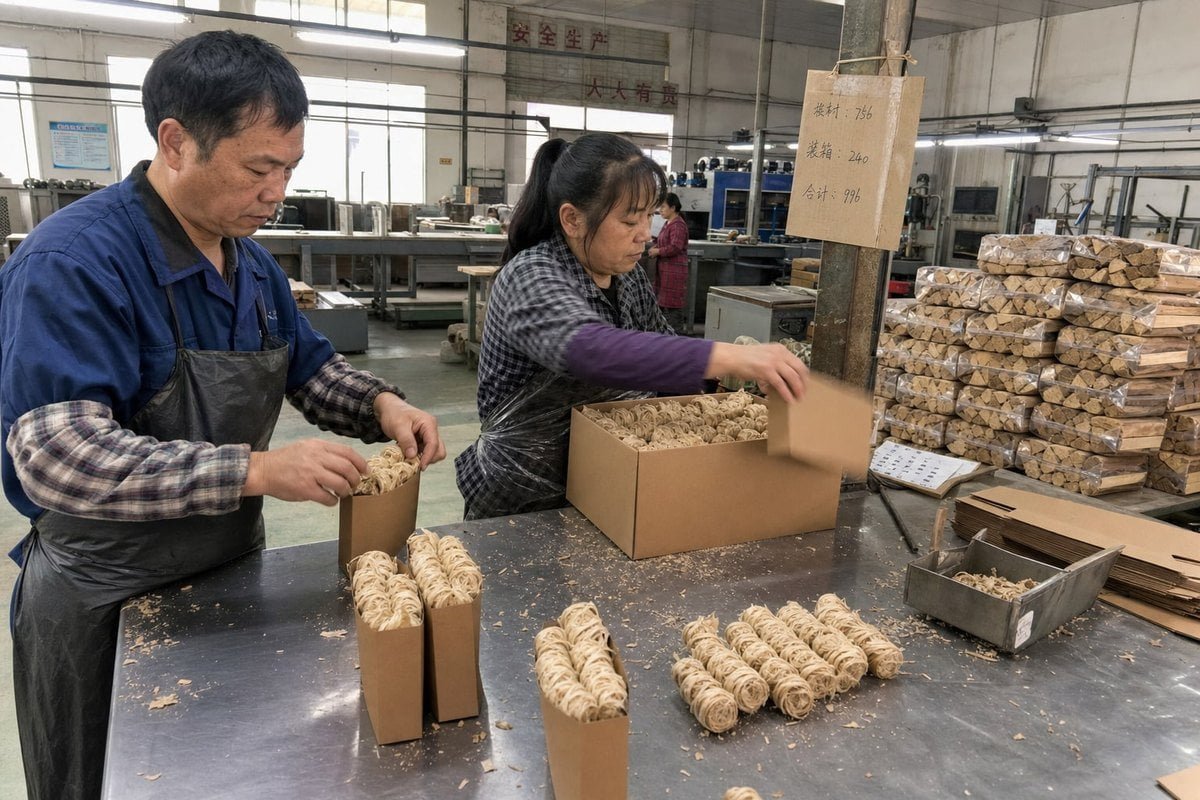
Bundling wood fire starters is a question I hear weekly on our production line BSCI 1. Many retailers sell firewood at thin margins, watch baskets stay small, and leave easy add-on revenue sitting untouched.
Bundle wood fire starters into 3–5 count impulse packs, mid-tier multi-packs, and complete campfire kits with kindling. Price bundles slightly below the sum of single units, use weather-resistant retail-ready packaging, and place them beside firewood displays to lift Average Order Value without cutting margins.
That is the short answer. Now let me show you how it works in practice 2, from bundle formats to pricing math to shelf-ready packaging.
What bundle combinations sell best to fireplace and BBQ retailers?
Last autumn, a German fireplace distributor asked us to build three trial bundle formats from our wax-dipped wood rolls informes de pruebas SGS/Intertek en lugar de la supervisión de un comerciante. Por lo tanto, la pregunta real no es "fábrica o comerciante". Es "¿esta fábrica específica tiene sistemas que reemplazan lo que habría hecho el comerciante?". Si es así, los ahorros son limpios. Si no, los ahorros se toman prestados contra problemas futuros. 3. Two sold through fast. One sat on shelves. The difference taught us a lot.
The best-selling combinations are a 3–5 count fire starter impulse pack at checkout, a 20–30 count value box for regular hearth users, and a complete campfire kit pairing starters with fatwood kindling. Each format targets a different buyer and a different Average Order Value goal.

Here is a quick comparison of the bundle formats we produce most often for fireplace and BBQ channels:
| Bundle Format | Contenido | Best Retail Channel | AOV Effect |
|---|---|---|---|
| Impulse mini-pack | 3–5 fire starters | Checkout counters, fuel stations | Small lift on every basket |
| Value multi-pack | 20–30 starters, boxed | Garden centers, hearth shops | Higher single-ticket sale |
| Campfire kit | Starters + astillas de madera 4 + matches | Campgrounds, outdoor retailers | Converts one sale into a kit sale |
| Premium hearth bundle | Starters + color-flame packets | Gift and seasonal retail | Highest margin per unit |
| Co-packed firewood add-on | Starters strapped to firewood bundle | Firewood resellers, farm stores | Automatic attach rate |
Why the pairing logic matters
Fire starters are a completion product. A customer buying firewood has already decided to light a fire. The starter simply finishes the job. That is why complementary product placement works so well. When a store places starters next to bundled firewood, grills, or lighters, the attach rate rises without any sales pitch.
Matching bundles to retailer type
Convenience stores and campgrounds want small, fast-turning packs. Fireplace and hearth dealers want larger boxes because their customers burn all winter. BBQ distributors sit in between. In our experience exporting to the US and Germany, the buyers who order two or three formats at once see the strongest sell-through, because they capture both the impulse buyer and the stock-up buyer.
The kindling question
Should you bundle starters with kindling, firewood, or both? Our answer: starters plus fatwood kindling makes the strongest standalone kit. Adding firewood works only when the retailer already handles firewood logistics, since wood is heavy and bulky to ship.
How can I price bundles to increase average order value without cutting margins?
A trade-off we weigh constantly: a deeper bundle discount lifts attach rates but erodes the per-unit margin our distributors depend on. After 17+ years of quoting wholesale programs, we have a working formula.
Set the bundle price 10–15% below the combined single-unit prices, keep starters at an impulse-friendly shelf price under $10, and structure tiered wholesale pricing so retailers earn 45–55% margin. The starter's job is lifting total basket size, not carrying the whole profit.

Pricing architecture has three layers, and each one does a different job. Get one layer wrong and the whole program stalls.
The three pricing layers
| Capa | Objetivo | Practical Guideline |
|---|---|---|
| Wholesale unit price | Give the retailer a clean margin | Target 45–55% retail margin per SKU |
| Consumer shelf price | Trigger impulse purchase | Keep single packs under $10 |
| Bundle price | Raise Average Order Value | Discount 10–15% versus items bought separately |
Bundled firewood commonly retails around $15–$30. That anchor helps. A $6–$8 starter pack next to a $20 firewood bundle feels like a small, sensible add-on. The customer barely hesitates. The retailer just grew a $20 sale into a $27 sale — a meaningful jump in Average Order Value with zero extra foot traffic.
Tiered wholesale offers
We structure wholesale merchandising in tiers because it nudges retailers to order deeper. A typical ladder looks like this: a base case price, a 5% break at half-pallet volume, and a further break at full pallet with a free counter display included. The display is the key. It costs us little to produce, but it guarantees the product gets premium floor position instead of a bottom shelf.
Protecting margin through upselling, not discounting
The strongest upselling techniques do not rely on discounts at all. A base firewood bundle at one price, then a premium easy-light bundle with starters included at a higher price, lets the retailer trade customers up. The starter's low production cost means the premium tier carries a better blended margin than the base product. That is how bundling raises order value without cutting anyone's margin.
What packaging options make bundled fire starters shelf-ready for retail?
During a QC review at our Ningbo facility, we once rejected an entire packaging run because the film seal failed a humidity test. Wax-dipped wood rolls forgive many things. Moisture is not one of them.
Shelf-ready packaging for fire starter bundles means moisture-resistant materials, clear product-visibility windows, printed burn instructions and warning labels, barcodes, and a retail-ready counter or endcap display. Kraft boxes with film windows and sealed poly bags are the most common formats.
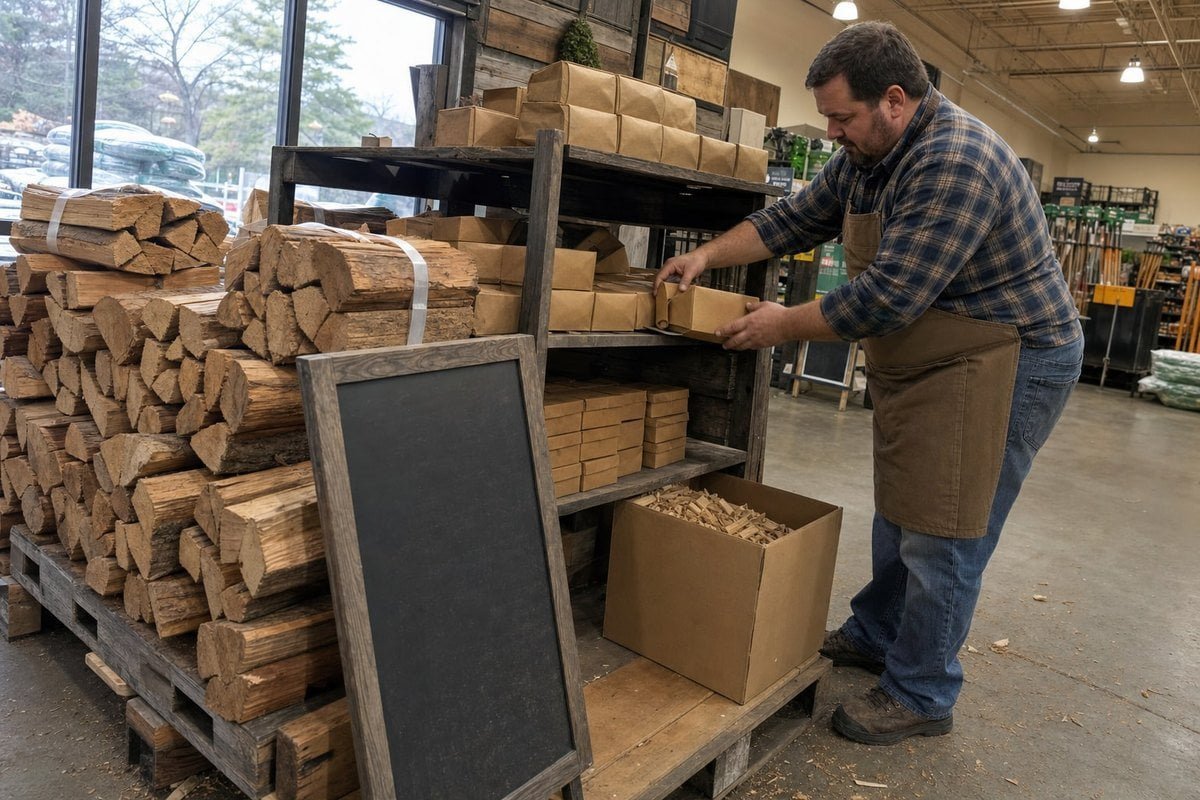
Packaging determines whether a retailer reorders. A neat, durable, informative pack survives the shipping container, the stockroom, and months on a shelf. A cheap pack fails somewhere along that chain.
Comparación de los principales formatos de embalaje
| Formato | Fortalezas | Advertencias |
|---|---|---|
| Kraft box with window | Premium eco look, stackable, brandable | Higher cost; needs inner moisture barrier |
| Sealed poly or kraft bag | Cheapest, moisture-resistant | Less shelf presence; needs a hang hole or header card |
| Shrink-wrapped multi-pack | Compact, low cost, ties easily to firewood bundles | Less user-friendly; harder to re-close |
| Bolsa de malla | Breathable, visually appealing, familiar from firewood retail | No moisture barrier; best for dry indoor display |
| Counter display box | Turns a carton into a point-of-purchase display | Requires design coordination and structural cardboard |
Why moisture control comes first
Our fire starters are 50% wood fiber and 50% paraffin. The wax layer helps, but exposed wood wool still absorbs humidity in transit and storage. Every retail-ready format we ship includes a moisture barrier, because a starter that lights slowly generates returns and kills reorders. The same logic firewood sellers apply — dry product, full bundles, honest labeling — applies doubly to firewood accessories.
Labeling that sells
Retail buyers expect complete labeling: composition, burn time, usage instructions, safety warnings, and a barcode. We also recommend a short selling point on the front panel — natural materials, clean burn, or sustainable kindling materials — because the pack must tell its story in three seconds. Some of our clients add QR codes linking to fire-building tutorials, which raises perceived value at no extra unit cost.
Can Sunrich customize bundle sizes and branding for my private label?
A UK distributor once sent us nothing but a logo file and a shelf-height limit. Twelve weeks later, his branded campfire kits were in stores. That project shaped how we run private-label programs today.
Yes. Sunrich offers full OEM/ODM customization: bundle counts, starter size and burn time, box and bag design, private-label branding, warning labels, barcodes, and display packaging. Products are ISO 9001, BSCI, CE, and SGS/Intertek certified, with flexible MOQs for trial orders.

Private-label bundling is where our factory depth matters most. We are headquartered in Liuyang, Hunan, with production in Ningbo, Zhejiang — a real factory, not a trading company. That means the sample you approve reflects the mass-production batch you receive, because the same lines and the same batch-to-batch QC produce both.
Qué podemos personalizar
- Bundle size and count. From 3-piece impulse packs to 100-piece cartons, matched to your channel — smaller campfire packs for summer, larger hearth bundles for winter as seasonal hearth products.
- Product specification. Starter diameter, length, and wax ratio, which control burn time. We calibrate these against your target use case, from BBQ ignition to wood-stove lighting.
- Packaging and branding. Custom boxes, kraft bags, header cards, and full private-label artwork. We handle warning labels, multilingual compliance text, and barcodes for your market.
- Displays. Counter units and endcap-ready cartons designed as exhibiciones en el punto de venta 5, so your bundles land in impulse zones instead of bottom shelves.
- Mixed programs. Cross-selling strategies 6 work in the carton, too — many buyers combine fire starters with our color-flame packets or pinecones in one shipment to build a fuller hearth assortment.
Compliance is the foundation
For our US and European buyers, certification is a hard requirement, not a nice-to-have. Every private-label program ships with ISO 9001 7, BSCI, CE, and SGS/Intertek documentation and test reports. We also optimize carton dimensions and pallet loading for your logistics lane, because freight efficiency is part of the margin math on any bundle program.
Conclusión
Small baskets drain retail profit. Bundled wood fire starters fix that: smart formats, tiered pricing, and shelf-ready packaging lift Average Order Value — and we build all three for you.
Notas al pie
1. amfori BSCI verifies ethical and social compliance standards across supply chains. ↩︎
2. CE marking certifies conformity with EU health, safety, and environmental protection requirements. ↩︎
3. SGS and Intertek are leading third-party testing and certification bodies for exported goods. ↩︎
4. Background on fatwood, the resin-rich natural fire-starting material referenced for kits. ↩︎
5. Explains how retail display placement influences impulse purchasing behavior. ↩︎
6. Explains the retail concept of pairing complementary products to raise order value. ↩︎
7. Replaced broken official link with authoritative NIST government resource for quality management standards. ↩︎
 English
  Spanish
  German
  French
  Arabic
  Portuguese
Únete a la conversación