







Whether wood fire starters need "CAUTION" or "FLAMMABLE" labels is a question our packaging team answers weekly. Get it wrong, and shipments stall at customs — or worse, get pulled from shelves.
Wood fire starters do not automatically require "CAUTION" or "FLAMMABLE" labels. Labeling depends on formulation, hazard classification, and jurisdiction. Many solid wood-and-wax starters are non-hazardous under FHSA and OSHA rules, but products with accelerants or high flammability ratings need mandatory warning labels.
The real answer sits in the details. Below, I break down the rules for the US and EU, what retailers expect, and how we handle it for private-label buyers.
What labeling requirements should I meet when importing wood fire starters into the US or EU?
Over 17 years of exporting fire-starting goods to the US, Germany, France, and the UK, I have watched labeling rules trip up more importers than tariffs ever did. The frameworks differ sharply by region.
For the US, wood fire starters fall under the Federal Hazardous Substances Act and CPSC labeling requirements; labels are mandatory only if the product is classified as hazardous. In the EU, CLP Regulation classification, general product safety rules, and language requirements govern what warnings must appear on packaging.

The first thing I tell every buyer is this: there are three separate labeling tracks, and they do not automatically overlap. Consumer labeling, workplace hazard communication standards, and transport dangerous-goods labeling are each governed by different rules. A product can be exempt from one and still caught by another.
The US track: FHSA and CPSC
Under the Bundesgesetz über gefährliche Stoffe 1, a product needs cautionary labeling only if two conditions are met. First, it must be a hazardous substance — toxic, corrosive, flammable, or combustible by regulatory definition. Second, it must pose a risk of substantial injury during reasonably foreseeable use. A compressed wood-shaving roll dipped in paraffin often fails to meet the flammability threshold, because it ignites slowly and has no low Flammpunkt 2 liquid component. That is why several commercial fire starter Sicherheitsdatenblatt 3s state plainly: not classified as hazardous under OSHA HazCom 2012, no GHS labeling applicable.
The EU track: CLP and GPSR
The EU works differently. Classification under CLP determines whether hazard pictograms, signal words, and precautionary statements are required. Even when a wood firestarter is not classified as hazardous, the Allgemeine Produktsicherheitsverordnung 4 still expects safe-use instructions, traceability details, and warnings in the language of the destination market.
| Regime | Gilt für | Trigger for Labels | Typical Outcome for Wood/Wax Starters |
|---|---|---|---|
| FHSA / CPSC (US) | Consumer packaging | Hazardous classification + injury risk | Often no mandatory hazard label |
| OSHA HazCom / GHS (US) | Workplace use | GHS classification | Frequently "not classified" |
| CLP (EU) | Consumer packaging | Harmonized classification criteria | Usually no pictogram; safe-use text still needed |
| Transport (ADR/DOT/IMDG) | Versand | Dangerous goods classification | Solid wax-wood starters typically not regulated |
| Kalifornien Prop 65 | US retail (CA) | Listed chemical exposure | Combustion by-product warning may apply |
The pattern is clear. A natural wood-fiber and paraffin starter — like the 50% wood fiber, 50% paraffin composition we print on our own retail boxes — usually avoids mandatory hazard pictograms. But add petroleum distillates or lighter-fluid-style accelerants, and the compliance picture flips fast.
Can Sunrich provide compliant warning labels and test reports for my private-label products?
A German distributor once emailed me at midnight because his previous supplier shipped 40,000 units with English-only warnings — Germany requires German. We reprinted his next order correctly, and he has stayed with us since.
Yes. We supply SGS and Intertek test reports, ISO 9001 and BSCI documentation, and CE-relevant paperwork with every order. Our OEM/ODM service includes designing compliant warning labels, precautionary statements, barcodes, and multi-language safety text tailored to your destination market's regulations.

Documentation is not a nice-to-have for the buyers we serve — it is the gate that decides whether a purchase order gets signed. Purchasing managers at established importers ask for our test reports before they ask for pricing, and honestly, that is the right order of operations.
What we hand over with every private-label order
Our compliance package covers four layers. Each one answers a different question your customs broker, retailer, or insurer will eventually ask.
- Prüfberichte von Drittanbietern from SGS or Intertek, confirming the product's tested behavior and material composition.
- A product-specific Safety Data Sheet, showing the GHS classification outcome — usually "not classified" for our wax-dipped wood rolls, which is exactly what retail buyers want to see.
- Fabrikzertifizierungen: ISO 9001 5 for quality management and BSCI for social compliance, both of which large retail sourcing channels audit against.
- Label artwork review, where we check your signal words, hazard statements, font contrast, placement, and language coverage before printing a single box.
Why the SDS matters even when no label is required
Here is a nuance many first-time importers miss. Even if your wood firestarter needs no hazard pictogram, retailers and freight forwarders will still request a Safety Data Sheet. The SDS proves the non-hazardous status; it is the document that justifies the absence of a label. We prepare these for every formulation we produce, including custom burn-time variants, because a missing SDS causes more shipment delays than a missing label ever does. When we develop a new size or wax blend for a client, the SDS gets updated before the first mass-production run — that discipline is why our first sample reliably matches what lands in your warehouse.
What safety information must appear on wood firestarter packaging to avoid customs or retail issues?
The trade-off I weigh on every packaging project is coverage versus clutter. A retail box has limited space, yet skipping one expected warning line can get a listing rejected by a major chain's compliance desk.
Packaging should display safe-use instructions, "Keep out of reach of children," composition details, storage guidance, manufacturer traceability information, and any jurisdiction-specific warnings such as California Prop 65 text. Hazard statements like "FLAMMABLE" are only mandatory if the product's classification requires them.

Customs officers and retail compliance teams check different things, but both respond badly to missing information. In our experience shipping to 30+ countries, the products that clear smoothly carry a consistent core set of statements — even when no formal hazard classification applies. Consumer product safety expectations at retail often exceed the legal minimum.
The baseline safety text we recommend
These lines cost nothing and prevent most disputes:
- Außerhalb der Reichweite von Kindern aufbewahren
- Use only in well-ventilated areas
- Do not use with gasoline or other liquid fire starters
- Store in a cool, dry place away from heat sources
- This is not a candle — do not burn unattended as a standalone item
That last line matters more than it looks. Wax-based starters resemble decorative items, and the "not a candle" disclaimer prevents flare-up misuse claims. It also protects you with product liability insurers, who often require specific cautionary language as a coverage condition regardless of what federal law demands.
Placement and formatting rules
When a hazard statement is required, US regulation 16 CFR 1500.121 6 governs how it appears: on the principal display panel, in a type size proportional to the panel, in a color that contrasts sharply with the background. Burying a warning in small grey print on a dark box is a compliance failure even if the words are correct.
| Information Element | Legally Required? | Retail Expectation | Where It Should Appear |
|---|---|---|---|
| Composition (e.g., wood fiber + paraffin) | Variiert je nach Markt | Stark erwartet | Back or side panel |
| Außerhalb der Reichweite von Kindern aufbewahren | If FHSA-classified | Always expected | Principal or back panel |
| Signal word (CAUTION/WARNING) | Only if classified | Fallweise | Principal display panel |
| Hazard statement (FLAMMABLE) | Only if classified | Fallweise | Principal display panel |
| Gebrauchsanweisungen | EU GPSR; best practice in US | Always expected | Rückseite |
| Manufacturer/importer traceability | Yes (EU); expected (US) | Always expected | Rückseite |
| Prop 65 warning | If selling into California | Required by CA retailers | Rückseite |
One more note on combustion by-products. Some fire products carry Prop 65 warnings 7 about carbon monoxide, soot, and smoke. Those warnings concern emissions during use, not the composition of the starter itself. It is a separate warning regime, and treating it as such keeps your artwork logical instead of alarmist.
How do I customize branded packaging while still meeting mandatory CAUTION or FLAMMABLE labeling rules?
Designing our own SUNRICH retail box — black-to-orange gradient, bold flame graphic, "100 pcs" badge — taught us that strong branding and compliant labeling can share the same panel. It just takes planning before the artwork stage, not after.
Design your branding first, then lock in a compliance zone on the artwork: reserve the principal display panel for any required signal words, use contrasting fonts per 16 CFR 1500.121, add multi-language precautionary statements for EU markets, and verify final artwork against your product's actual hazard classification.
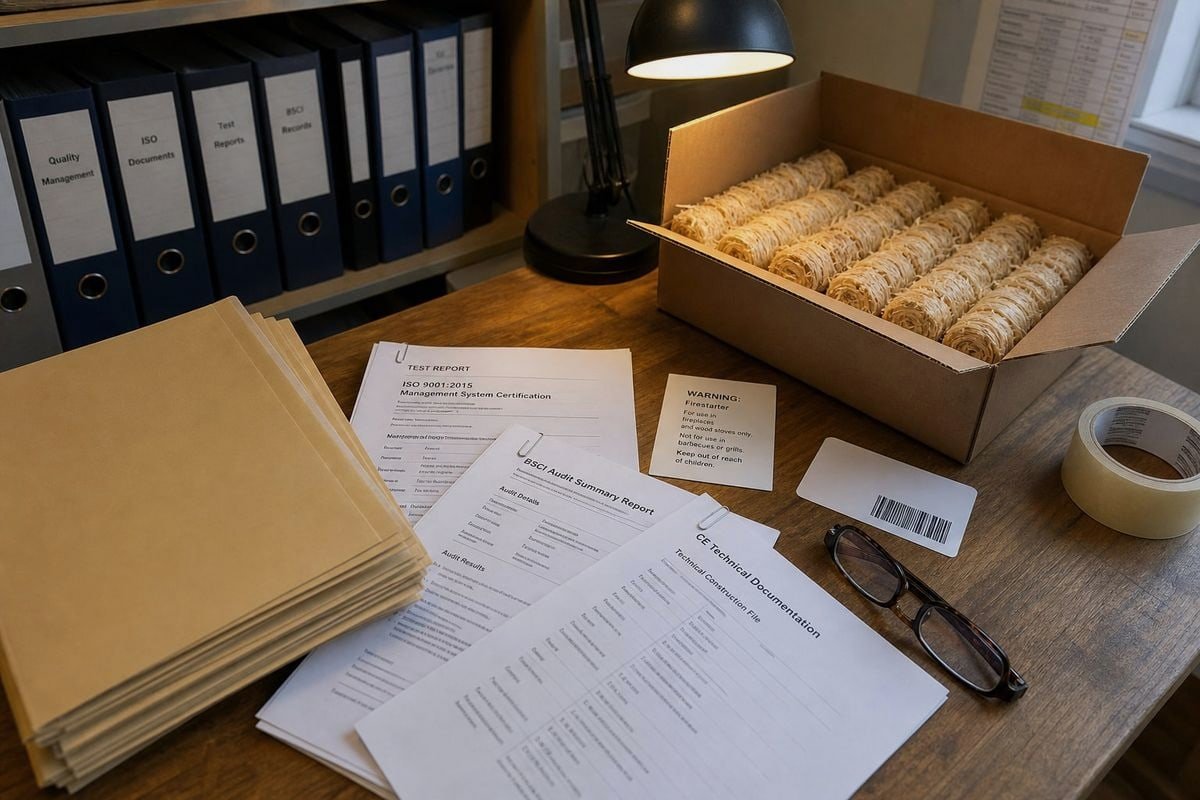
The mistake I see most often is treating warnings as an afterthought — squeezed into leftover corners after the logo, tagline, and hero image are placed. Compliant design works the other way around. Our packaging team starts every OEM project by mapping the mandatory and recommended text zones, then builds the brand identity around them.
A five-step process we use for every private-label project
- Classify first. We confirm the exact formulation and its classification outcome. "Combustible vs flammable" is not wordplay — the distinction determines whether a signal word is required at all, since flammable classifications carry stricter labeling duties than merely combustible materials.
- Choose the right signal word, if any. Signal words are tiered: CAUTION for lower-level hazards, WARNING and DANGER for progressively higher ones. Using DANGER on a non-hazardous product is not "extra safe" — it misrepresents tested hazard status and can confuse both regulators and consumers.
- Reserve the compliance zone. Any required hazard statement goes on the principal display panel with sharp color contrast. Watch the "natural marketing paradox" here: soft, eco-friendly aesthetics must never visually bury safety text.
- Localize. German for Germany, French for France and Canada, Dutch for the Netherlands. We print multi-language back panels as standard for EU-bound orders.
- Add smart extras. A QR code linking to the full Safety Data Sheet and usage videos keeps small boxes clean while giving retailers and end users complete documentation. Some brands also add the GHS flame pictogram 8 voluntarily as a universal, language-agnostic cue — acceptable when the classification genuinely supports it.
| Designelement | Brand Freedom | Compliance Constraint |
|---|---|---|
| Logo, tagline, colors | Voll | Must not obscure or outshine mandatory text |
| Product imagery | Voll | Flame graphics fine; no misleading safety claims |
| Signal word placement | None if required | Principal display panel, contrasting type |
| Warning language | Wording flexibility on voluntary text | Mandatory statements must use prescribed phrasing |
| Barcodes, QR codes | Voll | Must not overlap required label zones |
We handle all of this in-house — custom boxes, display packaging, warning labels, barcodes — so your artwork ships print-ready and pre-checked against destination-market rules.
Schlussfolgerung
Wood fire starters rarely need "FLAMMABLE" labels by default — but assuming so, either way, is risky. Classification, documentation, and market-specific rules decide. Partner with a factory that handles all three.
Fußnoten
1. Official CPSC source explaining the US statute governing hazardous substance labeling. ↩︎
2. Background concept explaining the flammability property used to classify fire starters. ↩︎
3. OSHA's HazCom page explains SDS requirements and GHS classification standards. ↩︎
4. Official EU page detailing GPSR requirements referenced for European market compliance. ↩︎
5. Highly stable and accessible overview of the standard to avoid common 403 blocks on iso.org. ↩︎
6. Direct regulatory text governing placement and formatting of hazard warning labels. ↩︎
7. California OEHHA's official Prop 65 page explains warning requirements for combustion by-products. ↩︎
8. Background on the GHS system that defines hazard pictograms like the flame symbol. ↩︎



 English
  Spanish
  German
  French
  Arabic
  Portuguese
Diskutieren Sie mit