






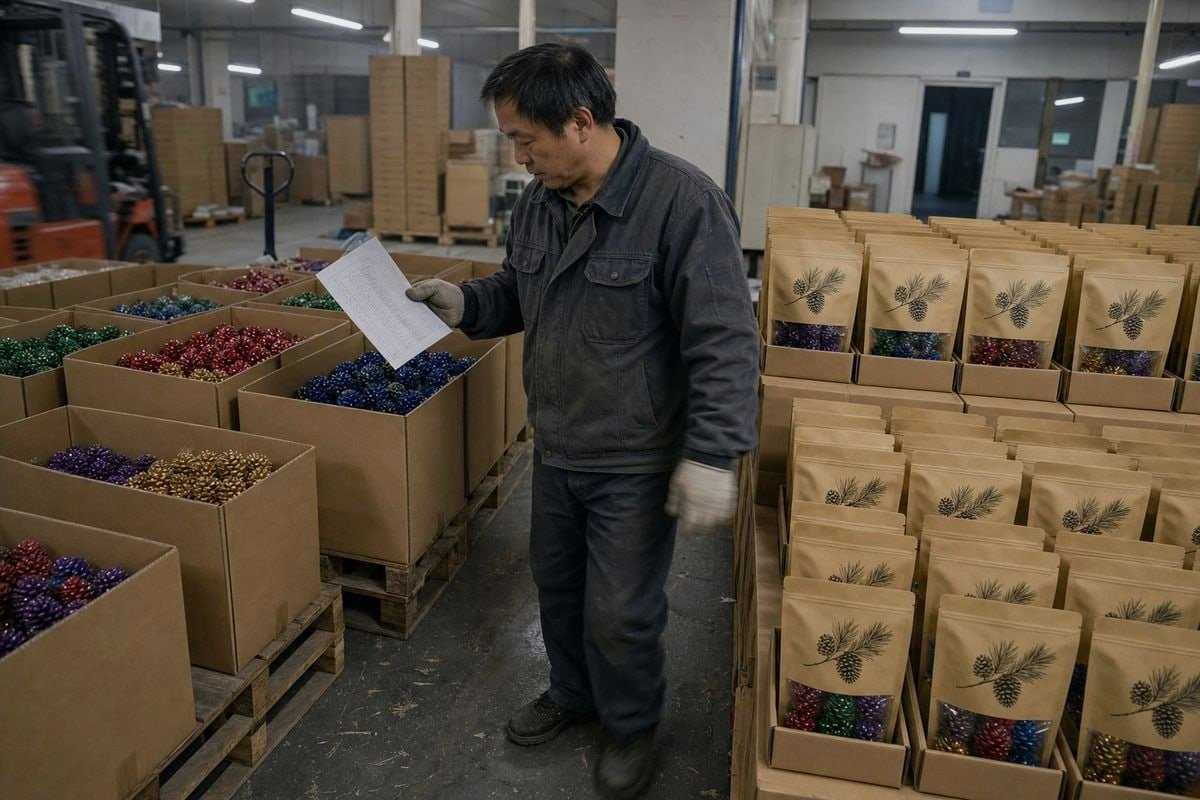
Buyers ask me about bag-in vs bulk fireplace colored pine cones almost weekly. Choosing wrong means dead inventory, freight overruns, and shelf returns — problems our production line helps clients avoid.
Bag-in fireplace colored pine cones come pre-packed in retail-ready consumer pouches for shelf display and gifting, while bulk colored pine cones ship loose in large cartons or bulk bags at a lower unit cost, requiring the buyer to handle repacking, portioning, and branding themselves.
Both formats contain the same treated cones inside. The real differences show up in compliance, logistics, branding, and order terms. Let me walk you through each one.
What certifications should I check before importing bag-in or bulk colored pine cones?
A German distributor once told me his previous shipment sat in customs for six weeks over missing test reports. That conversation shaped how our factory now documents every batch we export.
Before importing bag-in or bulk colored pine cones, verify the supplier holds ISO 9001 quality certification, BSCI social compliance, CE marking for the EU, and third-party SGS or Intertek test reports confirming the flame-colorant coating contains no harmful chemicals.

Certification requirements do not change much between bag-in and bulk formats, but the documentation burden does. Retail-ready bag-in products face stricter labeling scrutiny because they reach consumers directly. Bulk shipments still need chemical safety proof, but the labeling responsibility often shifts to whoever repacks them in the destination market.
In our seventeen-plus years exporting to the US, Germany, the UK, France, and beyond, we have learned that customs officers and retail compliance teams check different things. Customs cares about material safety declarations 1. Retailers care about warning labels, barcodes, and language requirements on the pack itself.
Certification checklist by packaging format
| Anforderung | Bag-in (retail-ready) | Bulk (loose cartons) |
|---|---|---|
| In unseren über siebzehn Jahren des Exports in die USA, nach Deutschland, Großbritannien und Frankreich sind die Dokumente, die Käufer am häufigsten anfordern, | Erforderlich | Erforderlich |
| SGS/Intertek chemical test report | Erforderlich | Erforderlich |
| CE marking (EU markets) | On each retail pouch | On master carton |
| Consumer warning labels | Printed on pouch by factory | Added by repacker |
| BSCI Sozialaudit | Expected by major retailers | Expected by major retailers |
| Barcode/EAN registration | Factory applies | Buyer applies |
The flame colors come from metal-salt coatings 2 on dried cones. That is exactly why test reports matter. A serious factory tests every production batch, not just one golden sample. When we onboard a new client, we send the current batch report alongside the sample so they can match paperwork to product. If a supplier hesitates to share recent test reports, treat that as a red flag regardless of price. For bulk buyers who repack locally, I also recommend asking for the raw coating specification. Your local repacking operation may need it for workplace safety documentation 3, and getting it after the fact is always harder.
How do bag-in and bulk packaging options affect my shipping and storage costs?
Cube efficiency is the trade-off I weigh most often when quoting a new order. Retail pouches look great, but air inside stand-up bags is expensive air once it enters a sea container.
Bulk colored pine cones cut shipping costs by roughly maximizing container density with fewer packaging layers, while bag-in formats occupy more cube per cone due to pouch headspace and display cartons, raising freight and warehouse cost but arriving shelf-ready with zero repacking labor.
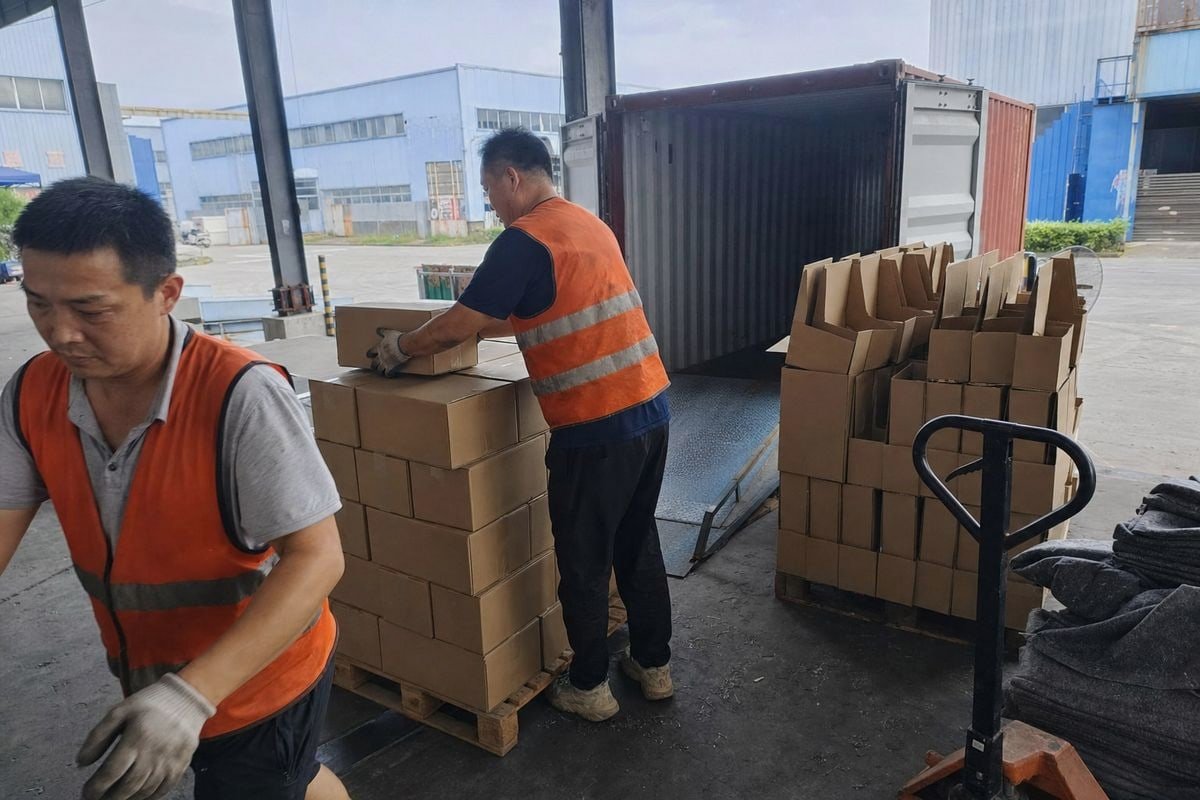
Pine cones are light but bulky. That means Seefracht 4 is almost always volume-charged, not weight-charged. Every design choice that adds air — stand-up pouch headspace, clear windows, display trays — adds cost per cone. Bulk cartons pack cones tightly, so you move more product per cubic meter.
But freight is only half the story. Bag-in products go from container to shelf with no touch. Bulk products need repacking, and repacking in the US or Western Europe costs far more per hour than it does at our Ningbo facility. Many of our distributors run the numbers and find that factory-side retail packing beats destination-side repacking, even after the extra freight.
Storage considerations
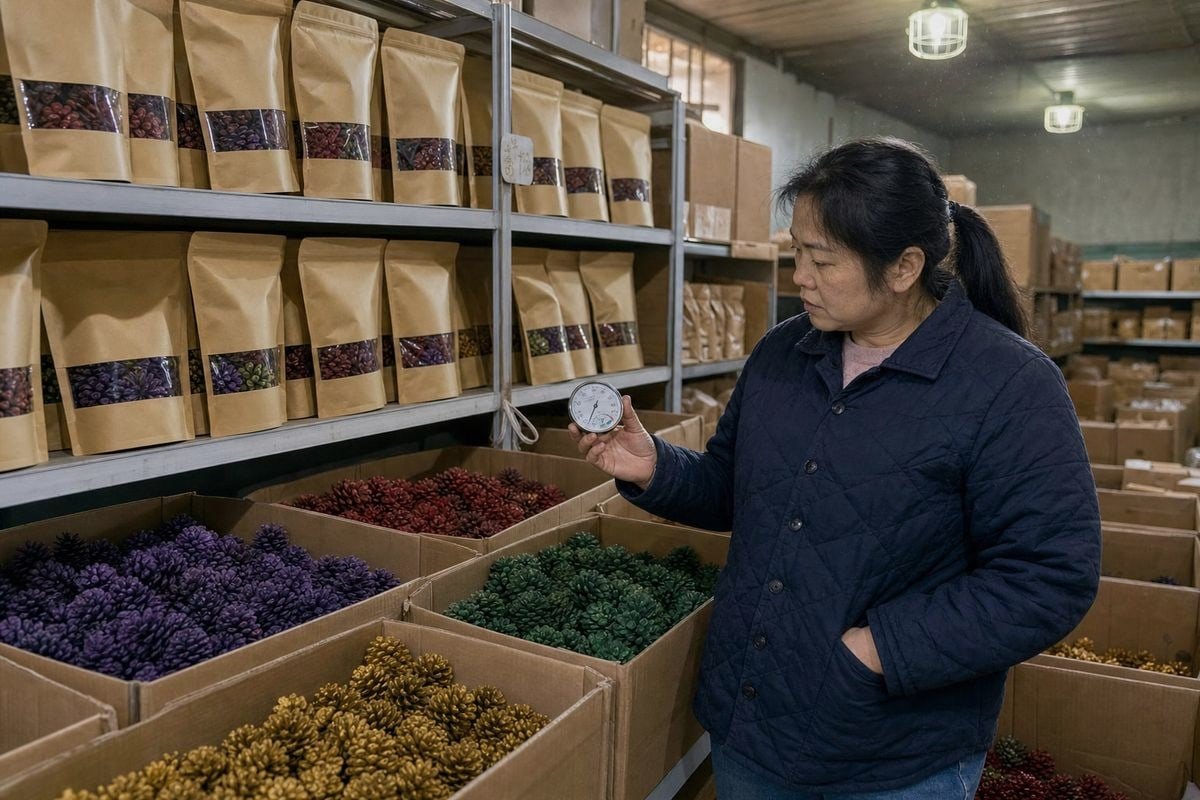
Storage behaves differently too. Sealed retail pouches protect moisture content and dye saturation. Cones stored in open bulk bins can absorb Umgebungsfeuchtigkeit 5 over a season, which dulls Flammenfarbintensität. If your warehouse is humid, bulk stock needs sealed liners or climate control.
| Cost factor | Bag-in | Großhandel |
|---|---|---|
| Container density | Lower (pouch headspace) | Higher (tight packing) |
| Freight cost per cone | Höher | Niedriger |
| Destination repacking labor | Keine | Significant |
| Warehouse handling | Case-pick, simple | Requires portioning area |
| Moisture protection in storage | Sealed pouches, strong | Needs liners or climate control |
| Damage and dust mixing risk | Niedrig | Moderate in open bins |
One more nuance: bulk bins holding different color batches side by side can cross-contaminate with residual coating dust, subtly shifting flame color purity. Sealed bag-in units avoid that entirely. Factor cleanup and segregation costs into any bulk plan.
Which packing format offers better private-label branding for my retail shelves?
Last season our design team built four different pouch layouts for a single UK fireplace brand — kraft window bags, burlap gift sacks, boxed sets, and a countertop display. That project taught me how much packaging drives sell-through.
Bag-in packaging offers far stronger private-label potential because the factory prints your brand, warning labels, barcodes, and design directly on retail pouches, while bulk cones arrive unbranded and force you to build packaging, labeling, and compliance printing yourself.
Retail buyers purchase with their eyes. Colored pine cones sell on ambiance — rainbow flames, cozy hearths, campfire nostalgia — so the packaging has to tell that story before the customer ever lights a fire. A kraft stand-up pouch with a clear window showing natural cones, a rainbow accent behind bold lettering, and a campfire scene communicates the product instantly. A plain poly bag does not.
Unsere OEM/ODM 6 line handles the full branding stack: pouch size and material, printed artwork, jute drawstring gift sacks for premium positioning, warning labels in your market's language, EAN/UPC barcodes 7, and custom display cartons for end-cap placement. That is the practical advantage of bag-in: everything ships shelf-ready.
When bulk still wins for branding
There is one honest exception. If you already run a co-packing operation or sell through channels where you blend cones from different color batches into custom assortments, bulk gives you flexibility that fixed pre-packs cannot. Hospitality clients and event suppliers sometimes want that mixing freedom. But for standard retail shelves — hardware stores, garden centers, gift shops, online marketplaces — factory-finished bag-in packaging gets you to market faster with fewer compliance mistakes.
A few branding formats we produce most often:
- Kraft stand-up pouch with clear window, matte finish, resealable zip
- Burlap or jute drawstring sack with printed logo for gift positioning
- Printed retail box with insert tray for premium holiday sets
- Shelf-ready display carton holding 12–24 pouches for end-caps
Each format carries your name, not ours. That is the point of private label.
What MOQ and lead time differences should I expect between bag-in and bulk orders?
A first-time Canadian importer recently asked us for a trial run before committing to a full container. Structuring that trial order differently for bag-in versus bulk saved him about three weeks of waiting.
Bulk orders typically carry lower effective MOQs and shorter lead times of roughly 3–4 weeks because they skip custom printing, while bag-in private-label orders need higher MOQs to justify packaging print runs and add 1–3 weeks for artwork approval, pouch production, and packing.
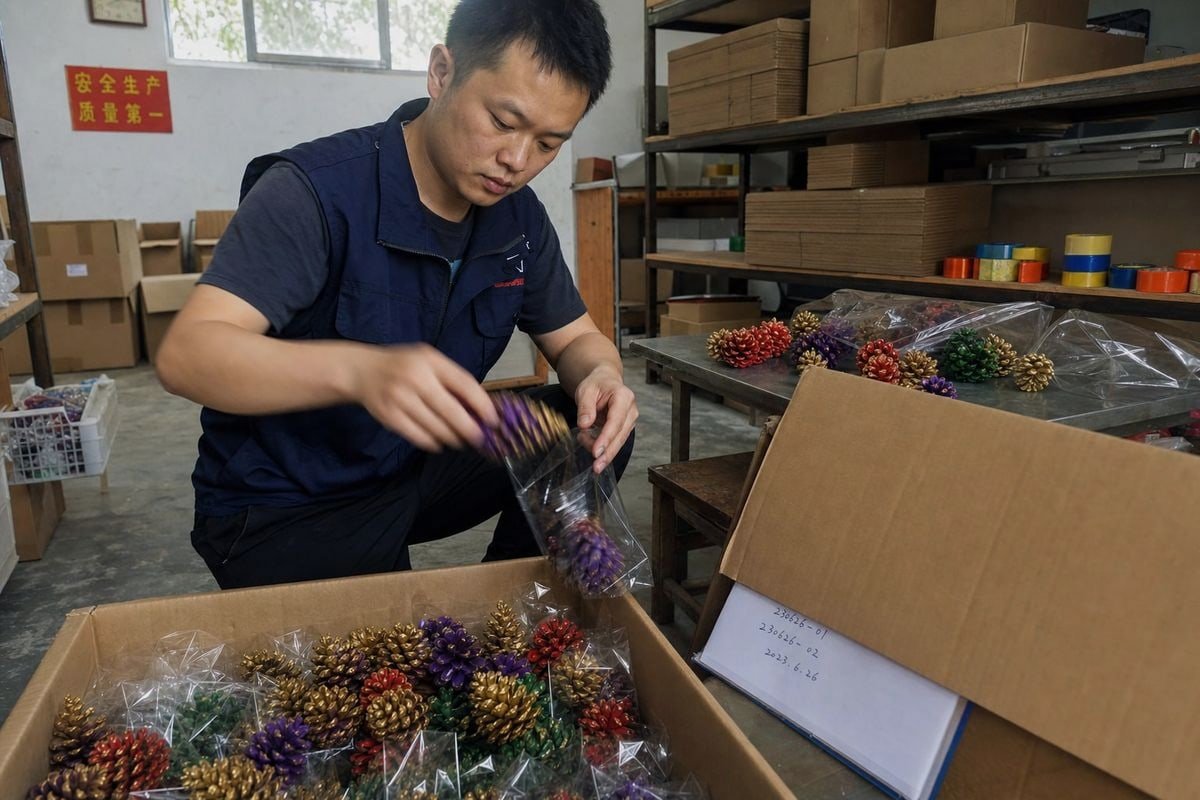
The difference comes down to what has to be manufactured. Bulk cones need only the cones themselves: sourcing, drying, coating, curing, quality inspection, carton packing. Custom bag-in orders add a second production stream — printed pouches, labels, and display cartons — that runs in parallel but has its own minimums and its own approval loop.
Printing is the real MOQ driver. Pouch printers have plate setup costs, so small print runs are uneconomical. That is why private-label MOQs sit higher than bulk MOQs. It is not the cones; it is the packaging.
Typical planning framework
| Order element | Großhandel | Bag-in private label |
|---|---|---|
| Effective MOQ | Lower — carton quantities | Higher — tied to pouch print run |
| Artwork approval stage | Not needed | 3–7 days, buyer-dependent |
| Produktionslieferzeit | ~3–4 weeks | ~4–6 weeks |
| Flexibilität bei Probebestellungen | Einfach | Possible with stock pouches |
| Repeat order speed | Schnell | Fast once plates exist |
| Peak-season buffer needed | +2 weeks | +2–3 weeks |
Two practical tips from our export desk. First, for trial orders, ask about stock packaging with a custom label — it lets you test the market at a low MOQ before investing in full custom print plates. We run this option regularly for new distributors. Second, order early for the season. Colored pine cones are heavily Q4-weighted, and our production calendar fills from late summer. A repeat client who books in June ships comfortably; a new client who calls in October is racing the clock. Once your artwork plates exist, repeat bag-in orders move nearly as fast as bulk, so the lead-time penalty is mostly a first-order cost.
Schlussfolgerung
Bag-in means shelf-ready branding and protection; bulk means lower unit cost and flexibility. Match the format to your channel, verify certifications, and partner with a factory that documents every batch.
Fußnoten
1. OSHA hazard communication guidance relevant to material safety declarations for customs. ↩︎
2. Background on chemistry behind metal-salt flame coloring compounds used on cones. ↩︎
3. OSHA resource on required workplace safety documentation for handling coated materials. ↩︎
4. International Maritime Organization oversees ocean freight regulations affecting shipping costs. ↩︎
5. Background on how ambient humidity affects moisture-sensitive stored goods like pine cones. ↩︎
6. Explains the OEM/ODM manufacturing model referenced for private-label branding. ↩︎
7. GS1 is the official standards body for EAN/UPC barcode registration used in retail packaging. ↩︎



 English
  Spanish
  German
  French
  Arabic
  Portuguese
Diskutieren Sie mit